

Katha Upanishad (Sanskri Text, Transliteration, Word-to-Word Meaning, English Translation and Detailed Notes) - A Most Useful Edition for Self Study
Book Specification
| Item Code: | NAE785 |
| Author: | Swami Sarvananda |
| Publisher: | SRI RAMAKRISHNA MATH |
| Language: | Sanskrit Text With English Translation |
| Edition: | 2020 |
| ISBN: | 9788171205004 |
| Pages: | 148 |
| Cover: | Paperback |
| Other Details | 7.0 inch X 5.0 inch |
| Weight | 100 gm |
Book Description
The sun does not shine there nor the moon the stars not these lightings and much less this fire. When that shines everything shines after that. By is light all this is lighted.
According to the orthodox commentators, this Upanisad is supposed to form part of the Brahmana belonging to the Katha Sàkha of the Krsan Yajurveda. Some have referred it to Säma-veda, and others again to Atharvaveda. But it is almost impossible to validate its authentic city in that way, since neither the Katha Brähmana nor Samhitã, nor those portions of the Säma-veda or Atharvaveda in which the Upanisad is supposed to be found are now available, So its real Vedic connection is hidden in obscurity. But due to its most poetic and charming presentation of the sublime doctrines of the Vedanta, the Kathopanisad has ever been a great object of interest to scholars, both of the East and of the West, from a long time past. From the number of its commentaries extant now, its popularity among the orthodox Hindus can also be well gauged; and Professor Max Muller tells us that it has been frequently quoted by the English, French and German writers as one of the most perfect specimens of the mystic philosophy and poetry of the ancient Hindus.
The story of Naciketas going to Yama, the prime controller of human destiny, under the command of his father, and subsequently his learning from Yama some secret knowledge of transcendental value, must have been an old story current among the ancient Aryans. since it can be traced in its embryonic condition to so far back as Rg-veda. There, in the 135th Sukta of the tenth Maala. mention is made of a boy — and Säyava tells us that he was no other than the Naciketas of the Taittiriya Brahmna — who went to the heaven of Yama under the express desire of his father that he should follow the ancients, Purãnan, (i.e., he should go where the departed ancients have gone); and he did so with much faith and perseverance sraddhä’ and ‘nisthä’) which elicited great commendation from Yama. Then he was shown the method by which he could come back to his father from the Yama-loka.
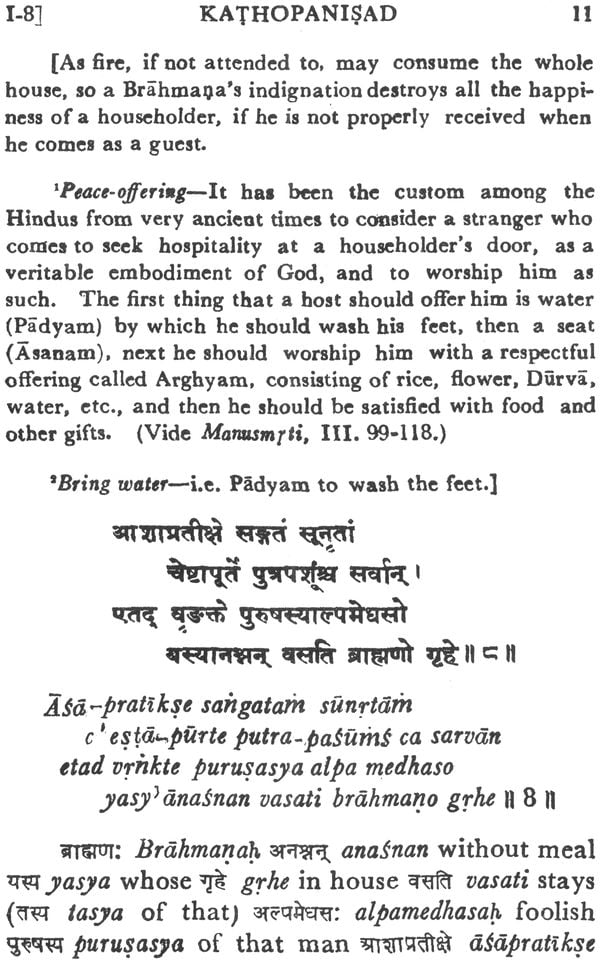
Next we find the story in a more developed form in the Taittiriya.Brahma4a, where it is told to explain how the Niciketa sacrifice has been so named. There the story runs - thus: Vajasravasa being desirous of great boons, sacrificed all his wealth. He had a son, called Naciketas. While he was still a boy, he felt a great fervour of faith in his heart when he saw cows brought to be given as sacrificial gift to the priests. He said: ‘Father, to whom wilt thou give me?’ He repeated the question a second and a third time; at which the father turned round and replied. ‘To Death, I give thee!’ Then he heard an unknown voice telling Naciketas: ‘He has said, “I give thee to Death; go thou to the house of Death.” So go to Death when he is not at home, and remain in his house for three nights without taking any food. If he happens to ask thee “Boy, how many nights hast thou been here?” say, “Three.” When he asks thee, “What didst thou eat the first night?” say. “Thy offspring.” If he asks, “What didst thou eat the second night?” say, “Thy cattle.” To the question “What didst thou eat the third night?” say, “Thy works.”’ So Naciketas went to Yama, while he was away from home, and he stayed in his house for three night without food. When Yama came back on the fourth day, he asked: ‘Boy, how many nights hast thou been here?’ Naciketas answered: ‘Three.’ ‘What didst thou eat the first night?’‘Thy off spring.’‘ What didst thou eat the second night?’‘Thy cattle. What didst thou eat the third night?’‘Thy good works.”
Then Yama said: ‘Obeisance to thee, revered sir? Ask for a boon.’‘ Grant that I may return living to my father,’ Naciketas replied. Yama said: ‘Ask for a second boon.’ Naciketas replied: ‘Instruct me how my good deeds may not be destroyed.’ Then Yama taught him the secrets of the Nciketa Agni (a kind of sacrifice). ‘Ask for a third boon,’ said Yama. ‘Tell me how to conquer death,’ Naciketas answered. Yama explained again to him the Naciketa Agni and through that he conquered death.
But here, the story has been pressed into service to impart the highest teachings of the Vedanta, making Yama, the knower of both the sides of life, the proper mouth-piece of the Sruti, and the young Brahmacãrin Naciketas, untainted by the desires of the world and filled with the fervour of faith, the proper recipient of those teachings. And hereby the Sruti has unerringly postulated who should be the teacher and who should be the student of the Vedãnta.