

Reduplication, ECHO Formation and Onomatopoeia in Marathi (An Old and Rare Book)
Book Specification
| Item Code: | NAM059 |
| Author: | Mahadeo L. Apte |
| Publisher: | Deccan College Postgraduate and Research Institute |
| Language: | English |
| Edition: | 1968 |
| Pages: | 128 |
| Cover: | Paperback |
| Other Details | 8.5 inch x 5.5 inch |
| Weight | 160 gm |
Book Description
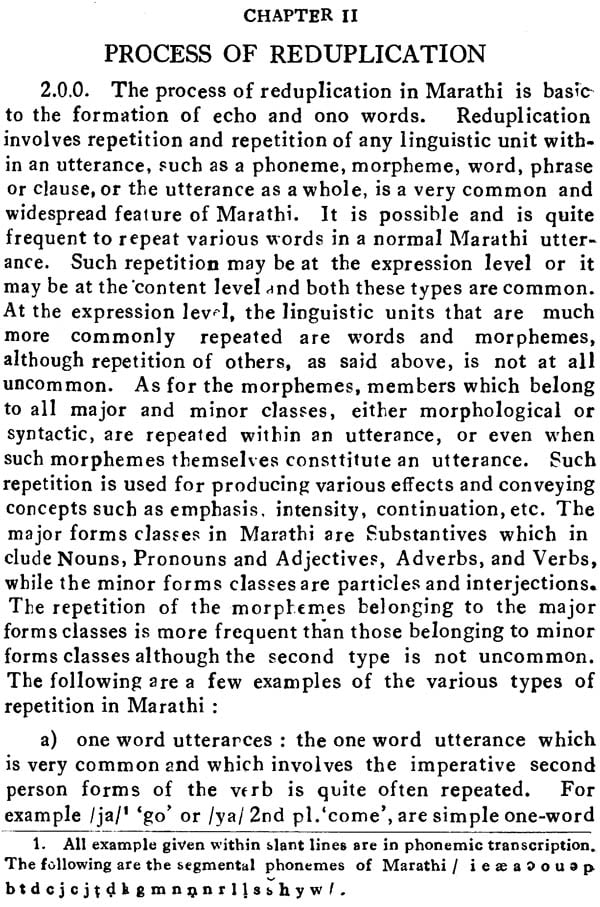
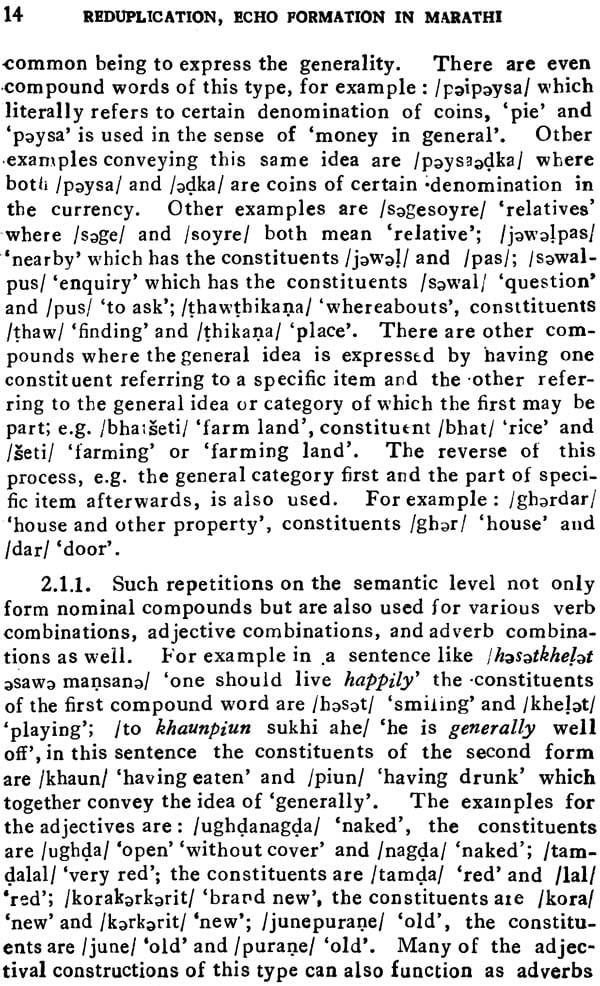
1.0.0 The task undertaken in this study is to investigate and analyse the process of reduplication and its relation to echo words and onomatopoeic words in Marathi, both from the linguistic and semantic point of view.
1.0.1 In many books on descriptive linguistics the process of reduplication is described in some detail. However, the topic of onomatopoeic words is treated rather in a cursory fashion mentioning only a few characteristic features of the forms which are called onomatopoeic in a broad sense. It also appears that there is no unanimity about the usage of the terms relating to such words. Apart from the term ‘onomatopoeic words’, such other terms as ‘echo words’, ‘reduplicative words’, ‘repetitive words’, ‘imitative words’, are also used. No detailed study of words which may fall into the categories indicated by any of the above terms, even with relation to a specific language is available, except a few articles.
1.1.0 Although linguists have used the terms given above, there is usually a distinction made between what are called ‘imitative’ words and ‘onomatopoeic’ words on the one hand and those which are called ‘repetitive’, ‘reduplicative’ and ‘echoic’ on the other. On the whole it can be said that the terms which belong to the first group are not formally defined, while those falling into the second group can be, and are, generally defined on formal basis. As far as dictionaries are concerned, such terms as ‘echoic’, ‘onomatopoeic’ and ‘imitative’ are indicated to have the same ‘meaning’. In Webster’s Third New International Dictionary (unabridged), under the word ‘onomatopoeic’ one of the meanings given is ‘echoic’ and the other is ‘formation of words in imitation of natural sound; the naming of a thing or action by a more or less exact reproduction of the sound associated with it. Under the word ‘imitative’, one of the alternatives given as the meaning is ‘onomatopoeic’. Under the word ‘echo’ one of the meanings given is the repetition of a sound, syllable, word, or phrase, for rhetorical or poetic purposes. The New English Dictionary (on historical principles), 1909, gives the meaning of the terms ‘onomatopoeic’, ‘echoic’, and ‘imitative’ as follows: ‘onomatopoeia’ is first explained as ‘the formation of a name or word by an imitation of the sound associated with the thing or action designated; this principle as a force in : the formation of words in a language; echoism; b. a word formed by this process; a word imitating the sound of the thing or action which it signifies’. Then the term ‘onomatopoeic’ is explained as ‘of, pertaining to or characterized by onomatopoeia, especially as applied to the origin of names or words; imitative in sound, echoic’. The term ‘echoic’ is explained as ‘of the nature of an echo’ while the term ‘echoism’ is explained as ‘the formation of words imitative of natural sounds’. The term ‘imitative’ is explained as ‘characterized by or consisting of an imitation’, while the term ‘imitative word’ is explained as ‘a word which reproduces a natural sound’. Thus, it will be noticed that in both dictionaries mentioned, one of the meanings of the term ‘onomatopoeic’ is given as ‘echoic’. It seems on the whole that the characteristic features of the words which are called either ‘onomatopoeic’ or ‘echoic’ is that they should have some sort of imitation of the natural thing or action. None of the definitions given above mentions repetition of the syllables of the stem as one of the essential features of the ‘echo’ or ‘onomatopoeic’ words and therefore cannot be called a formal definition.
1.2.0 Turning to the use of these terms by linguists, we find that Jespersen in his discussion of sound symbolism treats the terms ‘echoism’ and ‘onomatopoeia’ as equivalent. His statement indicates that in order to be included in the ‘echo’ word category, the word does not necessarily have to have my reduplicative part in it. Most of the examples given by him are or the type where the base form is not reduplicated.
1.2.1 Bloomfield in his brief discussion of onomatopoeic forms indicates that for him the terms ‘imitative’ and ‘onomatopoeic’ are equivalent. He defines onomatopoeic forms as those ‘which denote a sound or an object which gives out a sound. He further says that the imitative speech form resembles this sound. In such imitative forms doubled forms are common. He includes all such words under the term ‘symbolic’ forms. While discussing such symbolic forms he says: ‘a special type of symbolic form, which is quite widely distributed, is the repetition of the form with some phonetic variation, as in snip-snap, zig-zag.... It seems then that Bloomfield does not use the term ‘echo’ forms or ‘echoic’ forms to describe such words.
1.2.2 EMENEAU, on the other hand, seems to restrict the term ‘echo words’ to such formations where the repetition of the stem is partial and the meaning of such forms is usually “the object or action referred to by the stem and ‘thing(s) or actions like that which is denoted by the basic form”, or ‘other objects or actions of similar nature’, or ‘object and other things etc’. although he does not make a clear statement to this effect, his analysis and description of the various reduplicative processes in the Indian languages he has analysed, gives the impression that he intends to restrict the term ‘echo words’ only to forms having the type of meanings just mentioned. However, it is quite probable that this particular use of the term ‘echo words’ by him is applicable only to the languages he investigated and that this definition is not to be taken in a more general sense.
1.2.3 HOCKETT discusses the whole concept of onomatopoeic words under the expression ‘secondary associations’. He states that many combinations of phonemes seem unable to express certain meanings to an individual of a particular language community, because such combinations remind the speakers of other forms which are associated with ‘meanings’ exactly opposite to the intended meaning to be expressed by the new combination. Such associations of certain combinations of phonemes to meanings he calls ‘secondary associations’. He also states that ‘there can be no question but that onomatopoetic forms exist’. In his opinion, for a form to be onomatopoetic, the sound of a word should physically resemble its meaning. He says: “A form like ‘sun’, ‘man’, ‘chair’, or ‘bright light’ cannot be onomatopoetic because the only way in which the sound of a word can physically resemble its meaning is for the meaning itself to be a sound, or at the very least something which produces a characteristic sound. He further says: ‘Even in these instances, there is often a large arbitrary element in the phonemic shape of the word’. He is further of the opinion that ‘onomatopoeia can be judged only in terms of sound and meaning. HOCKETT does not use the term ‘echo forms’ in his discussion at all.
1.2.4 Many linguists, in addition to Jespersen, put all the concepts related with the terms ‘echo words’ or ‘onomatopoeic words’ in the broad expression ‘sound symbolism’. Although Sapir has no general discussion on the usefulness of the terms ‘echo words’ or ‘onomatopoeic words’ he has described in detail in his article ‘A study in phonetic symbolism’ the experiment he carried out to find how far the ‘expressive symbolism existed in any language apart from the ‘referential’ symbolism which is the very essence of linguistic form. The results of his experiments according to him go far to support the theory that such an ‘expressive’ symbolism does exist.
1.2.5 As for the dictionaries of linguistic terminology, the terms ‘echo word’, ‘echo formation’, ‘onomatopoeia’, ‘onomatopoeic’, ‘sound symbolism’, ‘phonetic symbolism’, ‘secondary associations’ are not given in HAMP’s Glossary of American Technical Linguistic Usage, 1925-1950. In A Dictionary of Linguistics by Mario A. PEI and Frank GAYNOR, the term ‘echo word’ is explained as ‘an onomatopoeic word’ and ‘echoism’ as onomatopoeia; ‘onomatopoeia’ is explained as the formation of words imitating natural sounds and ‘onomatopoetic (onomatopoetic) word’ is explained as ‘A word which imitates, reproduces or represents a natural sound’. These definitions are also not formal.
1.2.6 It can be readily seen from the above that no linguist has attempted so far to define the terms ‘echoic’, ‘onomatopoeic’, ‘imitative’, ‘repetitive’, and ‘reduplicative’ in any precise way, nor has anyone tired to establish any definite relationships between them. Of these the last two have probably received the best treatment, perhaps because of the fact that these two can be described in a strictly formal manner, however no such treatment seems available for the first three terms. It is also evident that the first two terms have been treated as equivalent.
| Foreword | ix | |
| I | Introduction | 1 |
| II | The Process of Redupication | 11 |
| III | Echo formation and Echo words | 22 |
| IV | Onomatopoeic word formation | 33 |
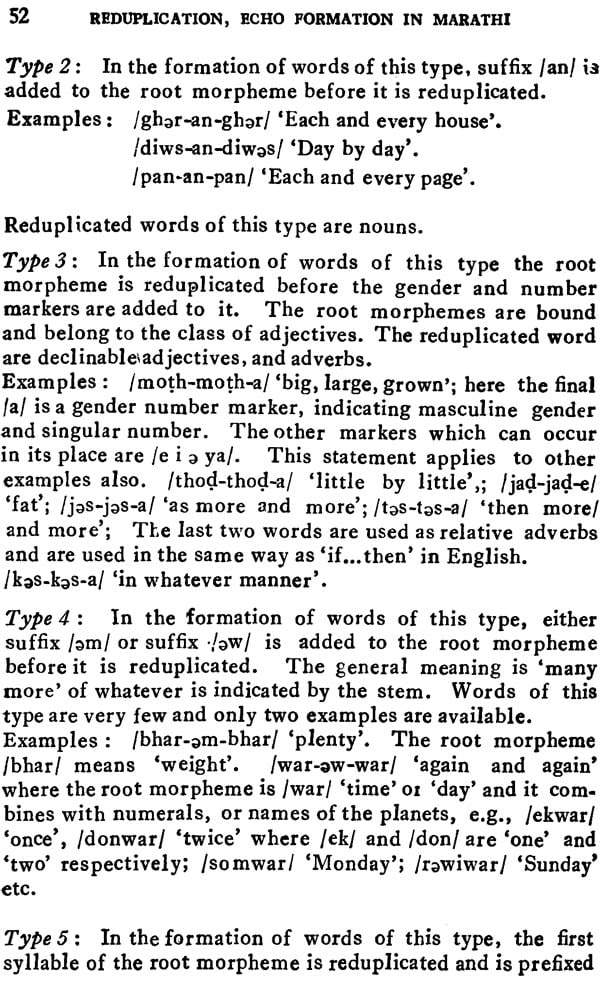
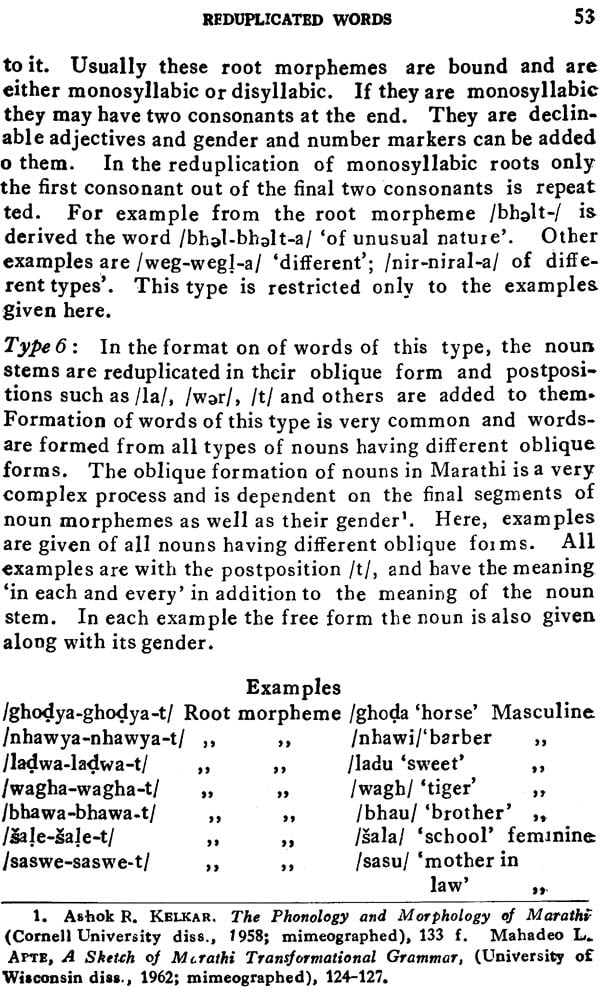
| V | Reduplicted words | 48 |
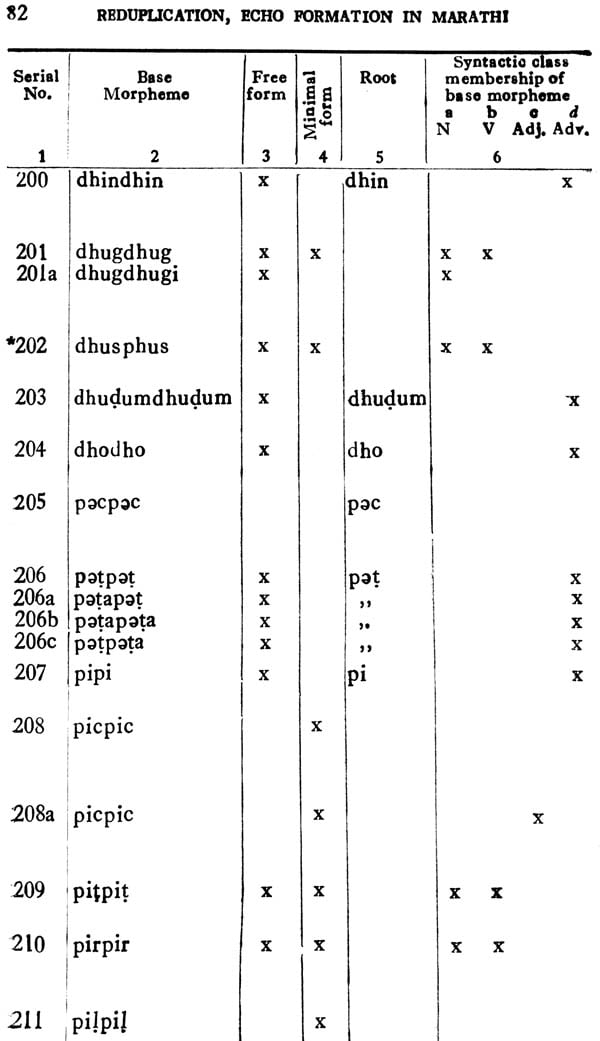
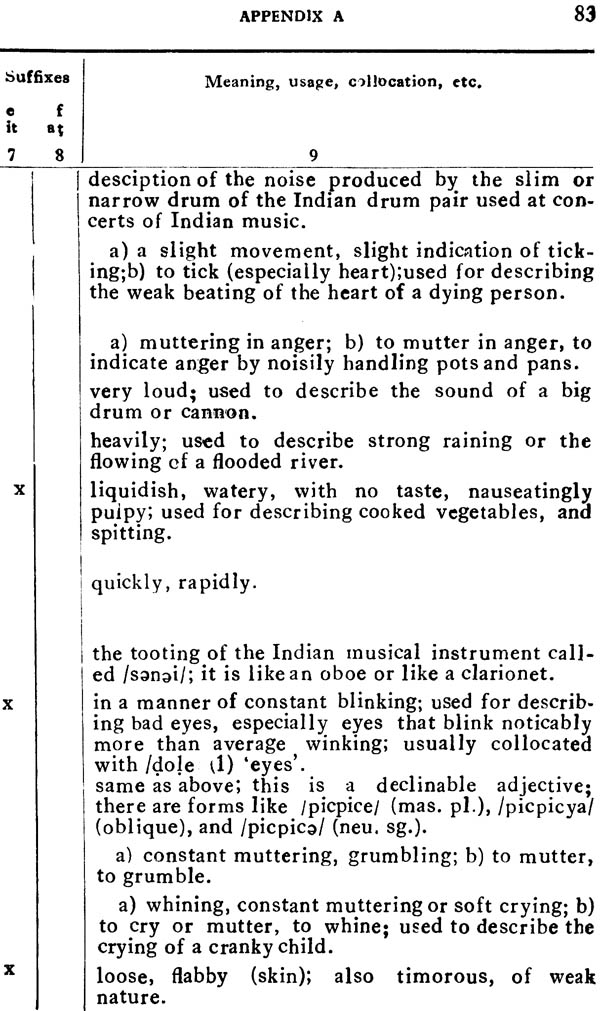
| Appendix A : List of reduplicated onomatopoeic words | 56 | |
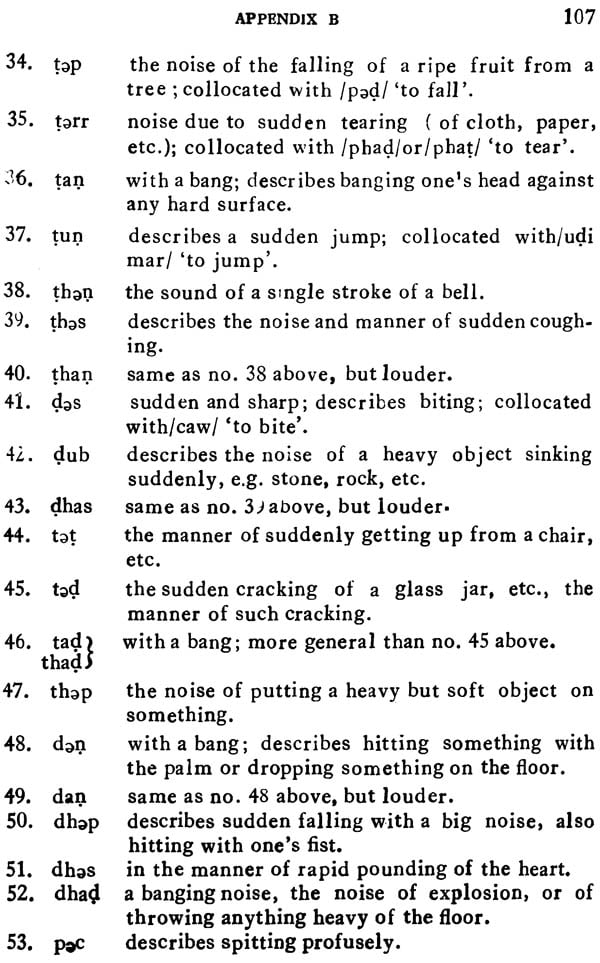
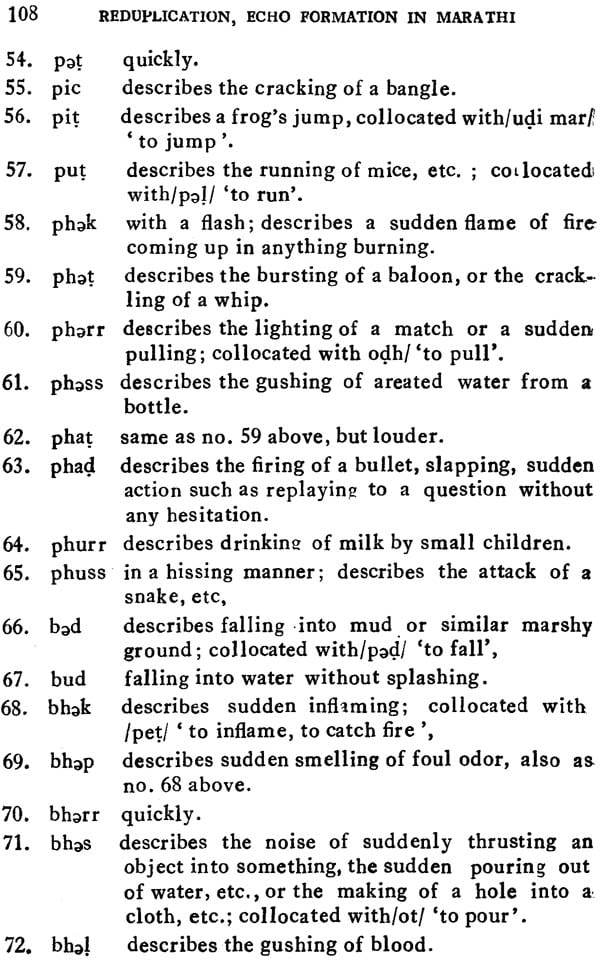
| Appendix B : List of simple onomatopoeic words | 104 | |
| Errata | 110 |