

Chinnamasta: The Aweful Buddhist and Hindu Tantric Goddess
Book Specification
| Item Code: | NAB308 |
| Author: | Elisabeth Anne Benard |
| Publisher: | MOTILAL BANARSIDASS PUBLISHERS PVT. LTD. |
| Language: | English |
| Edition: | 2017 |
| ISBN: | 9788120810655 |
| Pages: | 176 (B&W.illus.:7) |
| Cover: | Hardcover |
| Other Details | 9.0 inch X 6.0 inch |
| Weight | 370 gm |
Book Description
About the Book
This is the first monograph which examines the rare Buddhist and Hindu Tantric goddess, Chinnamasta, her rituals, her names and forms (namarupa) and their symbolism by comparing and contrasting her sadhanas (spiritual practices) in Hinduism and Buddhism. The entire Hindu "Chinnamastatantra" section from the Sakta Pramoda, the Buddhist "Chinnamunda Vajravarahisadhana" and the "Trikayavajrayoginistuti" are translated for the first time into English. Since Chinnamasta is a rare goddess, her texts were not popularized or made "fashionable" according to the dictates of a particular group at a particular time. The earliest extant texts date from the ninth and tenth centuries - a time when Hindu and Buddhist Tantras were developing under common influences in the same places in India. Having such texts about Chinnamasta Chinnamunda from these centuries, one can begin to understand the mutuality of a general Tantric tradition and the exclusivity of a particular Hindu or Buddhist Tantric tradition. Hence the study, not only examines Chinnamasta, but also attempts to understand what is a Tantric tradition.
About the Author
Elisabeth Benard became interested in India at the age of twelve years when her father first brought back Hindu image from a trip to India. For many years she looked at these image in her family library never dreaming that one day she would become a scholar in Indian religions. She researched in India under the auspicious of the American Institute of Indian Studies and received her doctorate from Columbia University. She has lectured widely in the United States, including at Smithsonian Institute and Asia Society, as well as in India and Japan. She has taught at Princeton, Rutgers University, Collage of Wooster and the University of Hawaii at Manoa. Presently she is teaching Hinduism, Women in Religion, and Asian Religions at Southwestern University in Georgetown, Texas.
Elisabeth Benard’s work on the Hindu-Buddhist goddess Chinnamastã is a product of indefatigable energy, not overlooking any lead from Sanskrit and Tibetan texts or from knowledgeable informants. So to cast light on a goddess that was strangely obscure and yet implicates any Indian goddess properly to be called wondrous or arousing of awe. Although completed in the United States, her treatise does not follow a History of Religions approach with a baggage of technical terms. Besides, Dr. Benard avoids the guessing and speculations that characterized some previous references to this goddess. Throughout she employs a direct communication with the reader while soberly basing her conclusions on stated sources.
One welcome feature of Benard’s book is the translation of much material from the Sakta Pramoda. Another fine feature is the treatment of the goddess’s names, both the 108 and 1,000 list. Her classification of the names by the rasas of Hindu drama is probably unique.
This work is a solid contribution to the theories of the Hindu and Buddhist Tantras and their symbolism, in particular as related to the goddess.
When I tell a Buddhist or Hindu scholar that lam writing on Chinnamastä, many scholars shrug their shoulders and say, “I am sorry but I never heard of her.” Others know her name but no more. Then I show them an illustration of Chinnamasta. Some of them gasp but others are intrigued. A very small group of scholars exclaim, ‘Tell me what you have found out; I have been trying to understand her for years.” When I first saw Chinnamasta, I was mystified and somewhat horrified. I asked myself, “Who is this goddess who is decapitated, holds a severed head, and drinks blood gushing from her neck?” Eager to forget this vision, I tried to find a category in which I could file her. No category was appropriate; she was not a mother goddess, a goddess of prosperity, or even a wrathful manifestation of the Great Goddess. She defied classification. Unable to ‘file her away’, I tried to rationalize her unique appearance. Who did she represent or what message was she expressing? No logical explanation became evident. By this time, my horror was transformed into fascination and I kept thinking about Chinnamastã. Everyday I asked myself, “Who is Chinnamasta; why is she depicted in this way?”
Unable to penetrate her mysterious message, I began to look for books or articles about her. Realizing that only a few articles were written about her, I decided to attempt a comprehensive study on Chinnamasta. More over I realized that this research could only be done in India in order to find the necessary texts and to meet scholars who would discuss her.
I would like to thank the American Institute of Indian Studies for providing a doctoral research grant 1986-87 to study in Varanasi and Sarnath, India. Many of the manuscripts and books which discussed Chinnamasta could only be found in India or Nepal. Most of the texts are sãdhanas and many of the sãdhanas are from the ‘Dhih Project’ estab lishe by the late Jagannath Upãdhyãya and the Director of the Central Institute of Higher Tibetan Studies, Samdong Rimpoche, in Sarnath. They graciously permitted me to copy all their manuscripts on Chinnamastã and Pandit Vraj Vallabh Dwivedi, present Director of the ‘Dhih Project’, spent many months discussing these manuscripts and the Chinnamastàtantra’ of the Sikta Pramoda. I would like to thank every on in the ‘Dhh Project’ for all their invaluable help and insightful discussions. Also I would like to thank Hemendra Chakravorty of Varanasi for commenting on numerous sãdhanas and ritual texts on Chinnamasta, as well as lending me books from his private library. This work could not have been done without the help of numerous people in North America, Europe, India, Nepal, and Tibet; I thank everyone for their help. I especially thank two kalyãnamitras, Diana Cutler and Karma Lekshe Tsomo. Also I appreciate the financial support for publication from the Center of Arts and luminaries and the University Research Council at the University of Hawaii at Manoa. I thank Mary Slusser for permission to reproduce the detail of Chinnamunda from the Vajravãrahi painting (plate 3).
My greatest gratitude is to four people who encouraged, inspired, and guided me through all these tumultuous years of trying to understand Chinnamastã. I thank my husband, Nima Dorjee, who applies his wonderful qualities of the wise old person and the playful child at the appropriate times. I thank His Holiness Sakya Trizin, whose vast wisdom coupled with compassion elucidates the subtlety of Tibetan Buddhism, and the late Dezhung Rimpoche, the epitome of Avalokitevara. To one who can he as enigmatic, yet as profound as Chinnaniasta—Alex Wayman— I thank you for your creativity, uncanny perceptions, love for a good debate, exactness, kindness and passion for the arcane and the subtle.
Chinnamasa/Chinnamunda the uncanny Buddhist Hindu Goddess explodes one’s limited understanding of the phenomenal world in order to reveal unconditioned reality. Both her head in her hand. The sadhana in the Sadhanamala describeds Chinnamunda as one who is of yellow color who holds in her left hand her own severed head which she severed with he own scimitar held in her right hand.s he is nude streams of blood issuing from the severed body fall into the mouth of her severed head and into the mouths of the two Yoginis on either side of her. This paradoxical goddess overwheims and initially frightens. She pushes one beyond dualities into the realm of the unconditioned and unconditional a spiritual experience eagerly sought but firthenning and repelling when actually experienced.
Arjuna’s ordinary reality is exploded into a million parts which destroyed the Human constructed limits. This experience of unconditioned reality is both marvelous and frightening later in this book. Chinnamasta’s hundreds and eight names and one thousand names will illustrate this paradoxical and awe inspiring combination of the marvelous and furious Rudofl Otto described the nature of unconditioned reality as that which makes a person stand in awe and simultaneously fascinates one. Chinnamasta is an aweful goddess in this sense.
She is also a paradoxical one who non verbally indicates unconditioned reality. Practitioners apply this teaching to become liberated from cyclic existence. Unfortunately one primarily find Chinnamasta in sensational Tantric art Books which portray Tantra as exotic sexual practice or degenerate previsions. In these books expalanations of Chinnamasta are brief and superficial. In reality however Chinnamasta Indicates a transcendence of the country or portrays the ordinary as extraordinary. There is a famous story about the Buddha who once taught in an enigmatic way, by holding a flower. Everyone waited patiently for the teaching to begin; onlyMahkkãyapa smiled. The Buddha smiled with him. The teaching was concluded. An ordinary flower evoked the experience of understanding the non-duality of ordinary/extraordinary. Chinnamasta uses her ordinary body in an extraordinary manner; she is able to function with a severed head.
Chinnamasta, this aweful’ goddess, is a Tantric goddess par excellence , A single definition of Tantra is very difficult because of the variety of Tantric traditions existing in the world—from Kashmir Saivism and Hindu akta, etc. in India to a variety of Buddhist Tantras in Nepal, Tibet, and Japan. Many contemporary Hindu ascetics define Tantra as action done with the body (tanu) for the purpose of protecting/bringing about release (tin). One etymology of Tantra divides the word into two roots, tan to stretch or expand and tra to save or protect. By combining these two roots, Tantra means the increase of methods available in order to liberate oneself from cyclic existence. Ideally, these methods should be efficacious and expedient. Furthermore, in researching about Tantra, one realizes the importance of the human body as the principal instrument for liberation rather than an impediment as propounded in other traditions.
The body consists of numerous levels of subtlety and all Tantric traditions agree that a subtle body is composed of subtle channels (näçiis) and winds prna, which circulate in the subtle channels. Furthermore they agree on the existence of three principal subtle channels, two ancillary ones which crisscross around a central channel. The subtle winds course through the two ancillary channels but in most people the subtle wind cannot enter the central channel because the two ancillary ones form knots at the points where they crisscross it. As long as the subtle winds cannon enter the central one, one experiences the duality of ordinary reality. By yogic methods one learns to untie these ‘knots’ thereby opening the central channel. When the subtle winds course through the central channel, the dichotomy of conditioned and unconditioned disappears. I would argue that Chinnamastà anthropomorphically represents this central channel, her two attendants represent the two ancillary subtle channels; their feet are intertwined with Chinnamastã’s thereby replicating the two ancillary channels which are intertwined with the central channel near the navel. Moreover, there are three bloodstreams and if correctly depicted the right bloodstream enters the right attendant’s mouth, the left bloodstream the left attendant’s mouth, and the central one is drunk by Chinnamastä. Since the attendants drink only from the right or left respectively, this indicates that they do not know the yogic process of manipulating the winds into the central channel. They experience the duality of ordinary reality. In contrast Chinnamasta, a great yogini, drinks her own blood from the central channel, thereby experiencing the collapse of duality. Thus Chinnamastä is the Tantric goddess par excellence because she represents the essential instrument and method of achieving liberation through the Tantric-yogic process of the manipulation of the subtle winds coursing through the subtle channels.
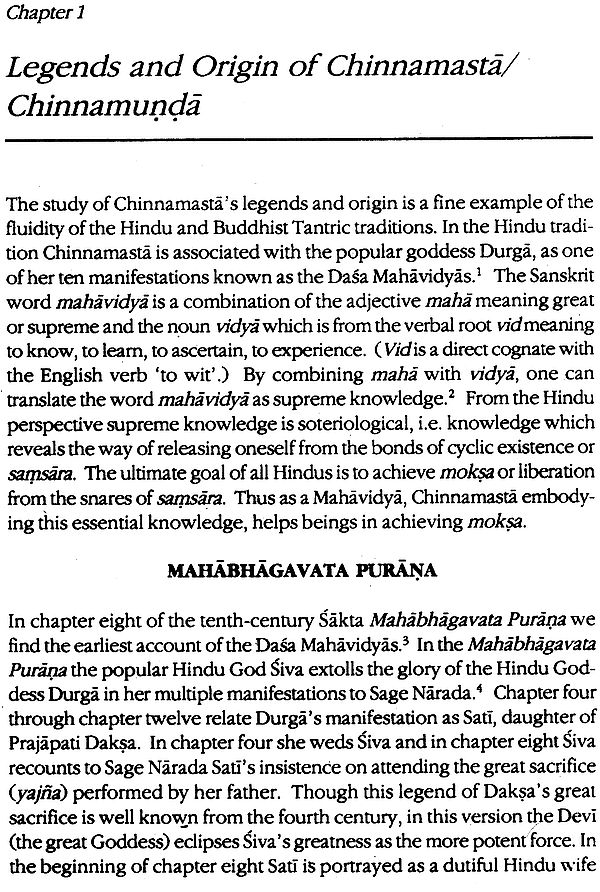
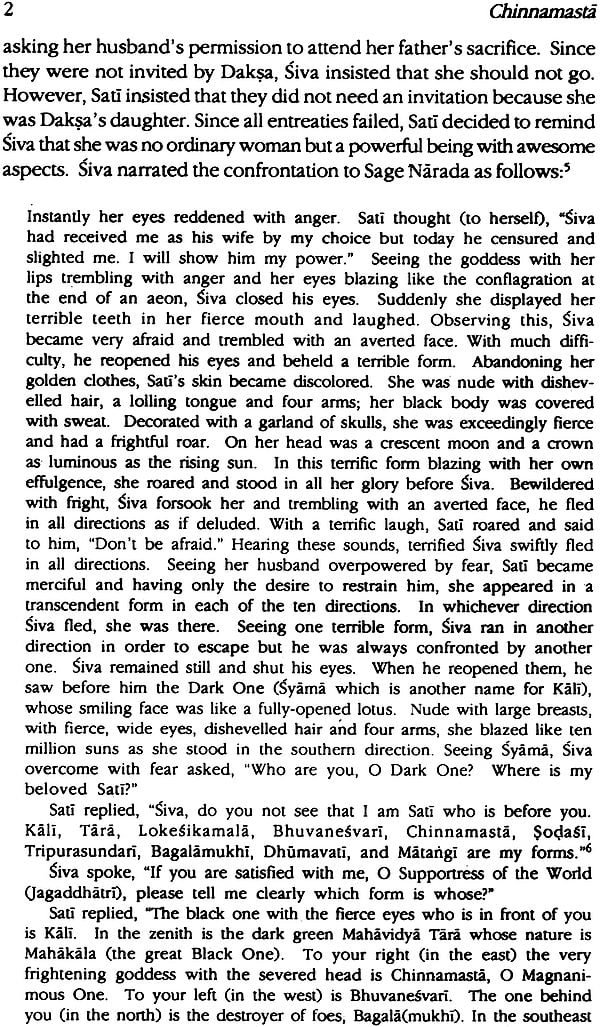
Who is she? Her legends are few but consistencies are apparent throughout the diverse material ranging from the .Mahasiddha and Tantric tradition to the Purãnas. Among the Hindu legends, Chinnamasta is Siva’s consort and in the Sakta Mahãbhagvata Purãna, she is one of the Dasa Mahvidyas (ten great knowledge goddesses). In the Buddhist tradition she is connected with the Mahasiddha tradition, especially the female Mahsiddhas, Mekhalà, Kanakhala, and most importantly, Laksmihkarã, Many of Chinnamurida sadhanas included Laksmihkara in their transmission lineages. In both the traditions she is an unusual emanation of a popular goddess: in Hinduism Durgà; and in Buddhism Vajravarahi Vajrayogini.
Various scholars assert a different origin for her. Some scholars, such as B. Bhattacharyya, hold that she is originally a Buddhist creation and is incorporated by the Hindus. Some Hindu scholars do not even consider the possibility for a non-Hindu origin, such as Shankaranarayanan who claim a Vedic antecedent. Since Chinnamasta is a rare form of a popular goddess, few know much about her. When [visited a Hindu temple dedicated to Chinnamasthi, the ritual priests, whose family have been the priests for centuries, were surprised and delighted that Chinnamasta was worshipped in Nepal, Tibet, and Mongolia. Likewise, the Tibetan Buddhist practitioners wanted to know more about the Hindu Chinnamasti Both Buddhism and 1-linduism have Tantric traditions and the nascence of Tantra is obscure. Extant Buddhist texts of Chinnamunda indicate an earlier origin than the Hindu ones; however, oral teachings must have preceded the texts. With these difficulties of overlapping between the two traditions and the uncertainty of the birth of Tantra, a definitive Hindu or Buddhist origin of Chinnamasta cannot be asserted.
This is the first monograph which examines Chinnamasta’s rituals, her names and forms (nämarupa) and their symbolism by comparing and contrasting her sadhanas (spiritual practices) in Hinduism and Buddhism. The entire Hindu ‘Chinnamastatantra’ section from the Sakta Pramoda, the Buddhist ‘Chinnamundã Vajravarahi sãdhana’ and ‘Trikayavajrayogini stuti’ are translated for the first time into English. Since Chinnamastã is a rare goddess, her texts were not popularized or made ‘fashionable’ according to the dictates of a particular group at a particular time. The earliest extant texts date from the ninth and tenth centuries a time when Hindu and Buddhist Tantras were developing under common influences and in the same places in India. Having such texts about Chinnamasta/Chinnamunda from these centuries one can begin to understand the mutuality of a general Tantric tradition and the exclusivity of a particular Hindu or Buddhist Tantric tradition. Hence the study not only examines Chinnamasta but also attempts to traditions what is a Tantric tradition.
| Foreword | v | |
| Preface | ix | |
| Introduction | xi | |
| 1 | Legends and Origin of Chinnamasta/ Chinnamunda | 1 |
| 2 | To worship a Deity one must become a deity | 23 |
| 3 | The Divine play of Chinnamasta | 51 |
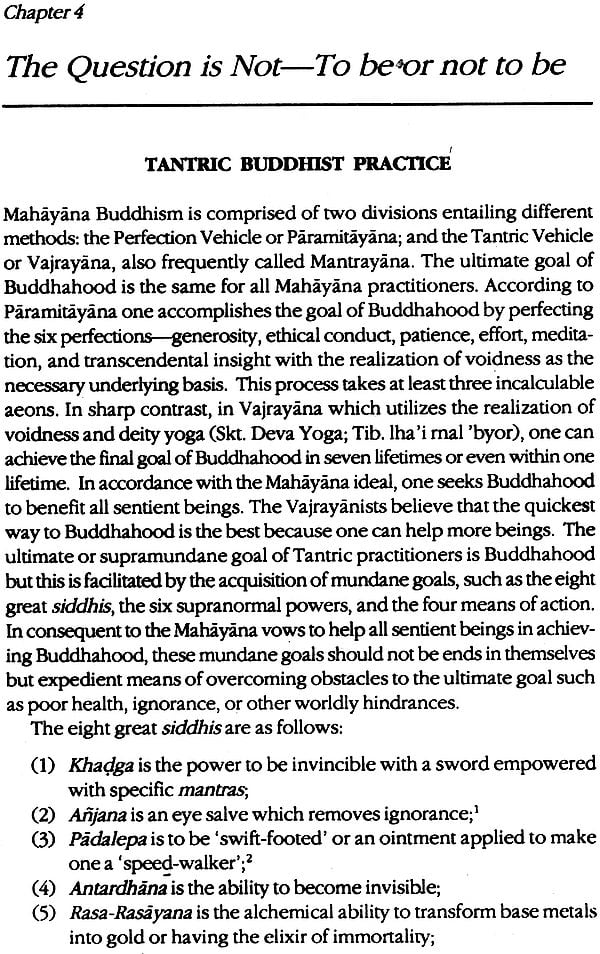
| 4 | The Question of Chinnamasta/Chinnamunda | 83 |
| Conclusion | 117 | |
| Appendix 1: The Thousand Names of the Goddess | 121 | |
| Appendix 2: Chinnamasta temples in northern India and the Kathmandu valley | 145 | |
| Bibliography | 149 | |
| Index | 157 |