

Indian Dance Mythology and Folk Dance
Book Specification
| Item Code: | UAR362 |
| Author: | Jagmohan Singh |
| Publisher: | Venus Publications, Delhi |
| Language: | English |
| Edition: | 2019 |
| ISBN: | 9789387851337 |
| Pages: | 280 |
| Cover: | HARDCOVER |
| Other Details | 9.60 X 6.40 inch |
| Weight | 570 gm |
Book Description
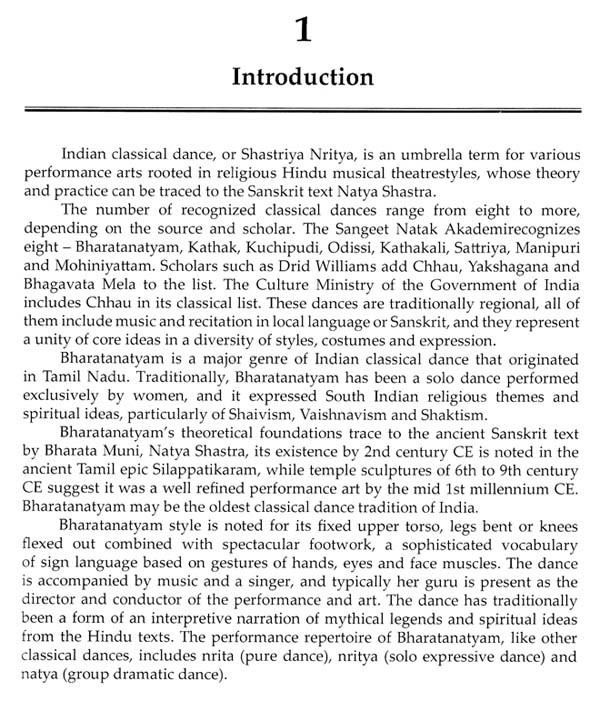
The number of recognized classical dances range from eight to more, depending on the source and scholar. The Sangeet Natak Akademi recognizes eight - Bharatanatyam, Kathak, Kuchipudi, Odissi, Kathakali, Sattriya, Manipuri and Mohiniyattam. Scholars such as Drid Williams add Chhau, Yakshagana and Bhagavata Mela to the list. The Culture Ministry of the Government of India includes Chhau in its classical list. These dances are traditionally regional, all of them include music and recitation in local language or Sanskrit, and they represent a unity of core ideas in a diversity of styles, costumes and expression.
Jagmohan Singh was born in January 12, 1954 in Agra. He did M.A in History and Political Science from Agra University, also did M.ED from Punjab University and has deep knowledge of Classical Dance. His books and stories have been best sellers in different states even his work translated into 50 regional languages and selling thousands of copies. His work has received numerous recommendation, he said that writing Dancing articles had been a healing act. He had enjoyed writing Dance more than any other.
Bharatanatyam, a pre-eminent Indian classical dance form presumably the oldest classical dance heritage of India is regarded as mother of many other Indian classical dance forms. Conventionally a solo dance performed only by women, it initiated in the Hindu temples of Tamil Nadu and eventually flourished in South India. Theoretical base of this form traces back to 'Natya Shastra", the ancient Sanskrit Hindu text on the performing arts. A form of illustrative anecdote of Hindu religious themes and spiritual ideas emoted by dancer with excellent footwork and impressive gestures its performance repertoire includes nrita, nritya and natya. Accompanists include a singer, music and particularly the guru who directs and conducts the performance. It also continues to inspire several art forms including paintings and sculptures starting from the spectacular 6th to 9th century CE temple sculptures.
The four Nattuvanars namely Ponaiyah, Vadivelu, Sivanandam and Chinnaiya who are renowned as Tanjaore Bandhu and who thrived in the Durbar of Maratha ruler, Sarfoji-II from 1798 to 1832 shaped up the modern day Bharatanatyam. Meenakshi Sundaram Pillai, a dance guru from the village of Pandanallur was a noted exponent of Bharatanatyam who is predominantly known for his style referred as the Pandanallur school of Bharatanatyam. One of his students Rukmini Devi championed and performed the Pandanallur (Kalakshetra) style and also remained one of the leading proponents of the classical dance revival movement. Balasarswati who was regarded as child prodigy by Vidhwans and Pandits also joined hands in reviving the dance form. She was a virtuoso of the Thanjavur style of Bharatanatyam. Other imminent Bharatanatyam artists include Mrinalini Sarabhai, her daughter Mallika Sarabhai, Padma Subramanyam, Alarmel Valli, Yamini Krishnamurthy and Anita Ratnam among others.
- Jagmohan Singh
**Contents and Sample Pages**