



Life and Teachings of Adi Sankaracarya (Shankaracharya)
Book Specification
| Item Code: | IDD138 |
| Author: | P. George Victor |
| Publisher: | D. K. Printworld Pvt. Ltd. |
| Language: | English |
| Edition: | 2008 |
| ISBN: | 8124601941, 9788124601945 |
| Pages: | 184 |
| Cover: | Hardcover |
| Other Details | 8.9" X 6.0" |
| Weight | 440 gm |
Book Description
From the Jacket:
Vedanta is recognized as the leading philosophy of the Vedic tradition. A major proponent of Vedanta was Sankaracarya who laid the basis for the propagation of Vedanta before the beginning of the Middle Ages. His contribution has been so immense and significant that often Vedanta has been interpreted as synonymous with Advaita Vedanta of Sankara.
Here, Dr. George Victor attempts to study comprehensively Sankaracarya's teachings on Vedanta - his views on scripture, perception and inference as pramanas or standards of knowledges; his explanations of the relation between Brahman and atman, Brahman and Isvara, maya and the world; and his concepts of jnana marga, karma marga and moksa, among others.
The work takes a close look at the date of Sankara and his life and times before plunging into a penetrative study of Sankara's commentaries on the triple texts, the Upanisads, the Brahmasutra and the Bhagavad-Gita - the foundations of Vedantic thought. With constant references to Sankara's major and minor works and hymns, and using a simple language that reflects a unique clarity in understanding Sankara's philosophy, it also examines his methodology of philosophical interpretations and how academicians have estimated Sankara in the past.
Authored by a scholar who has for long been associated with research and teaching of Sankara's philosophy, the book will be of interest to scholars and students of Indian philosophy as well as general readers.
About the Author:
Prof. George Victor, a teacher of Sankara Vedanta and western philosophy, organized the 'First National Seminar on Teaching Philosophy' in India in 1998. He is the Editor for Andhra University Philosophical Studies Series and has some published works to his credit: Social Philosophy of Vedanta, Moral Science and Social Justice: New Hopes for a Changing India.
Currently he is Senior Professor of Philosophy and Director, Centre for Religious Studies, Andhra University, Visakhapatnam.
| Preface | v | |
| 1. | Introduction to Vedanta | 1 |
| Study of Indian Literature | 1 | |
| What are Veda and Vedanta? | 3 | |
| The Triple Texts - Prasthanatrayi | 4 | |
| The Three Schools | 6 | |
| Advaita Vedanta and Indian Mind
| 7 | |
| 2. | Gaudapada, the Propounder | 11 |
| The Mandukya Upanisad | 12 | |
| The Mandukya Karika | 14 | |
| Agama Prakarana (Chapter on Scripture) | 14 | |
| Vaitathya Prakarana (Chapter on unreality) | 15 | |
| Advaita Prakarana (Chapter on Non-Duality) | 16 | |
| Alatasanti Prakarana (Chapter on Cerssation of Burning Coal)
| 17 | |
| 3. | The Date of Sankaracarya | 19 |
| The Indian Antiquary | 19 | |
| K.B. Pathak - The Source First Discovered | 20 | |
| K.T. Telang Rejects K.B. Pathak's Evidence | 21 | |
| Telang Rejects Max-Muller's Opinion | 22 | |
| Telang Proposes Different Date | 23 | |
| W. Logan's Account from Keralotpatti - Date known to Sankara's Native Land | 26 | |
| D.R. Bhandarkar Supports K.B. Pathak | 27 | |
| Narasimhachar Exchanges Views with Bhandarkar | 28 | |
| S.V. Venkateswaran Assigns Sankara to ninth century AD. | 29 | |
| Conclusion
| 30 | |
| 4. | The Times of Sankaracarya | 31 |
| Political and Social Conditions | 32 | |
| Religious Conditions
| 33 | |
| 5. | The Life of Sankaracarya | 37 |
| Sources | 38 | |
| Life at Glance | 39 | |
| Encounter with an Outcast | 40 | |
| Religious Harmony and Travels
| 42 | |
| 6. | The Works of Sankaracarya | 45 |
| Paul Hacker's Studies | 46 | |
| What is His Name? And Which is the Title | 47 | |
| Works Attributed to Sankaracarya
| 49 | |
| 7. | Sankaracarya on the Upanisads | 53 |
| Yajnavalkya and Maitreyi Dialogue | 53 | |
| Text Summary | 53 | |
| Sankaracarya's Commentary | 55 | |
| Yajnavalkya and Gargi Dialogue | 57 | |
| Text Summary | 57 | |
| Yajnavalkya Answers the Questions | 58 | |
| Yajnavalkya Answers Gargi | 59 | |
| Sankaracarya's Commentary
| 59 | |
| 8. | Sankaracarya on the Bhagavad Gita | 63 |
| Introduction | 63 | |
| Concepts of the Gita | 64 | |
| Lord Krsna | 64 | |
| Man | 64 | |
| Niskama-Karma-yoga | 65 | |
| Paths of the Gita | 65 | |
| Karma-yoga (The Discipline of Action) | 65 | |
| Jnana-yoga (The Discipline of Knowledge) | 66 | |
| Bhakti-yoga (The Discipline of Devotion) | 66 | |
| Yoga (The Discipline of Meditation) | 66 | |
| Ksetra and Ksetrajna | 67 | |
| Context | 67 | |
| Commentary | 68 | |
| Abandonment and Seeking the Lord as Shelter | 72 | |
| Commentary
| 72 | |
| 9. | Sankaracarya on the Brahma-sutra | 77 |
| Badarayana | 77 | |
| Samanvaya (Reconciliation of different statements) | 78 | |
| Avirodha (Opponent's views criticized) | 78 | |
| Sadhana (Means) | 79 | |
| Phala (Fruit, Result) | 79 | |
| Superimposition (Adhyasa) | 80 | |
| The first Brahma Sutra | 83 | |
| The Second Brahma Sutra | 85 | |
| The Third Brahma Sutra | 87 | |
| The Fourth Brahma Sutra | 88 | |
| Scriptures are Essential | 90 | |
| Brahman-knowledge and Moksa | 91 | |
| Seeker of Brahman
| 93 | |
| 10. | Minor Works and Hymns of Sankaracarya | 97 |
| Viveka-cudamani | 98 | |
| Upadesa-sahasri | 101 | |
| Atma-bodha | 103 | |
| Daksina-murti-stotra | 106 | |
| Sivananda-lahari | 108 | |
| Bhaja-Govindam
| 110 | |
| 11. | Teachings of Sankaracarya | 113 |
| Scripture, Perception and Inference | 113 | |
| Brahman-atman | 118 | |
| Brahman and Isvara | 119 | |
| Maya and World | 121 | |
| Jnana Marga and Karma Marga (Path of knowledge and path of Action) | 124 | |
| Vyavaharika-Satya and Paramarthika Satya (Phenomenal Truth and Noumenal Truth) | ||
| Moksa
| 128 | |
| 12. | Methodology of Sankaracarya | 131 |
| Scripture as Standard (Sastra as Pramana) | 131 | |
| Writing Commentaries | 134 | |
| Missionary Travels | 135 | |
| Rejection of Opponent Views | 135 | |
| The Dualist | 136 | |
| Parables
| 137 | |
| 13. | Social Philosophy of Sankaracarya | 139 |
| Doctrine of Illusion (Maya-Vada) - Refuted | 139 | |
| Social Order | 142 | |
| Ethics
| 146 | |
| 14. | Interpretations on Sankaracarya | 151 |
| Devotional Aspects | 152 | |
| Active Social Work
| 156 | |
| Glossary | 161 | |
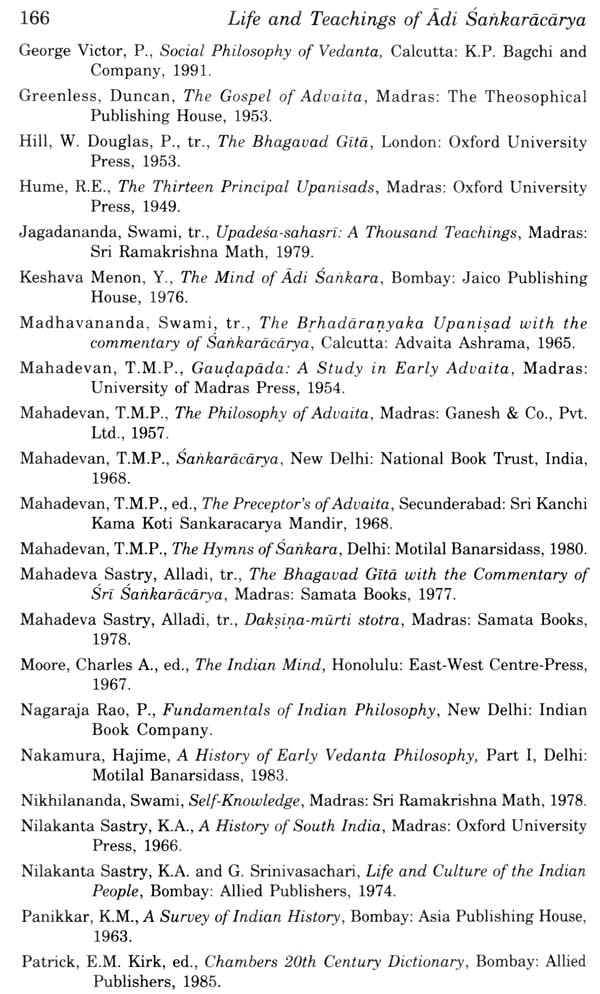
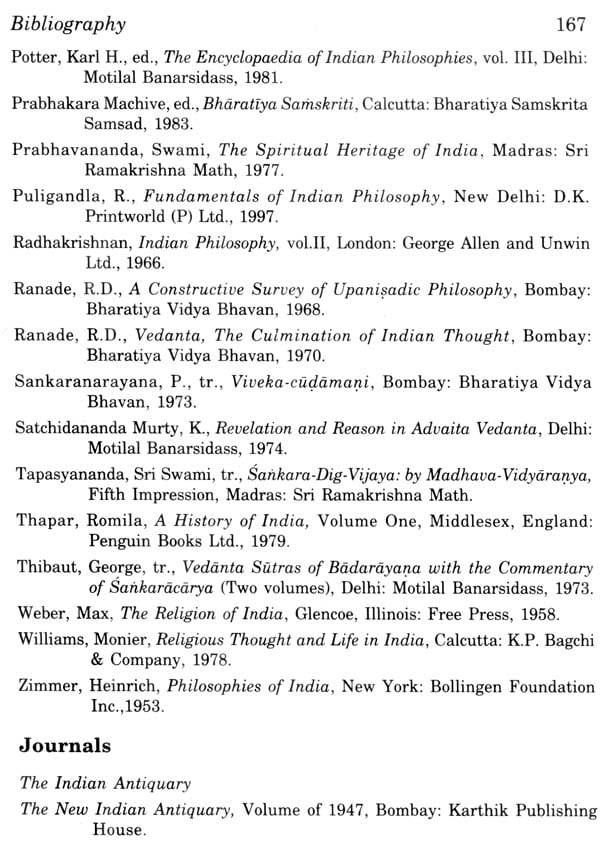
| Bibliography | 165 | |
| Index | 169 |
Of Related Interest:
Life of Shankaracharya - The Adventures of a Poet Philosopher
Click Here for an Exhaustive Collection of Books Relating to Shankaracharya


