

Radio In New Avatar AM to FM
Book Specification
| Item Code: | NAL547 |
| Author: | Dr. Ambrish saxena |
| Publisher: | Kanishka Publishers |
| Language: | English |
| Edition: | 2011 |
| ISBN: | 9788184572650 |
| Pages: | 610 |
| Cover: | Hardcover |
| Other Details | 8.5 inch x 5.5 inch |
| Weight | 770 gm |
Book Description
About the Book
This book ‘Radio in New Avatar: AM to FM’, however, covers five major areas (a) plan perspectives, (b) policy paradoxes, (c) popular paradigms, (d) potential and (e) prospects.
Radio broadcasting has been an important component of Five Year Planning in India. Extension of coverage, improvement in quality of programmes and achievement of development goals through radio have been the thrust areas during most of the Five Years Plans (FYPs). This book tries to help you understand the rich medium of radio ina better way by making an assessment of policy planning.
This book tries to apprise you with the policy formulations which covers reports of various committees and groups like Committee and Verghese Group, legislations like Prasar Bharati Act and Broadcasting Services Regulation Bill, recommendations of TRAI on FM Radio, Community Radio and Satellite Radio, and regulations like Private FM Radio Policy Phasa II, Community Radio Policy Draft Satellite Radio Policy Guidelines. A critical assessment reveals many serious policy paradoxes.
This book takes you to another serious aspect i.e. paradigm shifts in radio broadcasting policy in India. The changing concepts from public service broadcasting to commercial broadcasting, and from conventional (broadcasting) to community (narrowcasting) have been discussed vividly.
Radio is substantially a potential medium and the pace of its growth could be ascertained only by making right kind of policies. The prospects are bright with the condition attached that the government has to act more sensibly and promptly.
About the Author
Dr. Ambrish Saxena is one of the most celebrated media educator and researcher in the country. Having worked for three decades in media industry and academics he has developed a deep insight in communication and media studies which communication and media studies which is reflected in all his endeavours.
Dr. Saxena conceived, designed and launched four academic programmes during more than three years of his stay as Consultant Professor at the University Centre for Media Studies, Guru Gobind Singh Indraprastha University, Dalhi. He was also instrumental in the designing and restructuring of bachelor’s Programme at the same university. He was coordinator of BJ (MC), MJMC, PGDEM and CVP for various intervals and held the post of Director, Vivekananda Institute of Professional Studies for five years.
Dr. Saxena has two master’s degrees i.e MA (POL. Sc.) from Allahabad University and MJ from MGKV, Varanasi, and two PhDs, one on Right to Information and the other on Radio Broadcasting. He is also a law graduate.
Dr. Saxena joined journalism as a full-timer in 1979 and served some of the widely circulated Hindi and English newspapers including Amrit Prabhat and The Pioneer. He even worked as correspondent for the first TV Hindi news magazine Parakh produced by Vinod Dua.
Having turned to media education from practice, Dr. Saxena has taught at the Indian Institute of Mass Communication, Kamala Nehru College, Kalindi College and IP College of Delhi University and TV Today Media Institute. During his stay at IIMC, he has done report writing of two research projects, one on All India Radio (Ministry of I & B) and the other on Media Coverage of Health Issues in SE Asian Countries (WHO).
Dr. Saxena has authored two books i.e. “Right to information and Freedom of Press” and “Fundamentals of Reporting and Editing”
Preface
Radio broadcasting in its more than 80 years of journey in India has passed through many cycles of growth. It has been used for information, education and then wholesome entertainment, it has been carrying the character of public broadcasting and then turning to commercial broadcasting, it has been in the control of government, autonomous council and now the private entrepreneurs, it has been in the form of community broadcasting i.e. narrowcasting to a targeted community, it has even been portraying an international character in the form of satellite radio. The developments have been significant and the growth has been tremendous particularly during the past one decade.
When the government of Independent India was confronting with the issues of nation building and decided to take the course of Five Year Planning (FYP) for the purpose of development, radio emerged prominently on the scene. During initial five years plans, radio was developed as a development tool. Looking at past one decade, Ninth FYP emphasized on improving variety of contents and quality of broadcasting and Tenth FYP emphasised on substantially enhancing FM coverage.
As part of Eleventh FYP, a Working Group was set up in 2007 to suggest measures for improvement in radio broadcasting. To understand radio as a medium in Indian extent and to appreciate its role in development socity, it is essential to look into plan perspectives and to make an assessment of the success of these plans in achieving the plan objectives.
The policymaking for radio broadcasting has been a difficult job in view of the nature of medium and its distinct audience. The government has been appointing various groups and committees for collecting the necessary input for policy formulations, to name a few Chanda Committee (1966), Verghese Group (1978), Sengupta Group (1995), etc, The government has also been trying to bring legislations for regulating the radio broadcasting sector like Prasar Bharati Act 1997, Broadcasting Bill 1997, Communication Convergence Bill 2001 and Broadcasting Services Regulation Bill 2007.
The government has even involved a regulator i.e. TRAI whose recommendations have provided basis for policy making. TRAI recommendations for Phase II (2004) and Phase III (2008) of private FM radio broadcasting, recommendations community radio (2004), and recommendation on satellite radio (2205) and comments on Draft Satellite Radio Policy Guidelines (2008) deserve mention. Based on these recommendations the policy for private FM radio has been revised in 2005 (Phase II) and another revision (Phase III) is on the card. The policy revision for community radio has also taken place, though satellite radio policy is still awaiting formal announcement after finalisation of the draft.
These policy for formulations, legislations, recommendations and regulations are the focus of the book. An attempt has been made not only to assess the policy formulations but also to underline policy paradoxes in the context of media boom during pre and post liberalisation-globalisation period. The book tries to peep into the mind if the government while it decides the plan objectives, and initiates the policy framework to achieve those objectives.
This book presents a complete picture of radio broadcasting in India right from its evolution and growth, and the existing status. Radio as public service broadcaster, as a dev elopement agent, as a teaching device, as an entertainment tool, as a commercial venture, all such aspects has been dealt with. The decentralisation debate, the concept of autonomy, the reports of relevant committees, the enactment of legislations and implementation on them, everything has been discussed at length.
Radio’s facelifting has started with the advent of 21st century and the developments have been fast since 2001. Telecom Regulatory Authority of India (TRAI) has given an immense contribution in this regard by studying the major issues of radio broadcasting and making comprehensive recommendations. An effort has been made to examine the contemporary value of these recommendations in view of overall media scenario and broadcasting sector.
Though the book is focused on mainstream broadcasting, more precisely on private FM radio broadcasting, chapters have been included on community radio broadcasting and satellite radio broadcasting. The regulatory, technical and all other issues have been discussed in detail in the case of all three i.e. private FM radio, community radio and satellite radio.
Radio broadcasting has passed through various concepts, from control oriented paradigm to commercial paradigm and community paradigm. The three-tier broadcasting has been redefined with conventional broadcasting being challenged by private FM radio and community radio. Educational broadcasting has added one more tier to the new set up of three-tier.
Not only the broadcasting models have been changing, technological shifts have also been impacting radio transmission. From MW and SW bands of AM to VHF of FM and from analogue to Digital Radio Mondale (DRM+) transmission, radio broadcasting is getting a facelift. Thus, this book attempts to underline paradigm shifts in radio broadcasting.
There is a growing need of exploring radio to serve the changing societal needs. For this plan perspectives have to be corrected and policy paradoxes have to be removed. For academic purpose also, there is a need to understand and analyse the paradigm shifts in radio broadcasting. Some recommendations have also been made to ensure that future policy formulations remain on track, reassuring better prospects of this potential medium.
Contents
| Acknowledgements | vii | |
| Preface | xi | |
| 1 | Studying Radio Broadcasting Policy Framework | 1 |
| Radio Broadcasting: Policy Perspective | ||
| Issues of Radio Broadcasting | ||
| Studying Radio in Present Context | ||
| 2 | Objectives of Broadcasting in India | 13 |
| Radio-Emergence and Growth | ||
| Expansion of Radio in India | ||
| AIR as Public Broadcaster | ||
| Radio as Development Agent | ||
| Radio for Education | ||
| Commercialisation via Entertainment | ||
| 3 | Revamping and Regulating Broadcasting | 45 |
| Recommendations for Overhauling Broadcasting | ||
| Decentralisation Debate and Policy Shifts | ||
| Concept of Autonomy and its Interpretations | ||
| Fresh Efforts for Streamlining Broadcasting | ||
| Unfinished Broadcast/Convergence Legislations | ||
| Broadcasting Services Regulation Bill 2007 | ||
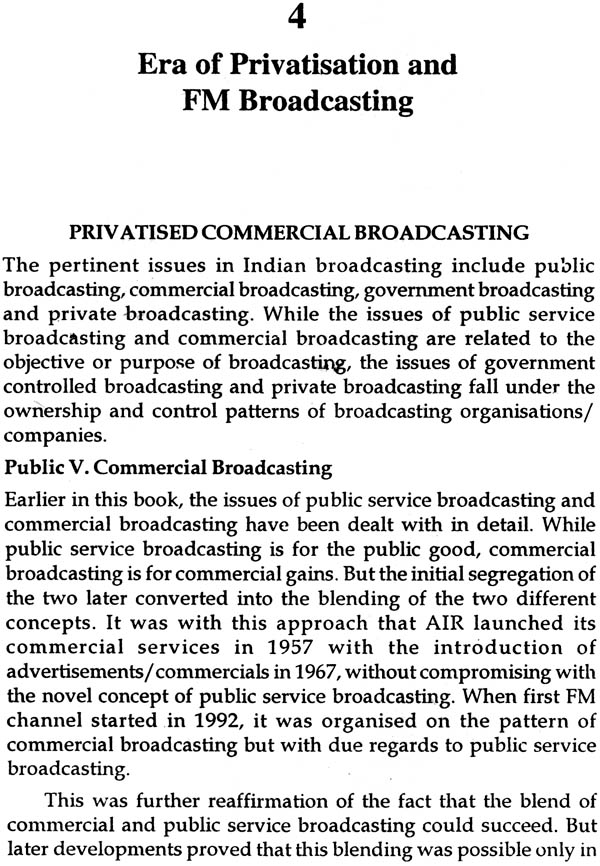
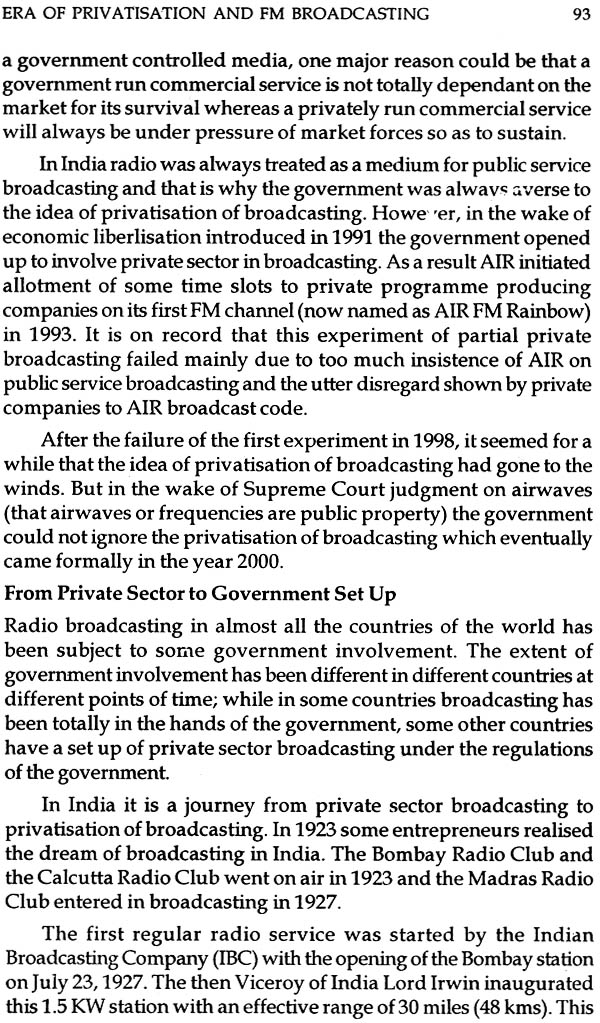
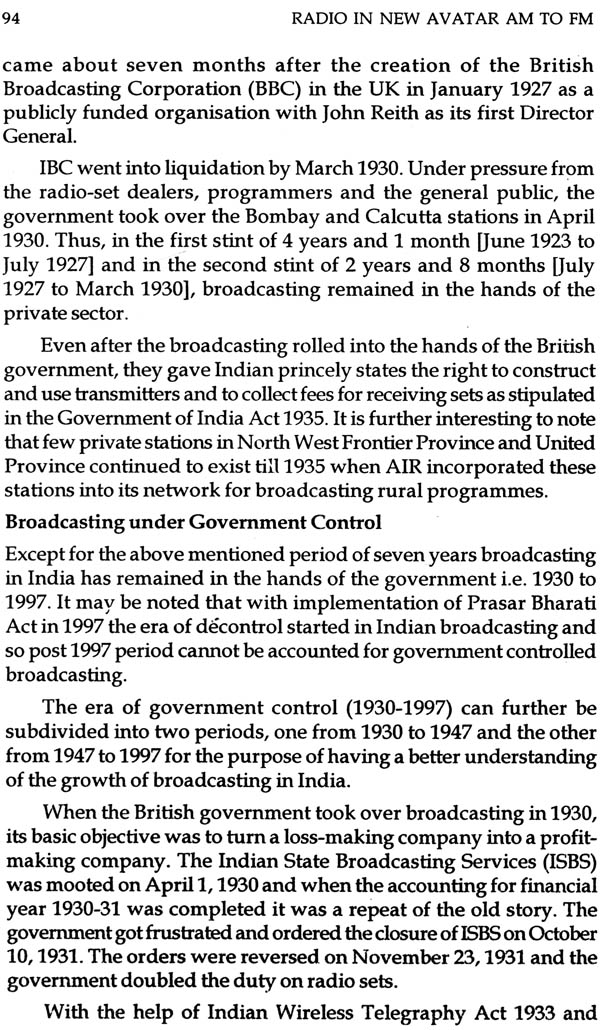
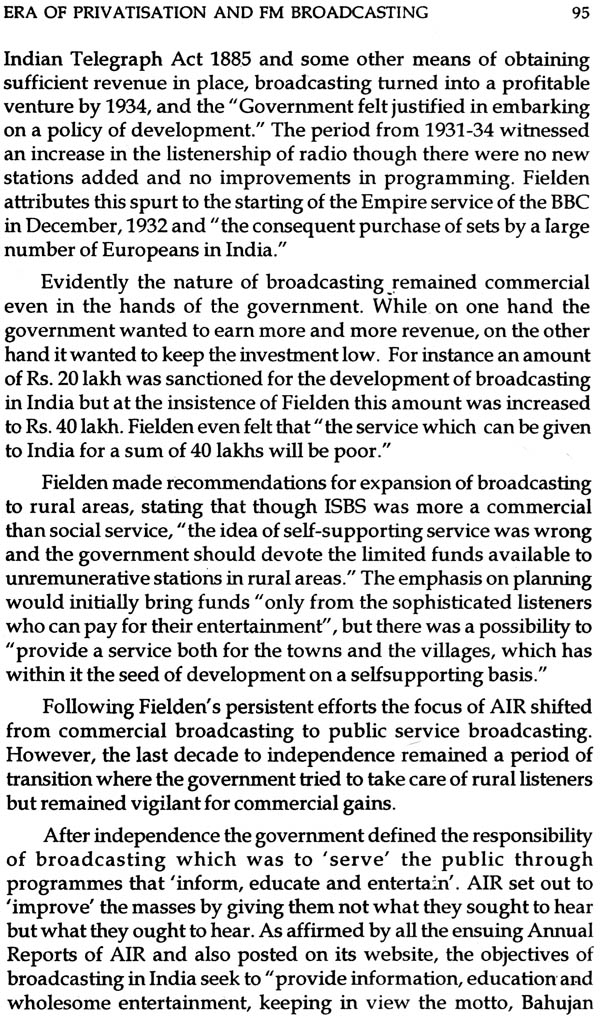
| 4 | Era of Privatisation and FM Broadcasting | 92 |
| Privatised Commercial Broadcasting | ||
| Attempts to Privatisation | ||
| Phase I of FM Broadcasting | ||
| Mitra Committee and Consultation for Policy Revision | ||
| Major Recommendations of TRAI for Phase II Policy | ||
| Policy on Expansion of FM Radio Broadcasting Services | ||
| 5 | Developments in Private FM Broadcasting | 139 |
| Fresh Efforts for Revamping of FM Broadcasting | ||
| TRAI Consultations on Regulatory Measures | ||
| Important Technical Issues for Consultation | ||
| Other Issues Under Consideration of TRAI | ||
| 6 | Third Phase of Private FM Radio | 168 |
| Principles Underlying FM Radio | ||
| Phase III Recommendation | ||
| TRAI Recommendations on Regulatory | ||
| TRAI Recommendations on Technical Issues | ||
| Other Issues Taken up by TRAI for Recommendation | ||
| Comments of TRAI on Views of Government | ||
| 7 | Satellite Radio and Regulatory Framework | 229 |
| Satellite Radio: A New Mode of Broadcasting | ||
| Regulation and Monitoring of Satellite Radio | ||
| Satellite Radio: Licensing and Other Related Issues | ||
| Technical Issues for Satellite Radio | ||
| Draft Satellite Radio Policy Guidelines | ||
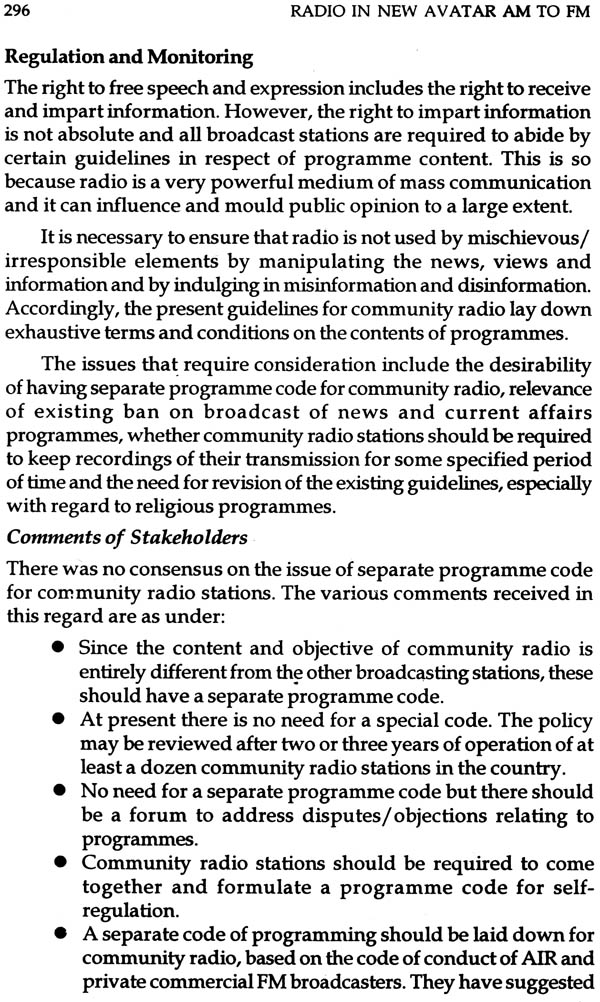
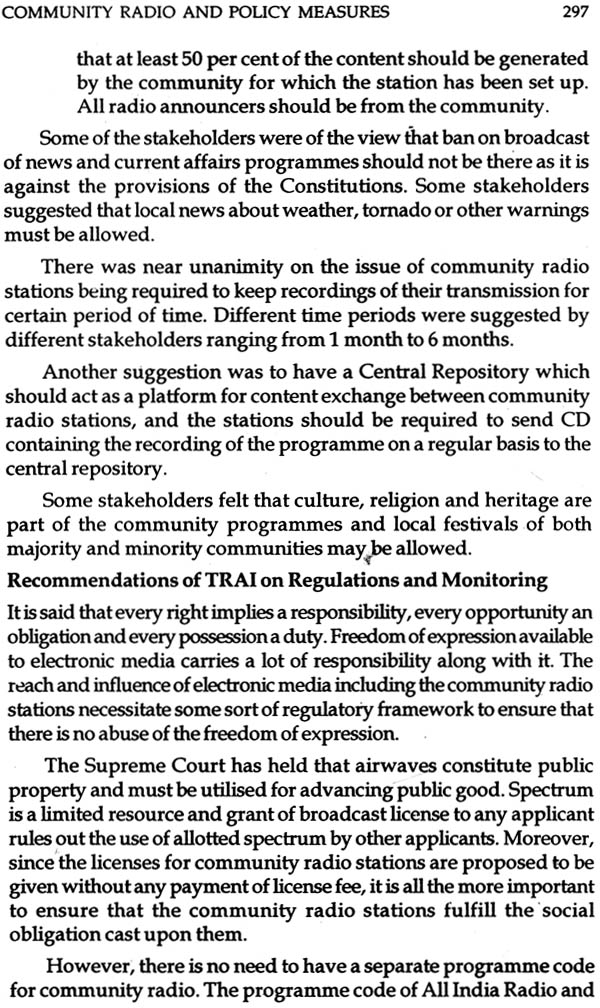
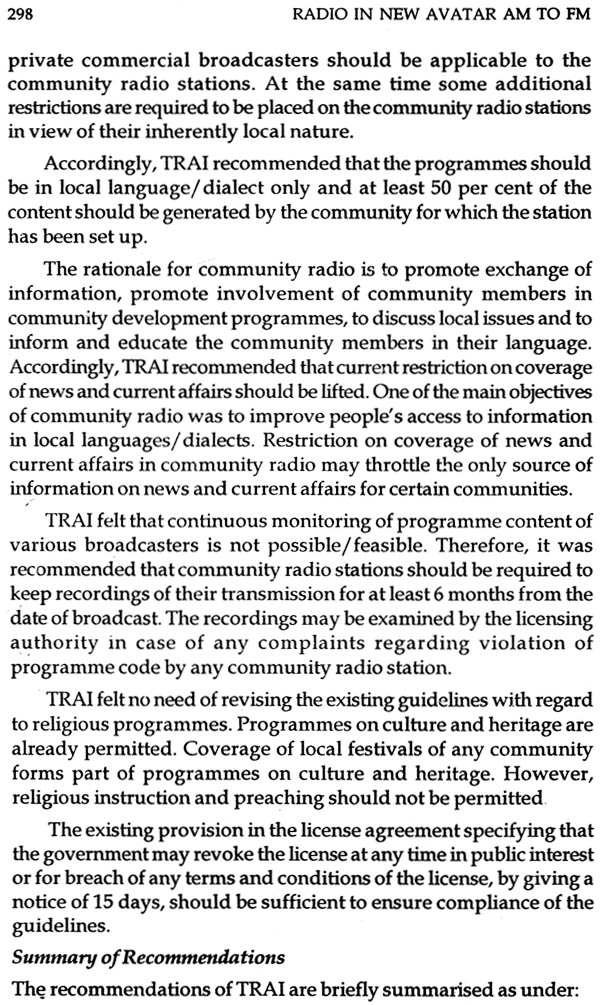
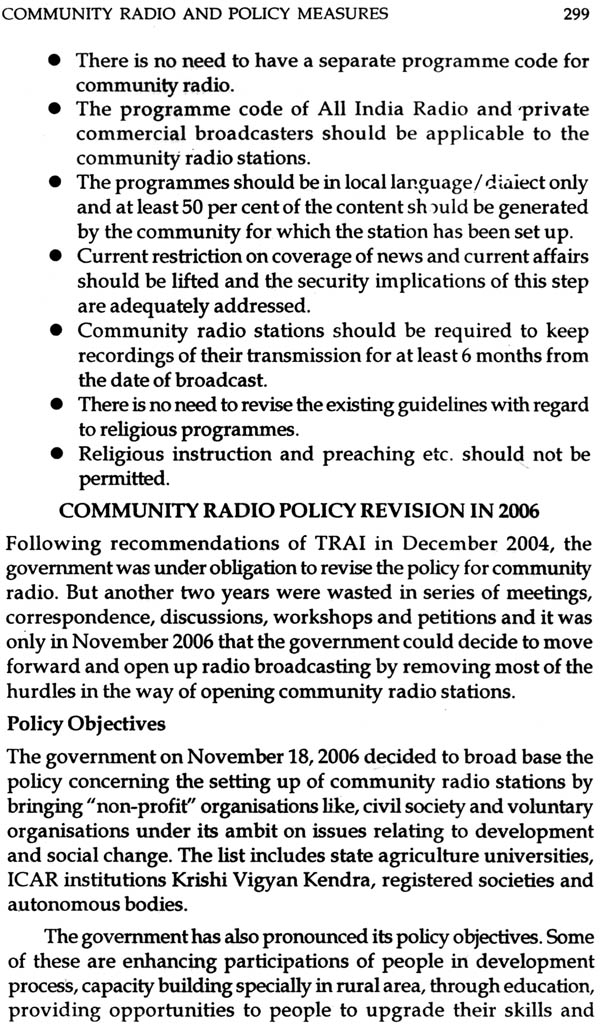
| 8 | Community Radio and Policy Measures | 271 |
| CRS: Departure from Centralised Broadcasting | ||
| Community Radio Policy as Announced in 2002 | ||
| Recommendations of TRAI on Licensing and Other Issues | ||
| Community Radio Policy Revision 2006 | ||
| 9 | Broadcasting Dogma as Propounded by Experts | 307 |
| Major Broadcast Areas for Coverage | ||
| Experts’ Opinions and their Analysis | ||
| 10 | Tuning Radio Broadcasting in India | 361 |
| Potential of Radio and Plan Perspectives | ||
| Radio Broadcasting Policy Paradoxes | ||
| Paradigm Shifts in Policy Formulations | ||
| Recommendations for Better Prospects | ||
| Annexures | ||
| I | A Review of Chanda Committee Report, 1966 | 386 |
| II | A Review of Verghese Group Report, 1978 | 391 |
| III | Introduction to Sengupta Group Report, 1996 | 396 |
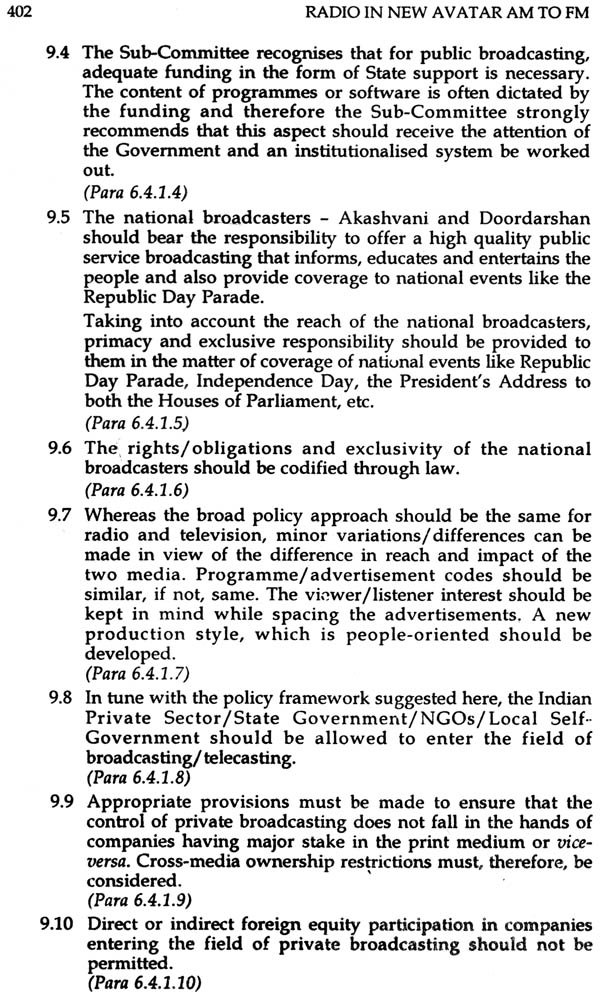
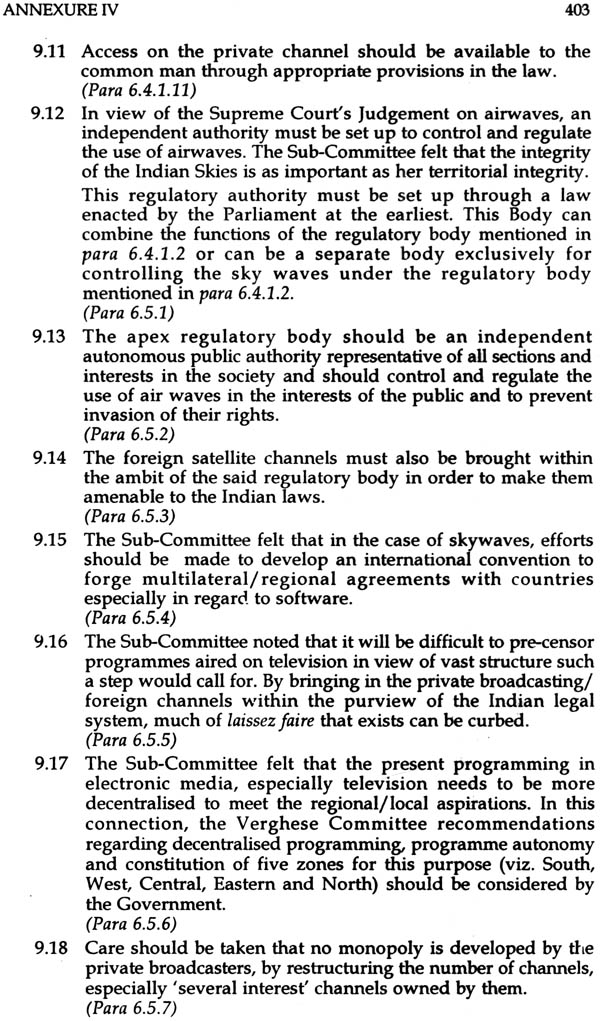
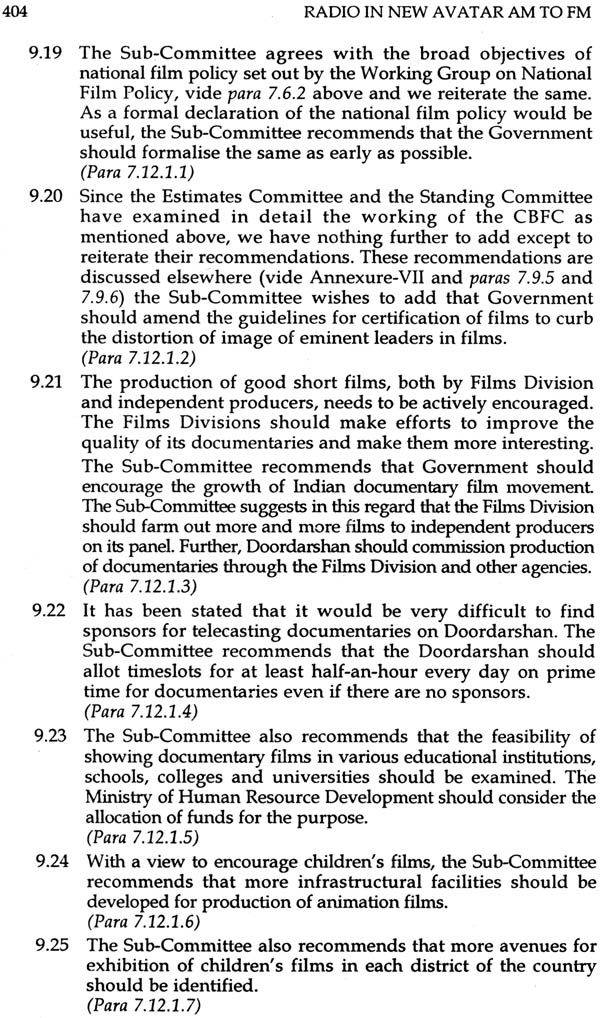
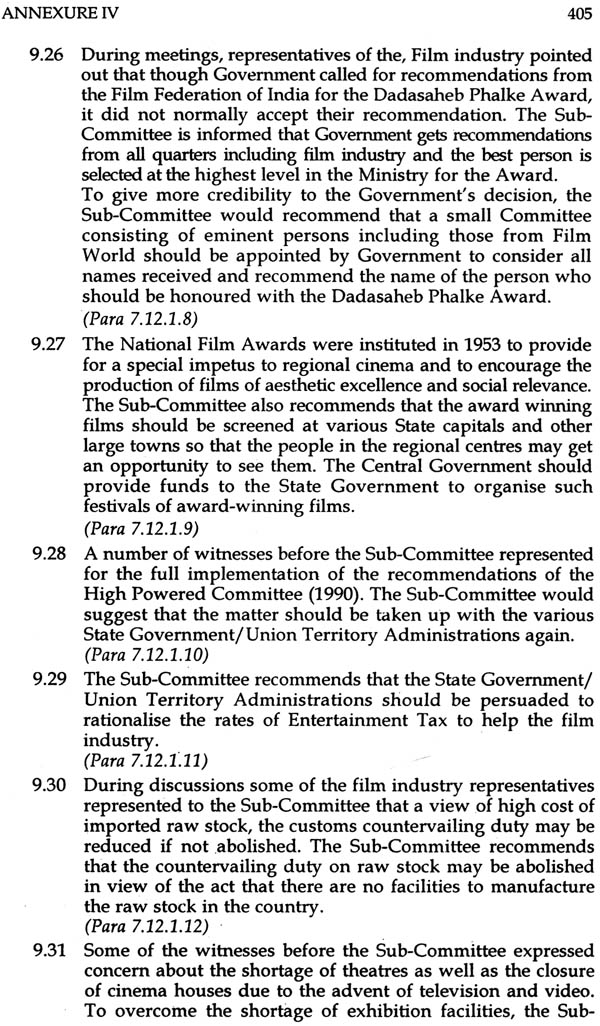
| IV | Summary of Paswan Committee Report, 1996 | 401 |
| V | The Prasar Bharati (Broadcasting Corporation of India) Act, 1990 | 409 |
| VI | The Broadcasting Bill, 1997 | 432 |
| VII | Communication Convergence Bill, 2001 | 445 |
| VIII | Broadcasting Services Regulation Bill, 2007 | 489 |
| IX | Policy on Expansion of FM Radio Broadcasting Services Through Private Agencies (Phase II), 2005 | 529 |
| X | TRAI Recommendations-FM Radio Phase III, 2008 | 546 |
| XI | Community Radio Policy, 2006 | 554 |
| XII | Draft Policy Guidelines for Satellite Radio,2008 | 559 |
| Bibliography | 580 | |
| Index | 583 |