

Resistance and the State: Nepalese Experiences
Book Specification
| Item Code: | NAG493 |
| Author: | David N. Gellner |
| Publisher: | Social Science Press |
| Language: | English |
| Edition: | 2008 |
| ISBN: | 9788187358411 |
| Pages: | 400 |
| Cover: | Paperback |
| Other Details | 8.5 inch X 5.5 inch |
| Weight | 370 gm |
Book Description
Preface
The papers in this collection were initially presented (with the exception of chapter 10) at a day-long panel during the Modern South Asian studies conference in Edinburgh in September 2000. Most of the papers have been revised since that presentation, some substantially so, but these revisions were mostly done in early 2001 and-with the exception of two short passages (pp. 128-30 and 332-4)-do not cover the period since the declaration of a State of Emergency in November 2001. No collection of this sort can hope to be wholly up to date. What we, the contributors to this volume, have aimed for is ethnographically informed and historically grounded analysis. We hope that it will stand the test of time; but whether it does or not, is for readers to judge. We do not, of course, imagine that this is any kind of last word on the subject: It is, we hope, a useful contribution to the understanding of state and society in Nepal in particular and to discussions of the state in South Asia in general.
I thank the European Bulletin of Himalayan Research for permission to reprint from issue 19 (autumn 2000) revised versions of the papers which appear here as chapters 7 and 10. Many thanks also to William Douglas for help with the map on p. 23.
As editor I have, among other things, tried to impose a compromise between English euphony and Nepali usage: 'Nepali' -both noun and adjective-refers either to people or to the language, whereas 'Nepalese' is used only as an adjective in other, more abstract contexts (such as the sub-title of this book).
Many dates are given, in the Nepalese style, in Vikram Samvat or era (VS), which began in 57 BCE. No glossary of Nepali words or expressions has been provided, but the index should direct the reader to the place( s) where specialized terms are defined and discussed.
Contents
| List of Tables | vii | |
| List of Plates and Maps | ix | |
| Preface | xi | |
| List of Contributors | xiii | |
| Introduction: Transformations of the Nepalese State | 1 | |
| Section 1: The State, Development, and Local Politics | 31 | |
| 1 | A Heterotopia of Resistance: Health, Community Forestry, | 33 |
| and Challenges to State Centralization in Nepal | ||
| 2 | Resisting the Environmentalist State | 83 |
| 3 | The Politics of Difference and the Reach of Modernity: | 113 |
| Reflections on the State and Civil Society in Central Nepal | ||
| 4 | Nepali Politics: People-Parties Interface | 133 |
| Section 2: The State and Ethnic Activism | 177 | |
| 5 | How Representative is the Nepali State? | 179 |
| 6 | An 'Indigenous Minority' in a Border Area: Tharu Ethnic | 199 |
| Associations, NGOs, and the Nepalese State | ||
| 7 | The History of the Messianic and Rebel King Lakhan | 244 |
| Thapa: Utopia and Ideology among the Magars | ||
| Section 3: The State and Maoist Insurgency | 279 | |
| 8 | Democracy and Dissent in Nepal: An Overview With | 281 |
| Some Perceptions from the Valley of Dhorpatan | ||
| 9 | Guns, Kinship, and Fear: Maoists among the Tamu-mai (Gurungs) | 305 |
| 10 | The Kham Magar Country: Between Ethnic Claims and Maoism | 326 |
| Person Index | 359 | |
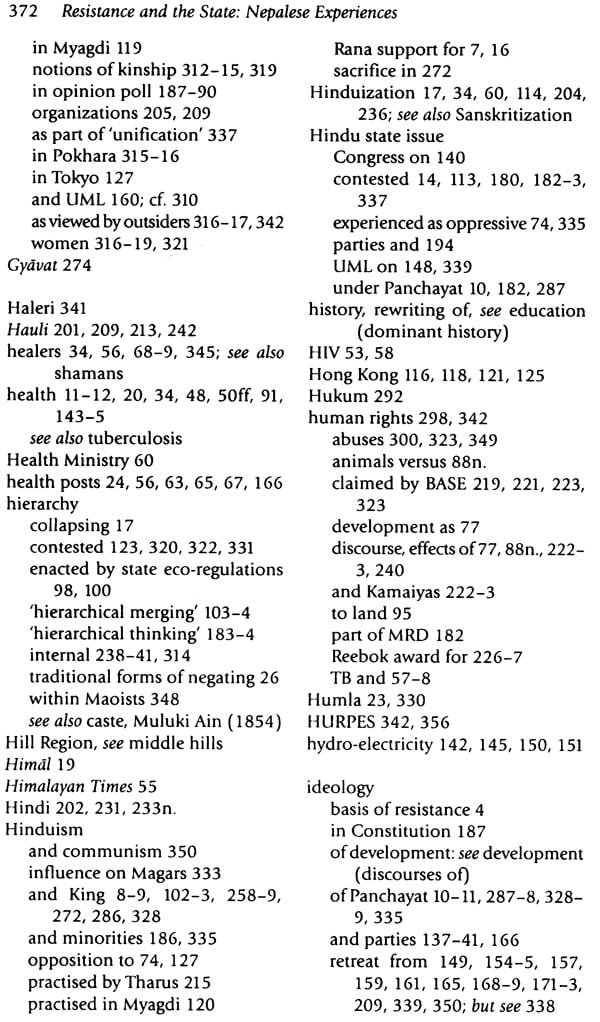
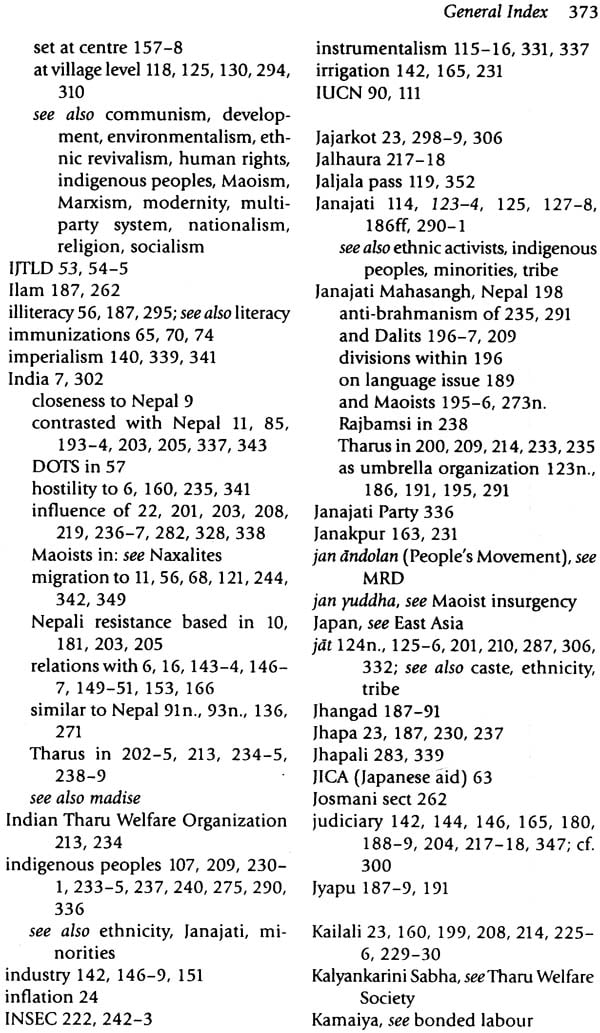
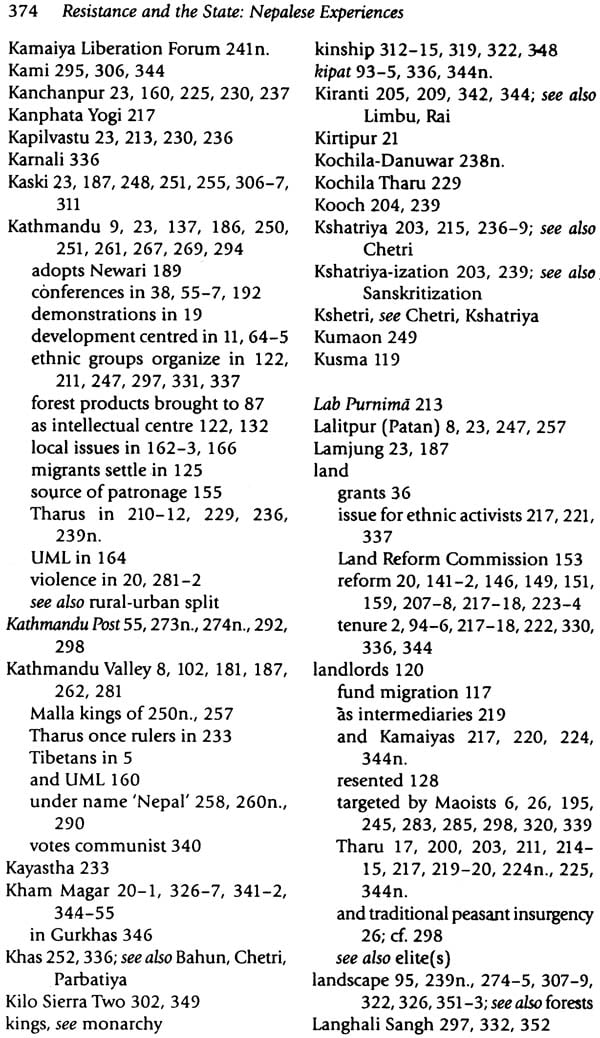
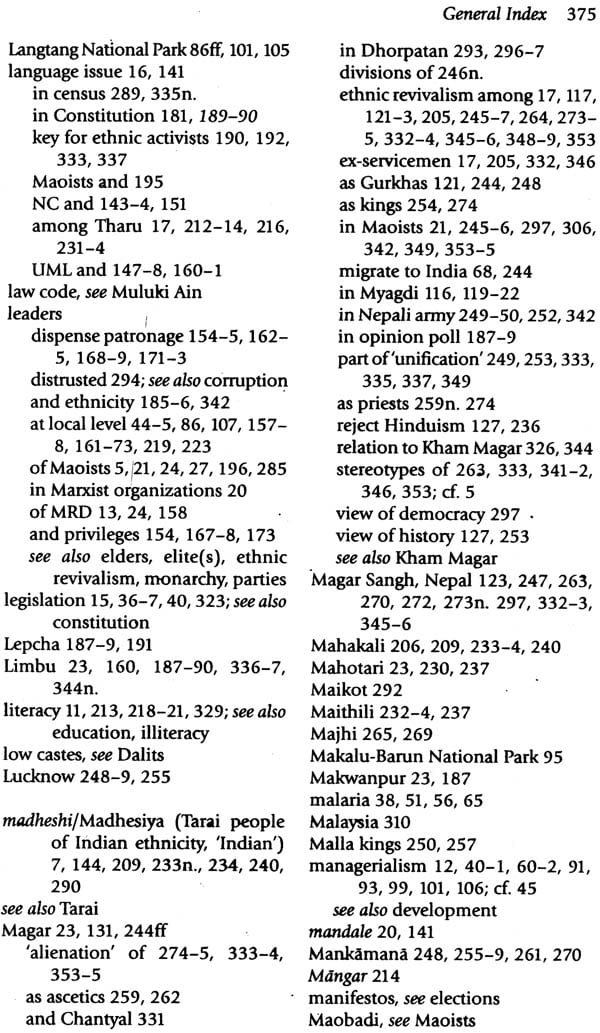
| General Index | 365 |