

Buddha's Original Logical- The Sautrantika Analytical Philosophy
Book Specification
| Item Code: | AZF293 |
| Author: | Amar Singh |
| Publisher: | Eastern Book Linkers |
| Language: | ENGLISH |
| Edition: | 2007 |
| ISBN: | 9788178541235 |
| Pages: | 327 (Throughout Black and White Illustrations) |
| Cover: | HARDCOVER |
| Other Details | 10.00X6.50 inches |
| Weight | 684 gm |
Book Description
"Nothing happens by a single cause but through collective causes everything is possible." This maxim (kāraṇāsāmagrīvada) of the Sautrān tika Philosophy is true in the production of this book. There have been many causes and conditions which should be pinpointed, in analyzing the writing of his book.
I had my first encounter with the Buddha's dialogues through B.R. Ambedkar's book, The Buddha and his Dhamma (which I finished in one day). The impact of the lucid, precise, meaningful logical, and psycho logical definitions of the Buddha was so great that my mind trained in the antagonistic Brāhmaṇic Philosophy and logic surrendered to Buddha's wisdom. I express my deepest gratitude to Ambedkar for inspiring Sutra studies in India, and have analyzed his views that 'everything is not Dukkha by nature' (anti pessimism 14.18) in the Sautrantika Analytical ethics. The disappearance of the Sautrāntika works and tactful inclusion of almost all Sautrāntika Acāryas into Vijñānavāda (idealism) make me suspect foul play against these critical philosophers.
Dr. Amar Singh is usually widely read in Indian philosophy, particularly, Buddhist philosophy. He is well known for his critical research. He is the position holder in M.A. (Philosophy) from Agra University (1960). First Ph.D. (1966) from Vidyalaṁkāra University of Sri Lankā and second Ph.D. (1980) from Toronto University, Canada. He worked under Prof. Rāhula Sankṛtāyana and A.K. Warder respectively. He also holds two oriental degrees, Sahitya Ratna and S. Sastri (first position). He was awarded A+ in Sansrkit Linguistics, Abhidharma and Pramana and received many financial awards from Toronto University.
He has held many important assign ments as Asstt. Professor, Vidyalaṁkāra University, Sri Lanka, Co-Director, Institute of Indology, New Delhi, Graduate Assistant, Toronto University, Canada.
He has contributed many research articles in different research journals.
"Nothing happens by a single cause but through collective causes everything is possible." This maxim (kāraṇāsāmagrīvāda) of the Sauträntika Philosophy is true in the production of this book. There have been many causes and conditions which should be pinpointed, in analyzing the writing of this book.
I had my first encounter with the Buddha's dialogues through B. R. Ambedakar's book, The Buddha and his Dhamma (which I finished in one day). The impact of the lucid, precise, meaningful logical, and psychological definitions of the Buddha was so great that my mind trained in the antagonistic Brahmanic Philosophy and logic surrendered to Buddha's wisdom. I express my deepest gratitude to Ambedakar for inspiring Sutra studies in India, and have analyzed his views that 'everything is not Dukkha by nature' (anti-pessimism 14.18) in the Sauträntika Analytical ethics.
"Dharmakirti, who is regarded as a Kant of India by Stcherbatsky, could not receive any recognition of his works from contemporary scholars. In the very beginning of pramäṇavärttika Dharmakirti expresses grief for the feeble mindedness (mandadhih) of scholars filled with the filth of jealousy (rasamala). He died as a desparate philosopher thinking that his works will be annihilated with his own body (svadehe jaram). The disappearance of the Sautrantika works and tactful inclusion of almost all Sautrantika Acaryas into Vijnanavāda (idealism) make me suspect foul play against these critical philosophers. The author expresses his deepest sympathy for these suppressed, neglected and forgotten ones, hoping that someone will further explore this lost treasure of the critical philosophy of India."
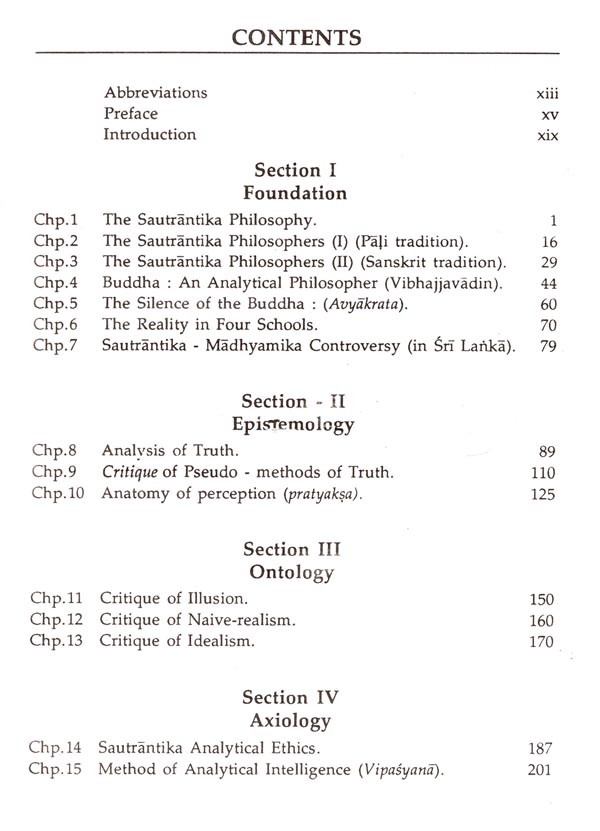
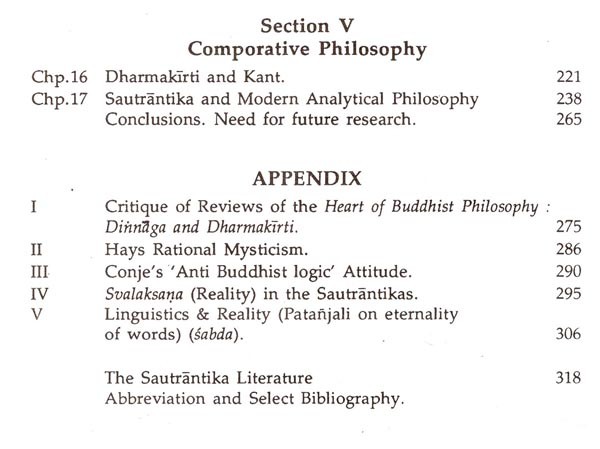
These are the feelings expressed by the present author regarding the Sautrantikas in the preface of his work: The Heart of Buddhist philosophy: Dinnaga and Dharmakirti. As no one came forward to explore this almost lost trend of Analytical Philosophy, I thought of myself to further explore in detail the philosophical aspect of the Sautrāntikas with two fold purposes in mind. Firstly, to provide a text book for M.A. students of Indian Buddhist Philosophy, and secondly to present enough material for future research and exploration. On the basis of a comprehensive and critical study of the important works of the Sautrantika philosophers, the conceptual frame work of their Philosophy is articulated in such a way that major contours of their philosophy will come to be cartographed and the logical geography of the major concepts employed by them will come to be mapped.
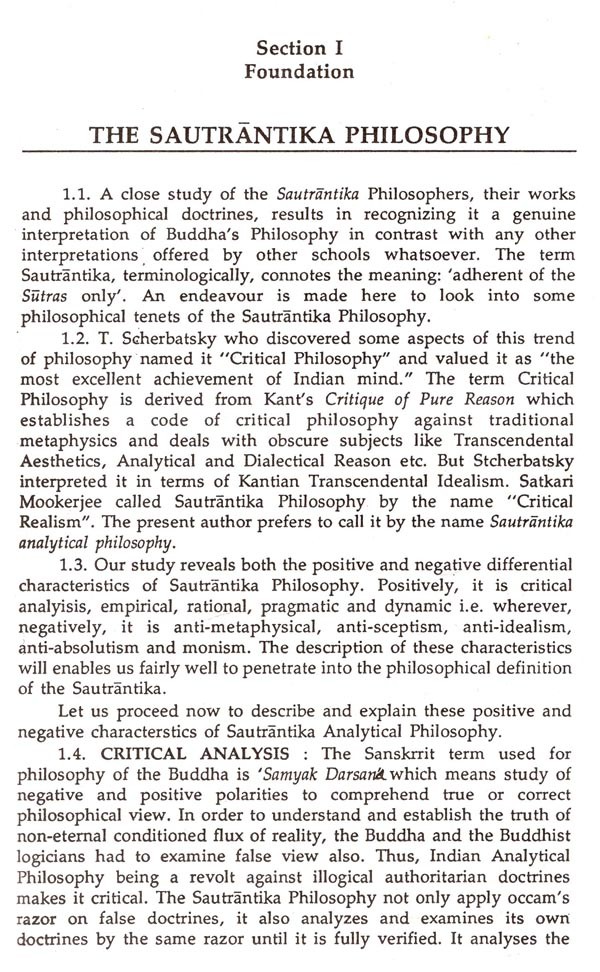
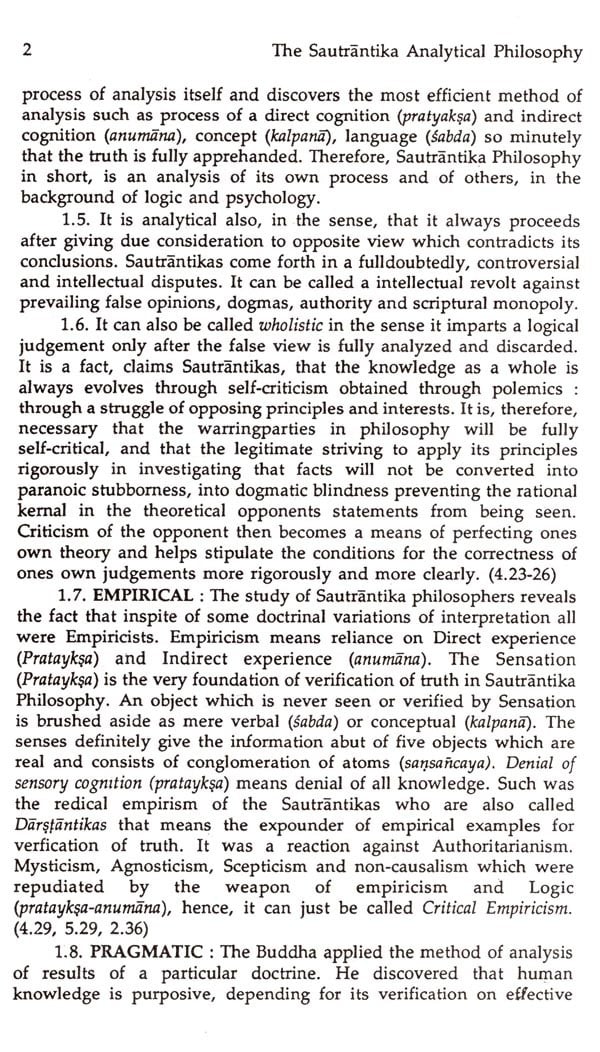
**Contents and Sample Pages**