

Indian Architecture: Problems in the Interpretation of 18th and 19th Century Architecture- A Study of Dilkusha Palace, Lucknow
Book Specification
| Item Code: | AZG457 |
| Author: | Neeta Das |
| Publisher: | B.R. PUBLISHING CORPORATION |
| Language: | ENGLISH |
| Edition: | 1998 |
| ISBN: | 9788170189961 |
| Pages: | 66 (B/W Illustrations) |
| Cover: | HARDCOVER |
| Other Details | 10.00x7.50 |
| Weight | 440 gm |
Book Description
It is the result of eight years of painstaking work by the Author. It is very pertinent and timely for scholars, students and general readers with an interest in the architectural and social history of Lucknow and India.
Trained as an architect, I shifted to Lucknow. My love for the place and a curiosity to test my knowledge of architecture prompted me to the streets and monuments of Old Lucknow, most of which were built in the 18th and 19th centuries. I spent three years internalizing all I could about Lucknow, its people and its architecture. The narrow confining streets, giving no clue of the life world in the courtyards beyond; the towering mosques and the mourning Imambaras; the labyrinthine palaces and the grand kothis; the complexity inherent in their spatial sequences, planning, and use of both traditional and foreign (mainly European) architectural elements; or just the coexistence of the everyday and the monumental structures. Though fascinating. none of the structures merited a place within the formal historical grid of Fletcher or Brown. They were, in fact, in two pages of Brown's book, summed up as being 'debased' and the 'style (that) had no spiritual value." The reason for their neglect slowly became clear to me. Piece by piece I went through the scholarship on Lucknow, and not only did it not satisfy my need to know and understand the architecture of Lucknow but all it provided was a torrent of criticism.
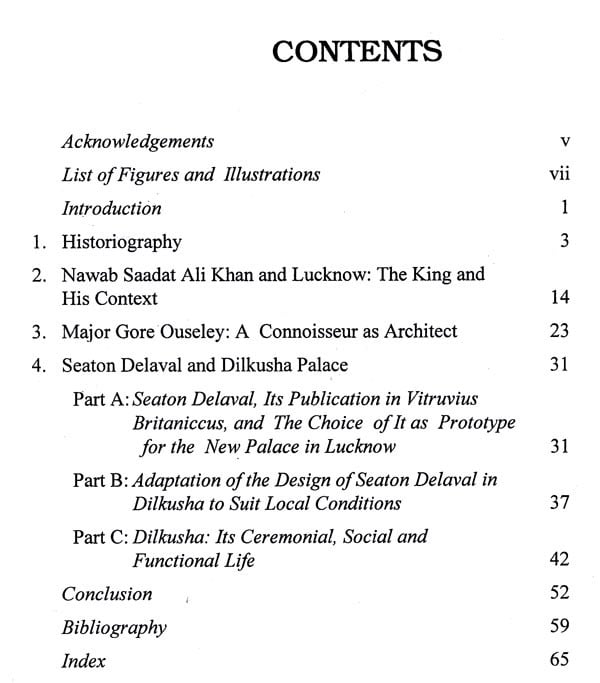
Book's Contents and Sample Pages **Contents and Sample Pages**