

Organizing Empire (Individualism, Collective Agency and India)
Book Specification
| Item Code: | NAG199 |
| Author: | Purnima Bose |
| Publisher: | Zubaan Publications |
| Language: | English |
| Edition: | 2003 |
| ISBN: | 9788189884017 |
| Pages: | 290 |
| Cover: | Hardcover |
| Other Details | 9.5 inch X 6.5 inch |
| Weight | 600 gm |
Book Description
Organizing Empire critically examines how concepts of individualism functioned to support and resist British imperialism in India. Through readings of British colonial and Indian nationalist narratives that emerged in parliamentary debates. Popular colonial historics, newsletters, memoirs, biographies, and novels, Purnima Bose investigates the ramifications of reducing collective activism to individual intentions. Paying particular attention to the construction of gender, she shows that ideas of individualism rhctorically and theoretically bind colonials, feminists, nationalists, and neocolonials to one another. She demonstrates how reliance on ideas of the individual-as scapegoat or hero-enabled colonial and neocolonial powers to deny the violence that they perpetrated. At the same time, she shows how analyses of the role of the individual provide a window into the dynamics and limitations of state formations and feminist and nationalist resistance movements.
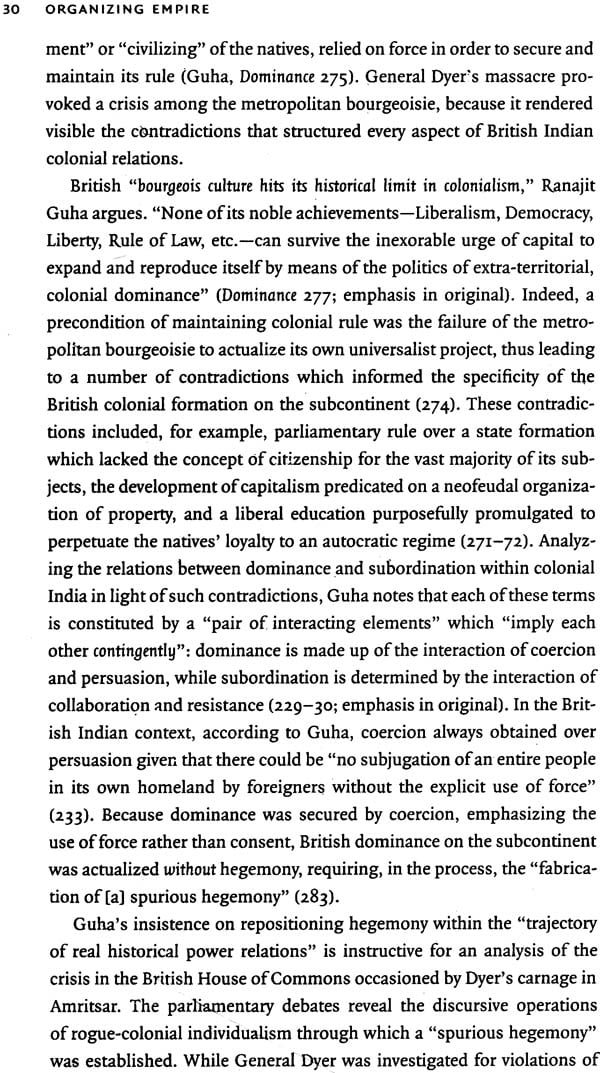
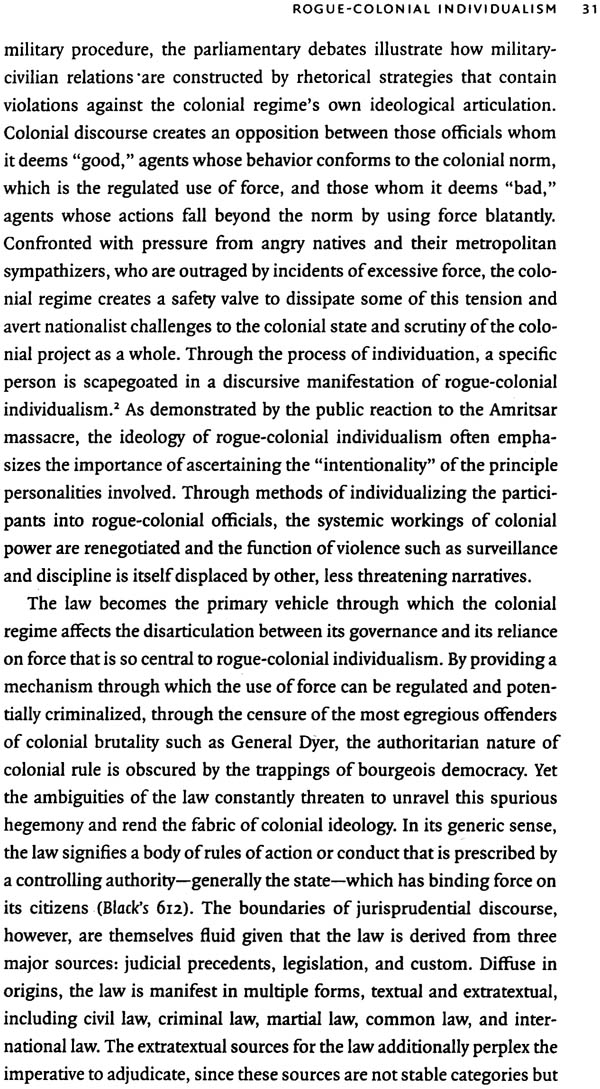
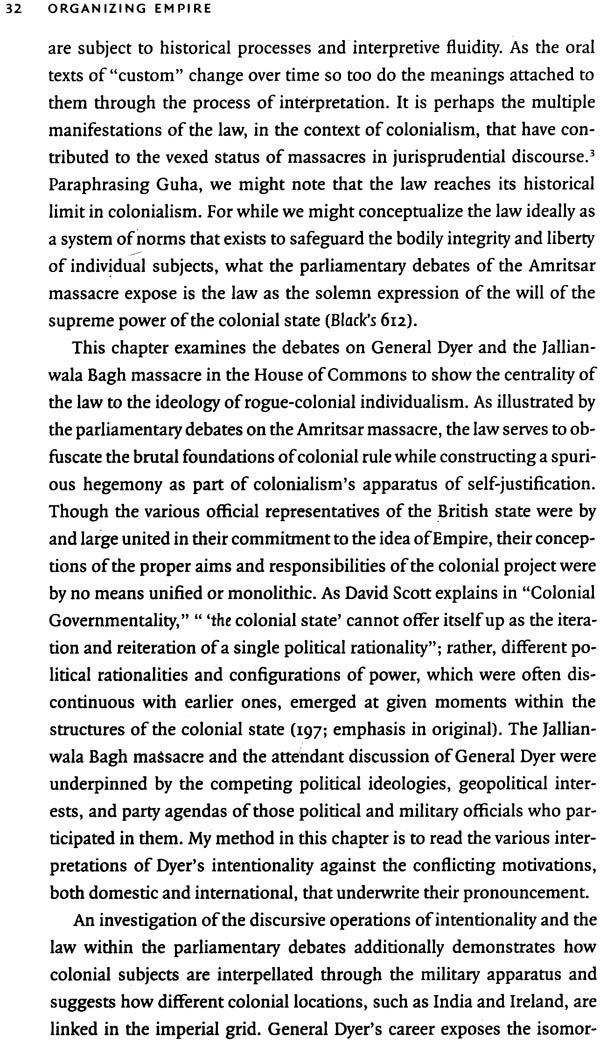
From a historically grounded, feminist perspective, Bose offers four case studies, each of which illuminates a distinct individualizing rhetorical strategy. She looks at the parliamentary debates on the Amritsar Massacre of 1919. In which several hundred unarmed Indian protesters were killed:
Organizing Empire: Individualism, Collective Agency, and India seeks to demonstrate the complexity and (in) commensurability of the multiple narratives which constitute our access to British colonial history. It insists that dominant and widely circulated Raj histories and memoirs can be read against the more obscured practices and narratives of nationalist and popular anticolonial activists and organizations. Such an investigation raises questions regarding the nature of dominance, hegemony, and resistance, particularly concerning the subjects who make history-in every sense of the phrase-and the ways in which the agents of struggle can or cannot be recognized within elite-imperial narratives. I explore these questions historically through archival materials including parliamentary debates, popular colonial histories, newsletters of organizations, biographies, and novels. The chapters of this book share a thematic and theoretical treatment of individualism and collective agency. I argue that the figure of the individual provides both the means by which repressive colonial and neocolonial power works to displace its own recognition of its constitutive violence and also ways to theorize feminist and nationalist resistance.
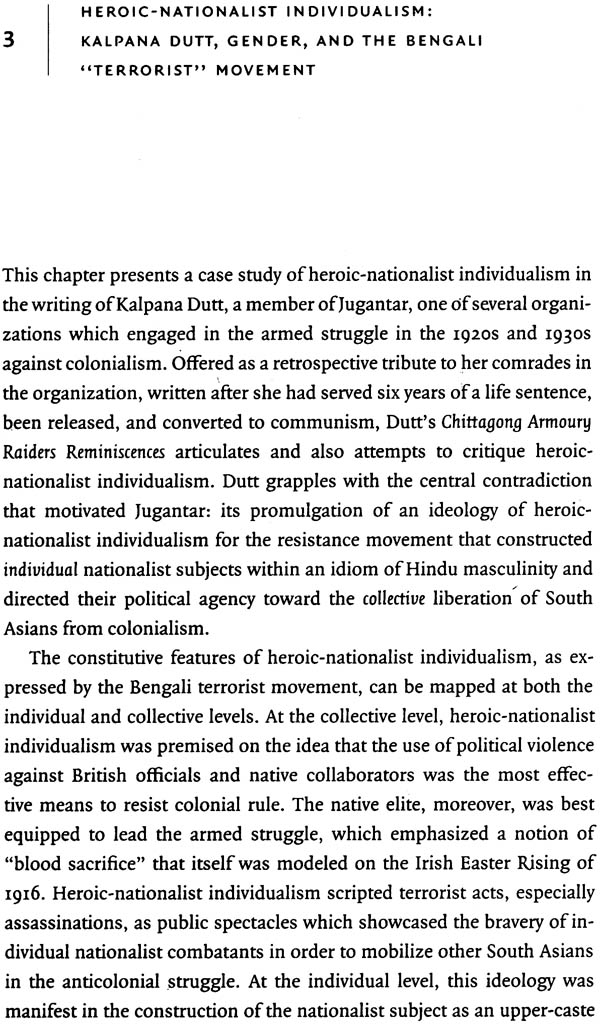
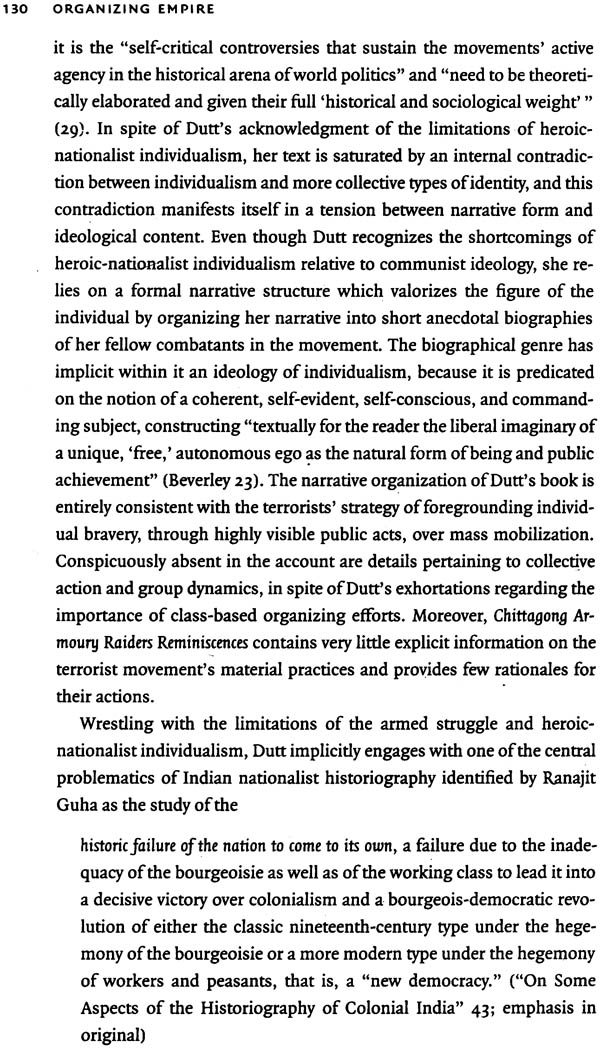
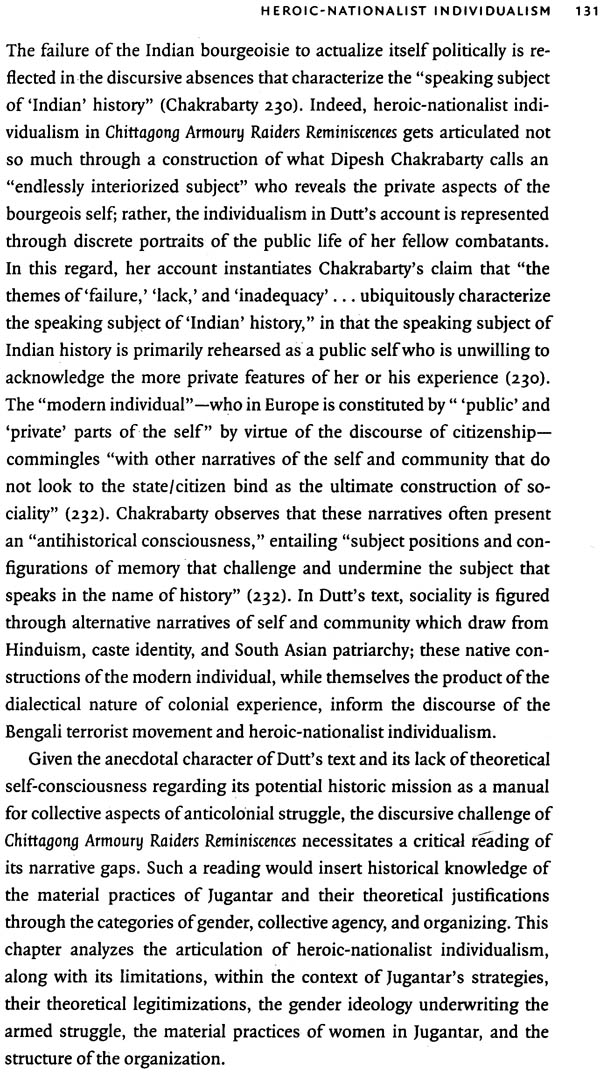
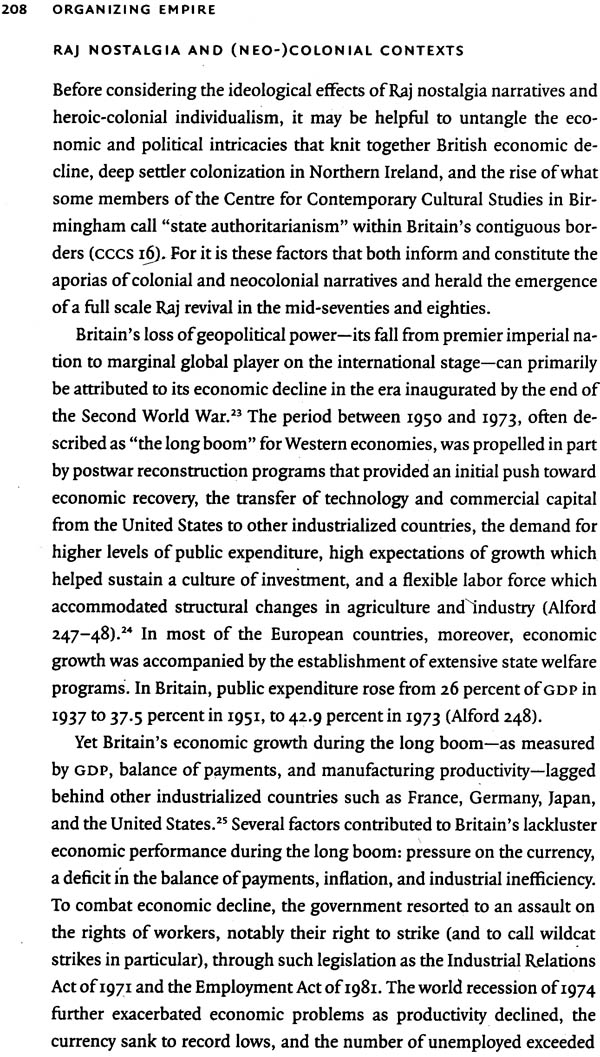
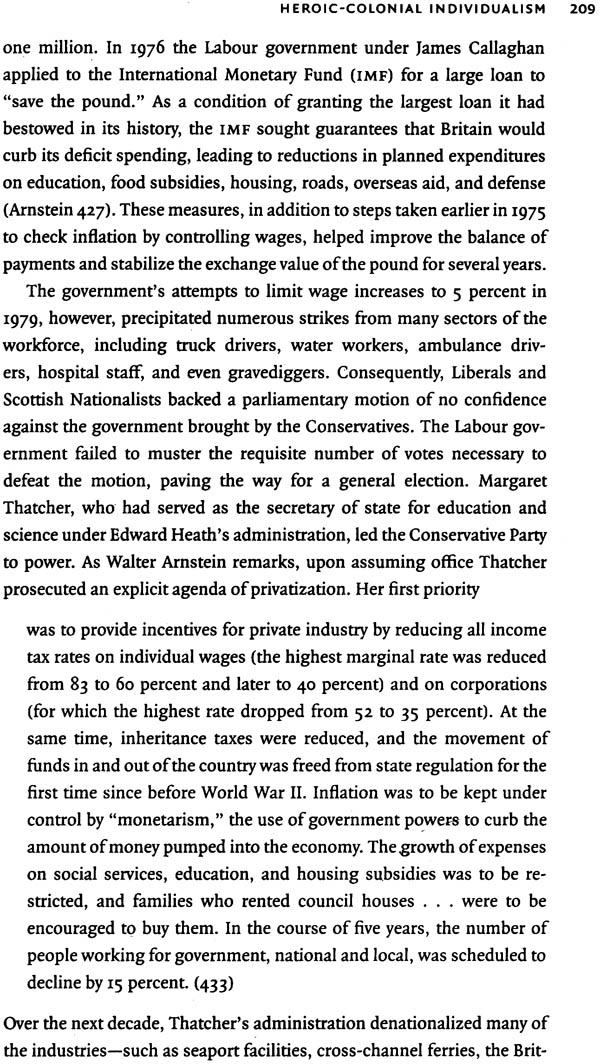
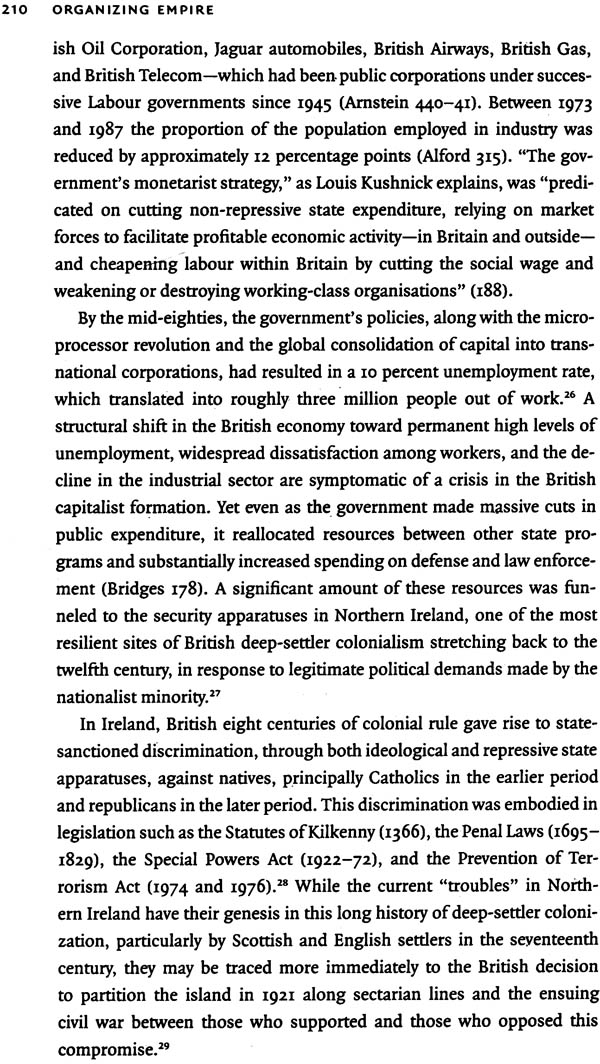
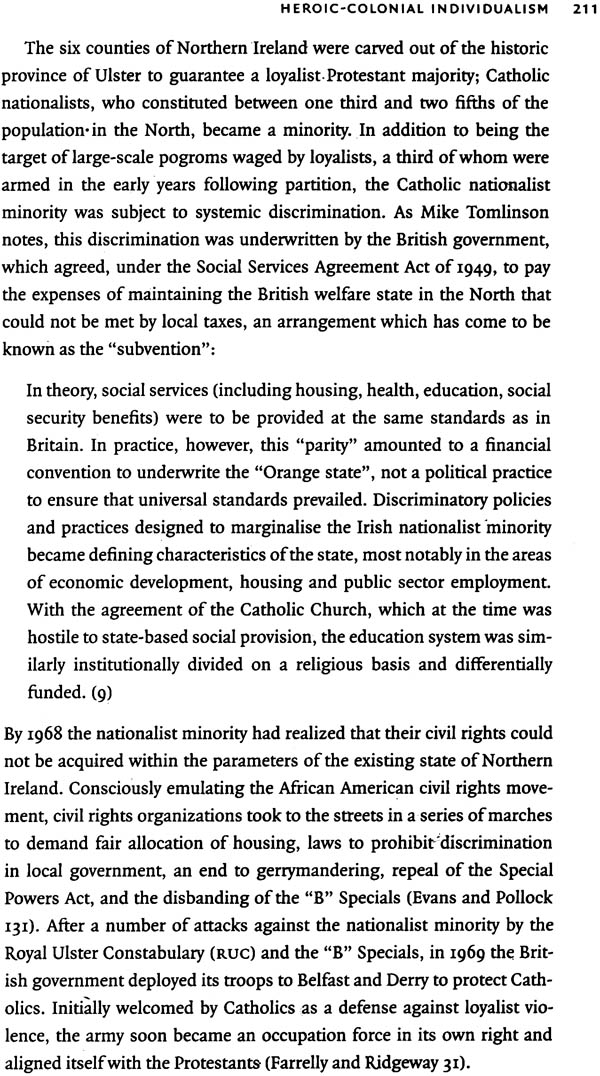
Each chapter offers a case study of individualism by focusing on a representative individual, or group of individuals, and analyzing her, his, or their self-fashionings in relation to the colonial state and organized, collective resistance to British rule. Chapter I investigates “rogue-colonial individualism” by examining how the repressive authority of the state is projected onto its most visible agent, in this case the putative author of the infamous Amritsar massacre, General Dyer, who is then repudiated as the pathological instigator of an aberrant “incident”. Chapter 2 treats “feminist-nationalist individualism,” as well as the tension between individuated leadership and the will to a horizontal representation of women’s collective social agency. In tracing the split self-fashioning of the Irish suffragette Margaret Cousins in Ireland and India, this chapter suggests how the authority of a nationalist movement’s individual representatives might be displaced in the process of feminism’s international circulation. Chapter 3 examines the discursive operations of “heroic-nationalist individualism” in the memoir of a Bengali insurgent, Kalpana Dutt, focusing specifically on the generative contradictions between the form of the memoir, so central to nationalist hagiography, and the project of cathecting an emancipated social collective through this very narrative medium. And finally chapter 4, on “heroic-colonial individualism,” addresses the phenomenon of “raj nostalgia” in the 1970s and 1980s, to explore how the retrospective construction of colonial administrators as the empire’s heroic servants ambivalently registers the emergence of displaced ex-colonial servants ambivalently registers the emergence of displaced ex-colonial populations as a dissident political force in the metropolis.
The four case studies, then, represent a range of subject-positions within the context of British imperialism in twentieth-century India. The range is by no means exhaustive, but the differences among the subject positions illuminate the constraints that the colonial situation of domination and subordination placed upon conceptions of individual agency and activism. Two of the case studies (chapters 1 and 4) deal with individuals and organizations that supported the British Raj. The other two (chapters 2 and 3) treat individuals and organizations that resisted and sought to overthrow the colonial regime. Chapters 1 and 2 also offer a comparative analysis of agency in relation to imperial domination in two colonial contexts, India and Ireland. And chapters 2 and 3 concern feminist as well as anti-imperialist forms of activism and agency.
Before engaging questions about subaltern identity and collective agency, however, it is necessary to trace the emergence of the ideology of individualism in seventeenth-century political theory in relation to its transmutations under colonial and nationalist ideology. The persistence of individualism in both ideologies has serious implications for how we theorize dominance, hegemony, and resistance in the colonial context.
Individualism And Colonialism
Organizing Empire maps the shifting uses of the term “individualism”, once used to denote part of a larger social collective but now denoting something distinct from it. Tracing the shift makes it possible to illuminate the suppressed collective aspect of the ideology of individualism within a colonial context. Broadly conceived, individualism is a set of ideas that emphasizes the importance of the individual, the individual’s interest, and a conception of the subject as a free and autonomous agent who exercises choice in the absence of a controlling state authority (Marshall 304). The word “individualism” is derived from “individual”, which in turn has its origins in the sixth-century Latin individuals, a negative adjectival form of divider, “to divide” (Williams, Keywords I6I). The meaning of “individual”, as Raymond Williams explains, encapsulates a paradox that posits the individual both as being distinct from others and as embodying a “necessary connection” to others through membership in a group (I6I). This contradiction is a result of the long evolution of the term in a range of discourses, inflecting the word with theological, scientific, political, and economic valences (I6I). The modern sense of the term “individual” and its early-nineteenth-century derivative, “individualism”, is marked by its prior applications: to the essential unity of the Trinity in medieval theology, to the physical and biological coherence of insentient and sentient entities in the seventeenth and eighteenth centuries, to the relation between the self, natural law, and the sociopolitical order during the Enlightenment.
In The Political Theory of Possessive Individualism, Crawford Brough Mac-Pherson argues that in the writings of John Locke in particular, political philosophy in the late seventeenth century signaled a movement away from previous understandings of the individual, who was no longer regarded as a “moral whole” nor as part of a larger social collectivity, but rather as a proprietor of “his” self, in which the concept of private property became even constitutive of subjectivity. (Since women were barred from property ownership, the gendering of pronouns is appropriate here.) MacPherson maintains that “the difficulties of modern liberal-democratic theory” inhere in the “possessive quality” of seventeenth-century individualism, which conceived of the individual as “essentially the proprietor of his own person or capacities, owing nothing to society for them” (3). “The relation of ownership”, he explains, “having become for more and more men the critically important relation determining their actual freedom and actual prospect of realizing their full potentialities, was read back into the nature of the individual” (3). To the extent that the individual “[wa]s proprietor of his person and capacities,” he was considered free. Freedom thus became “a function of possession” as well as “freedom from dependence on the wills of others” (3). As the basic unit of the social formation, the individual interacted with other “free equal individuals” who were “proprietors of their own capacities and of what they ha[d] acquired by their exercise” (3). Society was based on “relations of exchange between proprietors”, with the political apparatus conceived of as “a contractual device for the protection of proprietors and the orderly regulation of their relations” (269).
The notion of proprietorship underwriting possessive individualism-in its seventeenth-century and later articulations as described by MacPherson-becomes radically exaggerated in the context of early-twentieth-century British colonialism, giving rise to rogue-colonial individualism and heroic-colonial individualism. If, as Frantz Fanon persuasively argues, the colonial world is a Manichean one, in which the settler and the native constitute and are constituted by their differences from one another, it is also true that the discursive category of the “colonizer” is itself governed by the logic of an internal binary opposition which divides colonial officials into rogues on the one hand and heroes on the other-even while the colonizer in actuality consists of multiple, generally self-contained, competitive social-class factions, namely the governmental apparatus, the economic sector, missionaries, and the military. While colonial discourse generally casts its official agents in the heroic mold, it rhetorically displaces colonial violence by singling out those officials who exceed the limits placed on the use of force as determined by the colonial state. Such officials are seen as rogues by some, heroes by others. Both articulations of colonial individualism, however, are underwritten by a distinctly colonial notion of proprietorship in which the metropolitan-colonial subject exercises proprietorship over the person of the native and the territory and resources of the colony. Proprietorship thus acquires an element of political domination as well as of territoriality. In other words, the possessive quality of colonial individualism derives from the center’s territorial possession of the periphery and a concomitant ideological justification which postulates that metropolitan-colonial society possesses a higher moral authority than its native counterpart, legitimizing its domination of natives in those same territories.
Within the logic of colonial individualism, society is not conceived of as a system of exchange between free, equal individuals whose existence is autonomous from the colonial state. Rather, colonial individualism, like the caste system whose prejudices it also absorbed, is founded on a notion of radical inequality; in the eyes of the colonial state, the metropolitan-colonial classes occupy a higher status than the native classes on the basis of an incontrovertible material advantage, which derives from a preferential legal system founded on racialist assumptions (Balandier 45). Unlike the possessive individualism elaborated by MacPherson, which seems to disengage and isolate the individual from a larger social formation (through it too is based in extreme material inequality and hierarchy), colonial and nationalist forms of individualism openly articulate the self in relation to the colonial state, positing the self either as the agent of the colonial state or as its dissident.
Individualism And Nationalism
Frantz Fanon, in his teleology of nationalist consciousness The Wretched of the Earth, charts the development of the native intellectual from her or his interpellation through the colonial ideological and repressive state apparatuses to her or his affiliation with the struggle for national liberation. Contending that such a process entails the “eradication of the super-structure” provided by the colonial bourgeoisie, which values “the triumph of the individual”, “clarity”, and “beauty”, he notes that “individualism is the first to disappear. The native intellectual had learnt from his masters that the individual ought to express himself fully. The colonialist bourgeoisie had hammered into the native’s mind the idea of a society of individuals where each person shuts himself up in his own subjectivity, and whose only wealth is individual thought” (46). As the native intellectual becomes immersed within the various formal structures of the national liberation struggle-interacting with other natives within other natives within specific organizational contexts-she or he learns a new vocabulary, replacing the old one of bourgeois individualism with one which includes words such as “brother, sister, friend” that values horizontal, more egalitarian, social relations over vertical, hierarchical ones (47). Fanon predicts that “such a colonized intellectual, dusted over by colonial culture will…discover the substance of village assemblies, the cohesion of people’s committees, and the extraordinary fruitfulness of local meetings and groupments” (47). Sustained contact and work within an organized national liberation movement empower the native intellectual to reconceptualize the basic unit of society in collective terms.
Fanon’s narrative of the formation of political consciousness in relation to the native intellectual’s subjectivity predicates a rupture between a colonial ideology grounded in individualism and a nationalist ideology rooted in collectivity. According to him, it is the experience of organizing within indigenous structure such as those based in local territoriality and kinship (“village assemblies” and “local meetings”) along with emergent class-base groups (“people’s committees”) that signal the transition into nationalist consciousness for the native intellectual. His analysis of decolonization is remarkably prescient-particularly his warning that a neocolonial global configuration can render “independence” a nominal affair, leading to insignificant improvements in the quality of lives of majority populations in former colonies. Yet Fanon’s account of the process of political conscientization, whereby the native intellectual passes through colonial individualism and matures into a nationalism informed by a commitment to collectives, constructs a too-rigid opposition between the two ideologies. Rather, I argue that the ideology of individualism haunts the very structures of nationalist and activist accounts of political agency and collective struggle.
Indeed, individualism and nationalism converge in that both ideologies draw on what Richard Handler terms “an epistemology of entivity,” the presupposition that nations, like individuals, have an attributable, objective existence. Nations are analogous to individuals to the extent that both entities “possess” and are “bound” by unique attributes or characteristics (R. Foster 253). This shared epistemology suggests that the nation is apprehended by its members as being both “a collective individual” and “a collection of individuals” (Handler 39). Insofar as its members perceive the nation through bounded biological metaphors that imbue it with consciousness-constructing the nation as an “existent entity” which is a “living individual”-the nation is granted agency. Handler notes: “The nation can be shown to build, struggle, and create; it can be said to have a soul, spirit, and personality; it can be treated as a friend or parent. Most important, the metaphorical individual can be discussed in terms of its freedom to choose and its ability to control its own destiny” (41). Understood as a collective individual, the nation can exercise an autonomous will and choice which can prove critical for the project of self-determination (41). Understood as a collective individual, the nation can exercise an autonomous will and choice which can prove critical for the project of self-determination (41). Alternatively, figured as a collection of individuals, the nation becomes, in Aristotelian fashion, more than the sum of its individual members who, in turn, represent a specific type or character (43). In this other formulation of the nation as species being, Handler explains, the nation becomes “bounded physically by the attributes that distinguish it from all others, and temporally by its endowment with an evolutionary ‘beginning” (44). Nationalist ideology combines both senses of the nation, as a collective individual and as a collection of individuals, by positing the nation as “an individuated being” that is a unique constituent beings, who, in turn, are constituted internally as a collection of individuals related to each other by their likeness (R. Foster 253). In other words, each individual (such as an Indian) becomes a synecdoche of the collective individual (such as India), which is differentiated from other collective individuals (such as Britain) (253).
| Acknowledgments | ix | |
| Introduction | 1 | |
| 1 | Rogue-Colonial Individualism: General Dyer, Colonial Masculinity, Intentionality, and the Amritsar Massacre | 29 |
| 2 | Feminist-Nationalist Individualism: Margaret Cousins, Activism, and Witnessing | 74 |
| 3 | Heroic-Nationalist Individualism: Kalpana Dutt, Gender, and the Bengali "Terrorist" Movement | 128 |
| 4 | Heroic-Colonial Individualism: Raj Nostalgia and the Recuperation of Colonial History | 169 |
| Notes | 223 | |
| Bibliography | 251 | |
| Index | 265 |