

Glimpses Of Indian Culture: Ancient And Modern
Book Specification
| Item Code: | NAD911 |
| Author: | Dr. Pratap Chandra Chunder |
| Publisher: | Indian Museum, Kolkata |
| Edition: | 2007 |
| Pages: | 229 |
| Cover: | Hardcover |
| Other Details | 9.0 inch X 6.0 inch |
| Weight | 490 gm |
Book Description
This valuable work, written by a noted Indologist Dr.Pratap Chunder is broadly divided into two parts. In the first part the author has focused on ancient India and the topics incorporated in the second part are particularly on modern India. Collecting valuable materials from pre-historic and historic periods, Dr. Chunder made a comparative study of the ancient political systems of India and Iran. His comments on different old Persian inscriptions are really fascinating. Dr.Chunder has shown at the great Persian monarch Darius was impartial and actuated by a motive of general welfare. Dr.Chunder also has thrown interesting light on the common concept of divine order in ancient India and Iran. Dr. Chunder stated that “in ancient India the term common code of conduct implied a body of some ethical values and morally useful practices without distinction as to race, class, colour or creed”.
For his profound knowledge in law Dr. Chunder could easily discuss ‘ the idea of law in the Dharmasutras’, mainly of Gautama Vasistha Baudhayana and Apadtamba. He also commented that Kautilya was a curious mix of conservative and liberal views. Moreover Dr. Chunder thoroughly discussed Ashoka’s theory and practice of dharmavijaya. Dr. Chunder ‘s views on Shri Krishna are quite different from that of Swami Vivekananda. Dr. Chunder also focused on different manifestations and tradition of Indian Art.
In part two of this work Dr.Chunder thoroughly discussed the history of Calcutta. Vivekananda’s views of religion, Dr. Rajendra Prasad, Dr. Syamaprasad, Dr. Ambedkar Prafulla Chandra Sen and Pablo Picasso. He made a brief review of India’s Cultural progress since independence. He also referred to the composite culture as preached by our constitution. He said that in his concept of Swarajya people would “ enjoy full fundamental or human rights protected by a powerful enforcement system”
The scholarly world would certainly welcome it as a useful addition to the study of Indian history.
Chunder, Pratap Chandra, lawyer; b. Calcutta, India, Sept. 1, 1919; s. Nirmal and Suhasini Chunder; m. Leena Roy Chowdhury, 1940; 4 children. MA, LLB, PhD, U. Calcutta; DLitt, DSc. Law practice, Calcutta, 1945; mern. Senate and Law Faculty of Calcutta U., 1961- 68, Exec. Coun. Rabindra Bharati U., 1962-68, West Bengal Legis. Assembly, 1962-68; pres. West Bengal Provincial Congress Corn., 1967- 69; Min. Fin, and Judiciary in State Govt., 1968; mem. Working Corn, and Ctrl. Parliament Ed. of Org. Congress, 1969-76, Janata Party, 1977-, Lok Sabha from Calcutta, 1977-79; Union Mm. of Edn., Social Welfare, and Culture, 1977-79; mem. Calcutta Bar Assn.; pres. Internal. Edn. Conf., UNESCO, 1977-79, Indo-American Soc., 1984-92, 1997-, Writers’ Guild of India, 1985-, Bengali Literary Conf., 1987-, All India Buddhist Mission, 1989-, Iran Soc., 1990-92, Indian Inst. of Social Welfare and Bus. Mgmt., 1991-. World Bengali Conf., 1991, Soc. for the Deaf. 1991-94, Bharatiya Vidya Bhavan Calcutta Agartala Region, 1993-, Inc. Law Soc., 1995- 98; trustee Victoria Memorial, 1990-98, 1999-. Sardar V.B. Patel Mem. Trust, 1991-98: Regional Grand Master of Eastern India. 1990- 93; Dep. Grand Master. 1993-94: patron Mahabodhi Soc. of India. 1995-: chmn. Planning Bd.. Asiatic Soc.. 1998-2003. Bengal Heritage Commn.. 2001-. Former editor for several Bengali literary magazines. Author: (plays) Bubhuksa, Sahartail. Prajapati Amlamadhor, Ajab Desh (puppet play), (TV films) Lebedeff Ki Nakiya. (film) Sankha Sindar. Job Chamocker Bbi exhibitions include, in Calcutta. New Delhi. 1984 1985. 1987. 1999. 2002. 2003: author Kautilya on Iove and Morals. The Sons of Mystery Job Charnock Fair. In Captivity. Socialist Legality and Indian Law, Brother Vivekananda. Facets of Freemasonry. Kautilya Arthasasra. To Funny Puppet Plays. Living Education. Named Hon Citizen of New Orleans. USA recipient Best Playwright award. Calcutta U.. 1965.Bhalotia Prize for Best Novel 1991, Indira Gandhi Men. Prize for Edn.. 1992. Mother Theresa award 1998, Medal of Sophia U., AIFACS Awards for Art, 2002. Fellow: Asiatic Soc. of Ca1cutta. Avocation: reading, writing, painting.
Dr. Pratap Chandra Chunder is quite will-known as a Congress politician as well as an academician of our country. He has also earned reputation as a noted historian, litterateur, painter, lawyer’ and social worker. He did laudable work as the Union Minister of Education, Social Welfare and Culture. In fact, the academic life of our country is immensely benefited due to his active participation in various research centres or institutions. His historical and literary works were translated into various Indian languages. It is clearly revealed from the work entitled Glimpses of Indian Culture : Ancient and Modern that Dr. Chunder has thoroughly studied various aspects of Indian history, right from ancient to modem periods. Moreover, his articles on Pablo Picasso and Diego Rivera help us to look at Indian artistic scenario from a different viewpoint.
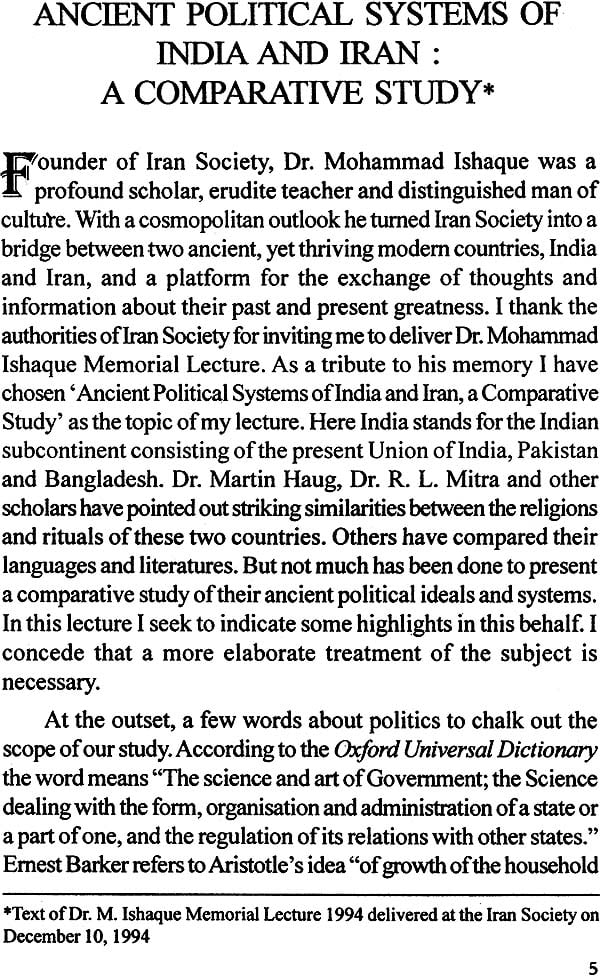
This is a collection of articles written by Dr. Chunder from time to time. This work is broadly divided into two parts : In the first part he has focused on ancient India and the topics incorporated in the second part are particularly on modem India. Several scholars ‘have pointed out striking similarities between the religions and rituals’ of India and Iran or ‘compared their languages and literatures’, although ‘not much has been done to present a comparative study of their ancient political ideals and systems’. Collecting valuable materials from pre-historic and historic periods, Dr. Chunder highlighted this aspect in his article Ancient Political Systems of India and Iran A Comparative Study. His comments on different old Persian inscriptions are really fascinating. He said that “in the Nax-i-Rustam inscription Darius formulated the noble policy of his administration which has an eternal ring”. Dr. Chunder has shown that the great Persian monarch ‘was impartial and actuated by a motive of general welfare’. Dr. Chunder cited this example to counter the views of ‘the doctrinaires who hold that monarchy represents the propertied class’. He also observed that “much later noble ideals of Persian emperors are reiterated by Kautilya in his Arthaãsfra and exemplified by Asoka revealed by his inscriptions”.
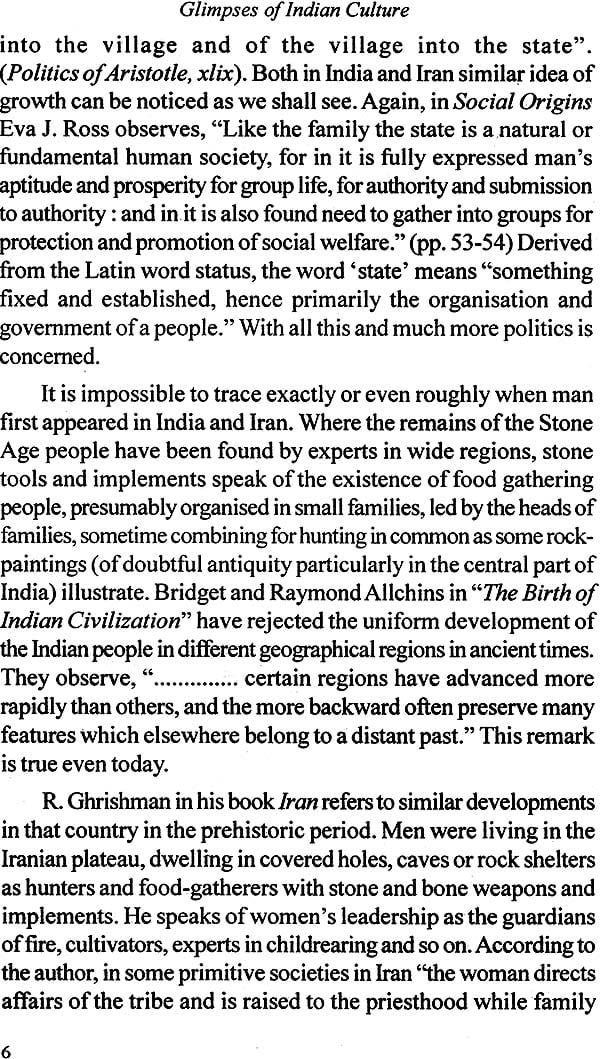
Dr. Chunder has thrown valuable light on the common concept of divine order in ancient India and Iran. Analysing the valuable source materials relating to it, he came to this conclusion that “a common lofty idea about divine or righteous order enlightened the minds of the Indians and the Iranians in the hoary past”. The Atharvaveda is mentioned by the scholars as ‘an enigmatic piece of literature of ancient India’. In fact, controversy raged ‘over its name, origin and antiquity and genre’. In spite of that “it is an absorbing work, dealing mostly with the life of ordinary people, their cravings, aspirations, love, hatred and urge for vengeance”. Dr. Chunder commented that this is the reason for which “the Atharvaveda continues to be a fascinating and engrossing source of ancient Indian life and culture”.
Another interesting part of this work is the common code of conduct in ancient India. Dr. Chunder wrote that “in ancient India the term ‘common code of conduct’ implied a body of some ethical values and morally useful practices without distinction as to race, class, colour or creed”. He cited it as “an example of Universal Law meant for mankind, a noble concept based on the notion of unity of men”. Depending on the Purãnas, the Vedic literature, Buddhist Dhammapada and Jaina texts, Dr. Chunder has mentioned the specific contents of the common code of conduct and the rules, practices and prohibitions of such common code. In defense of his argument he also quoted from the verses of the Mahãbhärata. Not only in sacred literature, the manual of political economy like Kautilya’s Arthasãstra too, enumerated the common code of conduct, which were nonviolence, truthfulness, non stealing, charity, forgiveness, self restraint, mental quietness, courage, purity and austerities. This code was for all castes. Even the famous Tamil Text Tirukkural ‘has an ode to virtue.’ Dr. Chunder observed that the common code of conduct in ancient India did not represent ethical aspirations only, a large part of it was enforced by the sovereign political authority, and therefore formed ‘a common heritage of the Indian people’.
For his profound knowledge in law, Dr. Chunder could easily discuss ‘the idea of law in the Dharmasutras’, mainly of Gautama, Vasistha, Baudhayana and Apastamba. He analysed ‘various notions about law in the Dharmasutras and similar ancient works’. He stated that “the Sütra-writers introduced a special term, Vyavahara, which assumed importance in later legal literature as a part of positive law enforced through the law courts”. Dr. Chunder also commented that ‘Vyavahàra denoted judicial procedure and Vivada the law-suit’.
The article entitled A Lost Book on Politics in Ancient India contains extracts from Dr. Chunder’s annotated English transalation of Kutilya’s Artha.ästra to be published by the M. P. Birla Foundation. This article particularly highlighted the book on Ràjadharma (royal duties) written by the mythical Supreme God (Brahma-Sanàtana). Then Dr. Chunder took up Kautilya’s attitude lowards social tolerance for discussion. He commented that Kautilya ‘was a curious mix of conservative and liberal views’. He elaborated this point in this article. More light was thrown by Dr. Chunder on food in Indian culture with particular reference to the ‘age of Arthasastra’. A large empire, established by Chandragupta Maurya, ‘could not be sustained by military might alone’. Dr. Chunder observed that this empire “needed a strong economic base which Kautilya’s meticulous planning provided.” Adequate attention was given to food for the expansion and the consolidation of the political power of that empire. Dr. Chunder stated that the Arthasastra provided “a proto-type of modern Welfare state particularly involved in solving the problems concerning food”. He also discussed the role of the state in this regard.
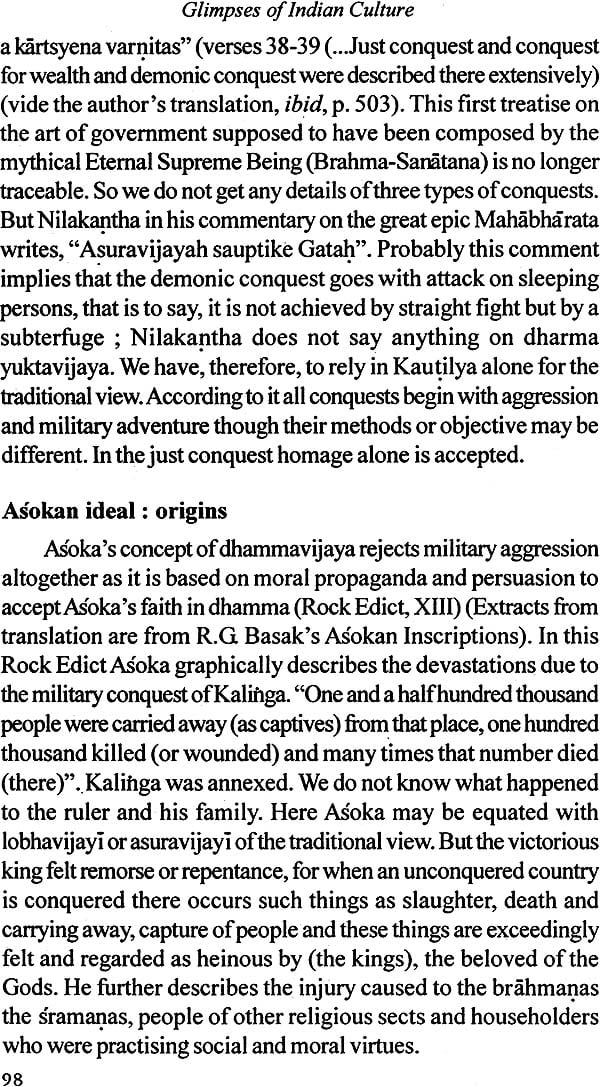
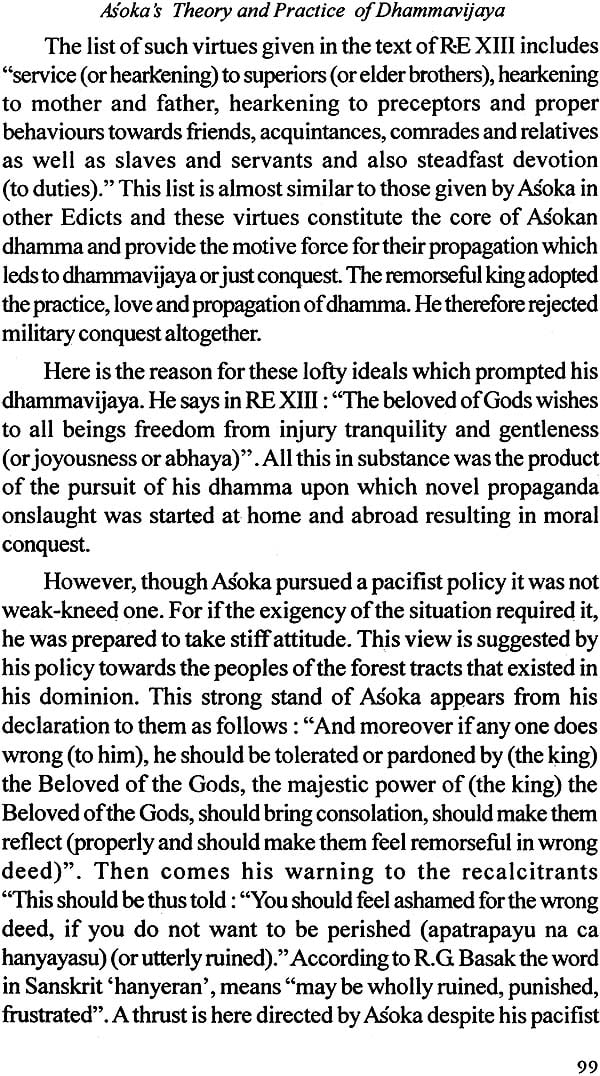
The traditional view of dharmavijaya is available in Kautilya’s Arthasastra and the Mahäbhàrata. It is quite well- known that Moka’s “concept of dhamma vijaya rejects military aggression altogether as it based on moral propaganda and persuasion to accept Asoka’s faith in dhamma”. Dr. Chunder thoroughly discussed Asoka’s theory and practice of dhammavijaya which he considered ‘unique in conception, wider in scope and more sublime than the traditional view’ in his article entitled Asoka s’ Theory and Practice of Dhammavijaya. In another article Last Days of King Asoka, Dr. Chunder narrated the sad end of this Great Emperor.
Dr. Chunder stated that “with due respect to Swami Vivekananda, I should say that Sri Krishna can be understood not only through love and action on His part, but also the philosophy which he had inculcated”. He had developed this idea in an interesting article Points of View Sri Krishna, The Prophet of Love and Action. Dr. Chunder made references to some paintings where Sri Krishna was depicted as ‘a man of action’.
At the end of ‘Part I’ of this book, Dr. Chunder took up a much debated issue What is Art in the Light of Indian Tradition? Discussing the views of the popular Dutch writer Hendrik Van Loon, Russian Savant Leo Tolstoy, Ananda Coomar Swamy and Benjamin Rownaldson on Art, Dr. Chunder focused on different manifestations and tradition of Indian art. He clearly stated that ‘it is hardly possible to find an all-embracing meaning for Indian art’. As “we have many traditions some emanating from the indigenous, some from foreign sources which make it difficult to give a correct answer to the question What is Art in the light of Indian Tradition”?
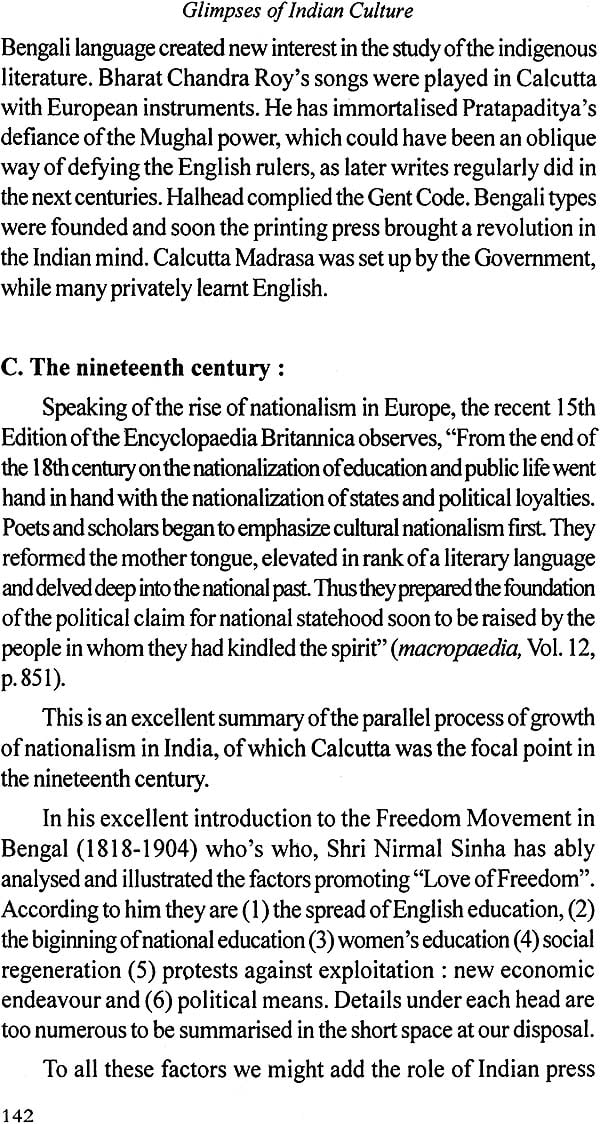
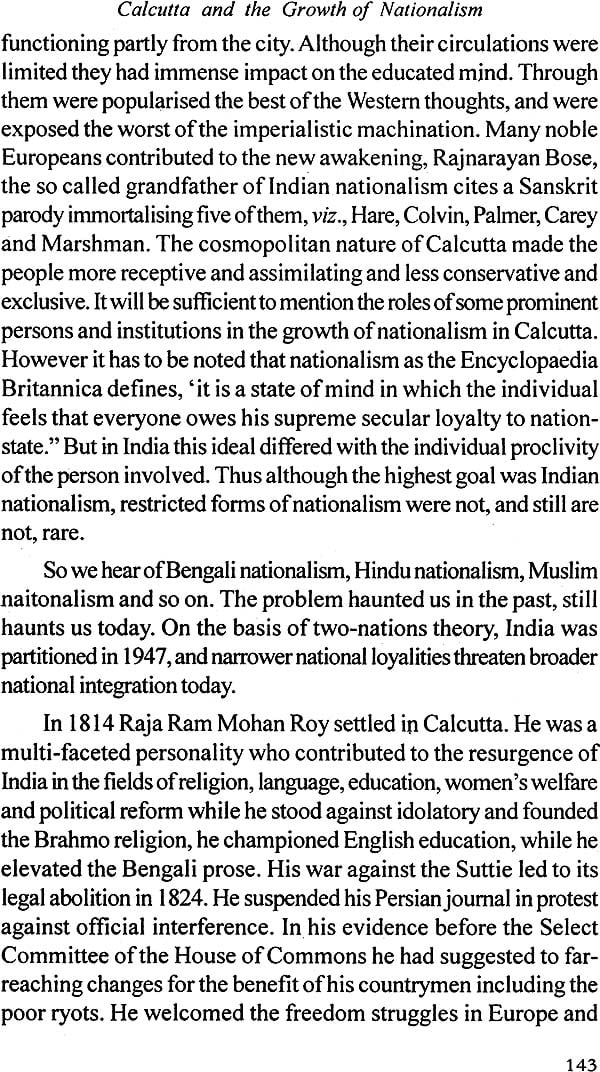
Three valuable articles on Calcutta are incorporated in Part II of this work. Dr. Chunder thoroughly discussed the history of Calcutta in the article Calcutta the Controversial City. He has covered all aspects relating to pre-colonial and colonial periods of this city. Materials collated by him in this article would be very much useful to those who wanted to know about this city. He could not agree with those who dismissed Calcutta as ‘a dying’ or ‘dead city’. Dr. Chunder also discussed the role of Calcutta in the ‘growth of nationalism’ in India in his article entitled Calcutta and the Growth of Nationalism. He believed that “as a political ideal, nationalism is both ennobling and debasing”. When Job Charnock settled in Calcutta in the late seventeenth century, ‘Europe, not to speak of India, did not know about nationalism’. In fact, “modern nationalist doctrine developed towards the end of the eighteenth century”. Dr. Chunder stated that from the very beginning of their settlement “ the English in Calcutta pursued a policy of the ‘carrot and stick’ towards the native”. They ‘fleeced the country’. Nearly 76000 people died in the streets of Calcutta during the famine of 1769-70. Dr. Chunder commented that “the violent reactions described in the Ananda Math of Bankim Chandra did not occur in Culcutta”. He discussed the forces which contributed to the growth of nationalism in Calcutta from the end of the eighteenth century. The Hindus took the lead in initiating anti-British activities in this city since the second half of the nineteenth century. He mentioned the role of the leading persons and associations in this connection. Then Dr. Chunder focused on the Partition of Bengal (1905), Mahatma Gandhi’s role, two-nation theory, the role of the Socialist and the Communist forces, Great Calcutta Killing (1946) and partition of the country (1947). Dr. Chunder observed that though Calcutta’s “political and economic statures are gone, the City is still the centre of cultural nationalism which continues to enthral the minds of the Indian people”.
Applying ‘nature’s freak, the Siamese twins’ to the city of Calcutta and its port, Dr. Chunder made efforts ‘to examine the inter-relation between the two entities to find out to what extent this designation is correct’. This theme was developed by him in the article entitled Calcutta City and Port Siamese Twins. No other scholar could discuss this issue in this way before him. Throwing light on the disparate growth of the ‘Siamese twins of Calcutta city and port’, Dr. Chunder commented that “both should be nourished and sustained by progressive measures and able administration”.
Dr. Chunder’s article Vivekananda on Religion : Some Aspects of His Chicago Addresses mentioned ‘some contradictions in Swamiji’s writings’. He wrote that “Swamiji was intolerant of that religion which bred sectarianism. His spirit of intolerance thus admits of exceptions”. Dr. Chunder also wrote that in ‘the Chicago addresses Swamiji was toying with the ideal of universal religion’. But he knew that “it was impossible for him to call upon the followers of major religions to give up their own” for which in the concluding address at Chicago Swamiji commented : “The Chrisctian is not to become a Hindu or a Buddhist nor a Hindu or a Buddhist to become a Christian. But each must assimilate the spirit of the others and yet preserve his individuality and grow according to his own law of growth”. Quoting it, Dr. Chunder raised a question : Is it not ‘eclecticism’? Dr. Chunder said that “an eclectic is one who selects what is best in various doctrines, methods or styles”. At the end of this article Dr. Chunder observed: “. . .the Master and his disciple were champions of religious tolerance, but not blind tolerance of the malign aspects of religion. They proposed religious tolerance based on the benign principles of moral judgement. This in my submission is the crux of Swami Vivekananda’s message to the world delivered at Chicago”. This article would certainly help us to look at Swamij’s Chicago addresses from a different perception.
It is revealed from Dr. Chunder’s article entitled Dr Rajendra Prasad and Globalization that during his student days in Calcutta, Rajendra Prasad successfully imbibed ‘the spirit of nationalism coupled with the love for mankind’. Moreover, Rajendra Prasad attached great importance to ‘the synthesis of the old and the new’. He wrote: “It is only in the synthesis of the old and new that the future of all countries, especially countries which have a great and ancient past, can be built upon. The good of man lies in the synthesis of physical and spiritual forces”. Dr. Chunder stated that Rajendra Prasad “had global views on many important aspects of human life”. Dr. Chunder also noticed “a lot of similarities between the global views of Dr. Rajendra Prasad and those of his mentor, Mahatma Gandhi”. In this article Dr. Chunder had thrown light on the views of Gandhiji and Rajendra Prasad keeping in view the modern concept of globalization.
In an article Dr. Syamaprasad Mookerjee From State to National Leadership, Dr. Chunder discussed briefly different stages of Syamaprasad’s political life. His assessment of such ‘a controversial political figure’, who ‘started as a state leader blossomed into a National Hero’, is interesting for the reason that Dr. Chunder forwarded his arguments supported by facts. Dr. Chunder rightly pointed out that “1941 was a high water mark in his political career”. This was the time when Syamaprasad firmly stood up “against communalism of the Muslim League and joined Fazlul Huq a non-league Muslim for saving Bengal from the evils of the League’s Communalism”. Dr. Chunder observed that “by joining progressive coalition, government of Fazlul Huq, Syamaprasad, President of the Hindu Mahasabha, set a sterling example of communal harmony”. Dr. Chunder also wrote that “in 1942 Syamprasad resigned from the Ministry in protest against the Government repression in Midnapore in connection with the August movement called by the Congress”. Syamaprasad’s letter to Lord Linlithgow, Viceroy and Governor-General, projected ‘him as a statesman of a high national stature’. Dr. Chunder himself was involved in the massive relief works organised by Syamaprasad during the famine of 1943. Dr. Chunder stated that Syamaprasad’s presidential address before the Hindu Mahasabha Session in 1944 revealed ‘his broad national out look’. Dr. Chunder also mentioned Syamaprasad’s help to ‘the students against the police atrocity during the 1.N.A. day in 1945. He declared that “Pakistan is no solution for the communal problem”. Dr. Chunder stated that in spite of his services to the nation he was miserably defeated in the general election in 1946. But he remained ‘undaunted’. He was not successful in opposing the creation of Pakistan. But “he along with a section of Congressmen succeeded in the partition of Bengal and the Punjab”. Syamaprasad became a Cabinet Minister in 1947 and ‘made his mark as an able minister’. During this time he was not happy with the affairs of the Hindu Mahasabha. Syamaprasad said that “the Hindu Mahasabha should give up politics and adopt socio-cultural activities”. Syamaprasad looked upon the Nehru-Liaquat Pact (1950) as an ‘appeasement of Pakistan’ and in protest ‘he resigned from the Central Cabinet’. Dr. Chunder discussed the views of Syamaprasad on the sad plight of the minorities in East Pakistan, his differences with Nehru on the questions of ‘declaration of war against Pakistan and exchange of population’, foundation of the Bharatiya Jana Sangha (1951) and his death in ‘mysterious circumstances’ in ‘a dingy bungalow’ in Kashmir in 1953. But ‘no enquiry was held about his death’. Dr. Chunder paid a tribute to him as ‘a great man’.
Dr. Chunder is bold enough to criticise certain aspects of social philosophy of Dr. Ambedkar in an article entitled Social Philosophy of Dr Ambedkar : A Critique. Dr. Ambedkar stated that his social philosophy was built upon the ideals ‘liberty, equality and fraternity’. He also said that his ‘philosophy has roots in religion and not in political science’. And he had derived them form the teachings oT his Master, the Buddha. Dr. Ambedkar announced it on 3 October 1954. Dr. Chunder took up these points for discussion in this article and stated that “Dr. Ambedkar’s greatness stood on four major planks, viz., his relentless fight against casteism, drafting the first republican constitution for independent India, sponsorship of Uniform Civil Code among the Hindus and adoption of Buddhism, and in all these pursuits his basic social philosophy provided the motive force”. Dr. Chunder said that “in his war against casteism he applied the tenets of liberty, equality and fraternity to expose the weakness of the Hindu Society”. Dr. Ambedkar found “in every Hindu consciousness that exists is the consciousness of his caste”. So he fought against ‘the tentacles of castes and suggested threefold action ‘educate, organise and agitate’. Dr. Chunder commented that “what he failed to grasp is that fragmentation of human society into stratified hierarchical group is not peculiar to the Hindus only. There are similar groups world over and the struggle for human unity and emancipation is an eternal one”.
Dr. Chunder also pointed out that “sometimes the academician and the activist Dr. Ambedkar clashed”. As an academician Dr. Ambedkar admitted that “caste existed long before Manu. He was an upholder of it and therefore philosophised about it but certainly he did not and could not ordain the present order of Hindu Society”. Dr. Chunder stated that yet ‘as an activist’ Dr. Ambedkar “encouraged the burning of the code of Manu as the root of all evils in the Hindu Society”. Dr. Chunder observed that though in varied degrees the Indian Constitution implemented Dr. Ambedkar’s ‘social philosophy of liberty, equality and fraternity’ through ‘provision of Fundamental Rights, Directive Principles, the abolition of un touch ability and the protection of minority rights’, yet “Dr. Ambedkar had to give up some of his extreme views, example, he did not insist on Separate Electorate for the Depressed Classes under the Constitution”.
On 14 October, 1956 Dr. Ambedkar embraced Buddhism though ‘he started the movement of renouncing Hindu religion in 1935’. After conversion he felt he was ‘liberated from hell’. He, however, admitted “his debt to Buddhism rather than to the French Revolution for his philosophy derived from liberty, equality and fraternity”. Dr. Ambedkar “also compared the Buddha with Karl Marx and found the former to be superior”. It is interesting to note that views expressed by Dr. Ambedkar on Buddhism in his magnum opus the Buddha and His Dhamma were rejected by the orthodox Buddhists as an incorrect interpretation of it. Dr. Chunder in this thought provoking article also referred to the views of Mahatma Gandhi on Dr. Ambedkar and Dr. Ambedkar’s reaction to Gandhiji’s criticism. At the end of this article Dr. Chunder commented that Dr. Ambedkar’s “fellow- converts claim to be New Buddhists and demand reservation like other scheduled castes and tribes. The great man who wanted to break the shackles f castes seems to be instrumental to the creation of a new sub-caste among the Buddhists. Is this a tragedy or a comedy”?
In delivering Prafulla Chandra Sen Memorial Lecture 2004 on the Crisis of Values in Indian Society Today at the Ramakrishna Mission Institute of Culture, Dr. Chunder highlighted the erosion of values in Indian life, particularly referring to certain observations made by Prafulla Chandra Sen on the ‘crisis of character’. For elaboration of his arguments, Dr. Chunder mainly depended on the news of ‘the rule of bribes’, criminalisation of politics’ and other crimes published in the dailies of the country. Dr. Chunder boldly stated that “the three pillars of the Indian democracy, legislative, executive and judialial show sings of deep cracks”. Dr. Chunder, however, observed from his personal experiences that ‘a massive portion of our people is good, honest and law-abiding’. So he put his faith ‘in our vast silent majority of our countrymen’. Citing examples, Dr. Chunder commented that “in every age throughout Indian history there has been some crisis in values or other”.
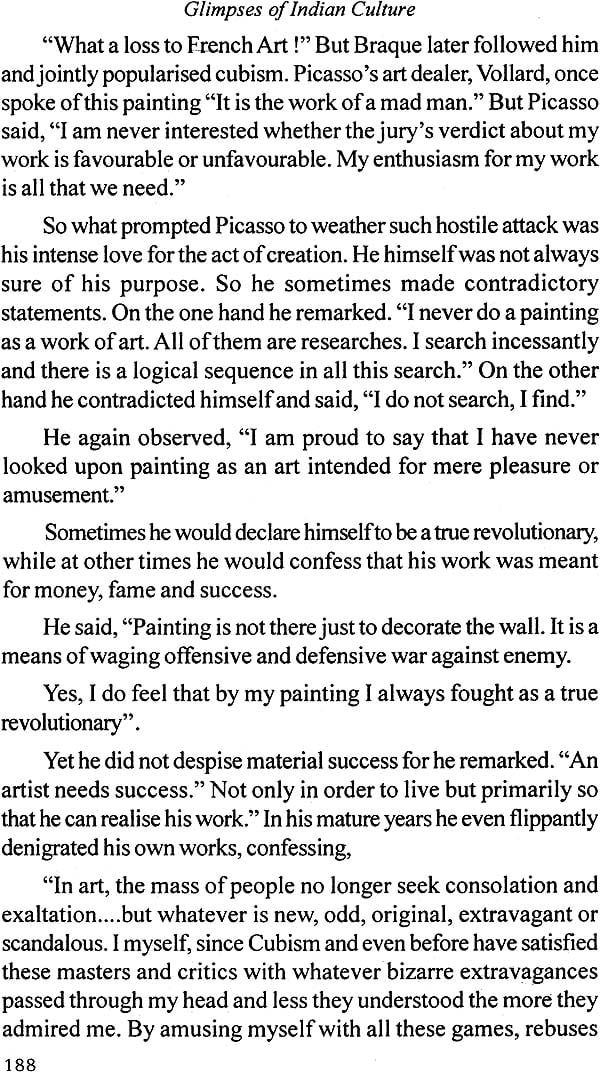
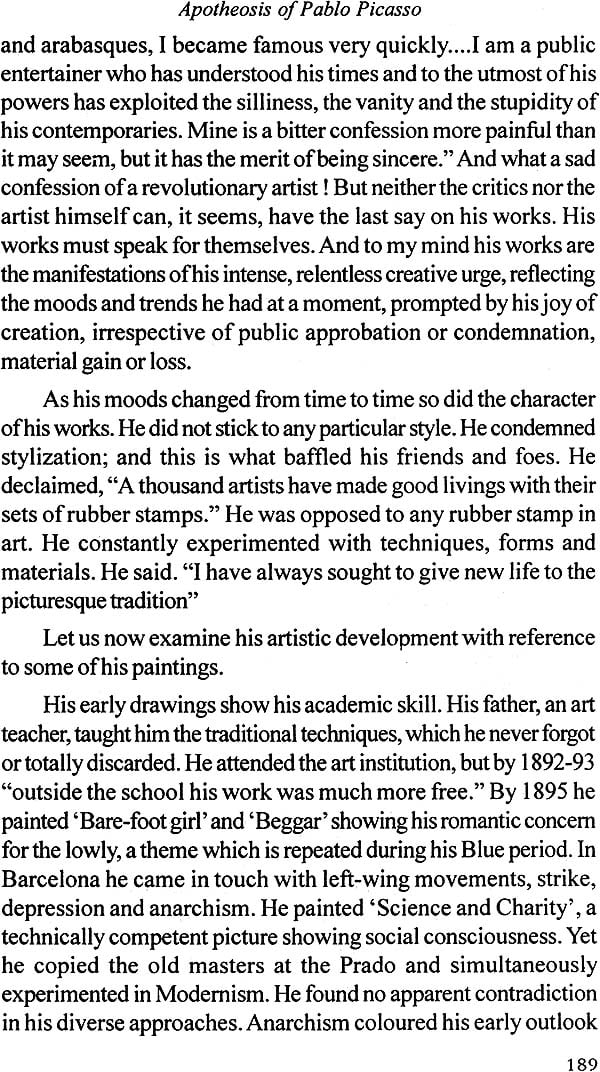
In his paper on Pablo Picasso, Dr. Chunder himself as a painter as well as a connoisseur of art, stated that ‘great painter without a style’ influenced ‘many artists throughout the world including India’. Dr. Chunder discussed the life and works of Diego Rivera as a ‘dynamic and dramatic’ artist. In fact, visiting, the retrospective exhibition at Philadelphia, Dr. Chunder could fully acquaint himself with ‘a panorama of dashing, vigorous and colourful styles of Diego Rivera’ and placed him ‘amongst the giants in the world of art’.
In the subsequent chapter Dr. Chunder made a brief review of India’s cultural progress since independence. He focused on ‘composite culture preached by our constitution’. As an optimist Dr. Chunder observed that in spite of so many hurdles ‘better forms of culture have evolved’ in India ‘despite temporary setbacks’. In the last chapter of Part-Il, Dr. Chunder explained his idea of Swarajya. He said that “in my concept of Swarajya people enjoy full fundamental or human rights protected by a powerful enforcement system”.
This valuable work clearly reveals that Dr. Pratap Chandra Chunder has a versatile mind. The scholarly world would certainly welcome it as a useful addition to the study of Indian history. I must sincerely thank the publisher for bringing out this work with such an attractive get up.
| Part-1: Ancient India | ||
| 1 | Ancient Political Systems of India and Iran: a comparative study | 5 |
| 2 | The Common Concept of Divine Order in Ancient India and Iran | 26 |
| 3 | The Enigmatic Atharvaveda | 30 |
| 4 | The Comman Code of Conduct in Ancient India | 34 |
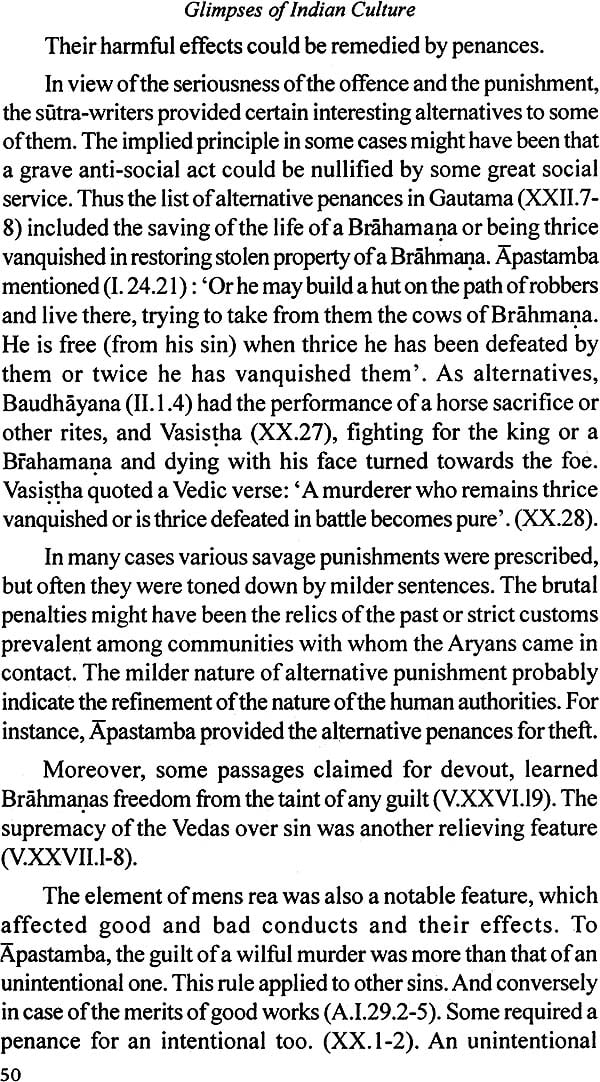
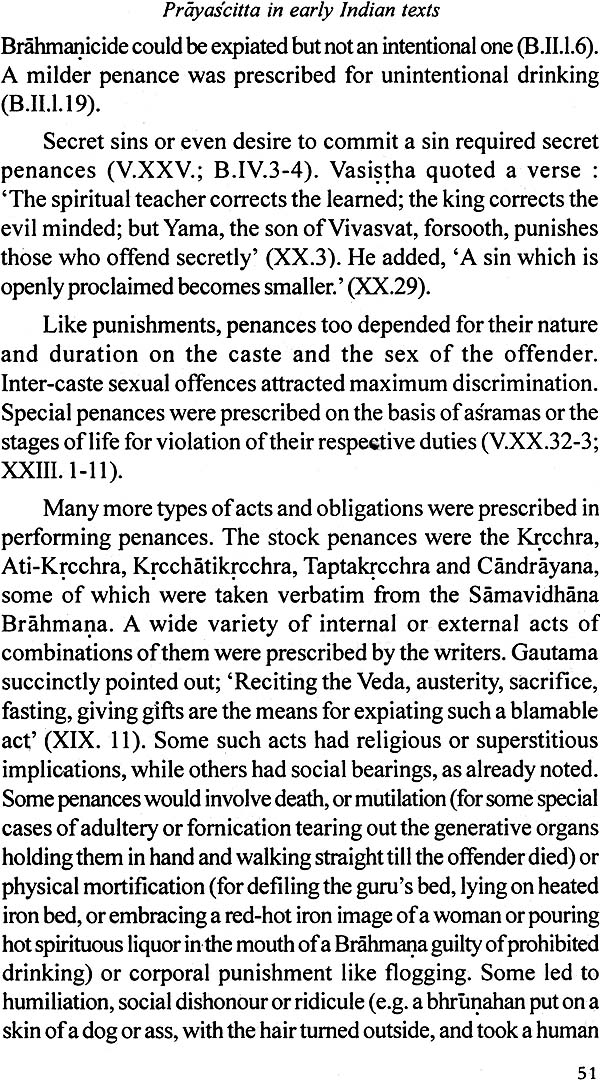
| 5 | Prayascitta in Early Indian Texts | 45 |
| 6 | The Idea of Law in the Dharma Sutras | 55 |
| 7 | A Lost Book of Politics in Ancient India | 72 |
| 8 | Kautilya's attitude towards social tolerance | 78 |
| 9 | Food in Indian Culture: the age of the Arthasastra | 83 |
| 10 | Ashoka's theory and practice of Dhammavijaya | 97 |
| 11 | Last days of King Asoka | 103 |
| 12 | Sri Krishna, The Prophet of Love and Action | 108 |
| 13 | What is Art in the light of Indian Tradition? | 113 |
| Part-II: Modern India | ||
| 14 | Calcutta the Controversial City | 123 |
| 15 | Calcutta and the growth of Nationalism | 136 |
| 16 | Calcutta City and Port: Siamese Twins | 151 |
| 17 | Vivekananda on Religion: some aspects of his Chicago addressed | 158 |
| 18 | Dr. Rajendra Prasad and Globalization | 162 |
| 19 | Dr.Syamaprasad Mookerjee from state to National Leadership | 169 |
| 20 | Social Philosophy of Dr. Ambedkar: A Critique | 175 |
| 21 | Crisis of values in Indian Society Today | 180 |
| 22 | Apotheosis of Pablo Picasso | 187 |
| 23 | The Metamorphosis of Diego Rivera | 194 |
| 24 | A Brief Review of India's Cultural Progress since Independence | 199 |
| 25 | What Swarajya means to Me | 211 |