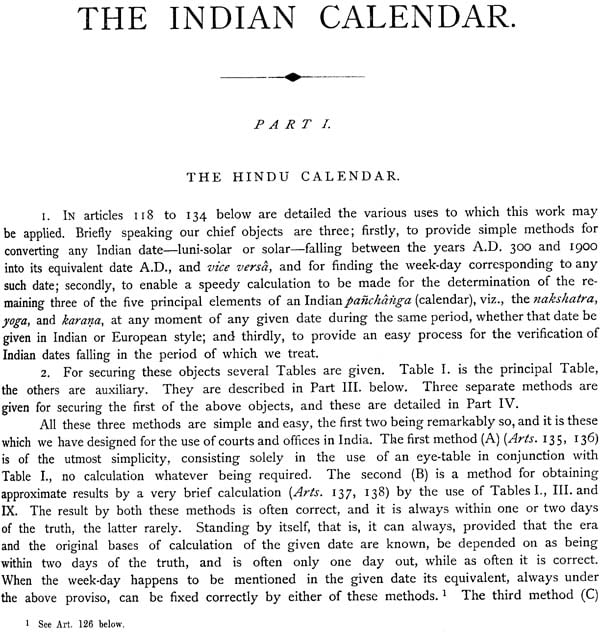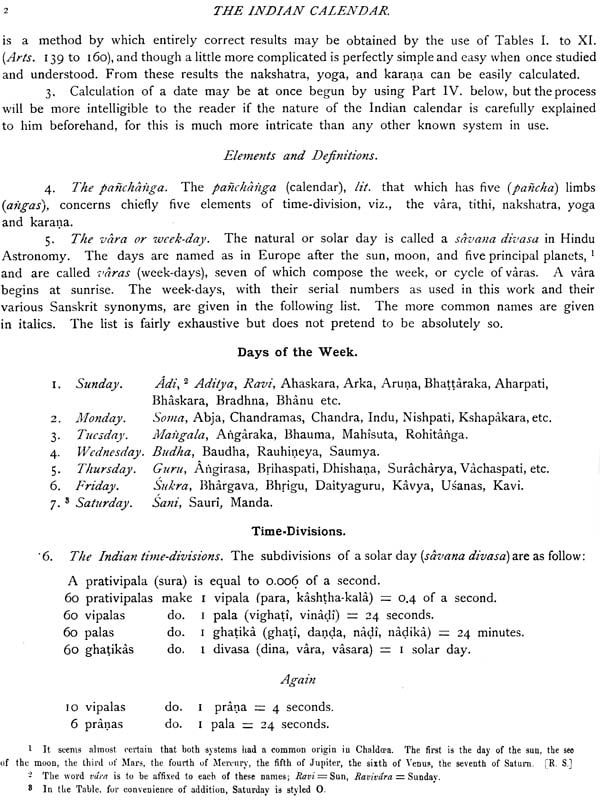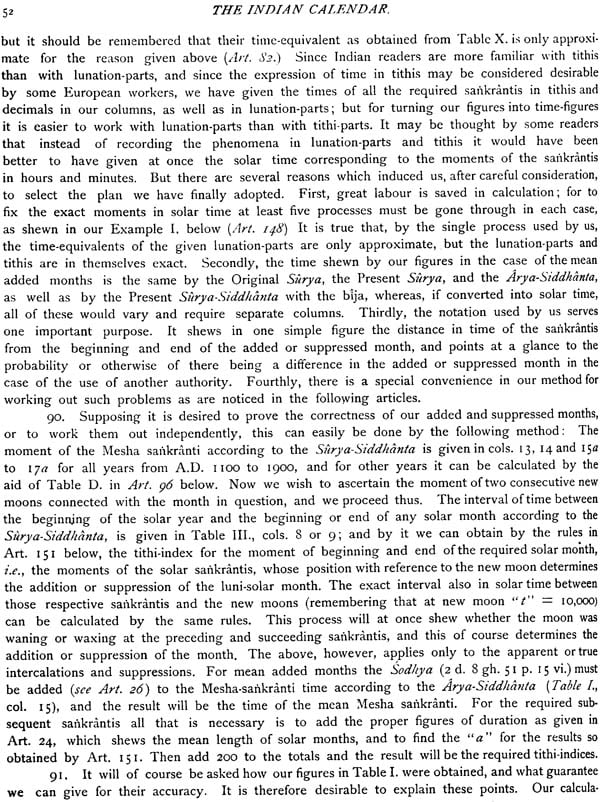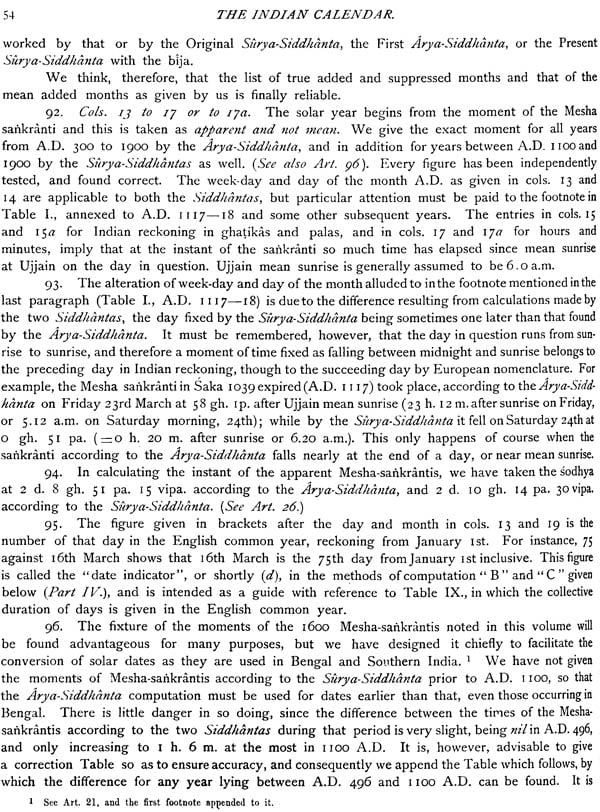


The Indian Calendar (With Tables for the Conversion of Hindu and Muhammadan Into A. D. Dates, and Vice Versa)
Book Specification
| Item Code: | IDJ996 |
| Author: | Robert Sewell, Sankara Balkrishna Dikshit, With Tables of Eclipses Visible in India by Dr. Robert Schram |
| Publisher: | MOTILAL BANARSIDASS DELHI |
| Edition: | 1996 |
| ISBN: | 9788120812079 |
| Pages: | 183 |
| Cover: | Hardcover |
| Other Details | 11.0" X 8.6" |
Book Description
Foreword
During the past decades considerable progress has been made in understanding and evaluating Indian astronomy and mathematics, due primarily to the researches carried out by David Pingree. In this connection his monumental Census of the Exact Sciences in Sanskrit, Series A. Vol. I (1970), II(1971), III(1976), IV(1981) published in Philadelphia deserves to be mentioned side by side with the "History of Mathematical Astronomy in India" in the Dictionary of Scientific Biography, Vol. XV. New York 1978, pp. 533-633, "Jyotihsastra. Astral and Mathematical Literature", A History of Indian Literature, Vol. VI, 4, Wiesbaden 1981, and finally "Jyotihsastra", Part I of A Descriptive Catalogue of the Sanskrit and other Indian Manuscripts of the Chandra Shum Shere Collection in Bodleian Library, Oxford 1983. Further R. Billard: L'astronomie indienne: Investigation des texts sanscritset des donnees numeriques, Paris 1971, Publications de 1'Ecole Francaise d'Extreme-Orient LXXXIII, and H. -G. Turstig: Jyotisa: Das System der indischen Astrologies, Wiesbaden 1980, Beitrage zur Sudasien-Forschung 57 my be mentioned here, although both these later books came under some criticism from D. Pingree.
In spite of the advanced knowledge of the system and the history of Indian astronomy and mathematics, comparatively little attention has been paid to the more practical side of astronomy, that is to say to the calendar. In particular the non-technical literature has hardly ever been taken into consideration. The wealth of information found in Buddhist sources reflecting the difficulties encountered in ancient time, when it became necessary to determine and to keep correct dates in every day life, has been almost completely neglected. Nevertheless the rules laid down for fixing the date of the uposatha or the beginning of the rainy season are highly interesting in many respects: Here we learn for instance that intercalary months were enforced by royal decree: Vinaya-Pitaka: Mahavagga can be gleaned from literature is aptly demonstrated by the very informative article by C. Vogel: "Die Jahreszeiten im Spiegel der altindischen Literature", Zeitschrit der; Deutschen Morgenlandischen Gesellschaft 121. 1971, pp. 284-326 (with an addendum ibidem 122.1972, p. *12*).
In a way practical difficulties similar to those experienced by the early Buddhists in India are not altogether alien to the present historian when it come to calculating dates mentioned in inscriptions themselves, and different calendar systems being in use at the same time, create problems, as the discussion by D. Pingree: " A Note on the calendars Used in Early Indian Inscriptions", Journal of the American Oriental Society 102-1982, pp. 355-359 shows.
Some help in solving such problems can be found in rather old publications: the pioneering articles by Hermann Jacobi (1850-1937) reprinted in his Kleine Schriften, Wiesbaden 1970 are still valuable today, and the publications by Robert Sewell (1845-1925) have been used by generations of epigraphists and historians. As these still important research tools have been out of print for a long time and are very hard to find, the general introduction to the Indian calendar is reprinted here as a first step. It has been supplemented by R. Sewell in two further books, which also deserve to be reissued in the course of time: Eclipses of the Moon in India, London 1898, and: Indian Chronography. An Extension of the 'Indian Calendar' with Working Examples, London 1912. Finally a series of articles by the same author, which originally appeared in Epigraphia Indica, has been collected as: The Siddhantas and the Indian Calendar Being a Continuation of 'Indian Chronography', Calcutta 1924.
In contrast to researches on the calendar in India proper, which have been somewhat neglected since R. Sewell's days, closely related systems borrowed from India have also been described more recently. First, as an old publication, A.M.B. Irwin: The Burmese Calendar, London 1901 can be mentioned. The Laotian time reckoning has been described after an early attempt by L. Finot: "Recherches sur la literature Laotienne", Bulletin de 1'Ecole Fracaise D'Extreme-Orient 17, 1917, pp.1-221 (on the calendar pp. 30-34) by Prince Phetsarath: "Le calendrier laotien", Bulletin des Amis de Laos, 4.1940, pp. 107-140, also in English as: "Tiao Maha Upahat Phetsarath: The Laotian Calendar", in: The Kingdom of Laos, Saigon 1959, pp. 97-125, and: S. Duperuis: "Le calcul du calendrier laotien", Peninsule, Etudes Interdisciplinaires sur 1'Asie du Sud-Est peninsulaine, 2/3, Paris, April 1981, pp. 25-118. For Thailand, where a rather old and probably highly interesting manuscript copied in AD 1578 under the title Adhikamasvinischaya (text in Lanna: Thai Yuan, describing Buddhist ecclesiastic chronology) and many colophons virtually untouched still await investigation, J. C. Eade: Southeast Asian Ephemeris, Solar and Planetary Positions, AD 638-2000, Ithaca/New York 1989 is a most helpful book. Indian influences on Indonesian chronology have been traced by J. G. de Casparis: Indonesian Malaysia und die Philippinen, I. Band Geschichte, 1. Lieferung, and finally the Tibetan chronology, also heavily indepted to India, has been described by D. Schuh: Untersuchungen zur Geschichte der tibetischen Kalenderrechnung, Wiesbaden 1973, Verzeichnis der Orientalischen Handschriften in Deutschland, Suplementband 16.
Preface
This Volume is designed for the use, not only of those engaged in the decypherment of Indian inscriptions and the compilation of Indian history, but also of Judicial Courts and Government Offices in India. Documents bearing dates prior to those given in any existing almanack are often produced before Courts of Justice as evidence of title; and since forgeries, many of them of great antiquity, abound, it is necessary to have at hand means for testing and verifying the authenticity of these exhibits. Within the last ten years much light has been thrown on the subject of the Indian methods of time-reckoning by the publications of Professor Jacobi, Dr. Schram, Professor Kielhorn, Dr. Fleet, Pandit Sankara Balkrishna Dikshit, and others; but these, having appeared only in scientific periodicals, are not readily accessible to officials in India. The Government of Madras, therefore, desiring to have a summary of the subject with Tables for ready reference, requested me to undertake the work. In process of time the scheme was widened, and in its present shape it embraces the whole of British India, receiving in that capacity the recognition of the Secretary of State for India. Besides containing a full explanation of the Indian chronological system, with the necessary tables, the volume is enriched by a set of Tables of Eclipses most kindly sent to me by Dr. Robert Schram of Vienna.
In the earlier stages of my labours I had the advantage of receiving much support and assistance from Dr. J. Burgess (late Director-General of the Archaeological Survey of India) to whom I desire to express my sincere thanks. After completing a large part of the calculations necessary for determining the elements of Table I., and drawing up the draft of an introductory treatise, I entered into correspondence with Mr. Sankara Balkrishna Dikshit, with the result that, after a short interval, we agreed to complete the work as joint authors. The introductory treatise is mainly his, but I have added to it several explanatory paragraphs, amongst others those relating to astronomical phenomena.
Tables XIV. And XV. Were prepared by Mr. T. Lakshmiah Naidu of Madras.
It is impossible to over-estimate the value of the work done by Dr. Schram, which renders it now for the first time easy for anyone to ascertain the incidence, in time and place, of every solar eclipse occurring in India during the past 1600 years, but while thus briefly noting his services in the cause of science, I cannot neglect this opportunity of expressing to him my gratitude for his kindness to myself.
I must also tender my warm thanks for much invaluable help to Mr. H. H. Turner, Savilian Professor of Astronomy at Oxford, to Professor Kielhorn, C.I.E., of Gottingen, and to Professor Jacobi.
The Tables have been tested and re-tested, and we believe that they may be safely relied on for accuracy. No pains have been spared to secure this object.
It was only in September, 1893, that I became acquainted with Mr. R. Sewell, after he had already made much progress in the calculations necessary for the principal articles of Table I. of this work, and had almost finished a large portion of them.
The idea then occurred to me that by inserting the a, b, c figures (cols. 23, 24, and 25 of Table I.) which Mr. Sewell had already worked out for the initial days of the luni-solar years, but had not proposed to print in full, and by adding some of Professor Jacobi's Tables published in the Indian Antiquary, not only could the exact moment of the beginning and end of all luni-solar tithes be calculated, but also the beginning and ending moments of the nakshatra, yoga, and karana for any day of any year; and again, that by giving the exact moment of the Mesha sankranti for each solar year the exact European equivalent for every solar date could also be determined. I therefore proceeded to work out the details for the Mesha sankrantis, and then framed rules and examples for the exact calculation of the required dates, for this purpose extending and modifying Professor Jacobi's Tables to suit my methods. Full explanation of the mode of calculation is given in the Text. The general scheme was originally propounded by M. Largeteau, but we have to thank Professor Jacobi for his publications which have formed the foundation on which we have built.
My calculation for the moments of Mesha sankrantis, of mean intercalations of months (Mr. Sewell worked out the true intercalations), and of the samvatsaras of the cycle of Jupiter were carried out by simple methods of my own. Mr. Sewell had prepared the rough draft of a treatise giving an account of the Hindu and Muhammadan systems of reckoning, and collecting much of the information now embodied in the Text. But I found it necessary to re-write this, and toad a quantity of new matter.
I am responsible for all information given in this work which is either new to European scholars, or which differs from that generally received by them. All points regarding which any difference of opinion seems possible are printed in footnotes, and not in the Text. They are not, of course, fully discussed as this is not a controversial work.
Every precaution has been taken to avoid error, but all corrections of mistakes which may have crept in, as well as all suggestions for improvement in the future, will be gladly and thankfully received.
From the Jacket
The practical difficulties in calculating dates mentioned in inscriptions or in the colophons to manuscripts are considerable. Among the books offering help to historians and editors alike, the works of R. Sewell stand out as excellent introductions to this intricate subject. The book reprinted here was first published in 1897. However, in spite of its age, The Indian Calendar has retained its usefulness for the benefit of scholars working on the chronology of Ancient India.
Robert Sewell (1845-1925) has written extensively on Indian history, Besides his works on the Indian calendar and on chronology, his book a Forgotten Empire: Vijayanagara (1900) is one of the pioneering efforts to describe South Indian history, and The Historical Inscriptions of Southern India (1923) is still a valuable took for research.
| | ||
| | ||
| Art. I. | Introductory | I |
| Art. 4 | The panchanga | 2 |
| Art. 5 | The vara, or week day Days of the week | 2 |
| Art. 6 | Time divisions | 2 |
| Subdivisions of the day | 2 | |
| Art. 7 | The tithi, amavasya, purnima | 3 |
| Art. 8 | The nakshatra | 3 |
| Art. 9 | The yoga | 3 |
| Art. 10 | The karana | 3 |
| Art. 11 | The paksha | 4 |
| Art. 12 | Lunar months | 4 |
| Art. 13 | Amanta and purnimanta systems | 4 |
| Art. 14 | Luni-solar month names | 5 |
| Art. 15 | The solar year, tropical, sidereal, and anomalistic | 5 |
| Art. 16 | The Kalpa. Mahayuga. Yoga. Julian Period | 6 |
| Art. 17 | Siddhanta year-measurement | 6 |
| Art. 18 | Siddhantas now used for the same | 7 |
| The Siddhantas and other Astronomical Works. | ||
| Art. 19 | Siddhantas, Karanas, bija, Hindu schools of astronomers | 7 |
| Art. 20 | Note on the Siddhantas, and their authors and dates | 7 |
| Art. 21 | Authorities at present accepted by Hindus | 9 |
| Further details. Contents of the Panchanga. | ||
| Art. 22 | The Indian Zodiac, rasi, amsa | 9 |
| Art. 23 | The Sankrantis. Names given to solar months | 9 |
| Art. 24 | Length of months | 10 |
| Duration of solar months. Table | 10 | |
| Art. 25 | Adhika masas. Calendar used | 11 |
| Art. 26 | True and mean sankrantis. Sodhya | 11 |
| Art. 28 | The beginning of a solar month | 12 |
| Rule I. (a) The midnight Rule (Bengal). | ||
| Rule I (b) The any-time Rule (Orissa). | ||
| Rule II. (a) The sunset Rule (Tamil). | ||
| Rule II. (b) The afternoon Rule (Malabar). | ||
| Art. 29 | Panchangs, tithis | 13 |
| Art. 30 | Extract from an actual panchanga | 13 |
| The Ahargana | 16 | |
| Art. 31 | Correspondence of tithis and solar days | 16 |
| Performance of religious ceremonies, sraddhas, vratas | 17 | |
| Art. 32 | Adhika and kshaya tithis | 17 |
| Art. 34 | Variation on account of longitude | 18 |
| Art. 35 | Examples of the same | 19 |
| Art. 36 | True and mean time | 19 |
| Mean sun, mean moon, true and mean sunrise | 19 | |
| Art. 37 | Basis of calculation for the Tables | 20 |
| Elements of uncertainty | 20 | |
| Art. 38 | Nakshatras | 21 |
| Yoga-taras. Equal and unequal space systems. Garga and Brahma Siddhanta systems | 21 | |
| Table. Longitude of Ending-points of Nakshatras | 22 | |
| Art. 39 | Auspicious Yogas | 22 |
| Art. 40 | Karanas | 23 |
| Art. 40a | Eclipses | 23 |
| Oppolzer's Canon. Note by Professor Jacobi | 23 | |
| Art. 41 | Lunar months and their names | 24 |
| Season-names, star-names | 24 | |
| Art. 42-44 | Modern names of, derived from the nakshatras | 24 |
| Table shewing this derivation | 25 | |
| Art. 45 | Adhika and kshaya masas. Rules | 25 |
| Table | 26 | |
| Art. 46 | Their names. Rules | 26 |
| Art. 47 | Their determination according to true and mean systems | 27 |
| Change of practice about A. D. 1100 | 27 | |
| Sripati. Bhaskaracharya | 28 | |
| Art. 48 | Rules given in another form | 28 |
| Art. 49 | Different results by different Siddhantas | 29 |
| Art. 50 | Some peculiarities in the occurrence of adhika and kshaya masas. | 29 |
| Art. 51 | Intercalation of months by purnimanta scheme | 30 |
| | ||
| Art. 52 | The Hindu New Year's Day in solar and luni-solar reckoning | 31 |
| When the first month is intercalary | 32 | |
| Differs in different tracts | 32 | |
| Art. | The sixty-year cycle of Jupiter | 32 |
| Art. 54-55 | Kshaya samvatsaras | 33 |
| Art. 56-57 | Variations in expunction of samvatsaras | 33 |
| Jyotisha-tattva Rule | 33 | |
| Art. 58 | To find the current samvatsara | 34 |
| Art. 59 | Rules for the same | 34 |
| (a) By the Surya Siddhanta | 34 | |
| (b) By the Arya Siddhanta | 34 | |
| (c) By the Surya Siddhanta with the bija | 35 | |
| (d) Brihatsamhita and Jyotishatattva Rules | 35 | |
| Art. 60 | List of Expunged Samvatsaras by different authorities. Table | 36 |
| Art. 61 | Earliest use of Jupiter's cycle | 36 |
| Art. 62 | The southern (luni-solar) sixty-year cycle | 36 |
| Art. 63 | The twelve-year cycle of Jupiter | 37 |
| Two kinds of Do. | 37 | |
| Art. 64 | The Graha-paravritti and Onko cycles | 37 |
| The Various Eras. | ||
| Art. 65 | General remarks | 39 |
| Art. 66 | Importation of eras into different tracts | 39 |
| Art. 67 | Examples of Do | 39 |
| Art. 68 | Eras differently treated by the same author | 39 |
| Art. 69 | Only one safe deduction | 40 |
| Art. 70 | Current and expired years. Explanation | 40 |
| Art. 71 | Description of the several eras | 40 |
| The Kali-Yuga | 40 | |
| The Saptarshi Kala Era | 41 | |
| The Vikrama Era | 41 | |
| The Christian Era | 42 | |
| The Saka Era | 42 | |
| The Chedi or Kalachuri Era | 42 | |
| The Gupta Era | 43 | |
| The Valabhi Era | 43 | |
| The Bengali San | 43 | |
| The Vilayati Year | 43 | |
| The Amli Era of Orissa | 43 | |
| The Fasali Year | 44 | |
| The Luni-solar Fasali Year | 44 | |
| The Mahratta Sur San, or Shahur San | 45 | |
| The Harsha Kala | 45 | |
| The Magi San | 45 | |
| The Kollam Era, or Era of Parasurama | 45 | |
| The Nevar Era | 45 | |
| The Chalukya Era | 46 | |
| The Simha Samvat | 46 | |
| The Lakshmana Sena Era | 46 | |
| The Ilahi Era | 46 | |
| The Mahratta Raja Saka Era | 47 | |
| Art. 72 | Names of Hindi and N. W. Fasali months | 47 |
| Description and Explanation of the Tables | ||
| Art. 73-102 | Table I. (general) | 47 |
| Art. 80 | "Lunation-parts" or "tithi indices", or "t." explained. | 49 |
| Art. 81 | Relation of "tithi-index" and "tithi-part" | 50 |
| Art. 82 | To convert "t." into solar time | 50 |
| Art. 83-86 | Lunar conditions requisite for the intercalation or suppression of a month | 50 |
| Art. 87 | Reasons for adopting tithi-index notation | 51 |
| Art. 90 | Method for arriving at correct intercalated and suppressed months | 52 |
| Art. 91 | Plan of work adopted for Table I | 52 |
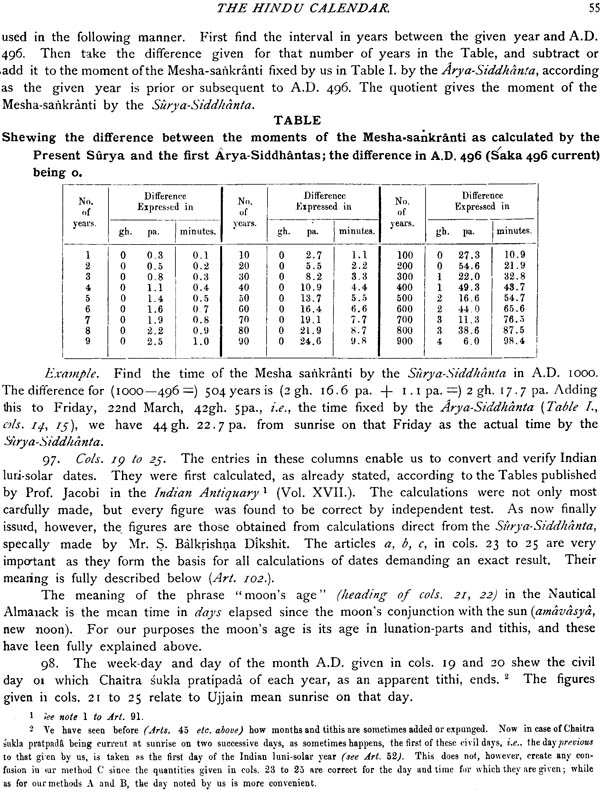
| Art. 96 | Moments of Mesha-sankranti differ according to Arya and Surya Siddhantas. | 54 |
| Table shewing difference | 55 | |
| Art. 102 | a, b, c, (cols. 23, 24, 25) fully explained | 56 |
| Table. Increase of a, b, c, in a year and in a day | 57 | |
| Art. 103 | Table II., Parts i. and ii. Correspondence of amanta and purnimanta months, and of months in different eras | 57 |
| Art. 104 | Table II., Part iii. Do. Of years of different eras | 58 |
| Rules for conversion of a year of one era into that of another | 58 | |
| Art. 105 | Table III. (Collective duration of months) | 59 |
| Art. 106 | Tables IV., V. (w, a, b, c, for every day in a year, and for hours and minutes) | 59 |
| Art. 107-110 | Tables VI., VII. (Lunar and solar equations of the centre) | 60 |
| Equation of the centre explained | 60 | |
| Art. 111 | Tables VIII., VIIIA., VIIIB | 62 |
| Art. 112-117 | Tables IX. To XVI | 62 |
| Use of the Tables. | ||
| Art. 118 | Purposes for which the Tables may be used | 62 |
| Art. 119 | To find the corresponding year and month of other eras | 63 |
| Art. 120 | To find the samvatsara | 63 |
| Art. 121 | To find the added or suppressed month | 63 |
| Art. 122-129 | to convert a Hindu date into a date A. D. and vice versa | 63 |
| By methods A, B, Or C, | 63 | |
| Art. 131-133 | To find the nakshatra, yoga, and karana current on any date | 64 |
| Explanation of work for nakshatras and yogas. | 64 | |
| Art. 134 | To convert a solar date into a luni-solar date, and vice versa | 65 |
| Art. 135-136 | Details for work by Method A | 65 |
| Art. 135 | (A) Conversion of a Hindu | |
| (B) Do. Of a date A. D. into a Hindu solar date | 66 | |
| Art. 136 | (A) Do. Of a Hindu luni-solar date into a date A. D. | 67 |
| (B) Do. Of a date A. D. into a Hindu luni-solar date | 68 | |
| Art. 137-138 | Details for work by Method B | 69 |
| Art. 137 | (A) Conversion of Hindu dates into dates A. D. | 69 |
| (a) Luni-solar Dates | 70 | |
| (b) Solar Dates | 73 | |
| Art. 138 | (B) Conversion of dates A. D. into Hindu dates | 74 |
| (a) Luni-solar Dates | 75 | |
| (b) Solar Dates | 76 | |
| Art. 139-160 | Details for work by Method C. | 77 |
| Art. 139 | (A) Conversion of Hindu luni-solar dates into dates A. D. | 77 |
| Art. 142 | A clue for finding when a tithi is probably repeated or expunged | 78 |
| Art. 144 | To find the moment of the ending of a tithi | 78 |
| Art. 145 | Do. Of its beginning | 78 |
| Art. 149 | (B) Conversion of Hindu solar dates into dates A. D. | 86 |
| Art. 150 | (C) Conversion into dates A. D. of tithes which are coupled with solar months | 89 |
| Art. 151 | (D) Conversion of dates A. D. into Hindu luni-solar dates | 90 |
| Art. 152 | (E) Conversion of dates A. D. into Hindu solar dates | 93 |
| Art. 153 | (F) Determination of Karanas | 96 |
| Art. 156 | (G) Do. Of Nakshatras | 97 |
| Art. 159 | (H) Do. Of Yogas. | 97 |
| Art. 160 | (I) Verification of Indian dates | 98 |
| | ||
| The Muhammadan Calendar. | ||
| Art. 161 | Epoch of the Hijra | 101 |
| Art. 162 | Leap-years | 102 |
| Art. 163 | The months. Table | 102 |
| Art. 164 | A month begins with the heliacal rising of the moon | 102 |
| Art. 165 | Occurrence of this under certain conditions | 103 |
| Art. 166 | Difference in,-caused by difference in longitude | 103 |
| Art. 167 | Days of the Week. Table | 103 |
| Art. 168 | Compensation for New Style in Europe | 103 |
| Art. 169 | Rules for conversion of a date A. H. into a date A. D. | 104 |
| Art. 170 | Rules for conversion of a date A. D. into a date A. H. | 105 |
| Dr. Burgess's Perpetual Muhammadan Calendar | 105-106 | |
| Table | I | I to cii. |
| Table | II | ciii to cvi |
| Table | III | cvii |
| Table | IV | cviii to cx |
| Table | V | cxi |
| Table | VI | cxii |
| Table | VII | cxiii |
| Table | VIII | cxiv |
| Table | IX | cxv, cxv |
| Table | X | cxvi, cxvii, |
| Table | XI | cxviii |
| Table | XII | cxix, cxx |
| Table | XIII | cxxi |
| Table | XIV | cxxiii |
| Table | XV | cxxiv |
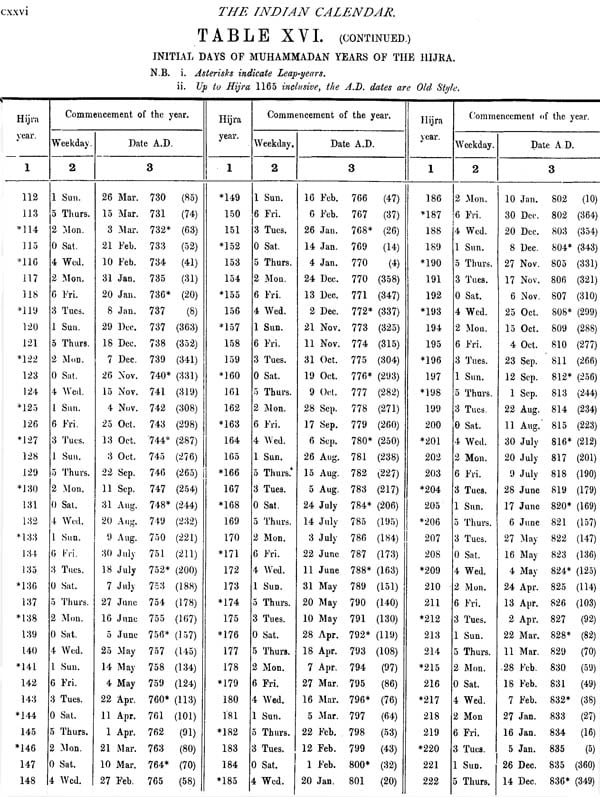
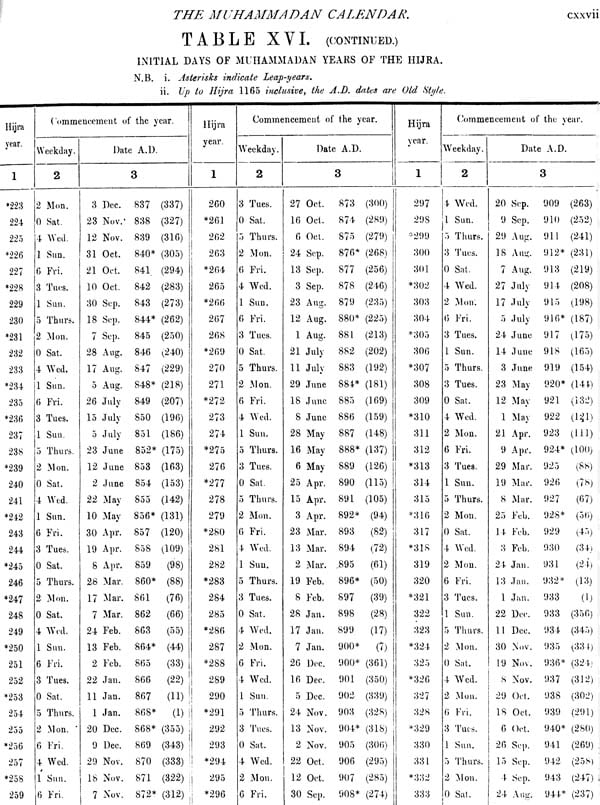
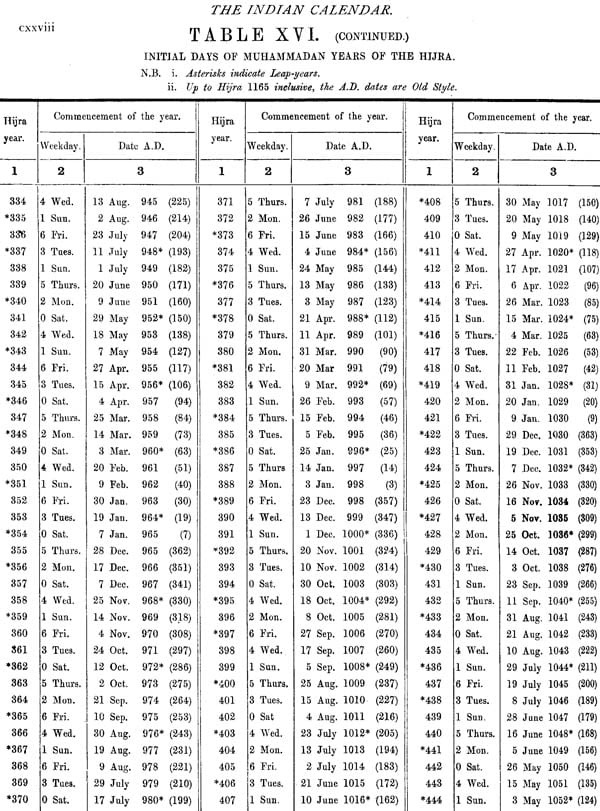
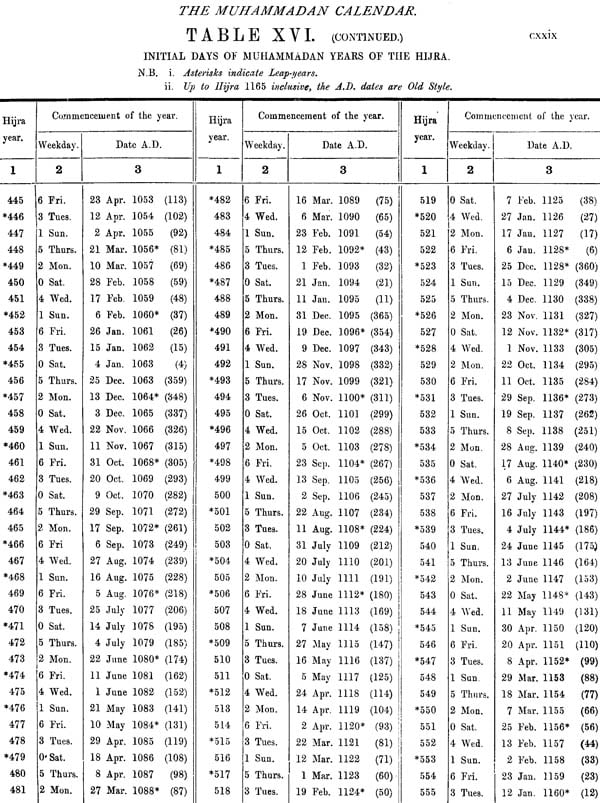
| Table | XVI | cxx, cxxxvi |
| | ||
| Eclipses of the Sun in India by Dr. Robert Schram | 109 to 116 | |
| Table A. | 117 to 127 | |
| Table B. | 128 to 137 | |
| Table C. | 138 | |
| Table D. | 139 to 148 | |
| Additions and Corrections | 149 to 161 | |
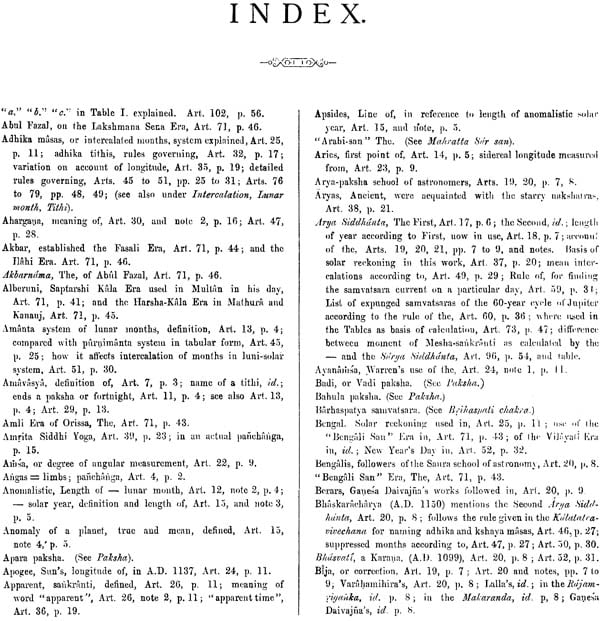
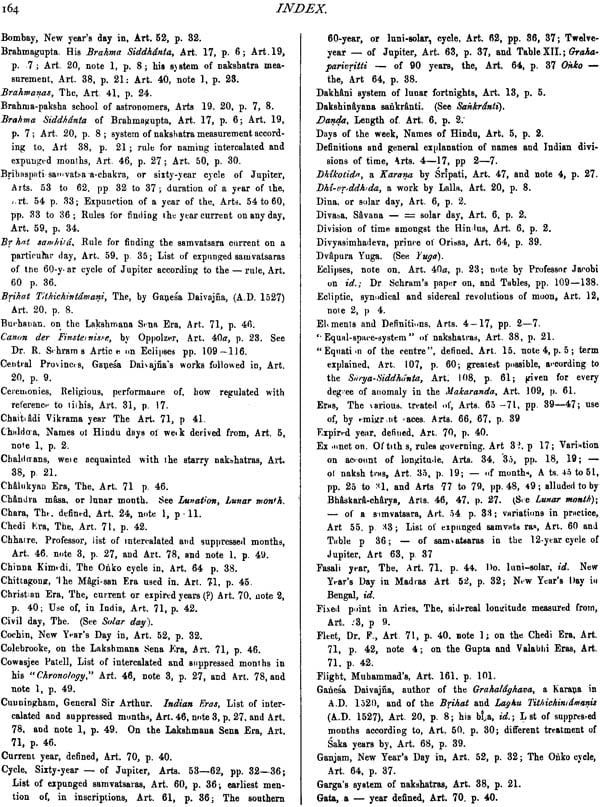
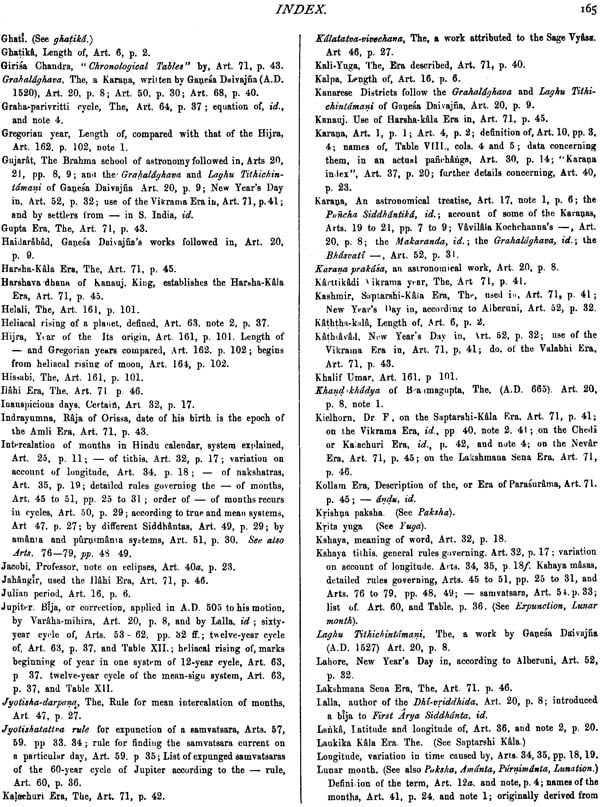
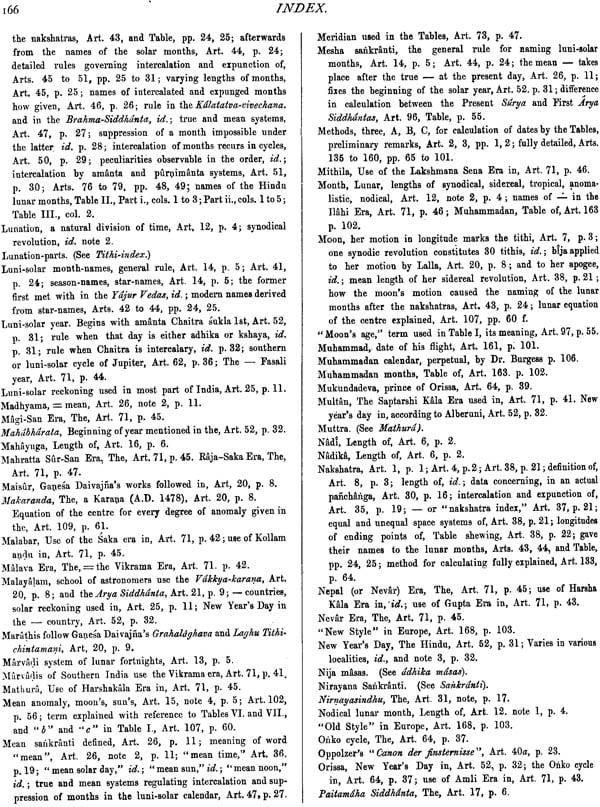
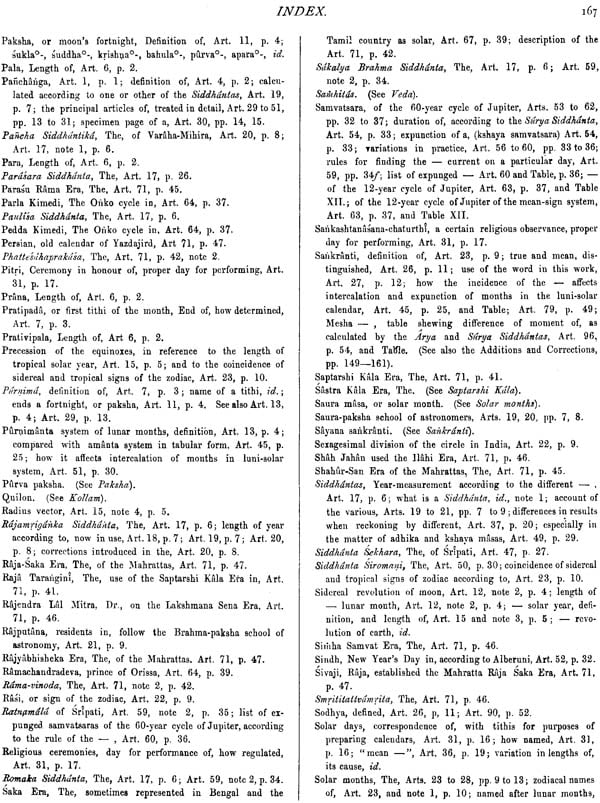
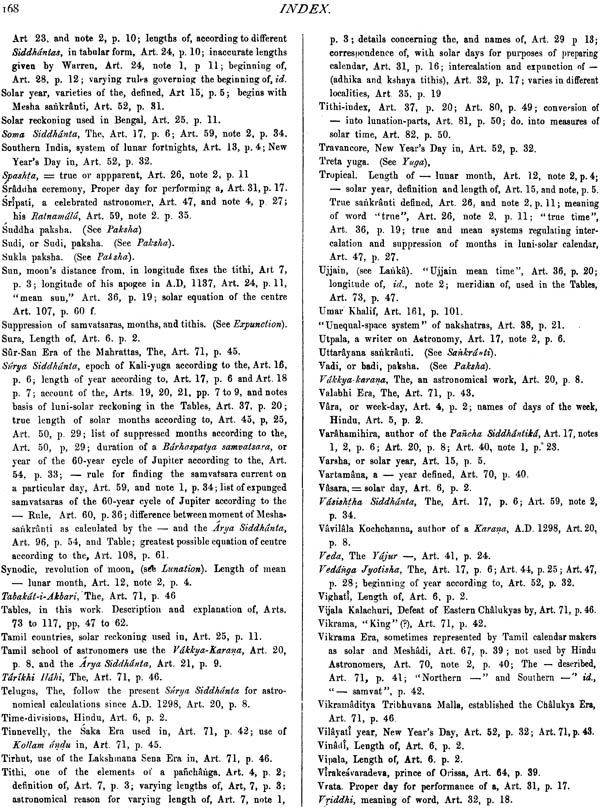
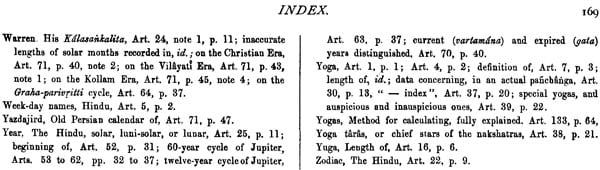
| Index | 163 to 169 |