

Sri Hari-bhakti-vilasa (Volume V) (Vilasas 17-20)
Book Specification
| Item Code: | IDJ612 |
| Author: | Srila Sanatana Gosvami |
| Publisher: | Ras Bihari Lal and Sons |
| Language: | Transliterated Text with English Translation |
| Edition: | 2006 |
| ISBN: | 8184030134 |
| Pages: | 624 |
| Cover: | Hardcover |
| Other Details | 9.2" X 6.5" |
| Weight | 1.80 kg |
Book Description
Introduction
There are two kinds of Vedic literature-fruitive and transcendental. Those who are inclined toward the fruitive division naturally have no interest in transcendental literature. Human beings mound their lives, actions, concepts and conclusions according to their own taste. For this reason, the smartas also have more faith in the literature of their choice. Because they are not qualified to study transcendental literature, they lack faith in them. That is the arrangement of the creator. There is no doubt that there is a confidential purpose behind this. The purpose is that if one remains fixed in his own position, according to his qualifications, he will gradually make advancement. As soon one gives up the duties pertaining to his position, he becomes degraded.
When human beings are engaged in fruitive activities, they are called karmis, and when they are engaged in devotional service, they are called devotees. As long as one is attached to the performance of fruitive activities, he should follow the path of smarta because will be beneficial for him. If he somehow transcends the platform of fruitive activities and enters onto the platform of devotional service, he will naturally develop a taste for spiritual life. That is why the creator has made two sets of literature fruitive and transcendental.
In order to strengthen the karmis' faith in fruitive activities, the smarta literature has prescribed many rules and regulations. Not only that, they have sometimes displayed an indifference towards transcendental literature, just to steady the karmis' faith in those rules and regulations. Although the two types of literature are actually one, they appear different to different people. Without being fixed in one's position, a person cannot attain any true benefit. For this reason, the Vedic because appears to be of two types.
In the Srimad-Bhagavatam (11.20.7-8) it is stated:
nirvinnanam, jnana-yoga nyasinam iha karmasu tesv anirvinna-cittanam karma-yogas tu kaminam
"Among these three paths, jnana-yoga, the path of philosophical speculation, is recommended for those who are disgusted with material life and are thus detached from ordinary, fruitive activities. These who are not disgusted with material life, having many desires yet to fulfill, should seek perfection through the path of karma-yoga."
yadrcchaya mat-kathadau jata-sraddhas tu yah puman na nirvinno nati-sakto bhakti-yoga' sya siddhi-dah
"If somehow or other by good fortune one develops faith in hearing and chanting My glories, such a person, being neither very disgusted with nor attached to material life, should achieve perfection through the path of loving devotion of Me."
Devotees are neither attached not detached. As long as one falsely thinks that he is the proprietor, he is under the influence of enjoyment and detachment. Devotees of the Lord are simply interested in serving Him. To renounce as mundane the objects that are related to Lord Hari is called pseudo renunciation, and to accept everything in relation to Lord Hari without attachment is called proper renunciation.
In the Srimad-Bhagavatam (11.3.44) it is stated:
paroksa-vado vedo 'yam' balanam anusasanam karma-moksaya karmani vidhatte hy agadam yatha
"Childish and foolish people are attached to materialistic, fruitive activities, although the actual goal of life is to became free from such activities. Therefore, the Vedic injunctions indirectly lead one to the path of ultimate liberation by first prescribing fruitive religious activities, just as a father promises his child candy so that the child will take his medicine."
In order to arrange for the observance of vows and rituals for those who desire to obtain the ultimate goal of life, Krsna-prema, the most merciful Lord Gaurahai, who is the deliverer of the people of Kali-yuga, instructed His associate, Srila Sanatana Gosvami, to compose the Vaisnava smrti, Sri Hari-bhakti-vilasa.
The responsibility for accumulating evidence for the subject matters specified by Sri Caitanya Mahaprabhu was entrusted to Sri Gopala Bhatta Gosvami. That is why, in each chapter, Srila Sanatana Gosvami has mentioned the name of Gopala Bhatta Gosvami. Srila Sanatana Gosvami has also written a commentary called Digdarsini for the easy and proper understanding of this literature.
From the Jacket
There are two kinds of Vedic literature fruitive and transcendental. Those who are inclined toward the fruitive division naturally have no interest in transcendental literature. Human being mould their lives, actions, concepts and conclusions according to their own taste. For this resin, the smartas also have more faith in the literature of their choice. Because they are not qualified to study transcendental literature, they lack faith in them. That is the arrangement of the creator. There is not doubt that there is a confidential purpose behind this. The purpose is that if one remains fixed in his own position, according to his qualifications, he will gradually make advancement. As soon one gives up the duties pertaining to his position, he becomes degraded.
When human beings are engaged in fruitive activities, they are called karmis, and when they are engaged in devotional service, they are called devotes. As long as one is attached to the performance of fruitive activities, he should follow the path of smarta because it will be beneficial for him. If he somehow transcends the platform of fruitive activities and enters onto the platform of devotional service, he will naturally develop a taste for spiritual life. That is why the creator has made two sets of literature-fruitive and transcendental.
Back of the Book
In order to arrange for the observance of vows and rituals for those who desire to obtain the ultimate goal of life, Krsna-prema, the most merciful Lord Gaurahari, who is the deliverer of the people of Kali-Yuga, instructed His associate, Srila Sanatana Gosvami, to compose the Vaisnava smrti, Sri Hari-bhakti-vilasa.
The responsibility for accumulating evidence for the subject matters specified by Sri Caitanya Mahaprabhu was entrusted to Sri Gopala Bhatta Gosvami. That is why, in each chapter, Srila Sanatana Gosvami has mentioned the name of Gopala Bhatta Gosvami. Srila Sanatana Gosvami has also written a commentary called Digdarsini for the easy and proper understanding of his literature.
| Introduction | ix | |
| Seventeenth Vilasa | ||
| Discussion of purascarana | 1 | |
| The necessity for performing purascarana | 2 | |
| The glories of purascarana | 3 | |
| The suitable place for performing purascarana | 5 | |
| The benefits obtained by performing this ritual | 7 | |
| Selecting the suitable place for performing purascarana | 8 | |
| The process of preparing a kurma Cakra | 10 | |
| The rules that govern eating | 12 | |
| Things to be avoided | 14 | |
| That which is to be done | 16 | |
| The selection of a sitting mat | 19 | |
| The rules governing the preparation of japa beads | 21 | |
| Specific merit obtained by using various kinds of beads | 23 | |
| The process for preparing a japamala | 25 | |
| In the same section of the Sivagama it is stated | 26 | |
| The process for purifying a japamala | 29 | |
| Different kinds of beads are meant for different classes of people | 30 | |
| The procedure for touching the finger joints while chanting | 32 | |
| Other rules for chanting with a japamala | 35 | |
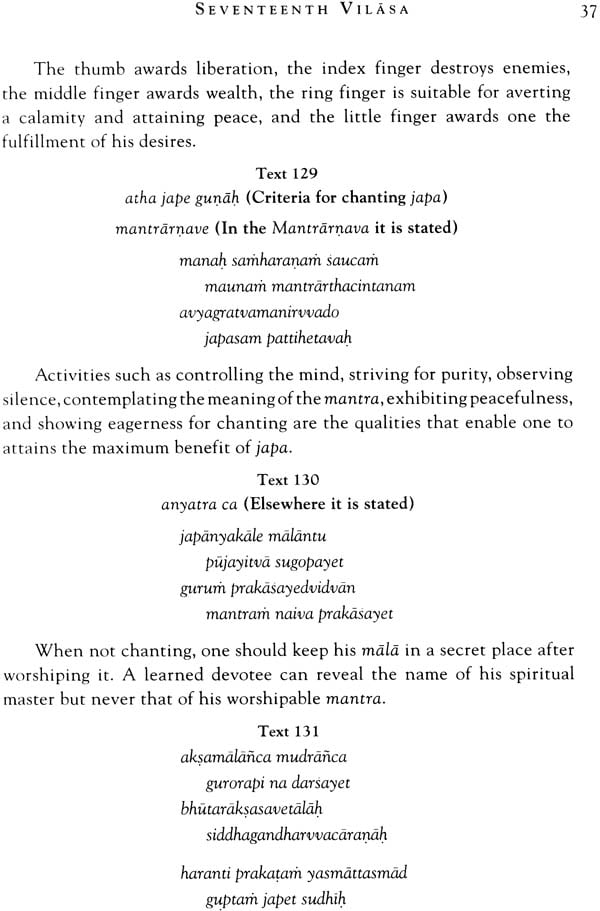
| Criteria for chanting japa | 37 | |
| Faults to be avoided while chanting japa | 38 | |
| Prescribed atonement for faults in this regard | 42 | |
| The various kinds of japa and their symptoms | 44 | |
| The glories of chanting a mantra | 46 | |
| Particular benefits obtained by chanting in various ways | 47 | |
| The rules for conducting a fire sacrifice | 56 | |
| The prescribed number of rounds to be chanted | 57 | |
| The process for performing tarpana | 61 | |
| The process for sprinkling water on one's head | 62 | |
| The process of purascarana in brief | 64 | |
| Alternatives in this connection | 67 | |
| The symptoms of perfection in the chanting of mantras | 68 | |
| The duty of one who has attained perfection by chanting | 70 | |
| The method of achieving perfection in case of failure | 71 | |
| Eighteenth Vilasa | ||
| The manifestation of the Deity | 77 | |
| The process for carving a Deity | 79 | |
| The measurements of the Deity | 81 | |
| That which is first to be performed | 82 | |
| The mantra for offering worship | 83 | |
| The measurement of the various limbs | 84 | |
| The breadth of the Deity | 87 | |
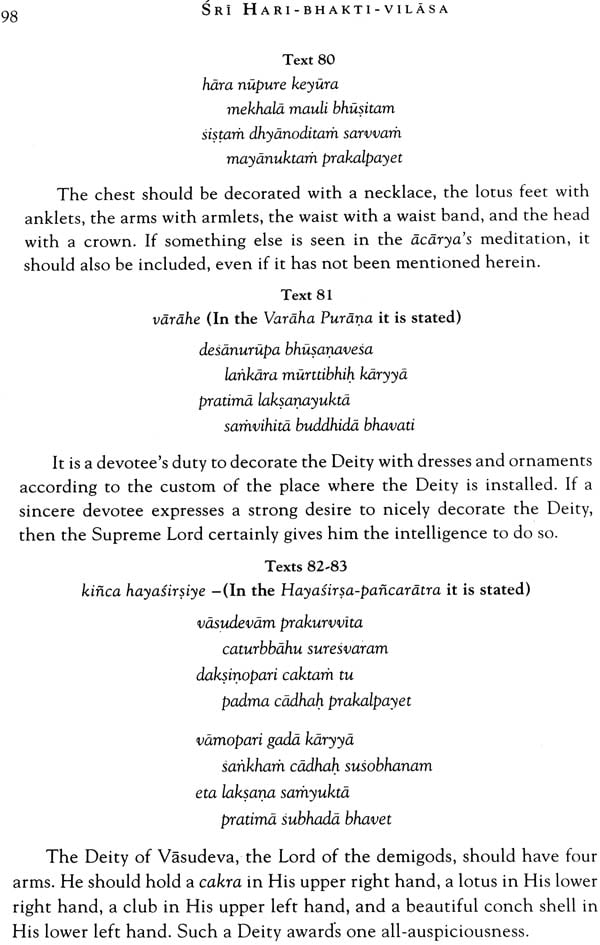
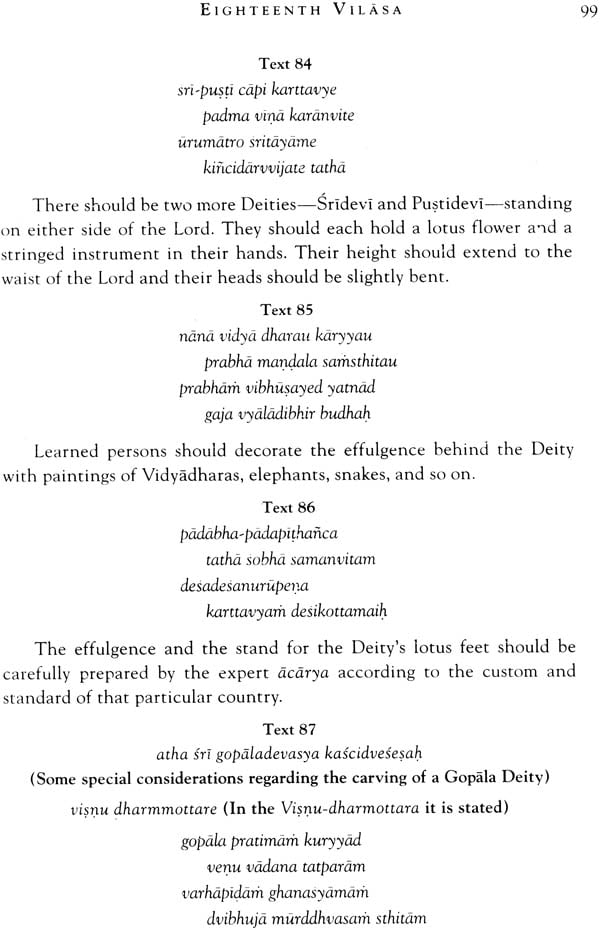
| Some considerations regarding the carving of a Gopala Deity | 99 | |
| The size of a female Deity | 102 | |
| The various sizes of different Deities | 107 | |
| The Deity of Varahadeva | 108 | |
| The Deity of Nrsimhadeva | 109 | |
| The Deity of Trivikrama | 110 | |
| The Deity of Matsya and Kurma | 111 | |
| The Deity of Maha-Visnu | 111 | |
| The Deity of Lokapala-Visnu | 112 | |
| The Deity of Vasudeva | 112 | |
| The Deity of Sankarsana | 115 | |
| The Deity of Pradyumna | 116 | |
| The Deity of Aniruddha | 116 | |
| The Deity of Vamandeva | 120 | |
| The Deity of Trivikrama | 121 | |
| The Deity of Parasurama | 121 | |
| The Deity of Lord Ramacandra | 122 | |
| The Deity of Krsna | 122 | |
| The Deity of Baladeva | 122 | |
| The Deity of Pradyumna | 123 | |
| The Deity of Kamadeva | 123 | |
| The Deities of Aniruddha and Samba | 124 | |
| The Deity of Gopala | 124 | |
| The Deity of Lord Buddha | 124 | |
| The Deities of Nara-Narayana | 125 | |
| Various Deities of the supreme Lord | 126 | |
| The Deity of laksmi Narayana | 131 | |
| In the Visvakarma sastra it is stated | 131 | |
| The deity of Yogasvami | 132 | |
| The ten principal incarnations of the Supreme Lord | 133 | |
| The characteristics of the Deity of Lord Kurma | 134 | |
| The characteristics of the Deity of Lord Varaha | 135 | |
| The Characteristics of the Deity of Lord Nrsimha | 136 | |
| The characteristics of the Deity of Lord Vamana | 138 | |
| The characteristics of the Deity of Lord Parasurama | 139 | |
| Characteristics of the Deity of Lord Rama | 140 | |
| Characteristics of Deity of Lord Balarama | 141 | |
| Characteristics of Deity of Lord Buddha | 141 | |
| Characteristics of Deity of Lord Kalki | 142 | |
| Characteristics of Deity of the nine vyuha | 142 | |
| Characteristics of Deity of Purusottama | 148 | |
| Characteristics of Deity of Visvarupa | 152 | |
| Characteristics of the Deity of the Supreme Lord | 153 | |
| Characteristics of the Deity of Laksmi | 154 | |
| Characteristics of the Deity of Garuda | 158 | |
| The fault of carving a substandard or disfigured Deity | 160 | |
| Deities of the Supreme Lord as manifested in different materials | 162 | |
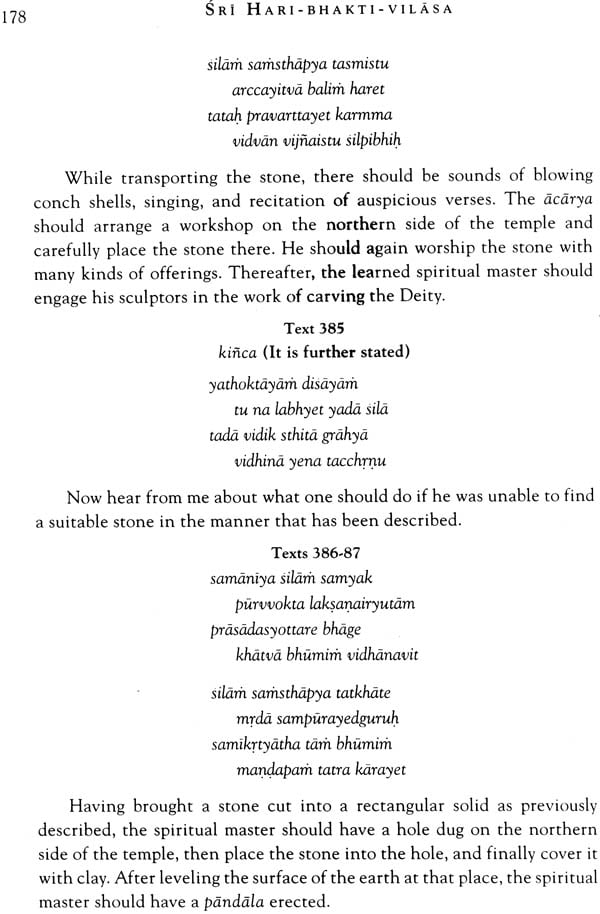
| How to choose a stone for carving a Deity | 166 | |
| The process for begging pardon | 172 | |
| The mantra for invoking the presence of the Lord | 173 | |
| The duty of a sculptor | 188 | |
| Nineteenth Vilasa | ||
| The procedure for installing the Deity | 203 | |
| The characteristics of installation | 203 | |
| The glories of the Deity installation | 204 | |
| The proper time for installing the Deity | 212 | |
| The suitable place for installing a Deity | 220 | |
| The qualifications of one who can install of the Deity | 223 | |
| The beginning of the installation of an immovable Deity | 232 | |
| The names of the sixteen mother of the universe | 233 | |
| The size of the altar | 240 | |
| Installing the water pitcher | 242 | |
| A mandapa for bathing the Deity | 245 | |
| Placing flags in the ground | 246 | |
| The procedure for worshiping the dik-palas | 249 | |
| The commencement of the installation ceremony | 254 | |
| Invocation before the solemnization of ceremony | 260 | |
| Bringing the Deity to the snana-mandapa | 267 | |
| The prayer | 270 | |
| Satisfying the sculptor | 271 | |
| The abhiseka ceremony | 273 | |
| The mantra to be chanted | 273 | |
| Invoking the Deity's vision | 275 | |
| Decorating the Deity's eyes with black ointment | 278 | |
| Offering of arghya | 278 | |
| The mantra for applying ointment | 281 | |
| The special bathing ceremony | 282 | |
| The glories of abhiseka | 293 | |
| The procedure for moving the Deity | 293 | |
| The procedure for installing the Deity | 300 | |
| Invoking life into the Deity | 307 | |
| The fire sacrifice | 311 | |
| The names of the eight murttis | 314 | |
| The glories of the adhivasa ceremony | 323 | |
| The procedure of digging a pit in the temple | 323 | |
| The procedure for purifying the Deity's stand | 328 | |
| The Deity's arrival at the principal mandapa | 329 | |
| The mantras for offering gems | 339 | |
| Specific articles offered to achieve specific benedictions | 347 | |
| The auspicious bathing of the Deity | 352 | |
| Offering gifts to Indra and others | 355 | |
| Placing the Deity's stand in the pit | 358 | |
| Activities to be performed after the Deity installation ceremony | 362 | |
| Mantras to be chanted while touching the limbs of the Deity | 363 | |
| The six mantras | 364 | |
| Special instructions for chanting the mantras | 365 | |
| The grand worship | 371 | |
| The mantra for inviting the Lord | 372 | |
| Symptoms indicating that the Lord has appeared in the Deity | 377 | |
| The procedure for worshiping the acarya | 380 | |
| The procedure for permanently establishing the Deity | 383 | |
| Activities to be performed on the fourth day | 391 | |
| The final bathing of the Deity | 394 | |
| The performance of the fire sacrifice | 400 | |
| Erecting a flag | 404 | |
| The procure for installing a movable Deity | 418 | |
| The glories of installing a moveable Deity | 438/td> | |
| The procedure for drawing auspicious symbols, or mandalas | 440 | |
| The procedure for greeting a brahmana | 441 | |
| The procedure for worshiping Vastudeva, or the guardian deity | 442 | |
| The procedure for bathing the Diety | 443 | |
| The mantra for bathing the Deity | 445 | |
| The procedure for offering garments of the Deity | 447 | |
| Offering prayers and gifts to the Deity | 448 | |
| The procedure for waking up the Lord | 451 | |
| The mantra for offering flowers | 455 | |
| The method for respecting the acarya | 457 | |
| The merit obtained by installing a Deity | 458 | |
| The glories of renovation of the Deity | 477 | |
| Twentieth Vilasa | ||
| The procedure for building a temple | 479 | |
| The proper time for constructing a temple | 485 | |
| The suitable place for building the temple room | 489 | |
| The procedure for purifying the location | 490 | |
| The procedure for acquiring land | 497 | |
| The method for determining the suitable direction | 499 | |
| The procedure for worshiping the guardian deity | 512 | |
| The procedure for building the foundation | 523 | |
| The characteristics of the stone | 531 | |
| The characteristics of a temple | 537 | |
| Some special characteristics of a mandapa | 551 | |
| The procedure for selecting a gate | 555 | |
| The procedure for building walls | 559 | |
| Planting trees around the temple | 560 | |
| Renovation of a temple | 562 | |
| The installation and marriage ceremony of Tulasi-devi | 564 | |
| The conclusion | 570 | |
| The duties of an unalloyed devotee | 572 |