

A Course in Indian Philosophy
Book Specification
| Item Code: | NAC659 |
| Author: | A.K. Warder |
| Publisher: | Motilal Banarsidass Publishers Pvt. Ltd. |
| Edition: | 2018 |
| ISBN: | 9788120814820 |
| Pages: | 260 |
| Cover: | Paperback |
| Other Details | 8.5 Inch X 5.5 Inch |
| Weight | 330 gm |
Book Description
The course for which the Outline of Indian Philosophy was originally written has long ceased to appear in any university calendar, thanks to the universal cuts in support for education. Its content is of course completely irrelevant to the world of greed and moneymaking which has replaced the remarkably idealistic societies emerging from the crucible of death and destruction in the Second World War. Then, the survivors were glad to be alive and wanted ib fill the mourning world with new joy, not with money. The greatest joy was that of knowledge in all its forms, of science, of art, of the human quest for enlightenment wherever records had survived. This knowledge was delightful in itself, but it might also enlighten our society and secure our freedom. The cultural hegemony of Europe having evaporated in the failure of 193840, the new knowledge might enhance our view of civilisation, giving breadth and depth to reflections on how the future might be better than the past.
That dream has now been shattered. This investigation of the philosophy of India, which was part of it, exists in a passive form, the professor who created it having retired. The publishers of the Outline, however, have resolved to renew the book, in the hope that such a prospect of sustained thought about the possibility of knowledge itself can still inspire fancy. They also wished to claim for it the status of an actual Course in Indian Philosophy, for private study.
The text has been kept to its original scope, since the first intention was just to photograph it, with revisions pasted over the old wording, occupying exactly the same space. These revisions, therefore, consist mostly of more exact translations substituted for the old ones, with here and there a substituted paragraph or some sentences added in the available space at the end of a chapter. No additions could be made to the Bibliography except by deleting existing items. Now the publishers have re-set the text, which greatly improves its appearance and clarity, but without having allowed the author to take advantage of the flexibility.
A translation can never be made perfectly accurate, but only to focus more sharply on the source, like a better telescope. As Dinnaga might have said, we can gradually exclude inaccuracy. Some examples here are: ‘sensation’ for ‘perception’, which should have been obvious before because it is ‘to the sense’ (pratyaksa); ‘perception’ is now restricted to the mental activity (samjnä). ‘Own-being’ instead of ‘own-nature’ is consistent with other kinds of ‘being’ (bhava). ‘Principles’, instead of ‘elements’ or ‘phenomena’, for dharmas is far better because it does not suggest eternal substances nor on the other hand an unlimited vagueness not yet analysed, without observed regularities. It may also show how its homonym came to be used for a doctrine. Sanskrit (and Pali) distinguishes many kinds of ‘object’, especially the real (vastu, ‘in itself or ‘out there’ as some would say), the ‘sense datum’ (visaya) and the ‘support’ (alambana, the mental ‘object’). There is the object aimed at, which is also the meaning (artha), we might call it the ‘objective’ (see pp. 92, 180), but has not yet been clearly focussed. Sense ‘entrance’ (dyatana) is much better than the vague ‘sphere’. ‘Base’ instead of ‘element’ is historically correct as well as clearer, since the dhatu is also the ‘ore’ from which a metal springs, its source. For vedana we have travelled from ‘sensation’ (rejected because that belongs to rupa, matter or the physical) via ‘emotion’ (but not in this book, rejected because it overlaps into the ‘forces’) to ‘experience’ (thus it is the same as vedayita, experienced or experiencing). Namarupa is still obscure, but it is nama which gives form to inchoate matter (rupa, originally the ‘appearance’, see pp. 18-9 and 50-1).
The longest revision concerns Dinnaga, especially on his Pramdiyasamuccaya, of which it is at last possible to obtain a sufficiently comprehensive view in its original Sanskrit terms, thanks to Professor Katsura’s article on the Apoha Theory of its fifth chapter. There is a substantial addition on the Bahurutiya School of Buddhists on p. 96, also derived from the research of Professor Katsura. Also substantial is the insertion on pp. 192-3 on the Sthaviravada philosophers Ananda, Dhammapala and the anonymous author of the Carhipa4a on the Patisambhidamagga.
So we try again to break through the limitations of Eurocentric prejudice and ignorance and misleading translations, which exclude the analytical philosophy of India, as well as her ancient sciences, from due notice and useful provision. People still think Indian philosophy must be ‘spiritual’: not philosophy but religion, irrational and mysterious. But on the whole Western philosophy is more ‘spiritual’ and mystical:
for a thousand years it was totally subordinated to dogmatic theology, whilst earlier Plato and others used myth to expound some of their supposed insights. Even recently, the struggle for independence from ‘revelation’ and faith has been hard and protracted. By contrast India, until the ravages of Western inquisition and the argument of the sword in the form of Islam, enjoyed two thousand years’ steady development of free thinking investigations of epistemology, logic and language. Who can better show the harmony and continuity between science and philosophy than the free Indian thinkers? Who now has the better understanding of the interaction between mind and matter, or between language and the incessant storms of radiance and molecules it tries to comprehend? In Lokayata and Buddhism mind is living matter itself, variously explained. In all Indian philosophy, with the partial exception of Navya Nyaya, language speaks only of classes, cannot reach particular events. Neurology now appears to confirm the Buddha’s hypothesis of the unreality of the ‘soul’ or ‘sell’ and to establish a Lokayata-like view of consciousness as a property of matter, suitably arranged. The quest for knowledge continues; perhaps a new dream of the future will take hold of humanity.
This Course, however, makes no comparisons, except that it necessarily translates Indian concepts into a foreign language. The aim here is simply expository: better communication from the vista of a past civilisation.
This Outline is intended to serve as an introductory textbook for Indian philosophy. It indicates the scope of the subject, providing essential basic material for the study, chronologically arranged, and giving references for further reading- The material’ here provided is taken direct from the original sources, i.e. the works of Indian philosophers, and translated by the author of the Outline in all cases: its authenticity can always be checked by anyone who eares to look up the original, provided lie can read the original language.
Much that is found in books purporting to be on ‘Indian Philosophy’ is of doubtful authenticity or else not on philosophy at all. Students should reserve judgment until they can verify the precise statements of Indian philosophers in the original sources, having first discovered which the relevant texts are. In no other subject have the subjective views of modern authors been so whimsical and arbitrary. As far as writings in English are concerned, the view seems to prevail that in fact India has had no philosophy in the strict sense of a discipline. Most English books contain only religious dogma and speculation, very various in content but agreeing in missing the problems of philosophy itself. It is as if every man is born knowing what ‘philosophy’ is, having his own ‘philosophy’, and accordingly able to select from Indian literature and write on ‘philosophy’ without having studied the subject itself. Of course, this is using the word ‘philosophy’ in a different sense from the discipline proper. The misfortune here is that those who are concerned with philosophy proper are put off by most of the books they may pick up on Indian ‘philosophy’ and misled into thinking India has nothing to offer in the way of philosophical investigations. The present book is merely a general survey, allowing no room for detailed exposition and discussion, which requires monographs on individual philosophers and problems. As a general outline it also traces the origins and is arranged chronologically, though it hardly contains any history beyond this arrangement. This is meant to facilitate the placing of a philosopher to some extent in the development and study of the problems, in other words in his philosophical environment. Despite its brevity and the limitations of an attempt to survey an entire field of human enquiry from its origins, it is hoped that this introduction will help to dispel misconceptions and to bring to the attention of contemporary philosophers investigations of interest and value.
In general the author has here sought for philosophy in the strict sense of the discipline of philosophical analysis and criticism, as explained in Chapter I. Metaphysics or ‘speculative philosophy’ is regarded as peripheral, bordering on religion. Ethics and aesthetics have been omitted as special philosophical enquiries which require separate study. Thus the main direction of the present study is epistemology, which includes logic.
| Preface to the Second Edition | vii | |
| Preface to the First Edition | xi | |
| I. Preliminary Definitions | 1 | |
| II. Summary | 4 | |
| III. Origins | 12 | |
| IV. Uddalaka | 20 | |
| V. Sandilya, Yajnavalkya and Other Upanisad Speculations | 25 | |
| VI. The Sramanas | 29 | |
| VII. Lokayata, Ajivaka and Ajnana Philosophy | 32 | |
| VIII. The Buddha | 45 | |
| IX. Jainism | 60 | |
| X. Samkhya and Mimamsa | 63 | |
| XI. Dharma and Artha | 69 | |
| XII. Ancient Indian Science | 76 | |
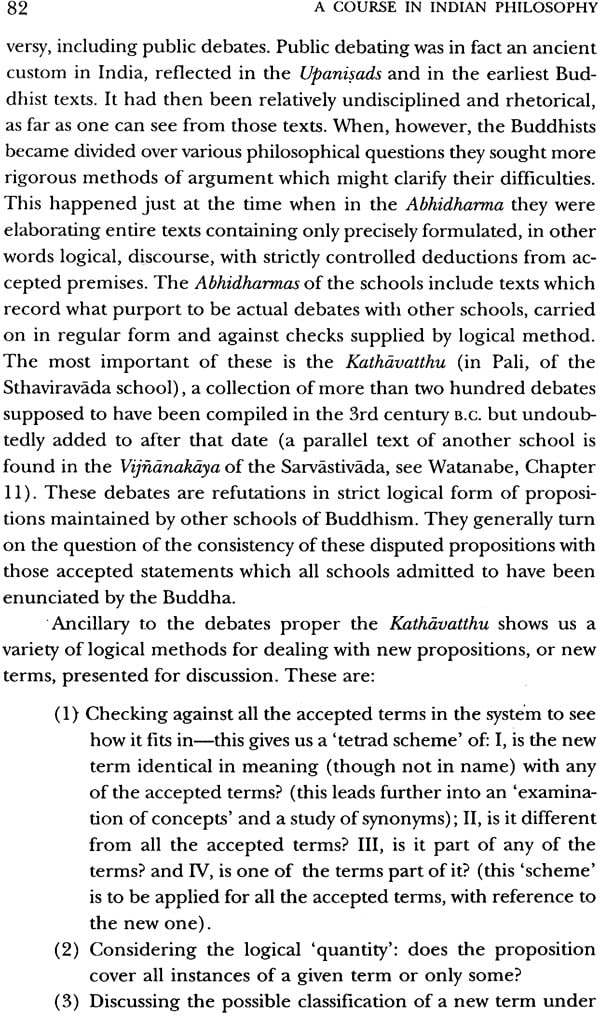
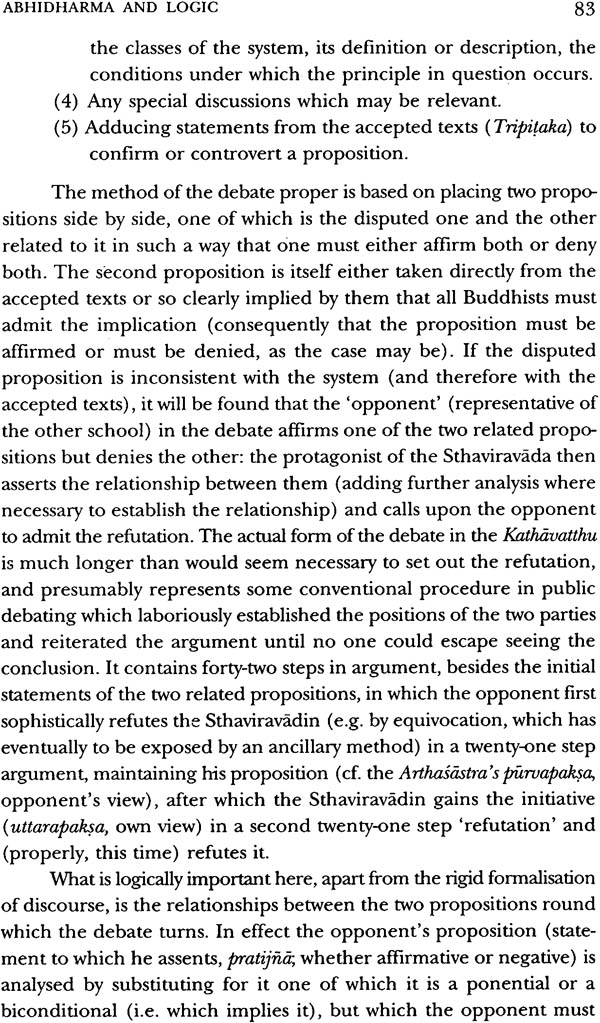
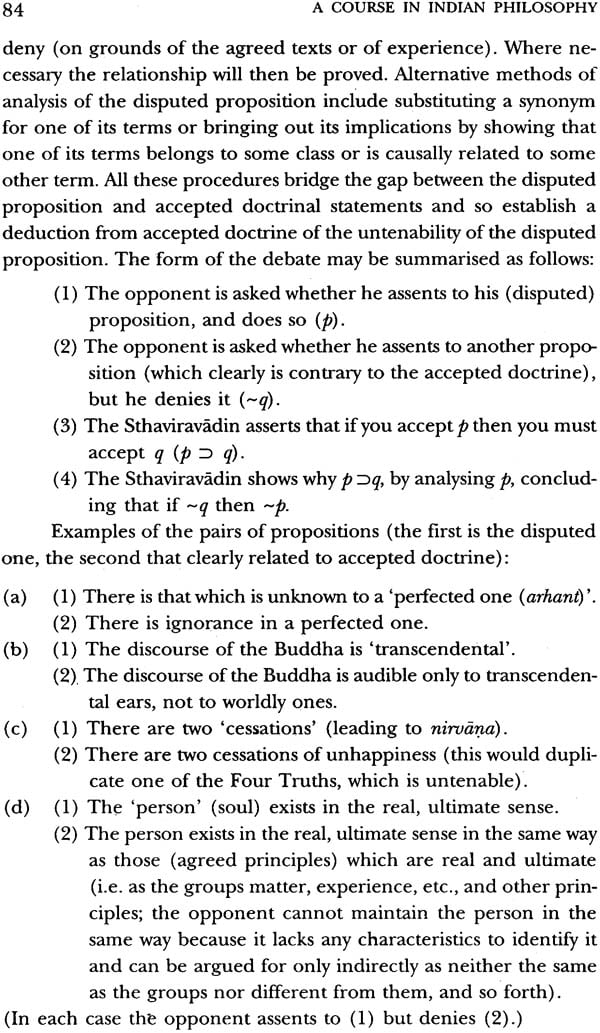
| XIII. Abhidharma and Logic | 81 | |
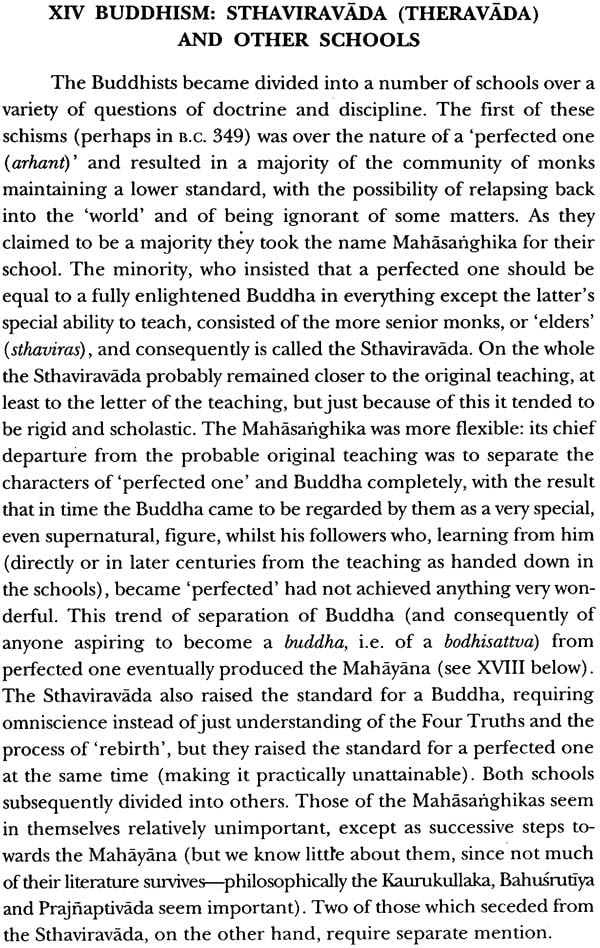
| XIV. Buddhism: Sthaviravada (or Theravada) and Other Schools | 85 | |
| XV. Jaimini and Varsaganya | 98 | |
| XVI. Vaisesika | 103 | |
| XVII. Further Developments in Logic and Epistemology | 115 | |
| XVIII. Mahayana Buddhism | 124 | |
| XIX. Debate and Logic (Caraka and Others) | 128 | |
| XX. Madhyamaka | 138 | |
| XXI. Aksapada and Nyaya | 150 | |
| XXII. Idealism: The Later Mahayana Sutras | 156 | |
| XXIII. Asanga | 161 | |
| XXIV. Dinnaga | 166 | |
| XV. Post-Dinnaga Brahmanical Philosophy | 184 | |
| XVI. Post-Dinnaga Buddhist Philosophy | 192 | |
| XXVII. Navya Nyaya | 208 | |
| Select Bibliography | 215 | |
| Index | 243 |