

Essays in Philosophy and Yoga
Book Specification
| Item Code: | NAK760 |
| Author: | Sri Aurobindo |
| Publisher: | Sri Aurobindo Ashram, Pondicherry |
| Language: | English |
| Edition: | 2012 |
| ISBN: | 9788170589747 |
| Pages: | 614 |
| Cover: | Paperback |
| Other Details | 8.5 inch X 5.5 inch |
| Weight | 810 gm |
Book Description
Essays in Philosophy and Yoga contains the short works of Sri Aurobindo that were written between 1909 and 1950 and published during his lifetime. All but a few are concerned with aspects of spiritual philosophy, Yoga, and related subjects. They include the following material:
Essays from the Karmayogin, a weekly newspaper edited by Sri Aurobindo in 1909 and 1910
The Yoga and Its Objects, an important early essay on Yoga, written around 1912
On Ideals and progress, The Superman, Evoluction, and Thoughts and Glimpses, four small books first published in 1920s
The Problem of Rebirth, sixteen essays on Karma, heredity, rebirth and evolution, first serialized in Arya review between 1915 and 1920
The supramental Manifestation upon Earth, eight essays on the future evolution of man, written in 1949 and 1950.
The early works in this book serve as a fine introduction to the central ideas of Sri Aurobindo’s spiritual philosophy and method of yogic practice. The final work, written shortly before his passing, presents his vision of the future of humanity.
The changes we see in the world today are intellectual, moral, physical in their ideal and intention: the spiritual revolution waits for its hour and throws up meanwhile its waves here and there. Until it comes the sense of the others cannot be understood and till then all interpretations of present happening and forecast of man’s future are vain things. For its nature, power, event are that which will determine the next cycle of our humanity.
Sri Aurobindo was born in Calcutta on 15 August 1872. At the age of seven he was taken to England for his education. He studied at St. Paul's School, London, and at King's College, Cambridge. Returning to India in 1893, he worked for the next thirteen years in the Princely State of Baroda in the service of the Maharaja and as a professor in the state's college.
In 1906 Sri Aurobindo quit his post in Baroda and went to Calcutta, where he became one of the leaders of the Indian nationalist movement. As editor of the newspaper Bande Mataram, he put forward the idea of complete independence from Britain. Arrested three times for sedition or treason, he was released each time for lack of evidence.
Sri Aurobindo began the practice of Yoga in 1905. Within a few years he achieved several fundamental spiritual realisations. In 1910 he withdrew from politics and went to Pondicherry in French India in order to concentrate on his inner life and work. Over the next forty years, he developed a new spiritual path, the Integral Yoga, whose ultimate aim is the transformation of life by the power of a supramental consciousness. In 1926, with the help of his spiritual collaborator the Mother, he founded the Sri Aurobindo Ashram. His vision of life is presented in numerous works of prose and poetry, among the best known of which are The Life Divine, The Synthesis of Yoga, Essays on the Gita and Savitri. Sri Aurobindo passed away on 5 December 1950.
Essays in Philosophy and Yoga consists of short works in prose written by Sri Aurobindo between 1909 and 1950 and published during his lifetime. All but a few of them are concerned with aspects of spiritual philosophy, yoga, and related subjects. Short writings on the Veda, the Upanishads, Indian culture, political theory, education, and poetics have been placed in other volumes.
The title of the volume has been provided by the editors. It is adapted from the title of a proposed collection, "Essays in Yoga", found in two of Sri Aurobindo's notebooks. Since 1971 most of the contents of the volume have appeared under the editorial title The Supramental Manifestation and Other Writings.
The contents are arranged in five chronological parts. Part One consists of essays published in the Karmayogin in 1909 and 1910, Part Two of a long essay written around 1912 and published in 1921, Part Three of essays and other pieces published in the monthly review Arya between 1914 and 1921, Part Four of an essay published in the Standard Bearer in 1920, and Part Five of a series of essays published in the Bulletin of Physical Education in 1949 and 1950.
Many of the essays in Part Three were revised slightly by the author and published in small books between 1920 and 1941. The editors have retained the titles and arrangement of most of those books.
The texts of the pieces have been checked against the texts published in journals and books during Sri Aurobindo's lifetime.
| Part One | Essays from the Karmayogin (1909-1910) | |
| The Ideal of the Karmayogin | 3 | |
| Karmayoga | 9 | |
| Man - Slave or Free? | 13 | |
| Yoga and Human Evolution | 18 | |
| Yoga and Hypnotism | 23 | |
| The Greatness of the Individual | 29 | |
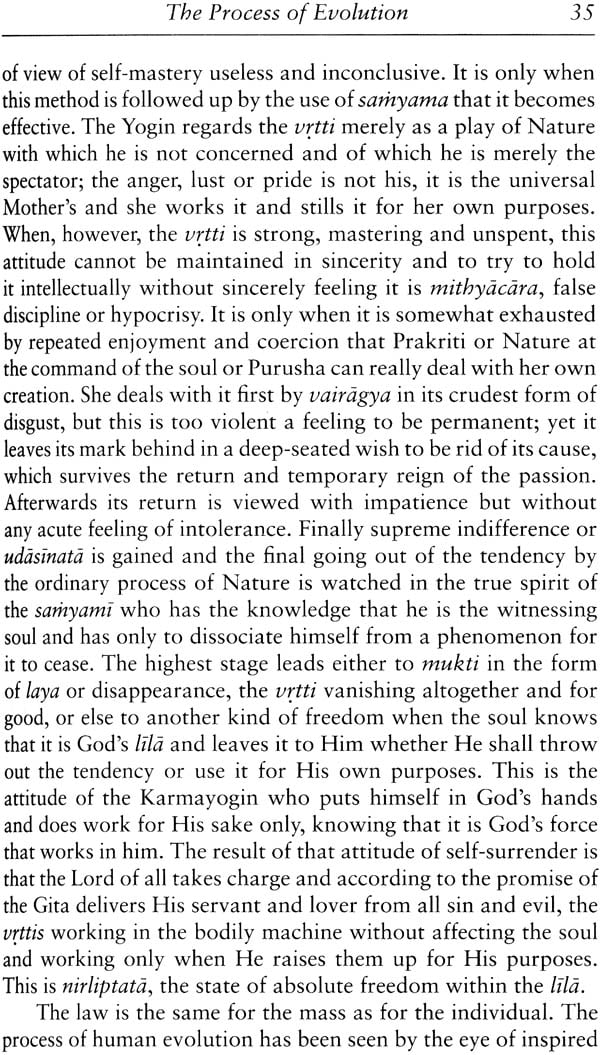
| The Process of Evolution | 33 | |
| Stead and the Spirits | 38 | |
| Stead and Maskelyne | 43 | |
| Fate and Free-Will | 47 | |
| The Three Purushas | 51 | |
| The Strength of Stillness | 57 | |
| The Principle of Evil | 60 | |
| The Stress of the Hidden Spirit | 64 | |
| Part Two | The Yoga and Its Objects (circa 1912) | |
| The Yoga and Its Objects | 71 | |
| Appendix: Explanations of Some Words and Phrases | 92 | |
| Part Three | Writings from the Arya (1914-1921) | |
| Notes on the Arya | ||
| The "Arya 's" Second Year | 101 | |
| Appendix: Passages Omitted from "Our Ideal" | 103 | |
| The "Arya's" Fourth Year | 105 | |
| On Ideals and Progress | ||
| On Ideals | 111 | |
| Yoga and Skill in Works | 119 | |
| Conservation and Progress | 127 | |
| The Conservative Mind and Eastern Progress | 133 | |
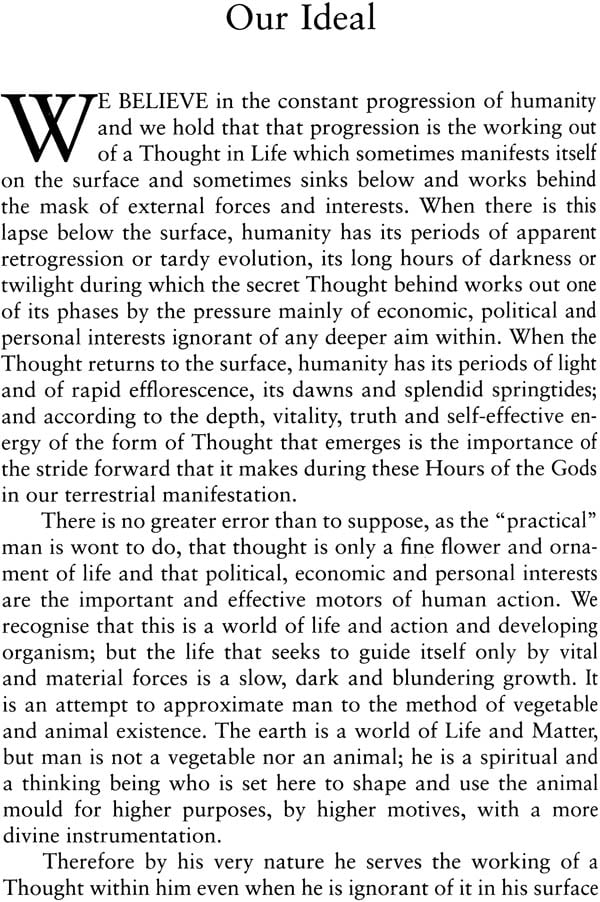
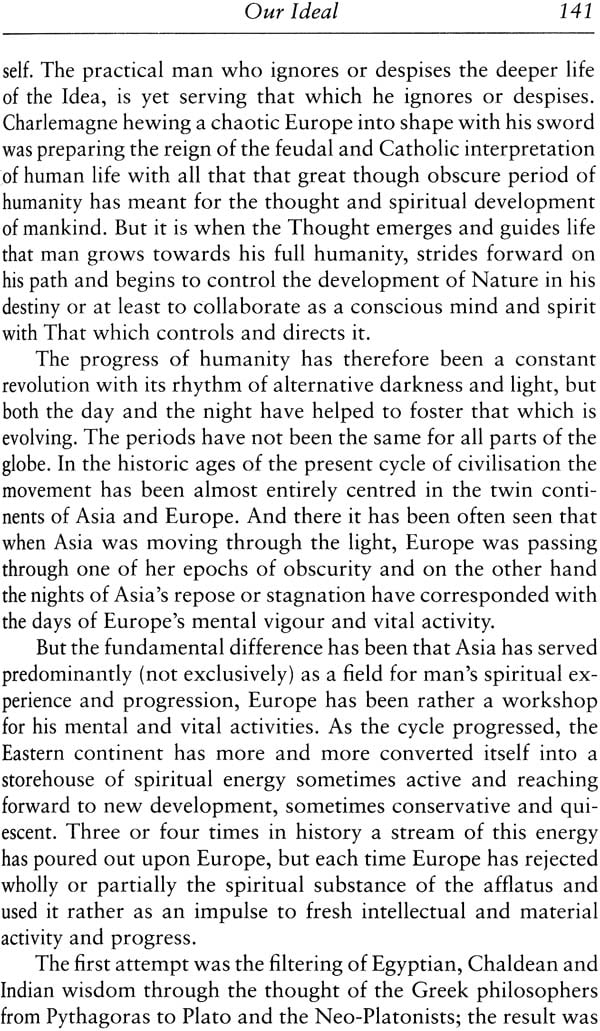
| Our Ideal | 140 | |
| The Superman | ||
| The Superman | 151 | |
| All-Will and Free-Will | 158 | |
| The Delight of Works | 163 | |
| Evolution | ||
| Evolution | 169 | |
| The Inconscient | 176 | |
| Materialism | 184 | |
| Thoughts and Glimpses | ||
| Aphorisms | 199 | |
| Thoughts and Glimpses | 208 | |
| Heraclitus | ||
| Heraclitus | 215 | |
| The Problem of Rebirth | ||
| Section I: | Rebirth and Karma | |
| Rebirth | 259 | |
| The Reincarnating Soul | 270 | |
| Rebirth, Evolution, Heredity | 277 | |
| Rebirth and Soul Evolution | 285 | |
| The Significance of Rebirth | 295 | |
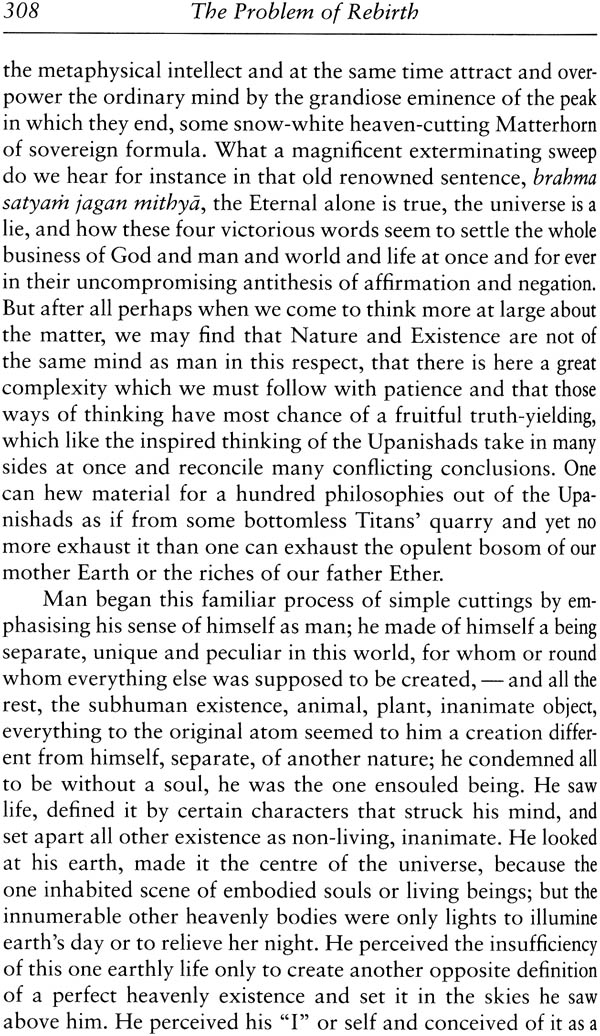
| The Ascending Unity | 307 | |
| Involution and Evolution | 317 | |
| Karma | 330 | |
| Karma and Freedom | 338 | |
| Karma, Will and Consequence | 351 | |
| Rebirth and Karma | 358 | |
| Karma and Justice | 367 | |
| Section II: | The Lines of Karma | |
| The Foundation | 379 | |
| The Terrestrial Law | 386 | |
| Mind Nature and Law of Karma | 398 | |
| The Higher Lines of Karma | 413 | |
| The Tangle of Karma | 427 | |
| A Clarification | 433 | |
| Other Writings from the Arya | ||
| The Question of the Month | ||
| The Needed Synthesis | 439 | |
| "Arya" -Its Significance | 441 | |
| Meditation | 445 | |
| Different Methods of Writing | 448 | |
| Occult Knowledge and the Hindu Scriptures | 451 | |
| The Universal Consciousness | 453 | |
| The News of the Month | ||
| The News of the Month | 459 | |
| South Indian Vaishnava Poetry | ||
| Andal: The Vaishnava Poetess | 465 | |
| Nammalwar: The Supreme Vaishnava Saint and Poet | 467 | |
| Arguments to The Life Divine | ||
| Arguments to The Life Divine | 471 | |
| Part Four | From the Standard Bearer (1920) | |
| Ourselves | 509 | |
| Part Five | From the Bulletin of Physical Education (1949-1950) | |
| The Supramental Manifestation upon Earth | ||
| Message | 517 | |
| Perfection of the Body | 521 | |
| The Divine Body | 536 | |
| Supermind and the Life Divine | 558 | |
| Supermind and Humanity | 568 | |
| Supermind in the Evolution | 578 | |
| Mind of Light | 585 | |
| Supermind and Mind of Light | 588 |