

How to Teach Religion
Book Specification
| Item Code: | UAR672 |
| Author: | Aniruddh Jha |
| Publisher: | Edukeen Publisher |
| Language: | English |
| Edition: | 2019 |
| ISBN: | 9789389387193 |
| Pages: | 282 |
| Cover: | HARDCOVER |
| Other Details | 9.50 X 6.50 inch |
| Weight | 590 gm |
Book Description
Religious education is controversial worldwide. Some countries, such as the United States, do not publicly fund religious education nor make it part of compulsory schooling. In other contexts, such as the United Kingdom, an 'open' religious education has emerged from Christian confessionalism that it is intended to promote religious literacy without imparting a particular religious perspective. This kind of religious education has drawn criticism because, it is argued, there is no neutral perspective from which to study religions and any kind of compulsory schooling is likely to impact on the formation of a student's religious identityReligion in India is characterised by a diversity of religious beliefs and practices. India is a secular state with no state religion. The Indian subcontinent is the birthplace of four of the world's major religions; namely Hinduism, Buddhism, Jainism, and Sikhism. According to the 2011 census, 79.8% of the population of India practices Hinduism, 14.2% adheres to Islam, 2.3% adheres to Christianity, and 1.7% adheres to Sikhism.
Aniruddh Jha is a Professor of Philosophy, University of Hyderabad. He achieved his degrees M.A. (Philosophy) and PhD (Moral Values of Hinduism in Veda) from BHU, Varanasi. He has worked extensively on Vedic philosophy, Classical Indian Philosophy, Contemporary Indian Philosophy, Comparative Religion and Buddhism. He has authored several spiritual books. He has authored more than twenty research papers and articles published in national and international journals. He has travelled all over India to teach Indian Religion & Philosophy.
Religious education is controversial worldwide. Some countries, such as the United States, do not publicly fund religious education nor make it part of compulsory schooling In other contexts, such as the United Kingdom, an 'open' religious education has emerged from Christian confessionalism that it is intended to promote religious literacy without imparting a particular religious perspective. This kind of religious education has drawn criticism because, it is argued, there is no neutral perspective from which to study religions and any kind of compulsory schooling is likely to impact on the formation of a student's religious identity Religion in India is characterised by a diversity of religious beliefs and practices. India is a secular state with no state religion. The Indian subcontinent is the birthplace of four of the world's major religions; namely Hinduism, Buddhism, Jainism, and Sikhism. According to the 2011 census, 79.8% of the population of India practices Hinduism, 14.2% adheres to Islam, 23% adheres to Christianity, and 1.7% adheres to Sikhism. Zoroastrianism and Judaism also have an ancient history in India, and each has several thousands of Indian adherents. India has the largest population of people adhering to Zoroastrianism (ie. Parsis and Iranis) and Bahá'í Faith in the world, even though these religions are not native to India. Many other world religions also have a relationship with Indian spirituality, such as the Baha'i faith which recognises the Buddha and Krishna as manifestations of the God Almighty.
HISTORY OF RELIGION
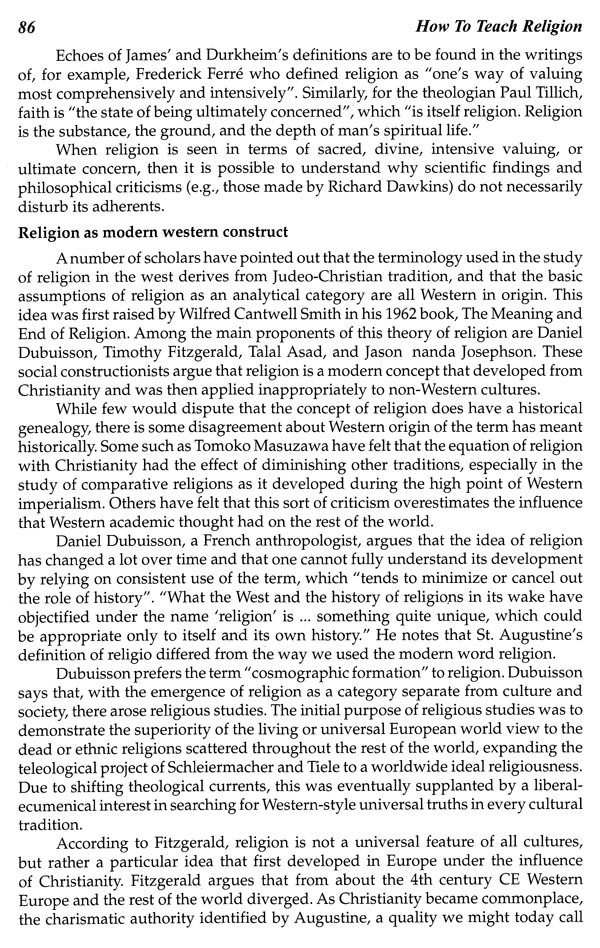
The history of religion refers to the written record of human religious experiences and ideas. This period of religious history begins with the invention of writing about 5.200 years ago (3200 BCE). The prehistory of religion involves the study of religious beliefs that existed prior to the advent of written records. One can also study comparative religious chronology through a timeline of religion. Writing played a major role in standardizing religious texts regardless of time or location, and making easier the memorization of prayers and divine rules. The case of the Bible involves the collation of multiple oral texts handed down over the centuries.The concept of "religion" was formed in the 16th and 17th centuries, despite the fact that ancient sacred texts like the Bible, the Quran, and others did not have a word or even a concept of religion in the original languages and neither did the people or the cultures in which these sacred texts were written.
The word "religion" as used in the 21st century does not have an obvious pre-colonial translation into non-European languages. The anthropologist Daniel Dubuisson writes that "what the West and the history of religions in its wake have objectified under the name 'religion' is something quite unique, which could be appropriate only to itself and its own history". The history of other cultures' interaction with the "religious" category is therefore their interaction with an idea that first developed in Europe under the influence of Christianity.
History of writing
The history of writing traces the development of expressing language by letters or other marks and also the studies and descriptions of these developments. In the history of how writing systems have evolved in different human civilizations, more complete writing systems were preceded by proto-writing, systems of ideographic or early mnemonic symbols.**Contents and Sample Pages**