

Manu-Smrti (A Critical Study and Its Relevance in the Modern Times)
Book Specification
| Item Code: | NAL853 |
| Author: | Asha Rani Tripathi |
| Publisher: | D. K. Printworld Pvt. Ltd. |
| Language: | English |
| Edition: | 2015 |
| ISBN: | 9788124608333 |
| Pages: | 384 |
| Cover: | Hardcover |
| Other Details | 9.0 inch X 6.0 inch |
| Weight | 710 gm |
Book Description
Manu-Smrti is one of the most coveted and popular works of ancient India. It comprises codes that are needed for an ideal, peaceful and harmonious society. The entire Manu-Smrti revolves around the Vedic concept of rta or dharma. The concepts of purusarthas, asramas and varnas have their roots in dharma. These concepts were meant to make the life of every member of the society fruitful and purposeful. The codes prescribed by Manu became an authority on ancient laws and were put in practice . The scholars working in different field of Sociology, religion, Philosophy, ethics ancient laws and politics are bound to consult Manu-Smrti for some reason or the other.
The present book is an effort to bring together all scattered materials related to different topics contained in Manu-Smrti. The book also aims to diffuse many of the doubts related to certain topics contained in Manu-Smrti, for example status of brahmana, sudra and woman. The analysis of topics such as human values, raja-dharma and Manu’s codes or crime and punishment has been presented in this book in a lucid style. All these topics bear great relevance even in modern times. The volume tries to maintain the originality of Manu’s concepts through retional and honest approach. The book also includes few modern subjects like economics, ecosystem management and biodiversity conservation that have been dealt by Manu in a scientific manner.
This book will benefit all those who want to know about the rules and practices that governed our ancient history, pertaining to all the aspects of human life.
Dr( Mrs) Asha Rani Tripathi, M.A(Sanskrit & Hindi), B.ED., Ph.D.(Sanskrit, Banaras Hindu University, Varanasi), was Head of the Department of Sanskrit & Hindi at Sankardev Collage, Shillong (affiliated to North-Eastern Hill University (NEHU) for twenty-four years. She also taught Sanskrit at Gorakhpur University for two years as a UGC Post-doctoral Fellows, and Hindi at NEHU, Shillong for four years as a Guest Faculty.
She has published thirty research papers and has participated and chaired technical sessions at several national and international conferences held in India and abroad (Turin , Darmouth, Kathmandu, Edinburgh and Houston). She has also published two books: Sanskrit ke Prateekatmaka Nataka (2003) and Khasi Folk Songs and Tales (in Hindi verses and prose) (2006).
Her current research interests are: Science in Rgveda, A Critical Study of Manu-Smrti; and Comparative Study of Indian and Western Aesthetics.
A Brief History of Vedic Literature
Indian thoughts and ideals are the real treasure house of the variegated products of the perennial flow of Indian culture. This tradition has acknowledge human life as a rare bliss and an opportunity to perform noble deeds. The human life was thus accorded a systematic form by framing it into different purusarthas (dharma, artha, kama and moksa). The practice of dharma became the main goal of life, as through dharma only, one might enjoy artha and kama in a desired manner and might finally attain moksa (freedom from the worldly life) through self-realization. The four Vedas laid the foundation of this unique philosophy. The tradition of attaching due importance to dharma in human life was further carried through all later writings. Kalpasutras (one of the Vedangas) brought out all the rules of dharma in a systematic form which were otherwise scattered all over the four Vedas. The three sections of Kalpasutras (Srauta, Grhya, Dharma) dictated the rules and regulations pertaining to dharma, related to the different aspects of life in a true and practical manner. Srautasutras deal with the performance of the Vedic rites, while Grhyasutras describe the numerous ceremonies connected to the domestic life of a person from his birth to death. Dharmasutras, which are directly connected to Grhyasutras, deal with dharma in detail. These Sutras have expanded the definition of dharma in its wider sense. The meaning of dharma was stretched to all social concerns such as rights, duties, law, religion and even culture. Most of these Dharmasutras had originated from different Vedic schools. Apart from that, there are many are many independent Dharmasutras.
The basic content Dharmasutras was to assert the authority of Vedas as the source of dharma. They also discussed the duties of four varnas (brahmana, ksatriya, vaisya and sudra), four asramas (brahmacarya, grhastha, vanaprastha and samnyasa), samskaras, governance, rules for taxation, ownerships, witness, moneylending, payment of dept and deposits, punishments for various crimes, inheritance, sraddhas, sins, expiations and penance. The prominent Dharmasutras are: Gautama-Dharmasutra, Baudhayana-Dharmasutra, Apastamba-Dharmastura, Vasistan-Dharmastura Hiranyakesi-Dharmasutra and Vaikhanasa-Dharmasutra. Many other Dharmasutras are the supplementary parts of Srautasutras and Grhyasutras and are mainly written in prose.
Manu-Smrti and Other Smrtis
Smrtis are the highly specialized literature focusing fully on various aspects of dharma. They follow the content of Dharmasutra and are the metrical codes. The term smrti means “remembrance”, as they reveal the dharma already prescribed in Vedas. The word smrti means the memory or recollection of what was previously cognized. They are the works rendered by those great sages who studied the Vedas and pondered over their injunctions and prohibitions. These sages were conversant with the codes and demonstrated the utility of those codes by practising them in their own life. Thus Smrtis became the tool of improving man’s day-to-day life for securing a fruitful future. Many Smrtis were composed side by side to Dhamasturas. Many times even Dharmasutras refer to Smrtis. Manu-Smrti, Yajnavalkya-Smrti, Parasara-Smrti, Narada-Smrti, Brhaspati and Katyayana-Smrti are the well-known Smrtis.
Among all these Smrtis, Manu-Smrti is the most ancient, authoritative and systematic One. It has been said that if Panini has determined the nature of the Sanskrit language for all time, Manu has determined the Hindu conduct for all time.
History of the Text of Manu-Smrti and Is Relation to Other Texts
Manu-Smrti is one of the most popular books that India has ever produced. It has received a high estimation for centuries. The publication of the translation of Manu-Smrit by Sir William Jones cleared all the doubts which Westerners had in their minds about Indian thought. In fact, it has paved the way for many European scholars to understand the Indian notions of judiciary based on the ground of practical and systematic judicial administration. All these subjects have been thoroughly discussed in Manu-Smrti. These topics become the centre of attraction and prompted numerous discoveries later on.
Sir William Jones’s translation (1794) was reprinted in 1796; Johann Huttner did the German translation in 1797; it was largely used by the scholars writing on early criminal law. A number of editions of this work have so far been published in India since 1796. In this work the Nirnaya Sagara edition with the commentary of Kulluka has been used. The widely acclaimed and well –known translations of Manu-Smrti have been done by V.N. Mandlik and Georg Buhler.
The content of Manu-Smrti has proved that India had a rich tradition of thinking on how to bring about real harmony between the different groups of the society and how to introduce an ideal life. In spite of all its substantiality, the work is shrouded in several types of controversies. In order to assess the in text in this true spirit, the following questions have to be answered first:
1. Was there a person named Manu as an author of the work and when was was it written?
2. Did he write the whole content of the book at a time or was it written in succession?
3. Is the extant Manu-Smrti the same work as was originally written by Manu?
It is not going to be an easy task to produce the facts related to all these question, but even then a humble effort can be made to ascertain the facts with the help of certain available evidences.
In many mantras of Rgveda, Manu has been mentioned as “father” (RV I.80, 114.2; VIII.63.1). At another place Manu is addressed as “our father” (yani manur-avrnita pita nah). One may also come across may compounded words like manu-jata, manu-pritasah and manur-hita. These words are occurring hundreds of times throughout Rgveda. At another place the sages pray to gods to show them the ancestral path of Manu (RV VIII.30). Manu is also considered as the light of the people (RV I.36.19). Manu offers sacrifices to the gods (RV V.35.15; VIII.30.2; X.36.10). Manu is also prayed to along with Indra (VIII.68.6). In Rgveda most of the mantras mention Manu as an individual sage. According to another mantra, Manu is a sage who offers prayers to thirty-three gods (VIII.27.4, 30.2). In Rgveda there are many stories related to Manu (X.61-63). Manu is also referred in Atharvaveda (XI.33) and in Samaveda (I.2.33; III.165, 145, 232; IV.123-24; VI.262). Manu has been delineated in Sanskrit literature from the early Vedic period onwards. He is regarded as father, as one of the ancient sages, a semi-divine person and a king who received law and regulation from the gods itself. Manu-Smrti also mentions that Manu became a king by his own righteous conduct (VII.4).
| Acknowledgement | v | |
| Scheme of Transliteration | xiii | |
| Abbreviations | xiv | |
| Introduction | 1 | |
| A Brief History of Vedic Literature | 1 | |
| Manu-Smrti and Other Smrtis | 2 | |
| History of the Text of Manu-Smrti and Its Relation to Other Texts | 3 | |
| A Debate on the Existing Controversy on Manavadharmasastra | 10 | |
| Relation of Manu-Smrti to Mahabharata and Arthasastra | 22 | |
| Time of Manu-Smrti | 32 | |
| The Content of Manu-Smrti | 42 | |
| Commentaries on Manu-Smrti | 43 | |
| 1 | Dharma and Manu-Smrti | 50 |
| Meaning of the Word Dharma | 50 | |
| Changing From of Dharma in the Vedas, Upanisads and Brahmanas | 52 | |
| Nature of Dharma | 55 | |
| Special Features of Dharma | 55 | |
| Dharmas Pertaining to Four Asramas of Human Life | 56 | |
| Practical Approach to Dharma | 63 | |
| Nature of Apad, Prayascitta and Sadharana Dharma | 64 | |
| Role of Rituals and Yajnas in Human Life | 70 | |
| Importance of Four Purusarthas | 72 | |
| The Sources of Dharma | 78 | |
| 2 | Human Values and Manu-Smrti | 78 |
| Meaning of the Word "Value" | 79 | |
| Indian Concept of Values | 80 | |
| Concept of "Rta" in Manu-Smrti | 81 | |
| Significance of Values in Human Actions | 89 | |
| Manu's Practical Approach to Value System | 97 | |
| Value as an Instrument for Improving the Quality of Life | ||
| Relevance of Manu's Idea of Human Values in Modern Life | 99 | |
| Importance of Human Values for Maintaining Global Harmony | 102 | |
| 3 | Manu's Treatment of Brahmanas | 105 |
| Ethos of Indian Culture | 105 | |
| Nature of the Class Division of the Society during Vedic Period | 106 | |
| Classes and Castes during Smrti Period and Justification for the Change | 106 | |
| Place of Brahmanas in the Society | 109 | |
| Conditions for Getting Brahmanahood | 110 | |
| Special Privileges Given to Brahmanas in Dharmasastras and Manu-Smrti | 115 | |
| Role of Bhrahmanas in Elevating the Society | 117 | |
| Reasons for Granting Special Privileges to Brahmans and Their Nature | 119 | |
| Role of Brahmanas in Governance and Administration | 120 | |
| Severe Punishment Prescribed for Brahmanas | 127 | |
| Atatayi Brahmanas | 130 | |
| Analysis of the Whole Concept Related to Brahmanas | 131 | |
| 4 | Raja-dharma and Manu-Smrti | 136 |
| Evidences of Monarchy in Vedas and Dharmasastras | 136 | |
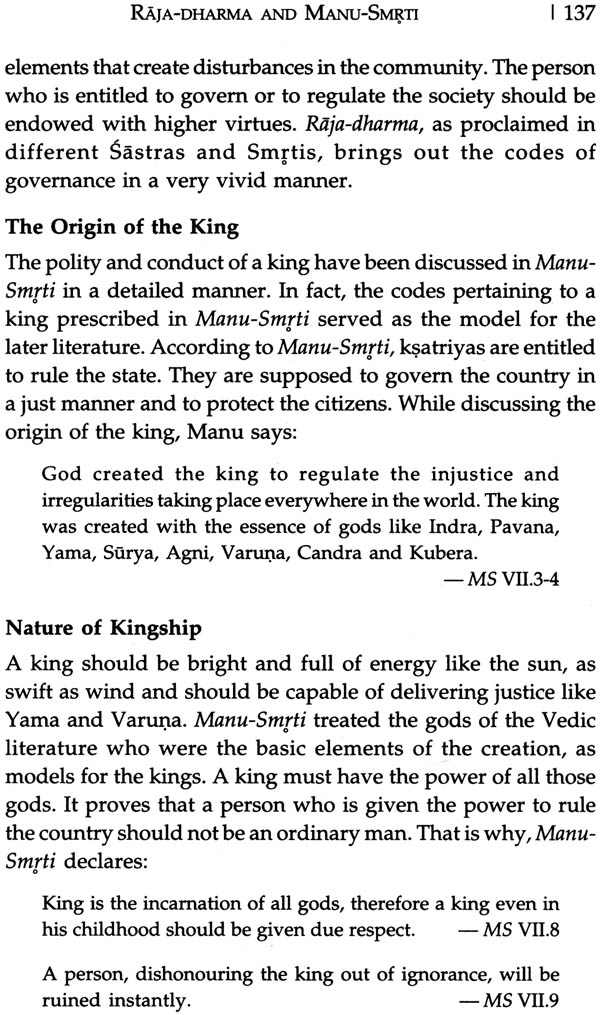
| The Origin of the King | 137 | |
| Nature of Kingship | 137 | |
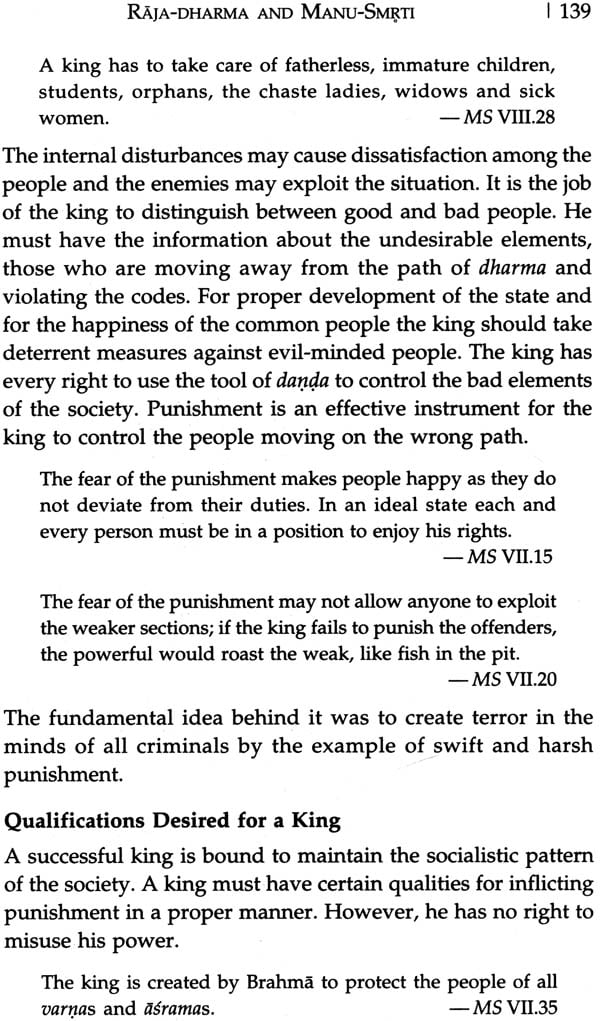
| Qualifications Desired for a king | 139 | |
| Construction of Durgas | 142 | |
| Art of War | 143 | |
| Diplomacy and Protection of Boundaries | 146 | |
| Appointment of Ministers and other Officials | 151 | |
| Statecraft | 156 | |
| 5 | Manu's Codes Pertaining to Punishment | 174 |
| Concept of Welfare State | 174 | |
| Theory of Matsya-Nyaya: Its Nature and Repercussions | 175 | |
| How to Prevent Matsya-Nyaya? | 177 | |
| Nature of Danda | 178 | |
| Why do We Need Danda | 179 | |
| Creation of a Trouble-free Society | 180 | |
| Role of Punishment in Maintaining Peace and Order | 181 | |
| Who May Have the Power of Inflicting Punishment? | 184 | |
| Points to Be Taken Care of at the Time of Punishing Someone | 186 | |
| Code of Punishment | 189 | |
| Importance of Law and Its Implementation | 190 | |
| Imposing Fine for Certain Types of Crime | 192 | |
| Who Are Liable to Be Punished? | 197 | |
| Acts Disturbing Public Life a Crime | 199 | |
| Protection of Ecosystem | 201 | |
| Protection of Human Rights | 203 | |
| Types of Crime and Punishment | 204 | |
| Reasons for Inflicting Harsh Punishments | 205 | |
| Relevence of Manu's Penal Codes in Present-day Social Challenges | 212 | |
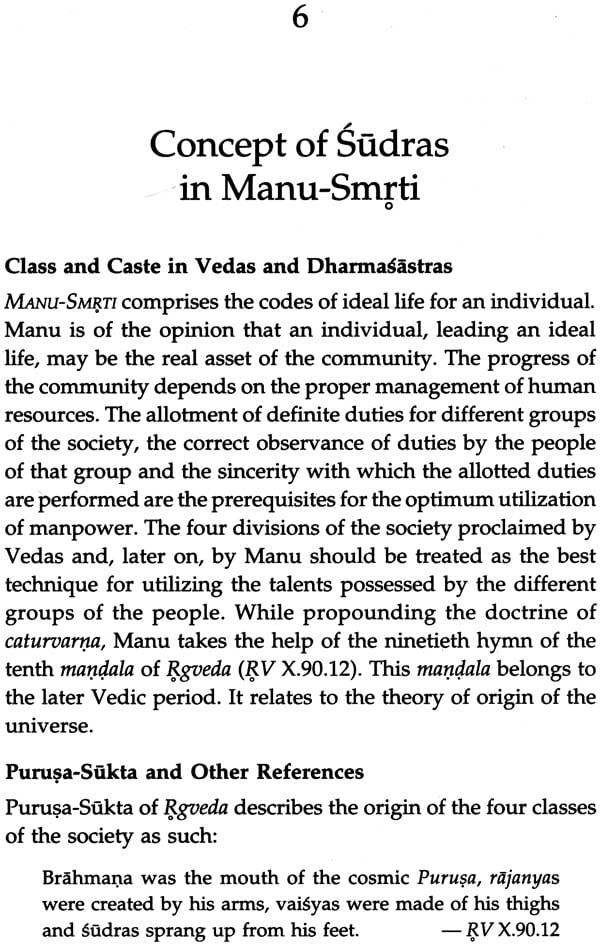
| 6 | Concept of Sudras in Manu-Smrti | 216 |
| Class and Caste in Vedas and Dharmasastras | 216 | |
| Pursa-Sukta and Other References | 216 | |
| Sudras in Early and Later Vedic Period | 217 | |
| Evolution of Sudra Concept: An Analysis | 218 | |
| Reasons for Including Sudras in Class System | 219 | |
| Kings Degraded as Sudras | 224 | |
| Concept of Anarya | 228 | |
| Status of Sudras | 231 | |
| Social Privileges of Sudras | 231 | |
| Means and Methods for Improving Status | 232 | |
| Sudras and Brahmanahood | 233 | |
| Rationality of Caste System | 234 | |
| 7 | Status of Woman in Manu-Smrti | 236 |
| Women in Vedic Period | 236 | |
| Women in Brahmana and Upanisadic Periods | 237 | |
| Pleasant Picture of Woman in Manu-Smrti | 238 | |
| Institution of Marriage | 240 | |
| Relation between Man and Women | 242 | |
| Life of Woman after Marriage | 244 | |
| Controversial Remarks in Manu-Smrti | 245 | |
| Woman as Mother | 247 | |
| Widow Remarriage, Niyoga and Childless Women | 251 | |
| Stri-dhana | 254 | |
| Provision of Putrika | 257 | |
| Punishment for Crime against Women | 259 | |
| Conclusion | 263 | |
| 8 | Manu's Concept of Prayascitta and its Significance in Maintaining Harmony and Peace | 267 |
| Meaning of "Peace" and "Harmony" | 267 | |
| Definition of Prayascitta | 268 | |
| Modes of Prayascitta and Its Relation with the Theory of Karma | 270 | |
| Prayascittas for Different Crimes | 271 | |
| Type of Diet vis-à-vis Crime | 281 | |
| Practical Approach to Prayascitta | 282 | |
| 9 | Seeds of Modern Economics in Manu-Smrti | 285 |
| Place of Wealth in Indian Tradition | 285 | |
| Varta in Manu's Perspective | 286 | |
| Components of Economic Growth | 288 | |
| Agriculture | 288 | |
| Labour | 295 | |
| Capital | 297 | |
| Banking | 299 | |
| Moneylending | 300 | |
| Trade and Industry | 303 | |
| Revenue and Taxation | 310 | |
| Conclusion | 315 | |
| 10 | Codes for Biodiversity Conservation and Ecosystem Stability | 317 |
| Man as a Member of Biological Community | 317 | |
| Ecosystem Stability | 318 | |
| Codes for the Exploitation and Protection of Plants | 320 | |
| Codes for Soil Conservation | 322 | |
| Eco-friendly City Planning | 325 | |
| Protection of Water Bodies | 326 | |
| Protection of Animals | 328 | |
| Conclusion | 330 | |
| Conclusion | 332 | |
| Bibliography | 345 | |
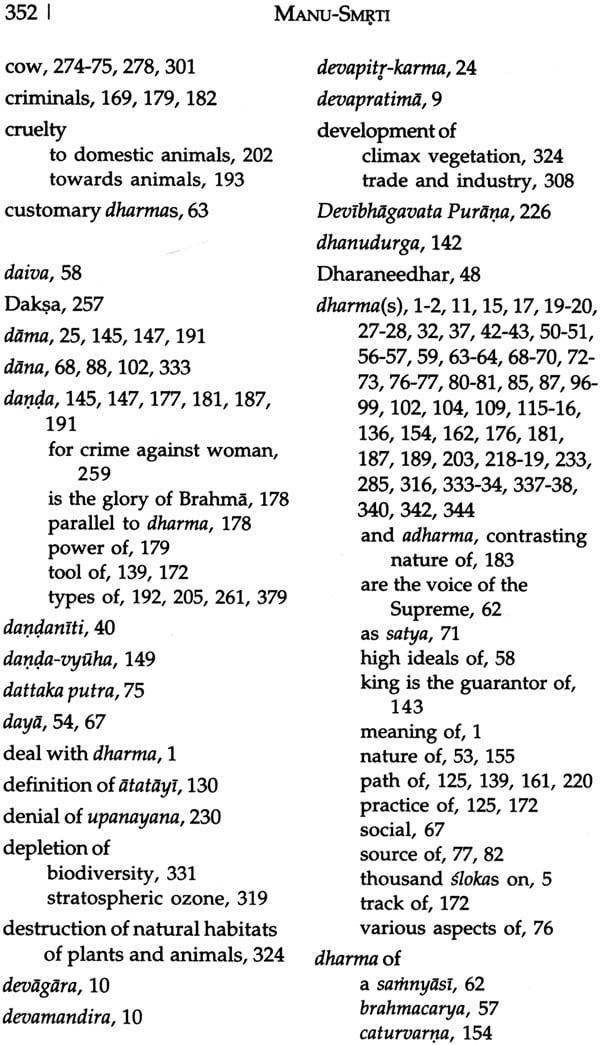
| Index | 348 |