

Principles and Practice of Panchakarma
Book Specification
| Item Code: | NAF264 |
| Author: | Dr. Pulak Kanti Kar |
| Publisher: | Chaukhamba Sanskrit Pratishthan |
| Language: | English |
| Edition: | 2013 |
| ISBN: | 9788170845185 |
| Pages: | 866 |
| Cover: | Hardcover |
| Other Details | 10.0 inch x 7.5 inch |
| Weight | 1.55 kg |
Book Description
The theoretical part of Panchakarma has been explained in this book with an outstanding clinical approach. The procedures have been critically analyzed in the purview of the concept of Panchakarma depicted in the compendium supported by appropriate references. The subject is presented in such a way that Ayurvedic people can realise the matter with a ration vision and can perform the therapy in daily practice.
Dr. Pulak Kanti Kar did has graduation from University of Calcutta, Post graduation in Panchakarma from Gujarat Ayurved University and Ph. D from Rajasthan Ayurved University. He has successfully performed thousands of Panchakarma in different critical diseases. He has written six valuable books on different aspects of Panchakarma. His approach & motivation to propagate Panchakarma has inclined several students & practitioners of Ayurveda to perform this therapy in clinical practice.
The principle based theories if applied in the clinical practice and show their effectiveness to mitigate the diseases, then the theories are converted into applied procedure. The principle is formed through observation, re-observation, experimentation, hypothesis, re-experimentation and conclusion. These six steps are primarily documented in different ancient medical compendium and the vivid description of any therapeutic procedure is detailed with its applied form. All the theories are having some prerogative values because of experimental depiction.
Panchakarma is a fruitful measure and its extensive efficacy is classified in different dimension to cure different types of complicated diseases. Vamana, Virechana, Niruha, Anuvasana and Nasya are the five procedures and subsequently Vamana, Virechana, Basti, Nasya and Raktamokshana are also broadly termed as Panchakarma. The qualitative effect of Panchakarma is purely detailed in a cumulative perspective. The cultivated knowledge of Panchakarma is well transmitted in the way. of applied synchronized process. The inclination towards the practice of Panchakarma is very much' essential for the Ayurvedic doctors to achieve the goal. In day to day practice, the new diseases are evolving with intense gravity and therefore to combat those, Panchakarma is an effective measure. It is not essential that all the karmas are to be performed at a time or in a specific disease, but considering the involvement of the Dosha, dhatu and mala, severity of the disease and the constitution of the individual, the respective measure is advocated following the principles; as a result of which, the outcome is extra-ordinarily beneficial.
In the ancient time it was well practiced with confidence as the Ayurvedic physicians were well acquainted about those therapies and were experts to perform and confident to arrest the adversities well in advance. In due course of time, the practice of this therapy was in a dilemma because of the non acquaintance of the principles of those therapies. The experienced physicians performed these therapies not only by the empirical ways but also maintaining the scientific entities. The appropriate choice of drugs, schedules of dose, preparation of the medicines, requirements for respective diseases were methodically pre tuned and these classical therapies were magnified in different consequences of different diseases.
The micro level analysis of Panchakarma is till unexplored in spite of several research works made in different apex and local Ayurvedic institutions. The recent generation always tries to analyse the matter in the perspective of modern lights. The enriched science behind this therapy is nowhere enlightened. This leads to call for reanalysis of the justification and efficacy of Panchakdarma in new dimension keeping the principles intact. Propagation of knowledge of Panchakarma will definitely accelerate the logical thoughts and practice with regained potentiality of the Ayurvedic physicians.
In this book, with the advent urge of the students, the thorough principles if Panchakarma have been postulated with an elaborative purview in a sequenced manner. Rhythmical study of the portion of Panchakarma of different Ayurvedic compendium has been incorporated in this book to hasten the micro analysis of the systematized study.
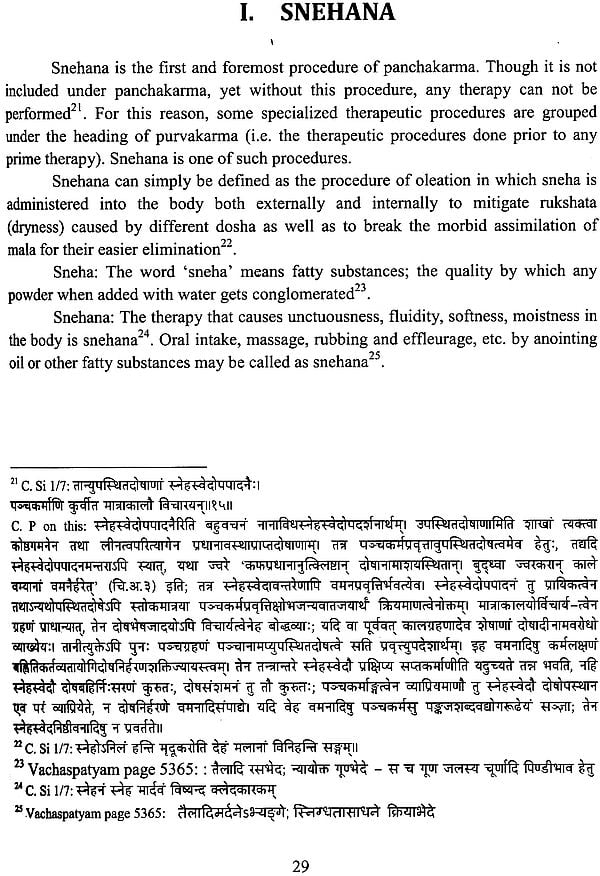
| I. | Snehana | 29 |
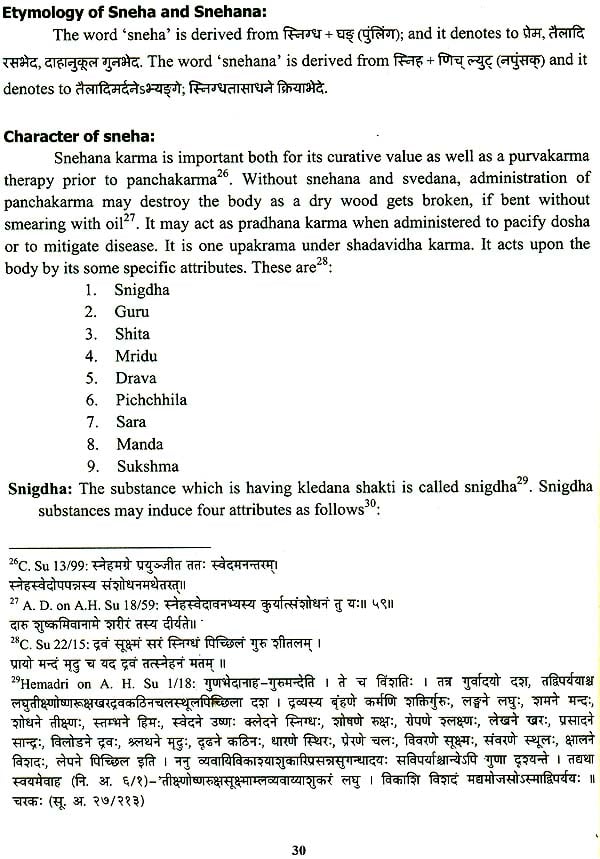
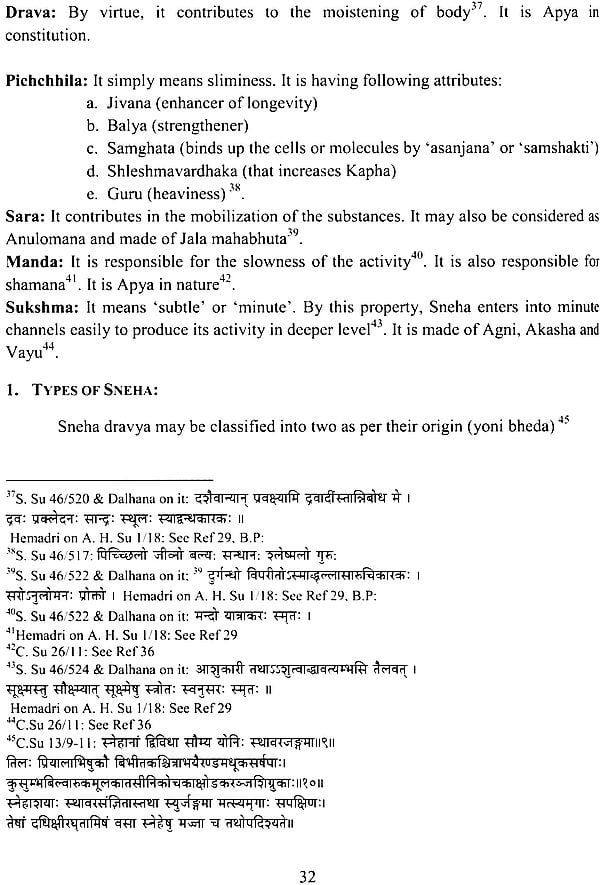
| 1 | Types of Sneha: | 32 |
| 2 | List of common sneha dravya: | 33 |
| 3 | Indications of snehana- karma: | 46 |
| 4 | Contra-indications of snehana-karma | 49 |
| 5 | Sneha pana kala: | 50 |
| 6 | Complications of snehapana if taken in wrong time: | 52 |
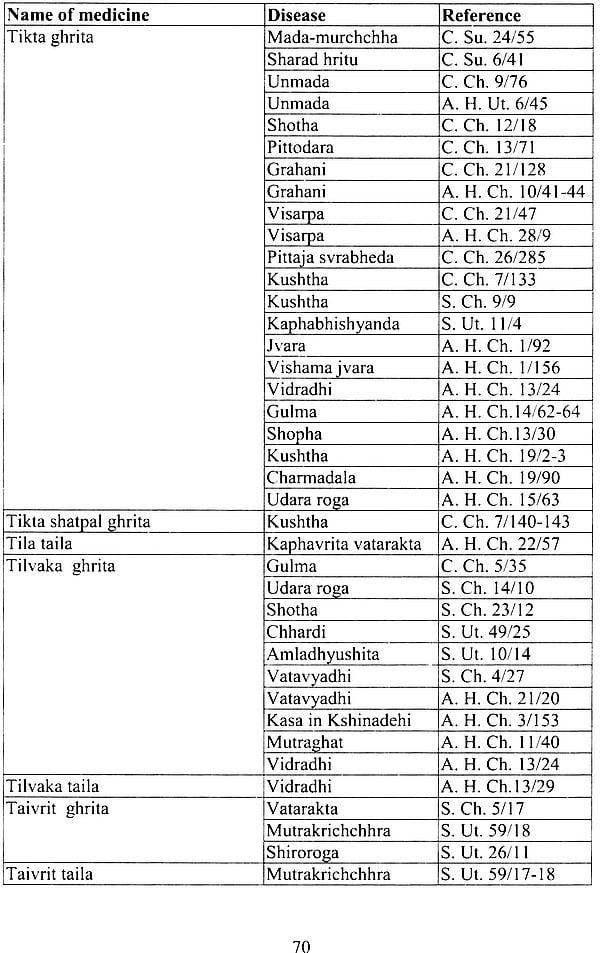
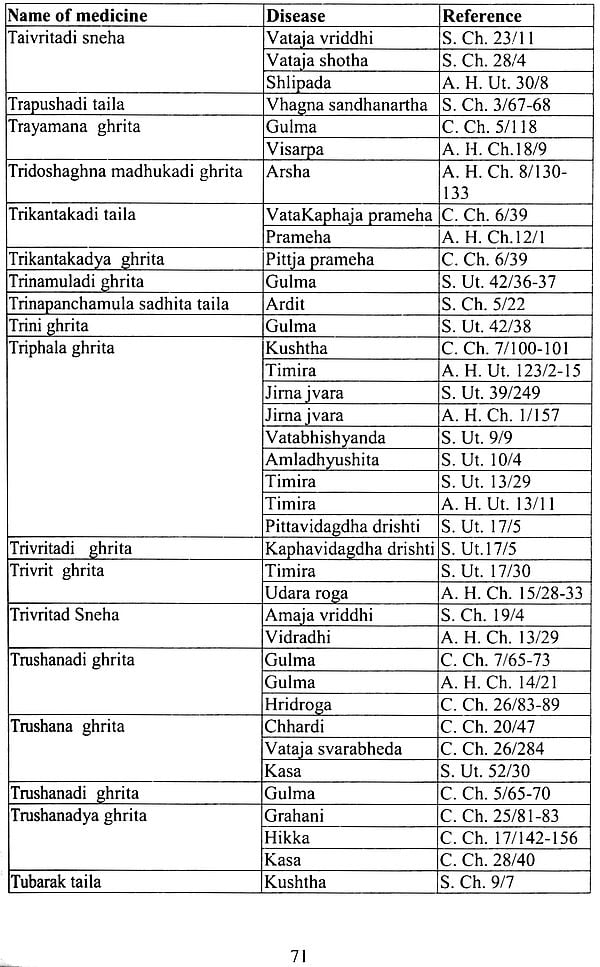
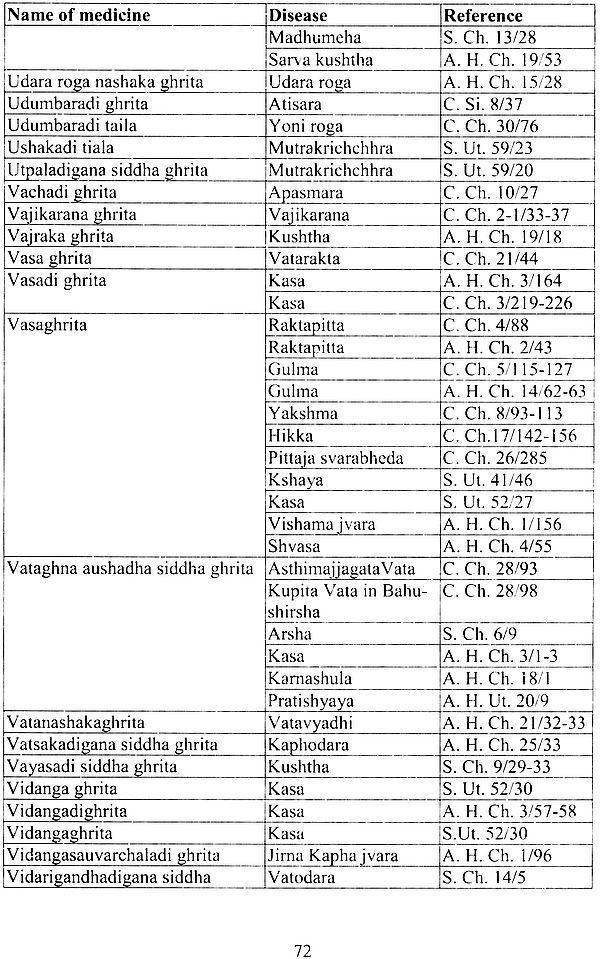
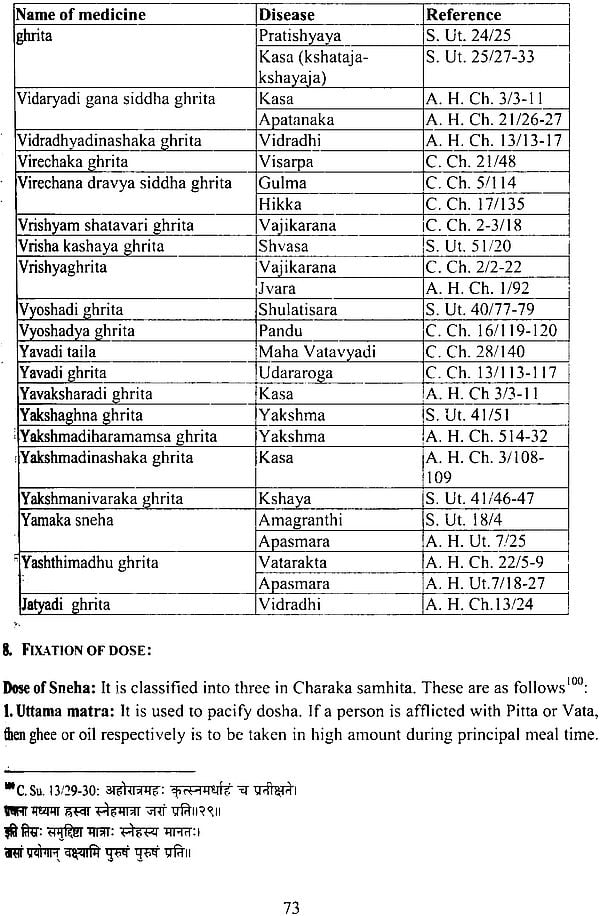
| 7 | List of Sneha to be used in different diseases: | 55 |
| 8 | Fixation of dose: | 73 |
| 9 | Determination of Koshtha: | 80 |
| 10 | Does calculaton: | 81 |
| 11 | Dietary regimen suggested by Charaa and Vagbhatta | 84 |
| 12 | Pradhana karma: | 84 |
| 13 | Snehapjirna lakshan: | 86 |
| 14 | Pradhana karma: | 97 |
| 15 | Sadyasnehana Yoga: | 102 |
| 16 | Sneha Vyapada | 105 |
| 17 | Bahya Snehana(external oleation) | 108 |
| A | Abhyanga: | 109 |
| B | Udnartana: | 115 |
| C | Mardana, Unamardana: | 117 |
| D | Padaghata: | 117 |
| E | Padabhyanga: | 117 |
| F | Samvahana: | 118 |
| G | Lepa: | 118 |
| H | Parisheka: | 120 |
| I | Gandusha | 122 |
| J | Murdha taila: | 130 |
| K | Karma Purana: | 145 |
| L | Nasa tarpana: | 145 |
| M | Akshi Tarpana: | 145 |
| N | Mastishkya: | 150 |
| O | Snehabagahana: | 153 |
| 18 | List of Snehana in different diseases: | 153 |
| II. | Svedana | 210 |
| 1 | Properties, main actions & predominance of mahabhura of svehana dravya: | 213 |
| 2 | Types of svedana: | 213 |
| 3 | Indication of sankara sveda | 226 |
| 4 | References of pinda sveda | 227 |
| 5 | Prastara sveda | 231 |
| 6 | Some indications of prastara sveda | 232 |
| 7 | Nadi sveda | 233 |
| 8 | Some references of madi sveda | 237 |
| 9 | Avagaha sveda: | 238 |
| 10 | Some references of nadi avagaha: | 240 |
| 11 | Pizhichil: | 248 |
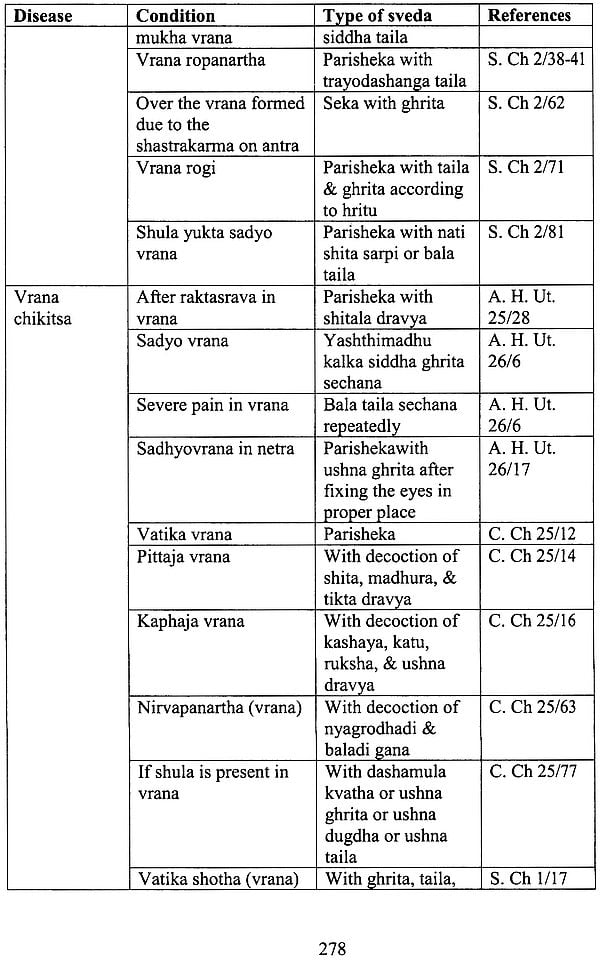
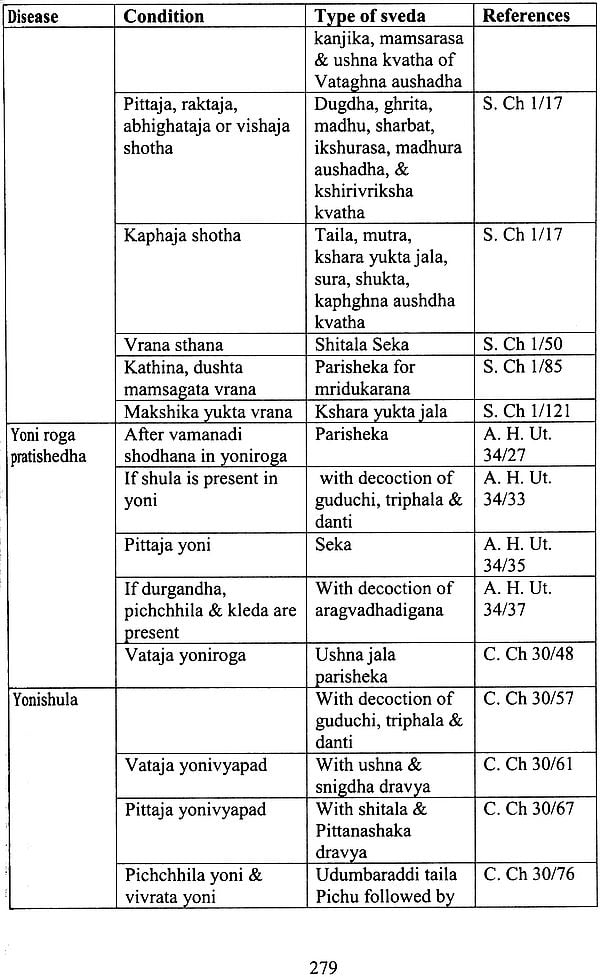
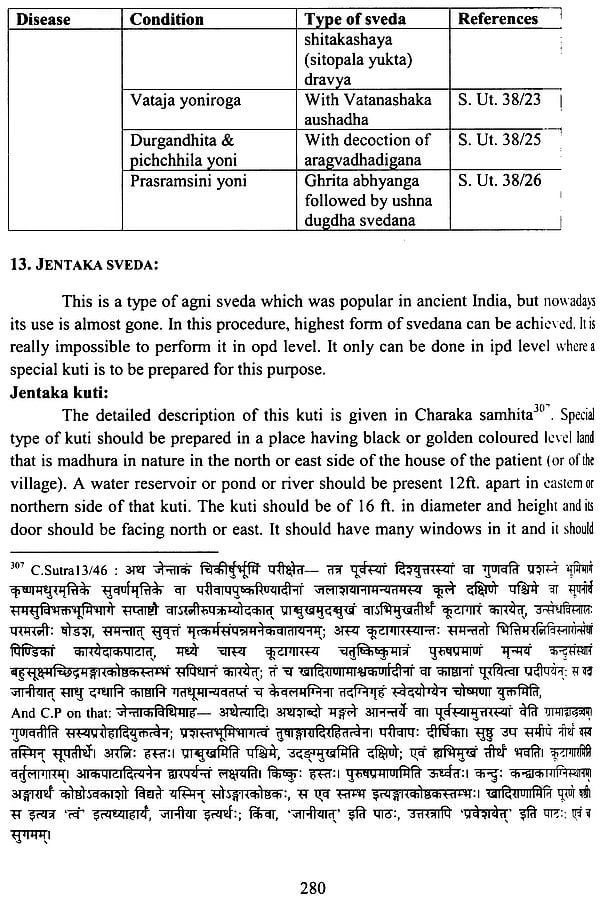
| 12 | Indication of parisheka: | 251 |
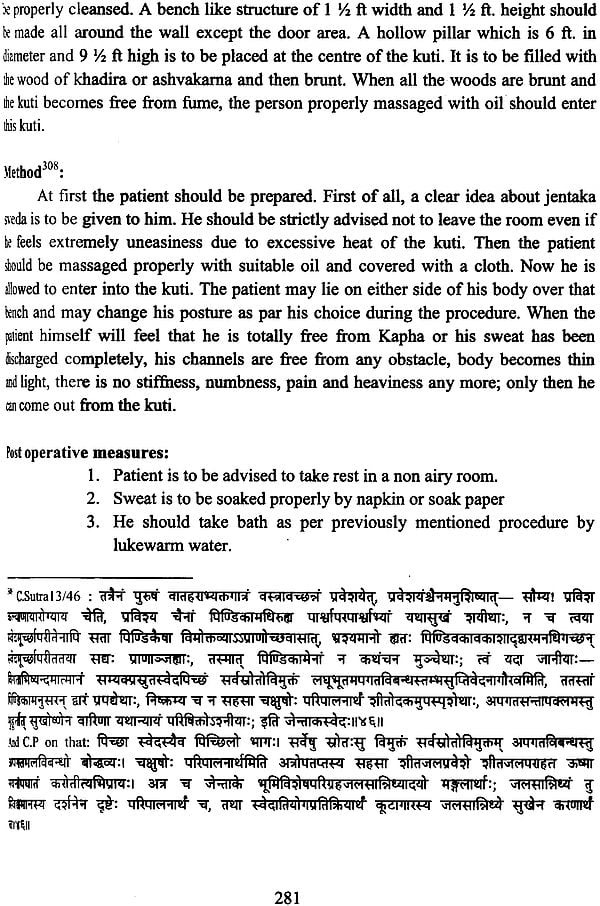
| 13 | Jentaka sveda: | 280 |
| 14 | Ashmaghana sveda: | 282 |
| 15 | Some references of ashmahhana sveda | 283 |
| A | Karshusveda: | 283 |
| B | Bhu sveda | 284 |
| C | Kumbhi sveda | 284 |
| D | Kupa sveda | 286 |
| E | Holaka sveda | 286 |
| F | Tapa sveda | 288 |
| G | Ushma sveda: | 289 |
| H | Upanaha sveda: | 291 |
| I | Three varieties of upanaha | 298 |
| J | Some references of upanha | 299 |
| K | Drava sveda | 308 |
| L | Anagneya sveda | 309 |
| M | Vyayama | 310 |
| N | Ushnasadana | 311 |
| O | Gurupravarana | 311 |
| P | Kshudha | 311 |
| Q | Bahupana | 311 |
| R | Bhaya | 311 |
| S | Krodha | 312 |
| T | Upanaha sveda: | 312 |
| U | Ahava | 312 |
| V | Atapa | 312 |
| 16 | Samyaka svedana lakshana | 313 |
| 17 | Ayoga of svedana | 313 |
| 18 | Atisvinna lakshan | 314 |
| 19 | Treatment for atisvinna | 315 |
| 20 | Indication of svedana | 317 |
| III. | Vamana | 327 |
| 1 | Sambhara Smgraha (collection of necessary utensils): | 334 |
| 2 | Vamana Karma | 336 |
| 3 | Indication of vamana | 337 |
| 4 | Contra indication of vamana | 340 |
| 5 | Reasons behind avoiding Vanana in contra indicated cases | 342 |
| 6 | Determination of Koshtha of the persom in vamana: | 347 |
| 7 | Pradhana karma: | 362 |
| 8 | Matra of vamana aushadha: | 363 |
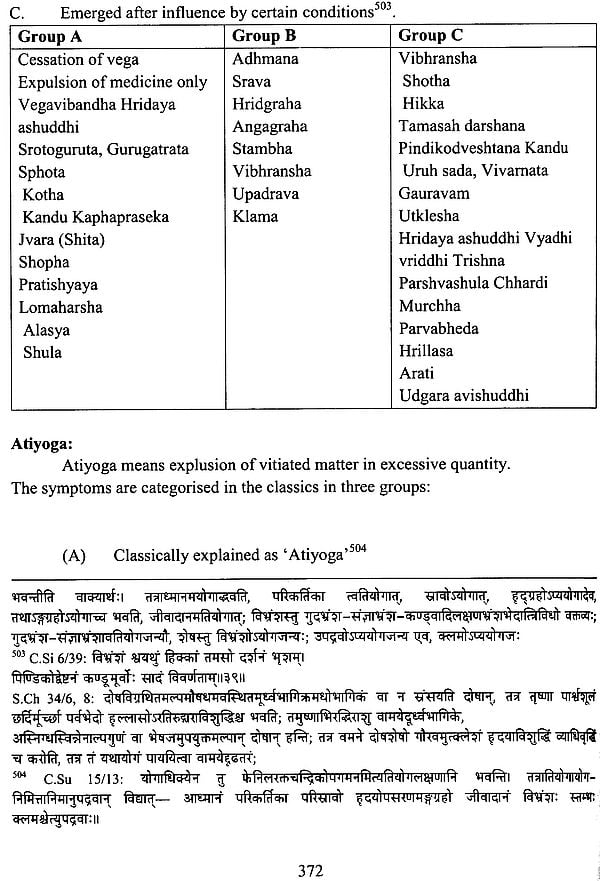
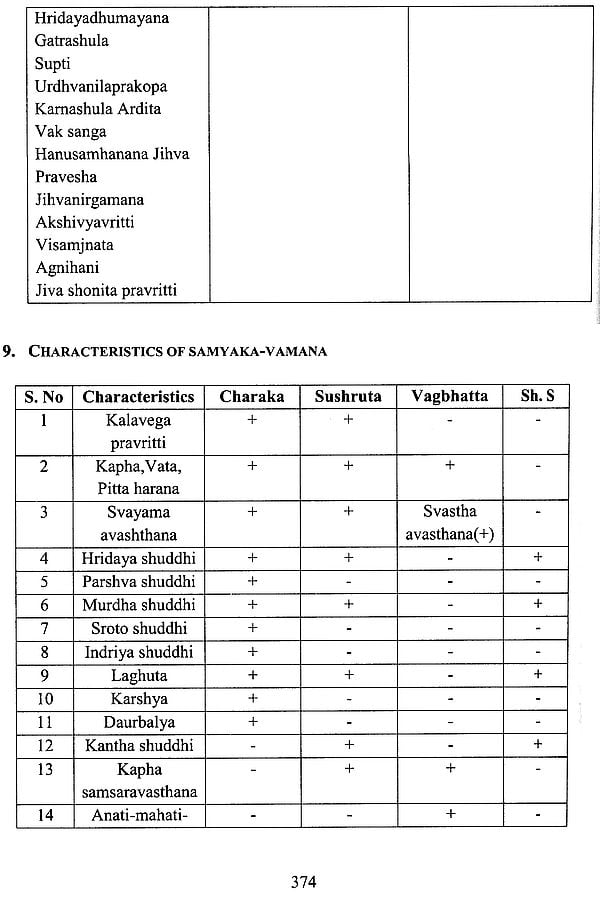
| 9 | Characteristics of samuaka-vamana | 374 |
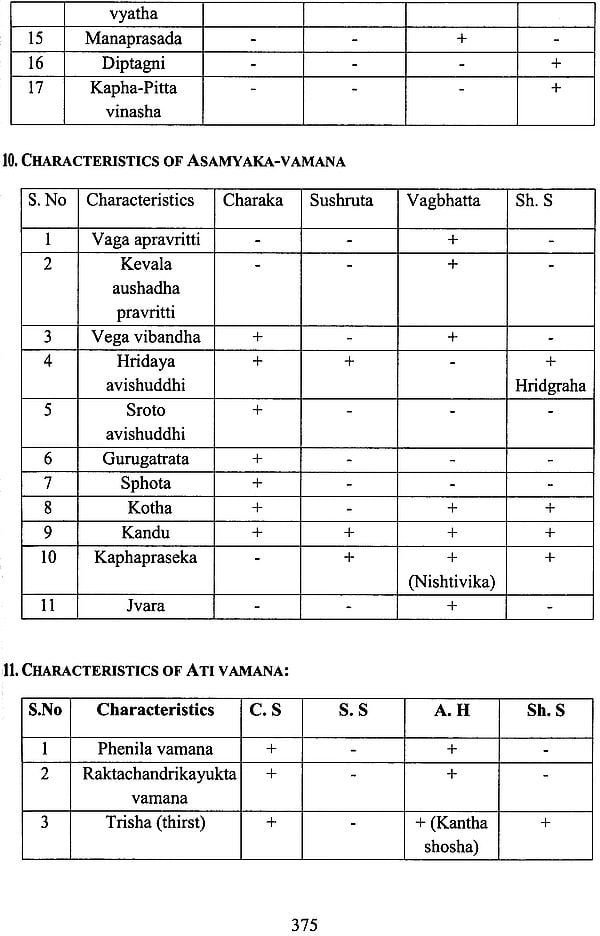
| 10 | Characteristics of Asamyaka-vanana | 375 |
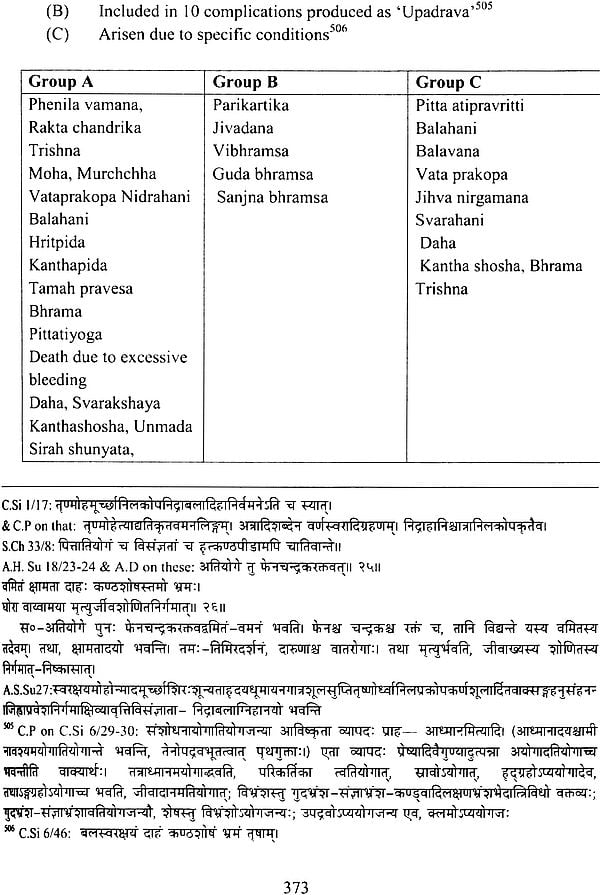
| 11 | Characteristics of Ati vamana | 375 |
| 12 | Pashchat karma | 376 |
| 13 | Evaluation of the shuddhi by several means | 377 |
| 14 | Details of complications | 384 |
| 15 | Samsarjana karma | 390 |
| 16 | Types of samsarhana krama | 392 |
| A | Peyadi samsarjana kraa | 390 |
| B | Tarpanadi krama | 34 |
| 17 | Table showing vuapada mentioned in different sanhita | 398 |
| 18 | Upadrava of vamana & virechana | 404 |
| 19 | Some common indications of Vamana | 426 |
| 20 | No. of Kalpana of Vamaka dravyas mentioned in Charaka Kalpasthana | 440 |
| IV | Virechana | 442 |
| 1 | List of virechana drugs | 445 |
| 2 | Best drugs for virechana | 451 |
| 3 | Classfication of virechana drugs | 451 |
| 4 | Virechana karma | 457 |
| 5 | Indication for virechana | 458 |
| 6 | Contra-Indications (Ayogya) | 461 |
| 7 | Selsection of virechana drugs as per the doshika dominancy | 467 |
| 8 | Dietetic regimen before virechana | 475 |
| 9 | Aushadhi matra of virechana | 478 |
| 10 | Assess ment of virechana | 484 |
| 11 | Samyaka Yoga Lakshana of Virechana Karma | 485 |
| 12 | Ayoga lakshana of Virechana karma | 487 |
| 13 | Atiyoga Lakshana of Virechana karma | 487 |
| 14 | Samsarjana krama | 491 |
| 15 | Tarpandi krama | 494 |
| 16 | Some kalpanas of Virechana | 505 |
| 17 | Indication of virechana in different diseases | 517 |
| V. | Basti | 530 |
| 1 | Classification of basti | 533 |
| 2 | Medicines used in basti | 544 |
| 3 | Indication of asthapana | 558 |
| 4 | Contra indication of asthapana | 561 |
| 5 | Indication of anuvasana | 565 |
| 6 | Contra indicationof anuvasana | 565 |
| 7 | Putaka Dosha and its complication | 569 |
| 8 | Basti netra | 570 |
| 9 | Table of calibre of the hole of nozzle according to age | 574 |
| 10 | Size of basti-netra, parinaha and karnika according to age(Sushruta) | 575 |
| 11 | Netra Dosha and its complication | 575 |
| 12 | Procedure of basti therapy | 577 |
| 13 | Niruha basti: Samyaka yoga lakshana | 602 |
| 14 | Niruha basti atiyoga lakshana | 603 |
| 15 | Nirhua basti atiyoga lakshana | 604 |
| 16 | Complications of niryha basti and their signs synotins and treatment | 605 |
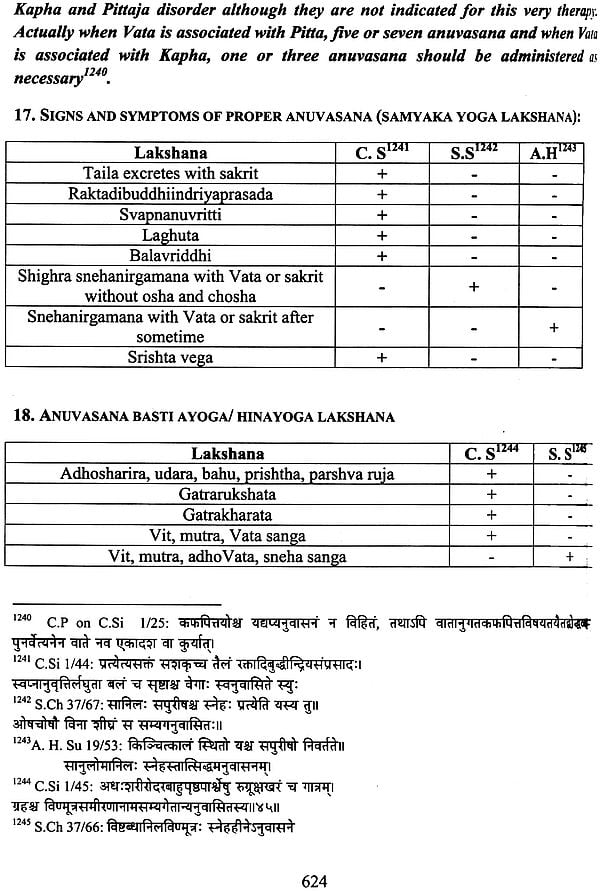
| 17 | Signs and symptoms of proper anuvasana(samyaka yoga lakshana) | 624 |
| 18 | Anuvasana basti ayoga/hinayoga lakshana | 624 |
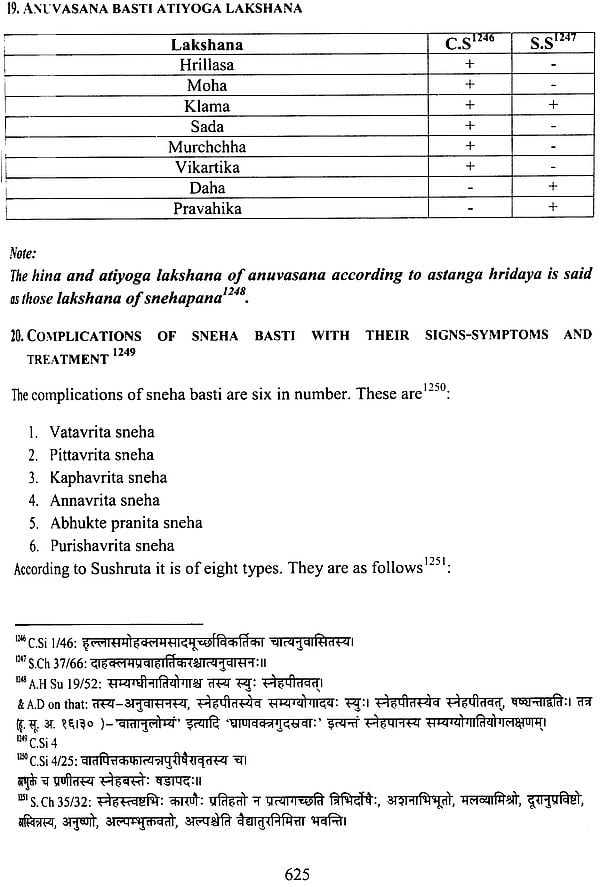
| 19 | Anuvasana basti atiyoga lakshana | 625 |
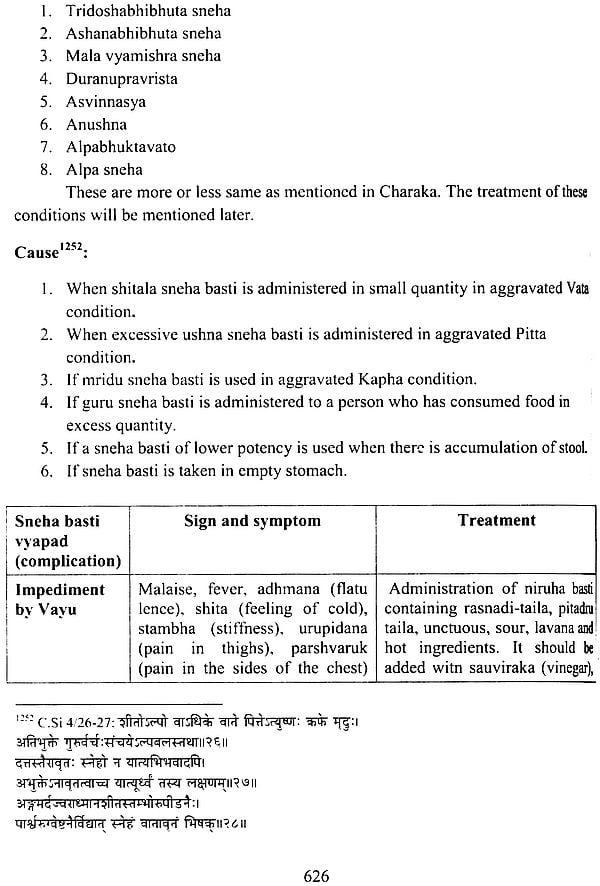
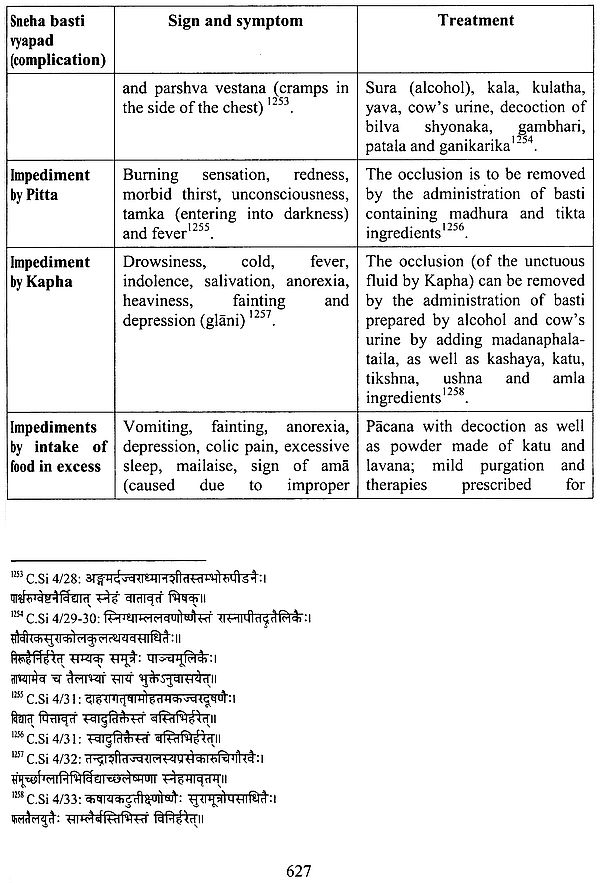
| 20 | Complications of sneha basti with their signs-symptoms and treatment | 625 |
| 21 | Uttarabasti | 629 |
| 22 | Basti vyapad according to Sushruta | 641 |
| 23 | Some important preparations of basti | 686 |
| VI | Nasaya Karma | 733 |
| 1 | Classification of nasya | 734 |
| 2 | Administration of nasya | 740 |
| A | Purva karma | 741 |
| 3 | General indications of nasya | 748 |
| 4 | Contra indications of naysa | 749 |
| 5 | Effect of nasya if administered in contra indicated condition | 751 |
| B | Pradhana karma: | 755 |
| 6 | Samyaka Yoga Lakshana of Virechana Karma | 757 |
| 7 | Ayoga | 759 |
| C | Pashchat karma | 762 |
| 8 | Dose of nasya at a glance | 775 |
| 9 | Duration of nasya karma | 776 |
| 10 | Some hasya yoga | 777 |
| 11 | Indication of nasya in different diseases | 779 |
| VII | Raktamokshana | 788 |
| 1 | Importance of rakta-mokshan | 789 |
| 2 | Types of rakta- mokshana | 797 |
| 3 | Prachchhana | 802 |
| 4 | Procedure | 802 |
| 5 | Shringavacharana | 803 |
| 6 | Alabu-avacharana | 804 |
| 7 | Ghati yantra | 804 |
| 8 | Sirvyadha | 805 |
| 9 | Rakta-mokshana yogya | 806 |
| 10 | Rakta-mokshana ayogya | 810 |
| 11 | Rakta-mokshana-- samyaka srava lakshana | 822 |
| 12 | Asamyaka srava lakshana | 822 |
| 13 | Raktamokshana ti srave lakshan | 823 |
| 14 | Four measures to stop bleeding | 826 |
| 15 | Jalauka avacharana | 831 |
| VIIII | Appendix | 844 |