

Rajagriha in Ancient Literature
Book Specification
| Item Code: | NAL463 |
| Author: | Dr.Bimala Churn Law |
| Publisher: | Archaeological Survey of India |
| Language: | English |
| Edition: | 1999 |
| Pages: | 57 (4 B/W Illustrations) |
| Cover: | Hardcover |
| Other Details | 10.5 inch x 8.5 inch |
| Weight | 440 gm |
Book Description
A detailed study of important ancient historical sites is greatly needed. In this monograph an attempt has been made to give an exhaustive and systematic account of Rajagriha, one of the most important ancient Indian cities, from all the available literary sources, Brahmanical Jain and Buddhist. I may draw the readers’ attention to the map of Rajagriha published in the Archaeological Survey Report for 1905-06. I am grateful to Rao Bahadur K. N. Dikshit, M.A., Director-General of Archaeology in India, for kindly asking me to undertake this work. I trust that this treatise will be found useful by those for whom.
| 1 | Different names: their origin and significance | 1 |
| 2 | General description and topography | 2 |
| 3 | Antiquity and history of Rajagriha | 21 |
| 4 | Antiquity and location of the five hills | 28 |
| 5 | Rajagriha in religious history | 33 |
| 6 | Architecture of Rajagriha: secular religious | 42 |
| Index | 45 | |
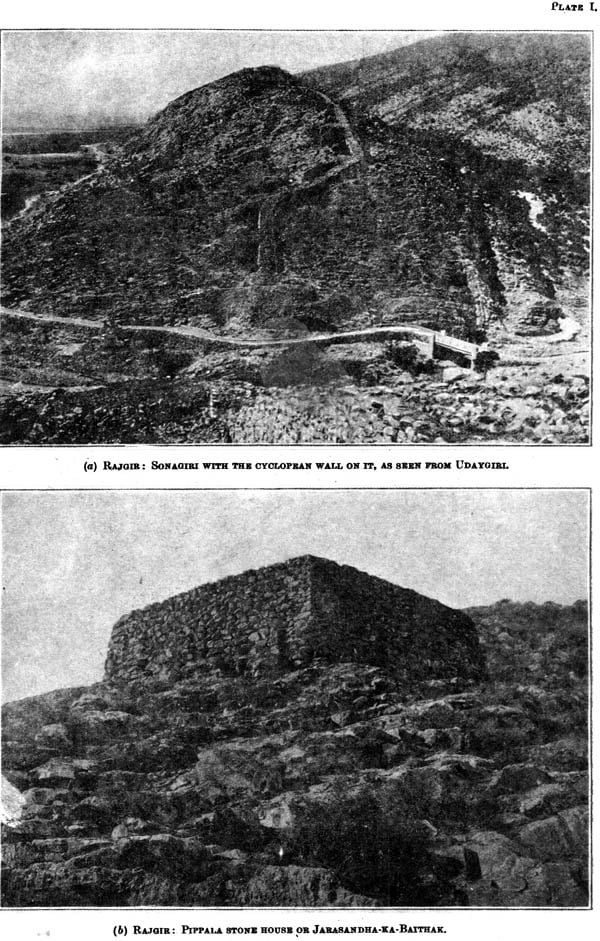
| Plate I.-Rajgir- | ||
| (a) | Sonagiri with the cyclopean wall on it, as seen from Udaygiri | |
| (b) | Pippala stone house or Jarasandh-ka-Baithak | |
| Plate II.-Rajgir- | ||
| (a) | New Rajgir: South Gate of Fort | |
| (b) | Maniyar Math; Fragmentary red sandstone sandstone sculpture as reconstructed |