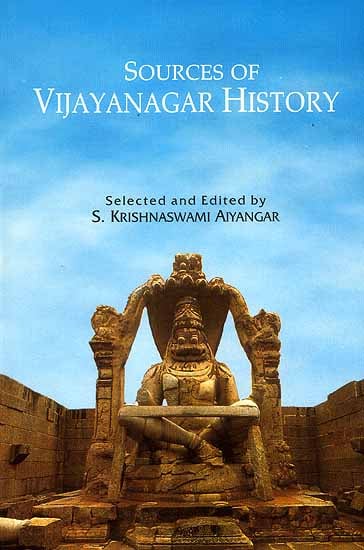


Sources of Vijayanagar History
Book Specification
| Item Code: | IDK928 |
| Author: | S . Krishnaswami Aiyangar |
| Publisher: | Aryan Books International |
| Edition: | 2003 |
| ISBN: | 8173052573 |
| Pages: | 414 |
| Cover: | Hardcover |
| Other Details | 9.1” X 5.7” |
Book Description
The present volume consists of extracts from hitherto untapped source – various Sanskrit and Telugu works bearing on the history of the Empire. A constructive study of these sources goes a long way in correcting the chronicles in many places and conveys information which would make a fuller history of the empire of Vijayanagara possible. Many of these are unpublished manuscripts, rare publications and works out-of-print. Each of the extract has been provided, with an English introduction which, though not a faithful translation, contains a summary of the historical facts.
Besides the obvious value of these extracts, they also throw considerable light on the possible of various subordinate families of this work, it is hoped, would show the Vijayanagara empire in a proper setting, in respect of its character and significance in the history of India.
The course of his work was much facilitated by the ready assistance that he always received from the Librarian and the staff of the Government Oriental Manuscript Library. In the present stage of manuscripts cataloguing in this part of the present stage of manuscripts cataloguing in this part of the country much has to be left for change. A few of the most important among the works laid under contribution in the following selection are found to be in the libraries but not catalogued. While, therefore, the collection presented here may, from our present knowledge of manuscripts, considered fairly exhaustive, it will not be surprising at all if many more come to light through the active work of the various search parties that are out at work from the Government Manuscript Library now. When practically the whole work was in type, the student lighted upon the work Sivatattvaratnakara from which three excerpts, throwing new light upon the later history of Vijayanagara, are made. If other works like this should be forthcoming, it need not cause any surprise at all.
In the work of selecting and editing, I had thought the willing assistance of the student himself which rendered the work much less onerous to me than it would otherwise have been. It only remains to acknowledge the assistance rendered in proof-reading by the other Research student of mine, Mr. R. Satyanatha, R.A. (Hons.), and the excellent work of the Government Press in putting the matter through the press. Those interested in historical research will surely feel grateful to the Madras University Syndicate for their enlightened policy in promoting the publication of this work, which, let me hope, is but the beginning of a long series to come.
| Introduction | 1 | |
| 1. | Kamparayacharitram of Ganga Devi | 23 |
| 2. | jaimini Bharatam of Pinavirabhadra | 29 |
| 3. | Saluvabhyudayam of Rajanatha Dindima | 30 |
| 4. | Ramabhyudayam of Saluva Narasimha | 32 |
| 5. | Prapannamrtam of Anantarya | 34 |
| 6. | Acharyasuktimuktavali of Kesavacharya | 40 |
| 7. | Annals of Hande Anantapuram | 45 |
| 8. | Madhaviya Dhatuvritti by Sayanacharya | 46 |
| 9. | Veda Bhashya by Sayanacharya | 48 |
| 10. | Udaharanamala of Bhoganatha | 48 |
| 11. | Devyaparadhastotra of Vidyaranya | 50 |
| 12. | Tarkabhasha by Chennubhatta | 51 |
| 13. | Tatparya Dipika by Madhavacharya | 51 |
| 14. | Nanartha Ratnamala by Irugapa Dandanatha | 52 |
| 15. | Narayanivilasam by Virupaksha | 53 |
| 16. | Prayogaratnamala by Chaundapacharya | 53 |
| 17. | Kridabhiramam of Vinukonda Vallabharaya | 55 |
| 18. | Haravillasam of Srinatha | 57 |
| 19. | Mahanataka Subhanidhi by Immadi Deva Raya | 60 |
| 20. | Chatu verses about Srinatha’s visit to Vijayanagar | 60 |
| 21. | Commentary on the Kavyalankara Sutra of Vamana | 62 |
| 22. | Taladipika of Saluva Gopa Tippa | 63 |
| 23. | Vikramarka Charitramu of Jakkana | 63 |
| 24. | Seshadharmamulu of Saranamantri | 65 |
| 25. | Gangadasapratapavilasam | 65 |
| 26. | Srisailam plates of Virupaksha | 67 |
| 27. | Prapannamrtam of Anantachrya | 71 |
| 28. | Ramarajiyamu of Venkayya | 79 |
| 29. | Ramabhyudaya of Saluva Narasimha | 83 |
| 30. | Colophon of Ramabhyudaya by Dindima | 85 |
| 31. | Jaimini Bharatamu of Pinavirabhadra | 85 |
| 32. | Varahapuranam by Mallayya and Singayya | 87 |
| 33. | Saluvabhyudayam by Dindima | 90 |
| 34. | Ramarajiyamu, Araviti Bukka and his children | 102 |
| 35. | Parjatapaharanamu by Nandi Timmana | 106 |
| 36. | Achyutarayabhyudayam by Rajanatha | 108 |
| 37. | Amuktamalyada by Krishna Deva Raya | 109 |
| 38. | Rayavachakamu | 110 |
| 39. | Krishna Raya Vijayam by Kumara Dhurjati | 129 |
| 40. | Amuktamalyada by Krishna Deva Raya | 132 |
| 41. | Parijatapaharanamu by Nandi TImmayya | 138 |
| 42. | Jambavatikalyanam by Krishna Deva Raya | 142 |
| 43. | Agastya’s Bharata Champuvyakhya by Saluva Timma | 143 |
| 44. | Tukka Panchakam | 143 |
| 45. | Prabodha Chandrodaya Vyakhya by Nadindla Gopa | 144 |
| 46. | Rajasekharacharitram by Madayagari Mallana | 146 |
| 47. | Krishnarjunasamvadam of Nandila Gopa | 149 |
| 48. | Mahimnastavavyakhya by Desayamatya | 151 |
| 49. | Peddana’s chatu verses on Krishna Deva Raya | 152 |
| 50. | Srivallabhacharyacharitram | 154 |
| 51. | Tamil Navalar Charital | 155 |
| 52. | Lilavati of Vallabhacharya | 156 |
| 53. | Achyutarayabhyudayam of Rajanatha Dindima | 158 |
| 54. | Varadambika Parinayam by Tirumalamba | 170 |
| 55. | Bhagavata Campu of Rajanatha | 176 |
| 56. | Annals of Hande Anantapuram | 178 |
| 57. | Ramarajiyamu, Aliya Rama and his children | 181 |
| 58. | Svaramelakalanidhi by Ramayamatya Todaramalla | 190 |
| 59. | Sivatattvaratnakara by Keladi Nasavabhupala | 194 |
| 60. | Prapannamrtam by Anantachrya | 202 |
| 61. | Balabhagavatam of Konerunatha Kavi | 204 |
| 62. | Yadavabhyudaya Vyakhya by Appaya Dikshita | 209 |
| 63. | Paramayogi Vilasam by Timmaraju | 211 |
| 64. | Srutiranjani by Tirumala Raya | 212 |
| 65. | Ramarajiyamu, Tirumala Raya and his sons | 213 |
| 66. | Vasuchritramu by Ramarajabhushana | 216 |
| 67. | Chatuverse about Tirumala Raya | 221 |
| 68. | Ramarajiyamu, Venkatadri and his sons | 222 |
| 69. | Narasabhupaliyamu by Bhattu Murti | 224 |
| 70. | Jambavati Kalyanam by Ekamranatha | 227 |
| 71. | Satyaparinayam by Ekamranatha | 229 |
| 72. | Laksmivilasam by Rayasam Venkatapati | 230 |
| 73. | Annals of Hande Anantapuram | 231 |
| 74. | Ahobalam Inscription of Sriranga Raya | 233 |
| 75. | Yayaticharitram by Ponnilanti Telaganarya | 236 |
| 76. | Tapatisamvaranam by Addanki Gangadhara | 238 |
| 77. | Aminabad Inscription of Amin Mulk | 239 |
| 78. | Charuchandrodayam of Chennamaraju | 241 |
| 79. | Ramarajiyamu, Venkatapati Raya | 243 |
| 80. | Chandrabhanu Charitram by Tarigoppula Mallana | 247 |
| 81. | Sidhout Inscription of mala Ananta | 248 |
| 82. | Verses about Venkatapati Raya, Chinna Bomma Nayaka and Appaya Dikshita | 250 |
| 83. | Prapannamrtam by Anantarya | 251 |
| 84. | Raghavendravijaya by Narayana | 252 |
| 85. | Raghunathabhyudayam of Vijayaraghava Nayaka | 254 |
| 86. | Raghunathabhyudayam of Vijayaraghava Nayaka: War with Jagga Raya | 259 |
| 87. | Raghunathabhyudayam of Vijayaraghava Nayaka: The Place at Tanjore | 264 |
| 88. | Sahitya Sudha by Govinda Dikshita | 267 |
| 89. | Sangita Sudha by Raghunatha Nayaka | 269 |
| 90. | Sahityaratnakara by Yagnanarayana Dikshita | 269 |
| 91. | Raghunathabhyudayam of Ramabhadramba | 284 |
| 92. | Chikkadeva Raya Vamsavali by Tirumalarya | 302 |
| 93. | Bahulasvacharitram by Damarla Vengalabhupala | 304 |
| 94. | Chatu verse about Jagga Raya and Yachma Nayaka | 308 |
| 95. | Ushaparinayam by Damarla Ankabhupala | 308 |
| 96. | Chikkadevaraya Vamsaval Sringa Raya III | 309 |
| 97. | Ramarajiyamu, Peddavenkata, Chinna Venkata and his sons | 310 |
| 98. | Tanjavuri Andhra Rajulacharitra | 319 |
| 99. | Sivatattvaratnakara by Keladi Basavabhupala | 337 |
| 100. | Sivatattvaratnakara, Venkatappa Nayaka and his successors | 344 |
| Index | 365 |