

Philosophy of Life - As Reflected in the Bani of Guru Nanak and Upanisads
Book Specification
| Item Code: | NAO072 |
| Author: | Kanta Arora |
| Publisher: | D. K. Printworld Pvt. Ltd. |
| Language: | English |
| Edition: | 2019 |
| ISBN: | 9788124609453 |
| Pages: | 368 |
| Cover: | Hardcover |
| Other Details | 9.0 inch X 6.0 inch |
| Weight | 640 gm |
Book Description
This volume illustrates, compares and discusses as to how Guru Nanak with his transcendental exposition, sharp skill, argumentative capability and common poetic language further enriched, explained, simplified, modernized and expressed various theological and philosophical concepts elucidated in Upanisads for the understanding and adaptation of a common man. Upanisads are "breath of eternal" and hymns of Guru Nanak are "a divine song of life". Guru Nanak's exuberance of love and search for God and godly people was not confined to any religion or religious institution. He revolted against the ritualistic mind of a brahmana. He was essentially a man of God whose love and quest for search for the Ultimate Truth knew no limits. In the pursuit of this search he enjoyed a reach to the state of void meaning a state where there is no distinction between the object and the subject - the knower and the known. He was a protagonist of Bhakti tradition and stressed more on bhakti or devotion to God. He taught the Sahaja-Patha or Surata Sabada Yoga that easily takes one straight to the Lord by spontaneous concentration of mind.
Both hymns of Guru Nanak and Upanisads explain that the real aim of human life is to attain liberation from the repeated coming and going in incarnations, which can be attained by adequate karma, knowledge and disciplined meditation.
Born in a small town of Chamkaur Sahib.
Kanta Arora MA, LLB, PhD, spent her childhood within the premises of Ghari, where Sri Guru Gobind Singh had sacrificed his two sons. This had left a profound influence of Guru Nanak's teaching on her.
Having done graduation and post- graduation from the Punjab University, she joined Govt of India and held various positions in Finance and Accounts Dept of different ministries.
After superannuation, she became a regular student of theology and made a comparative study of religions and consciousness studies and got her PhD for the thesis "Philosophy of Life: A Study in the Light of Bani (Hymns) of Guru Nanak and Upanishads" from the Centre for Conscious Studies at Dayalbagh Educational Institute (Deemed to be University). She has participated in many national seminars, and international conferences organized by the Center for Conscious Studies, University of Arizona, USA.
The seed of my love for the hymns of Guru Nanak was sown in my childhood when I was merely ten-year old. A simple old lady in my neighbourhood used to frequently utter sainam waheguru and to my childish question as to why these words are uttered by the Sikhs, she explained with extreme love by reciting first two lines of Japji called mula mantra and quipped after the word jap and advised me to attend to my school work first and try to know further when time comes. Her simple explanation to the word waheguru was that she is appreciating her guru and any one may use this word for saying wah-uan for his/her guru and there is only one God and His name is sat, that is the only Truth. People who tell that sainam wiiheguru words are only for believers of Sikhism are ignorant of the truth taught by Guru Nanak. Her simple explanation to my childish question remained ever fresh till I myself had a chance and ability to enjoy the universal contents of Japjf and other hymns of Guru Nanak in the later years with a strengthened belief in the Rgvedic statement:
ekam sat vipra bahudha vadanti - RV I.164.46 Today I am made to believe that those who widened Hindu-Sikh divides and created worst horror and turmoil in the last quarter of the twentieth century are either ignorant or are not willing to understand the real message of Guru Nanak. I personally consider, believe and call the hymns of Guru Nanak "Divine Songs of Life". These describe vividly many aspects of physical and metaphysical lives of human beings on earth in a most simple and practical way for the common man. I conducted a serious search for the relevant materials to the topic from the sri Guru Granth Sahib and the principal Upanisads. Relevant abstracts from the verses have been included in each chapter with their code indicated in their original scriptures. Text of the original language is given in English with transliteration to enjoy and understand the essence of the verses. Selection of various verses on the same topic from different hymns impresses upon the instructions and teachings repeated time and again by Guru Nanak, in broken pieces to address all sorts of seekers at different times and places. Some longer abstracts from his hymns are included to enable the reader grasp the fragmented essence of his scriptures.
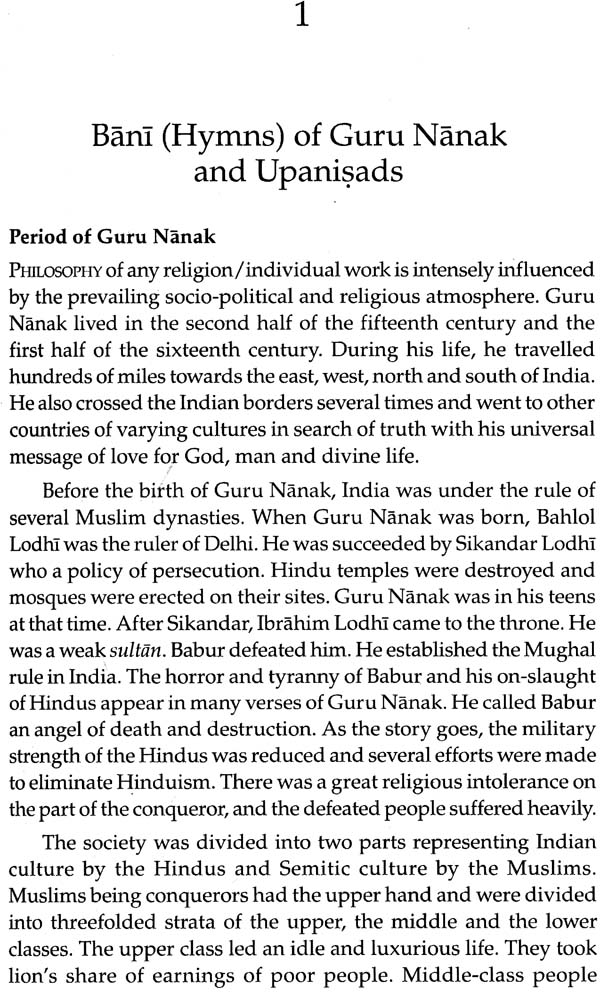
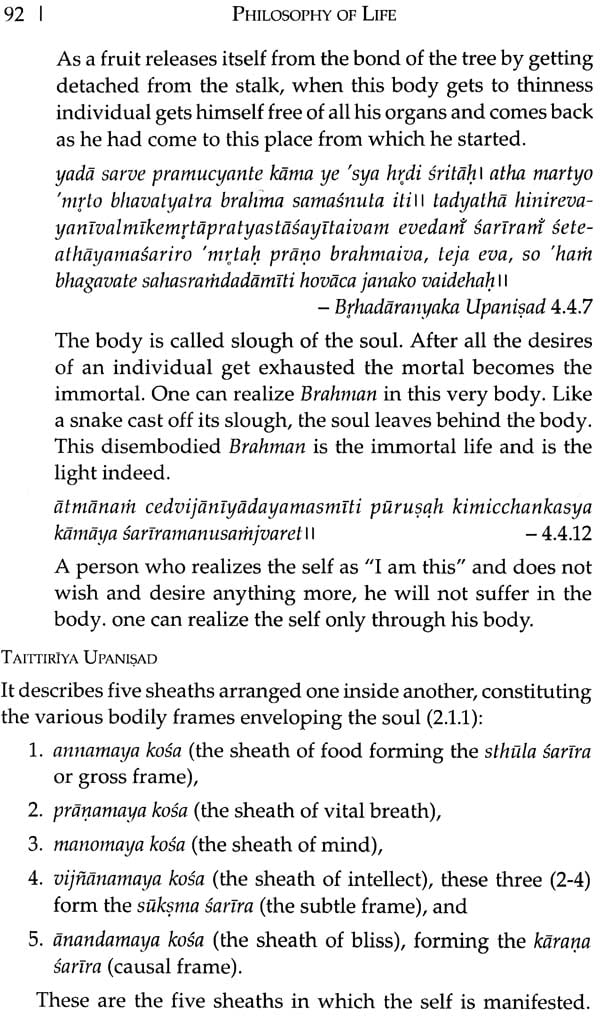
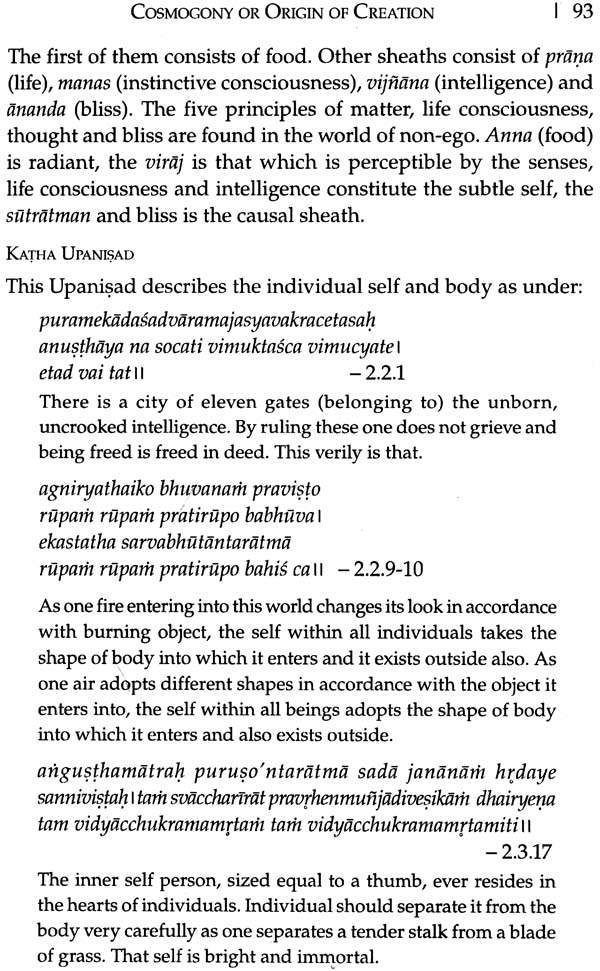
The subject matter is divided into six chapters. First chapter provides brief introduction to Guru Nanak and his hymns, Vedic religion, the Upanisads and a general overview describing bani (hymn) of Guru Nanak as a divine song of life. It discloses as to what Guru Nanak spoke about himself and about the experiences of life lived. It illustrates as to how his philosophy of life is Upanisadic in origination and portrays his sound knowledge of existing Vedic literature, his love for God, godly people and vision of better worldliness. Second chapter discusses cosmogony or origin of creation as explained by Guru Nanak and the Upanisads in the hymn arbada narbada dhaundhukara (Adi Granth, p. 1035) and Nasadiya Sukta of the Rggveda along with the concepts of Universal Soul and individual soul, identity between the two, nature of individual soul and body.
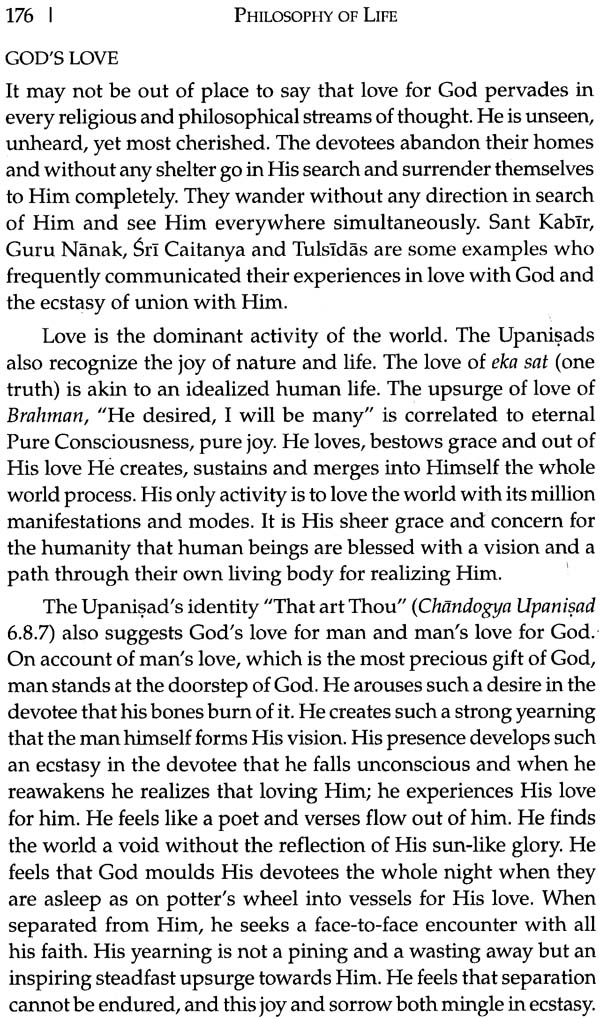
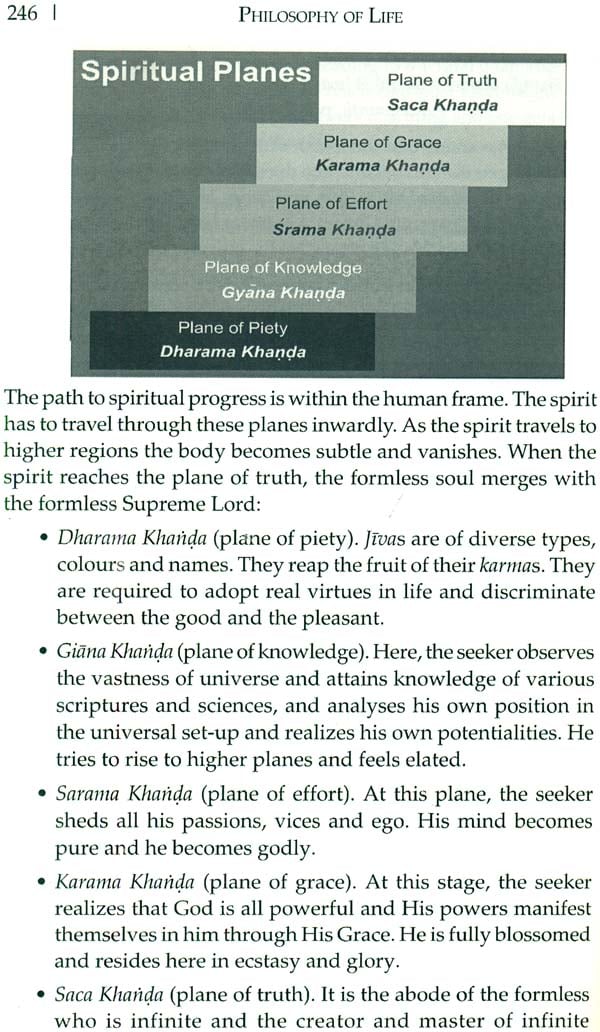
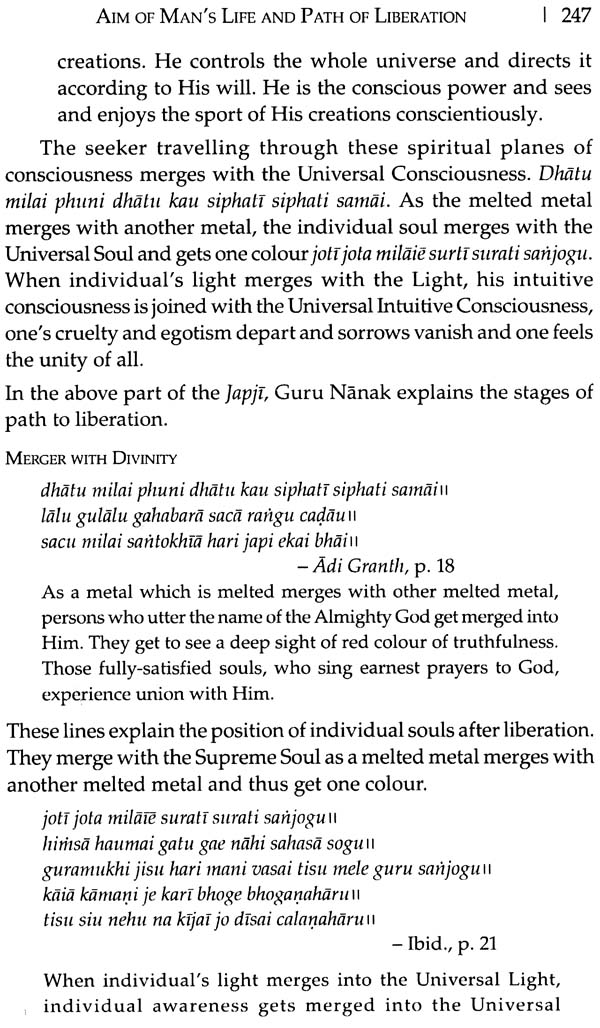
Third chapter explores the mutual relationship among God, man and the world, world struggle and other concepts of great relevance to human life. Both Upanisads and hymns of Guruanak provide a deep insight and understanding into these concepts. Fourth chapter is divided into three parts. First part explores the role of a true guru and homage paid to such a guru in the hymns of Guru Nanak and Upanisads. Second part highlights the mutual love between God and man, expression of love for God; experience of reciprocal love of God, man's feeling fire of separation and urge for His blessed vision and ecstasy of union with God. Third part explains the concept of grace (nadara) as illuminated in the hymns of Guru Nanak and the Upanisads. Fifth chapter discusses the aim of man's life, suggested path for his liberation and his personal experience of divinity. With struggling and suffering in the worldly life and deeply in love and fear of God, one tries to find a way as to how he should conduct himself to be happy in life and face death peacefully. One starts searching for the meaning of his life and the true aim of his human form. One may wonder as to what path one may follow in his endeavour to attain liberation. The Upanisads prescribe the path to liberation through knowledge of Brahman and realization of oneness of individual soul with the Universal Soul. Guru Nanak accepts the basic doctrine of liberation (moksa) of the Upanisads and prescribes sahaja patha (spontaneous concentration of mind) for personal experience of divinity within oneself for liberation.
Sixth chapter illustrates as to how Guru Nanak with his transcendental exposition, sharp skill and argumentative capability, and common poetic language enriched, explained, simplified and modernized various theological concepts of philosophy of life for use and understanding of a common man and the physical and experiential realities of life derived there from, which are required to be revisited and endorsed afresh generation after generation to keep pace with the changing priorities of life and get the best for oneself out of the fleeting moments of precious life.
There is a humble message for claimants and custodians of the legacy of Guru Nanak to shun all preachers and practices advocating separation, of any institutionalized religion, on the basis of philosophy of life of Guruanak from the universal approach of Upanisadic philosophy being attributed to Sikhism and Hinduism. Both are above the boundary walls of any institute of religion and for the benefit of all mankind at large. Any argument and strife for confinement of highest knowledge revealed by the sages, seers and Guru Nanak for separation and division of society and caging it into religions rather than absorbing their essence for better living is sheer ignorance.
Contents
| Preface | V | |
| Acknowledgements | ix | |
| 1 | Bani (Hymns) of Guru Nanak and Upanisads | 1 |
| Period of Guru Nanak | 1 | |
| About Guru Nanak | 3 | |
| Hymns of Guru Nanak | 6 | |
| Vedic Religion | 8 | |
| Upanisads | 9 | |
| A General Overview of Hymns of Guru Nanak and Upanisads | 17 | |
| A - BanI (Hymns) of Guru Nanak A Song of Life | 17 | |
| Guru Nanak speaks: | ||
| (a) About life lived and real experiences of life | 17 | |
| (b) Speaks about himself | 24 | |
| (c) About the falling social, religious and ethical values | 27 | |
| (d) Connubial bliss with supremacy of Love for God | 30 | |
| B - Hymns of Guru Nanak Are Upanisadic Guru Nanak: | 31 | |
| (a) Expressed unity of all existence in Pure Consciousness | 32 | |
| (b) Explains the existing Vedic philosophy with his superb vision and skill | 38 | |
| C - Guru Nanak Placed Love for God & Godly Life above all organized religions | 43 | |
| D - An Advocate of Better Worldliness | 46 | |
| Conclusion | 51 | |
| 2 | Cosmogony or Origin of Creation | 54 |
| Hymns of Creation by Guru Nanak | 55 | |
| Hymn of Creation (Rgveda X.129.1-7) | 58 | |
| Universal Soul and Individual Soul | 62 | |
| Universal Soul | 63 | |
| Individual Soul | 68 | |
| The Relationship of Individual Soul and Universal Soul | 69 | |
| Nature of Individual Soul and Body | 76 | |
| (a) Nature of Body | 77 | |
| (b) Nature of Individual Soul | 85 | |
| 3 | God, Man and the World | 98 |
| Mutual Relationship between God, Man and the World | 98 | |
| Relation between God and Man | 99 | |
| Relation between God and the World (Creation) | 103 | |
| Relation between Man and the World | 109 | |
| Divine Will, Fear of God and Free Will | 121 | |
| Divine Will (Hukam-Dharman) | 121 | |
| Fear of God (Rta), Free Will | 124 | |
| Stages of Life and Haume (l-ness) | 128 | |
| Stages of Life | 128 | |
| Haume (I-ness) | 132 | |
| The World Struggle and Suffering in the World | 140 | |
| 4 | God's Love and Grace in Life | 151 |
| Role of Guru | 151 | |
| (a) No Salvation without a True Guru | 155 | |
| (b) Serving the True Guru | 162 | |
| (c) Homage to Guru | 168 | |
| (d) Conclusion | 175 | |
| God's Love | 176 | |
| Prayer for the Vision of God | 177 | |
| God's Love, in the Hymns of Guru Nanak | 178 | |
| Nadar (Grace) | 192 | |
| 5 | Aim of Man's Life and Path of Liberation | 199 |
| Aim of Man's Life in the Hymns of Guru Nanak | 200 | |
| Aim of Man's Life according to Upanisads | 222 | |
| Path of Liberation | 228 | |
| Path of Liberation in the Hymns of Guru Nanak | 228 | |
| Path of Liberation in the Principal Upanisads | 248 | |
| Personal Experience of Divinity | 257 | |
| Personal Experience of Divinity in the Hymns of Guru Nanak | 258 | |
| Personal Experience of Divinity in the Principal Upanisads | 278 | |
| 6 | Conclusion | 285 |
| Spiritual Unity and Solidarity in All Existence | 290 | |
| Balanced Combination of Rituals and Meditation: | 291 | |
| Ignorance and Knowledge | ||
| Who Is the Real Agent in the Individual? | 292 | |
| That Alone Know as Brahman | 293 | |
| Brahman Is beyond All Perceptions | 294 | |
| Two Kinds of Knowledge Are to Be Known: The Higher as well as Lower | 296 | |
| Brahman Is Both the Efficient and Material | 296 | |
| Cause of the Creation | ||
| Nature of Liberation | 297 | |
| Turtya: Fourth Stage of Consciousness; Significance of Syllable Aum | 298 | |
| That Form from which the Origin, Continuance and Dissolution of the World Come Is Isvara | 299 | |
| Seeking Brahman-Knowledge from a Teacher | 299 | |
| True Nature of Brahman Is Pure Consciousness | 300 | |
| Teaching the World of Brahman | 300 | |
| The Primal Sound Resonates Deep Within | 302 | |
| Everything Flows from the Self | 302 | |
| Theoretical Unknowability of Brahman | 303 | |
| The Truth | 304 | |
| Cosmogony or Origin of Creation | 305 | |
| Identity between Individual Soul and Universal Soul | 305 | |
| Individual Soul and Body | 306 | |
| Mutual Relationship between God, Man and the World | 306 | |
| Divine Will, Fear of God and Free Will | 308 | |
| Haume (l-ness) | 310 | |
| World Struggle and Suffering in the World | 311 | |
| Role of a Guru | 313 | |
| God's Love | 315 | |
| Nadar (Grace) | 318 | |
| Aim of Life | 318 | |
| Path of Liberation | 322 | |
| Personal Experience of Divinity | 328 | |
| Message | 333 | |
| Revelations at a Glance | 334 | |
| Bibliography | 337 | |
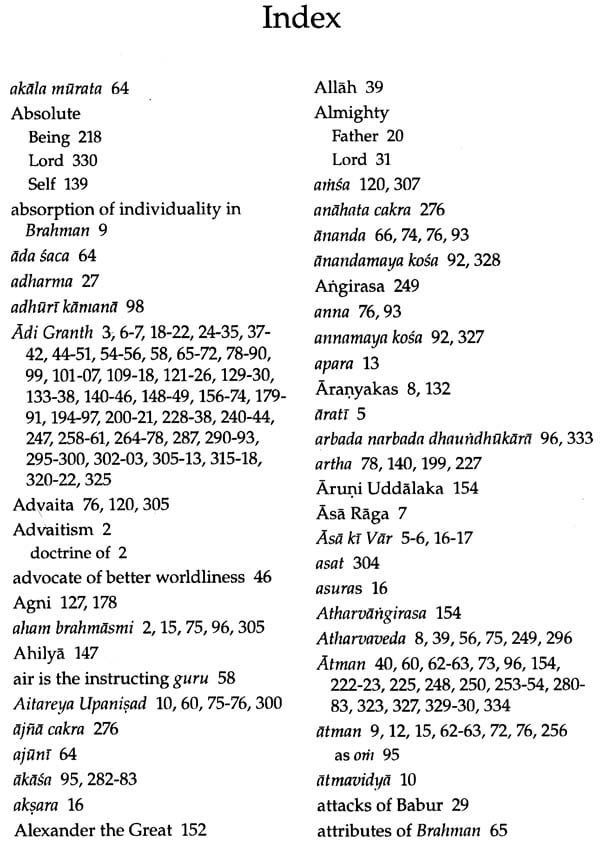
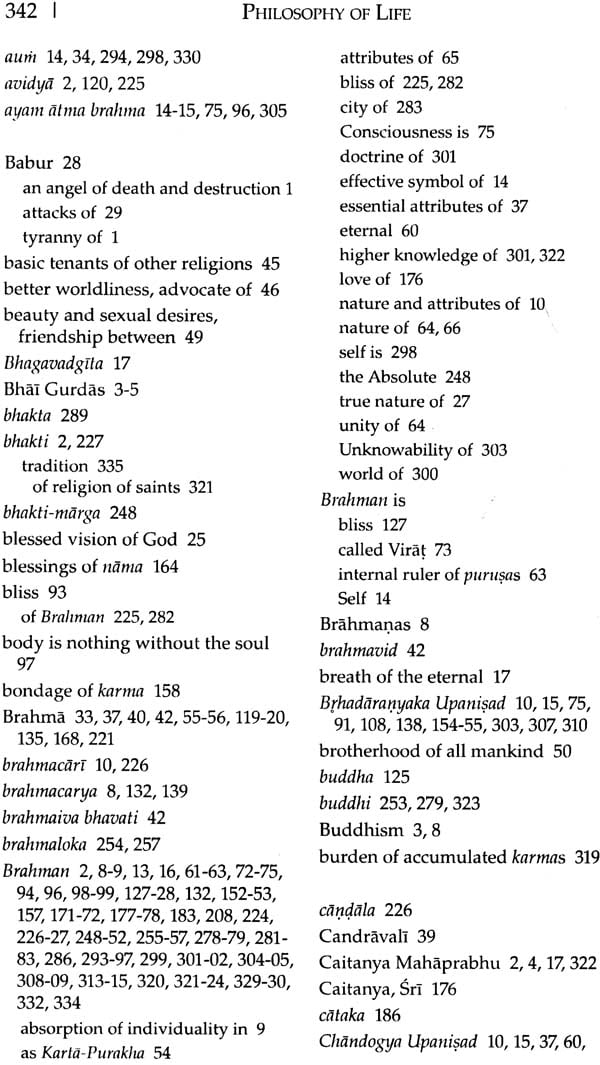
| Index | 341 |