

Sri Gaudiya Kanthahara: A Necklace of Vaisnava Verse
Book Specification
| Item Code: | IDL202 |
| Publisher: | RAS BIHARI LAL AND SONS |
| Language: | (Transliterated Text and English Translation) |
| Edition: | 2005 |
| ISBN: | 9788187812739 |
| Pages: | 490 |
| Cover: | Hardcover |
| Other Details | 8.8” X 5.8” |
| Weight | 770 gm |
Book Description
In explaining the importance of Krsna conscious preachers studying the philosophy, and specifically stressing the need to memorize verse, Srila Prabhupada gave this example. He said that in the courtroom an expert lawyer knows how to immediately back up his points by citing from the lawbooks and relevant precedent-setting cases. The expert preacher must be like the courtroom lawyer. He must have at his command all the scriptural references to support his preaching. “We do not manufacture anything,” His Divine Grace would often say. “Our knowledge is coming in parampara and it is based on the sastra, we simply repeat the message as it is.”
Hence devotees eager to emulate Srila Prabhupada’s preaching spirit are duty bound to have at their fingertips a wide range of verse to show that Krsna consciousness is not an amalgam of whimsical ideas; rather it is parampara knowledge and citing verses can dynamically underscore fails to be impressed when a devotee speak the philosophy with strong logic and reason and back up his statements with appropriate scriptural references.
Here in Sri Gaudiya Kanthahara verse lovers will find many of the verses that Srila Prabhupada made familiar to us by his regularly quoting them in his books, lectures, and conversations. They will also find many verses that are not so familiar, but were often alluded to by Srila Prabhupada. The discovery of these verses will surely give added pleasure to verse lovers. These verses were all favorites of Srila Bhaktisiddhanta Saraswati Prabhupada.
This book is a preacher’s companion in two ways. As a collection of key verse – over a thousand – it is wonderful in its scope and therefore an excellent companion. But it is more than a verse book. Because of the way the verses are organized this collection doubles as a wonderful summer of the Gaudiya Vaisnava philosophy, which is the crème de la crème of all systems of philosophy. Even a casual reading therefore has immense value for instructing one in the lenghth, breadth, and depth of the Krsna consciousness philosophy.
| | ||
| | ||
| | ||
| One must accept a guru in disciplic succession | ||
| A qualified guru and disciple are hard to find | ||
| A genuine guru knows the truth about Krsna | ||
| A guru is a master of his sense | ||
| A pure devotee is the guru of all varnas and asramas | ||
| A guru is an acarya of sambandha-jnana | ||
| Who is an acarya? | ||
| Example is better than precept | ||
| Inconceivable oneness and difference of guru, Vaisnava, and Krsna | ||
| Siksa-guru–Caitya-guru and mahanta (personal)-guru | ||
| By the mercy of Krsna gets the mercy of guru | ||
| Guru gives scientific knowledge about the highest spiritual reality | ||
| The spiritualmaster is the energy of Krsna | ||
| The guru is gaura-sakti and gaura-priyatama | ||
| A guru in name only commits a great offense | ||
| Scholarship is no qualification for becoming a guru | ||
| A non-Vaisnava cannot be a guru | ||
| Bogus gurus | ||
| The injunction to abandon a bogus guru | ||
| A materialistic, professional, family or vyavaharika-guru must be given up | ||
| One who rejects a false guru must accept a real guru | ||
| Why become a disciple? | ||
| Who thinks the spiritual master an ordinary man goes to hell | ||
| One who thinks the guru ordinary does not progress | ||
| For transcendental knowledge on must approach a guru | ||
| The guru takes one beyond jnana to pure devotion | ||
| Guru and Lord Nityananda are non-different | ||
| The authorized sacred tradition | ||
| Lord Brahma, the original teacher | ||
| Sri Madhva-the sampradaya acarya | ||
| The Brahma-Madhva Gaudiya sampradaya | ||
| | ||
| | ||
| | ||
| Bhagavatam is the crown jewel of all revealed scriptures | ||
| Bhagavatam is the ripened fruit of the Vedic desire tree | ||
| Bhagavatam is the literary incarnation of Krsna | ||
| Paramahamsas sing Bhagavatam for the benefit of all souls | ||
| Bhagavatan is dear to the topmost paramahamsas | ||
| Bhagavatam is the natural commentary on Vedanta | ||
| Bhagavatam is the essence of all the scriptures | ||
| Whoever disregards Bhagavatam is lost | ||
| Bhagavatam reveals the inner meaning of Vedanta | ||
| Bhagavatam is the cream of the Vedas and the very form of Krsna | ||
| Self-manifest and enternal, Bhagavatam is not ordinary literature | ||
| Bhagavatam is beyond sensual experience | ||
| Two kinds of bhagavata: the book and the person | ||
| The inconceivable nature of Bhagavatam | ||
| Bhagavatam is understood through Vaisnavas | ||
| Study Bhagavatam in light of previous acarya | ||
| Who does not recognize Bhagavatam is doomed | ||
| The proud cannot relish the nectarean juice of the Bhagavatam | ||
| Lecturing on Bhagavatam as a profession is prohibited | ||
| Who won’t hear the Srimad-Bhagavatam | ||
| Further prohibitions against lecturing on Bhagavatam for money | ||
| Don’t hear Bhagavatam from nondevotees | ||
| The eighteen Puranas | ||
| The Puranashave three divisions – sattvika, rajasika and tamsika | ||
| What is to be known as sastra | ||
| What is Pancaratra | ||
| The words of the Pancaratra are as goods as God | ||
| Narada Pancaratra is the cream of Vedic literature | ||
| Narada Pancaratra is authorized | ||
| | ||
| | ||
| | ||
| The definition of a Vaisnava | ||
| Different kinds of Vaisnavas | ||
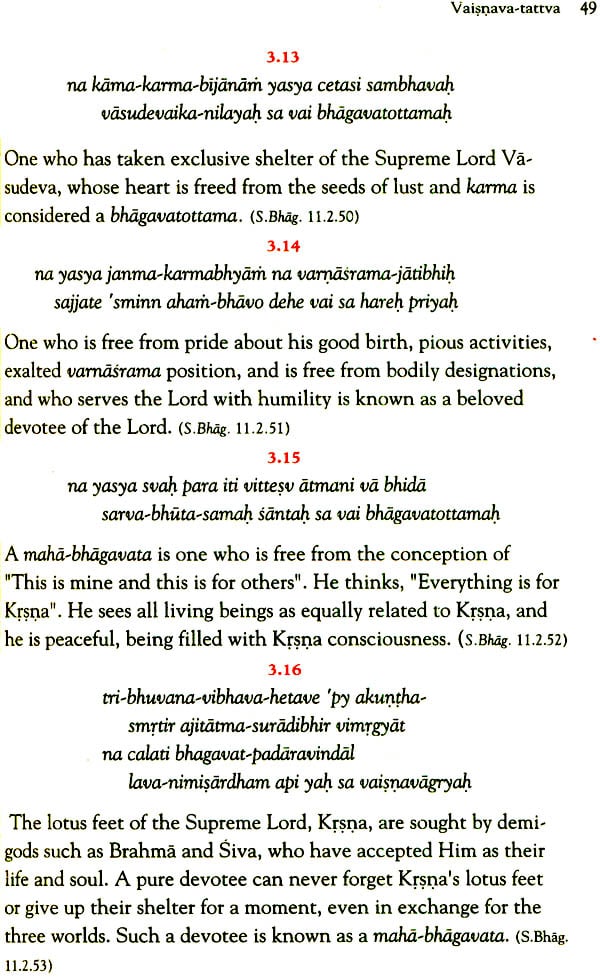
| Three kinds of devotees – arcane-marga and neophyte devotees | ||
| Arcana-marga and the advanced devotees | ||
| Arcana-marga and the advanced devotee | ||
| The symptoms of a neophyte devotee | ||
| Symptoms a madhyama-adhikari | ||
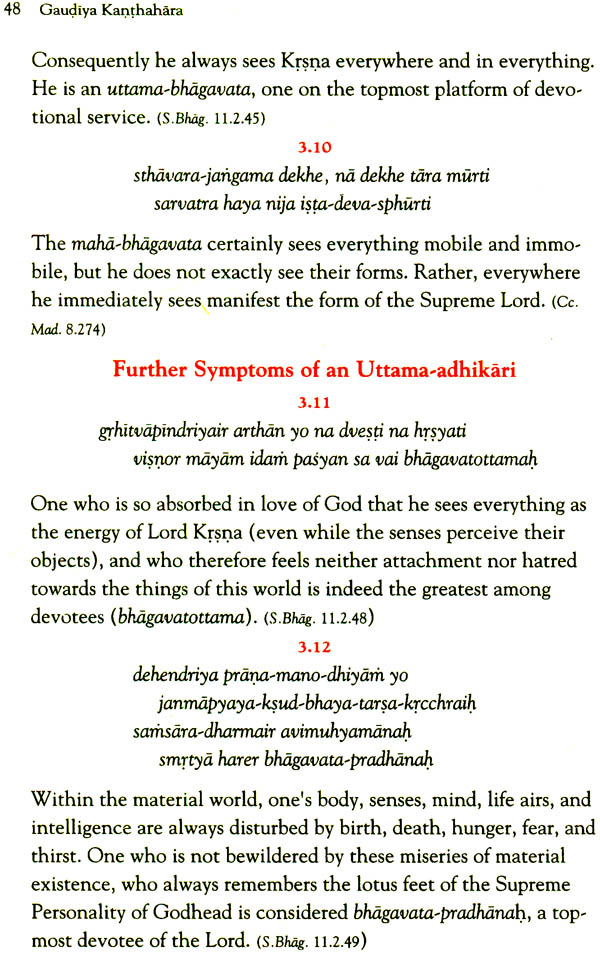
| Symptoms of an uttama-adhikari | ||
| Further symptoms of an uttama-adhikari | ||
| The Paramahamsa Vaisnava | ||
| Description of the three kinds of devotees from Caitanya-caritamrta | ||
| A ordinary Vaisnava | ||
| A superior Vaisnava | ||
| The topmost Vaisnava | ||
| Who is a Vaisnava | ||
| The twenty-six qualities of a Vaisnava | ||
| Vaisnavas see with equal vision | ||
| The Lord is conquered by devotion | ||
| A Vaisnava is supremely merciful | ||
| The glories of the servants of the Vaisnavas | ||
| Further glories of the Vaisnavas | ||
| Without taking shelter of a Vaisnava all knowledge is lost | ||
| Only Vaisnavas are really merciful to the fallen | ||
| The glories of exclusive Vaisnava | ||
| Vaisnava is very rare | ||
| Out of many liberated souls, a pure devotee is very rare | ||
| A Vaisnava is beyond mundane knowledge | ||
| A Vaisnava is paradukha-duhkhi | ||
| A Vaisnava is transcendental | ||
| A Vaisnava’s birth, family and nation are of no importance | ||
| A devotee is dearer than one’s own family | ||
| The twelve Mahajana | ||
| Important devotees | ||
| Prahlada is the best of the devotees | ||
| Better than Prahlada are the Pandavas | ||
| Uddhava is superior to the Yadavas | ||
| The gopis are superior to Uddhavai | ||
| The gopis are superior to the Laksmis of Vaikuntha | ||
| Radharani is the best of all devotees | ||
| The glories of Gauranga’s devotees | ||
| The unfortunate position of nondevotees | ||
| Pure devotees to Gauranga is best of all | ||
| Without devotion to Gauranga, one’s knowledge of scripture is nonsense | ||
| Without the mercy of Gauranga’s devotee everything is impossible | ||
| | ||
| | ||
| | ||
| The evidence from sruti for Lord Caitanya | ||
| Evidence from Bhagavatam for Lord Caitanya | ||
| Evidence of Mahabharata for Sri Caitanya | ||
| Evidence of the Puranas for Lord Caitanya | ||
| The version of the Gosvamis | ||
| Sri Gauranga is the source of all avataras | ||
| Sri Gauranga is unattainable by worldly knowledge | ||
| Lord Caitanya’s sixfold nature | ||
| Sri Gauranga is the Supreme Truth | ||
| Lord Caitanya is the jagad-guru | ||
| Lord Gauranga is the best of all | ||
| Gauranga’s tattva, nama, rupa and lila | ||
| Gauranga delivers all by distributing nama | ||
| Gauranga is the giver of Krsna prema | ||
| Who cheat themselves out of love of God | ||
| One can know the conclusion of scripture by Sri Gauranga’s mercy | ||
| Lord Gauranga’s preaching pastimes | ||
| Sri Gauranga’s example and precept | ||
| Gauranga’s principle and ultimate goals | ||
| Sri Gauranga principle and ultimate goals | ||
| Sri Gauranga is like a lion | ||
| Sri Gauranga external reason for appearing | ||
| Lord Gauranga’s confidential reason for appearing | ||
| He has the mood of Sri Radha but externally spreads the holy name | ||
| The pastimes of Sri Caitanya are eternal | ||
| Materialists and demonic persons are envious of Sri Gauranga | ||
| Gauranga is not the enjoyer of Gaura-Nitai | ||
| The position of those who cheat themselves of Lord Gauranga’s mercy | ||
| Gauranga appears as His holy name and as His deity | ||
| Gauranga’s teaching in a nutshell | ||
| | ||
| | ||
| | ||
| Nityananda and Advaita-Two main branches of the Caitanya tree | ||
| Baladeva is the original Sankarsana | ||
| Balarama and Nityananda are non-different | ||
| The glories of Nityananda Prabhu | ||
| Nityananda is the savior of the most fallen | ||
| The desire for bhakti is strengthened by the mercy of Nitai | ||
| Nityananda is the foremost preacher | ||
| Nityananda mad about serving Sri Caitanya | ||
| Those who doubt that Gaura and Nitai are inseparable are offenders | ||
| Faith in Gaura without Nitai, or vice verse, opposes pure devotional service | ||
| | ||
| | ||
| | ||
| The truth about Advaita Prabhu | ||
| Advaita is the material cause of mundane creation | ||
| Advaita is Sadasiva | ||
| The Meaning of the name Advaita | ||
| Advaita Acarya is a preacher of krsna-bhakti | ||
| He is the avatara of Mahavisnu and a devotee of Lord Caitanya | ||
| Advaita and Nityananda are servants of Advaita | ||
| The saragrahi followers of Advaita are devotees of Gauranga | ||
| The useless followers of Adavaita Acarya | ||
| were cut off from Gauranga’s mercy | ||
| | ||
| | ||
| | ||
| The one Absolute Truth is realized in three ways | ||
| Bhagavan realization is complete, Paramatma and Brahman are partial | ||
| The conclusion of the sruti about Brahman | ||
| The conclusion of Bhagavad-gita | ||
| The conclusion of the Gosvamis | ||
| The conclusion of the Gosvamis | ||
| Nirvisesa means Krsna has no material qualities | ||
| Yogis worship the Supersoul | ||
| Paramatma is an ekamsa expansion of the Supreme Lord | ||
| The Supreme Truth has three potencies | ||
| Visnu is the Supreme Truth | ||
| Krsna is the Supreme Visnu | ||
| Krsna is the independent Supreme Person | ||
| Krsna is the ultimate goal of all vedic literature | ||
| The meaning of Bhagavan | ||
| Krsna is the Supreme Master | ||
| Krsna is the cause of all cause | ||
| Krsna is the Supreme Shelter of everything | ||
| Krsna is the Original person | ||
| On the basis of rasa, Krsna is superior to Narayana | ||
| Narayana is the opulent pastime expansion of Krsna | ||
| The demigods recognize Krsna as Supreme | ||
| This world is maintained by an extended expansion of Krsna | ||
| Krsna is Lord of Vrdavana, with two hands holding the flute | ||
| The real from of Krsna | ||
| The Vedas of speak of the pastimes of the Supreme Lord | ||
| By Serving Krsna the universe is satisfied | ||
| The demigods are never envious of Krsna | ||
| Krsna appears in three categories | ||
| The two division of svayam-rupa | ||
| Two divisions of svayam-rupa-prabhava and vaibhava | ||
| Prabhava-vilasa-Expanding many forms to marry thousands of queens | ||
| Vaibhava-prakasa | ||
| The four-handed Vasudeva is prabhava-vilasa | ||
| Tad-ekatma-rupa | ||
| Two divisions of tad-ekatma-rupa | ||
| Two divisions of vilasa forms are for different moods and pastimes | ||
| from prabhava-vilasa come the catur-vyuhas | ||
| The original catur-vyuha are the Lords in Mathura and Dvaraka | ||
| The twenty-four principal expansions of the original catur-vyuha | ||
| The original catur-vyuha expands into Vaikuntha | ||
| Further expansions of the second quadruples | ||
| Svamsa expansions appear in the material world | ||
| Six kinds of avataras | ||
| Who is called Svayam Bhagavan | ||
| Avatari and the different avataras of the Lord | ||
| The distinction between avatara and avatari | ||
| The avataras of the Lord are divine | ||
| Time and purpose for Lord’s avatara | ||
| The principal reason for Krsna’s advent | ||
| Krsna’s avataras are countless | ||
| The purusa-avataras are the origin of everything | ||
| Because He descends to the material world, the Lord is called avatara | ||
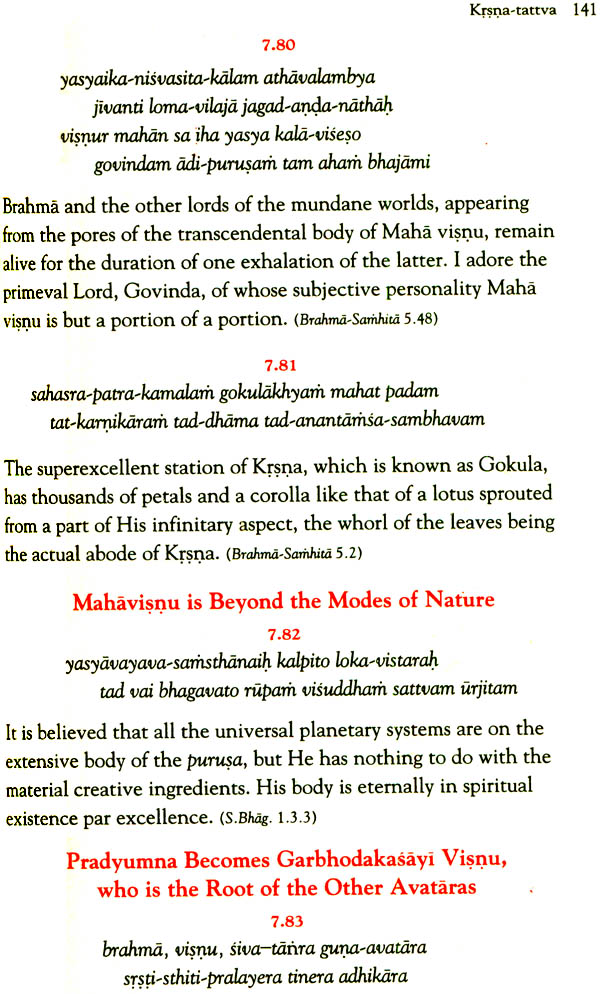
| Mahavisnu is a partial part of Krsna | ||
| Mahavisnu is beyond the modes of nature | ||
| Pradyumana becomes Grabhodakasayi Visnu | ||
| Aniruddha is Ksirodakasayi Visnu | ||
| Brahma is the avatara of rajo-guna | ||
| Brahma is empowered for the work of creation | ||
| Rudra is the avatara of the mode of ignorance | ||
| The distinction between Krsna, Siva, and jiva | ||
| Rudra is one with, yet different from the Lord | ||
| The difference between Siva and Krsna | ||
| Rodra is always absorbed in a synthesis of the qualities of maya | ||
| Visnu is above the modes of nature | ||
| Visnu is a svamsa expansion of Krsna | ||
| Krsna expands as Visnu just as an original candle lights other candles | ||
| The constitutional position of Visnu, Brahma ad Siva | ||
| The eternal and transcendental character of Krsna’s birth and pastimes | ||
| Evidence from sruti about the transcendental character of Krsna’s pastimes | ||
| The apani-padah verse means that His body is transcendental | ||
| The Lord’s body is not material | ||
| Transcendental science can’t be understood by material intelligence | ||
| The body of the Lord is transcendental substance | ||
| The name and form of the Lord | ||
| Who cannot understand Krsna’s From is a mudha | ||
| The deity from of the Lord appears in eight kinds of material substances | ||
| | ||
| | ||
| | ||
| The energies of the Supreme Lord are unlimited | ||
| The Lord’s unlimited energy is divided into three principle categories | ||
| Three varieties of the Lord’s energy | ||
| The evidence from sruti for cit-sakti | ||
| The evidence from smrti for cit-sakti | ||
| The evidence from smrti for jiva-sakti | ||
| The evidence from for maya-sakti | ||
| The evidence of the smrti for maya-sakti | ||
| Two kinds of maya is the shadow of yoga-maya | ||
| Hladini, samvit and sandhini-three kinds of energy | ||
| Those who are most dear to Krsna are His internal energy | ||
| Sri Radhika is Krsna’s most complete energy | ||
| All the Lakshmi are expansion of Sri Radha | ||
| | ||
| | ||
| | ||
| Krsna, the ocean of transcendental mellows appears differently to devotees | ||
| The absolute truth is the personification of divine mellows | ||
| The fine principle rasa | ||
| The seven secondary rasa | ||
| Srimad Bhgavatam on santa-rasa | ||
| Being fixed in Krsna is a quality of santa -rasa | ||
| The essential feature of santa-rasa | ||
| Dasya-rasa = santa -rasa + service | ||
| Srimad-Bhagatam on dasyarasa | ||
| The Srimad-Bhagavatam on the glories of dasya-rasa | ||
| The glories of being a servant of Krsna | ||
| The srutis on sakhya-rasa | ||
| In sakhya-rasa the Lord may be defeated by the jiva | ||
| Sakhya-rasa | ||
| Vatsalya-rasa | ||
| Rati is the root is the cause of rasa | ||
| Two kinds of alambana | ||
| Krsna is the best of all objects of worship | ||
| Srimad Radharani is the best of all asrayas | ||
| Subdivision of rasa | ||
| | ||
| | ||
| | ||
| The jiva is a separated infinitesimal particle (vibhinnmsa) of the Lord | ||
| The nature of the jivas is transcendental substance | ||
| The jivas is a particle of a ray of Paramatma | ||
| The jivas is conscious atomic energy | ||
| The infinitesimal soul is pure, but… | ||
| The soul pervades the body with consciousness | ||
| The evidence of Vedanta on the nature of the soul | ||
| Two kinds of souls-“bound” and “liberated” | ||
| The soul’s constitutional position | ||
| The jiva is an eternal servant of Krsna | ||
| The jiva is Krsna’s tatastha sakti | ||
| The jivas is a manifestation one with and different from the Lord | ||
| The jivas are dependent on God | ||
| Suddhavaita -on the difference between jiva and isvara | ||
| Sankara was an proponent on the difference between jiva and isvara | ||
| The cause of the jiva’s ignorance | ||
| In ignorance, the soul suffers repeated birth and death | ||
| Attaining Krsna’s lotus feet is liberation from all material suffering | ||
| The siddhanta of the Visisthadvaita -vada | ||
| The Siddhanta of Dvaitadvaita-vada on the subject of the jiva | ||
| The siddhanta of Suddhadvaita-vada | ||
| A liberated soul attains a perfect spiritual body in the service of Krsna | ||
| Suddhadvaita-vada on the distinct position of the eternally liberated souls | ||
| One who equates the jiva with the Supreme Lord is an atheist | ||
| | ||
| | ||
| | ||
| The sruti on the subjects of acintya-bhedabheda-tattva | ||
| Srimad-Bhagavatam on acintya-bhedabheda-tattva | ||
| Smrti on acintya-bhedabheda-tattva | ||
| The Brahma-sutras support the view of sakti-parinamavada | ||
| The meaning of parinama-vada and vivarta-vada | ||
| | ||
| | ||
| | ||
| Sreyas and preyas | ||
| The purpose of human life | ||
| Three different paths-karma, jnana, and bhakti | ||
| who qualifies for karma, jnana, or bhakti | ||
| To be fixed in that for which one is qualified is a good quality | ||
| Even sages and demigods are bewildered trying to understand the Vedas | ||
| The Vaisnava guru never encourages karma | ||
| Karma-yoga does not give freedom from the fear of birth and death | ||
| Bhagavatam derides karma and jnana | ||
| Materialistic karmic activities are condemned | ||
| The path of karma is condemned in the Vedas | ||
| Without worshipping Visnu, worship of demigods is improper | ||
| Impersonalism is condemn the ascending path of knowledge | ||
| Destinations of followers of the ascending and descending path | ||
| Education, austerity, work, knowledge, etc. doesn’t enable one to see God | ||
| The Vedas on the ascending path of impersonal knowledge | ||
| Bhakti is superior to karma and jnana | ||
| The eightfold Yoga system does not lead to the highest goal | ||
| Mind control through pranayama is impossible | ||
| Yoga and pranayam are a waste of time | ||
| Who is a real yogi and sannyasi | ||
| Without bhakti there is no means to attain the Supreme | ||
| Pure devotion is the only means to attain Krsna | ||
| The goal of bhakti and the goal of karma and jnana are not the same | ||
| The character of bhakti | ||
| | ||
| | ||
| | ||
| Jnana-misra-bhakti-Devotion mixed with knowledge | ||
| Karma-misra-bhakti-Devotion mixed with karma | ||
| The definition of bhakti | ||
| The srutis glorify bhakti | ||
| Two kinds of bhakti -vaidhi and raganuga | ||
| Vaidhi-bhakti | ||
| Raga-bhakti | ||
| The nine limbs of bhakti | ||
| Sravana and smarana are best | ||
| Sravana | ||
| The gradation of what is obtained by sravana | ||
| The glories of sravana | ||
| The meaning of the world kirtana | ||
| The material senses can’t appreciate the transcendental nature of Krsna | ||
| Kirtana | ||
| The glories of Krsna-kirtana | ||
| Kirtana describing the Lord’s qualities is the aim of all knowledge | ||
| The glories of the qualities of the Supreme Lord | ||
| Nama-kirtna is the only way in Kali-yuga | ||
| The harinama verse explained | ||
| Smarana | ||
| The result of remembering material subjects verses remembering Krsna | ||
| The result of remembering Krsna | ||
| Kirtana is better than sravana and smarana | ||
| Pada-sevana | ||
| The result of Pada-sevana | ||
| Arcana | ||
| Vandana | ||
| The glories of vandana | ||
| Dasyam | ||
| The different branches of dasyam | ||
| The prayer of the servant of the Lord | ||
| The definition of sakhyam | ||
| Two divisions of sakhya-based on faith and on friendly affection | ||
| Generic sakhyam, based on faith | ||
| Sakhyam based on intimate feelings of friendly affection | ||
| Generic sakhyam, based on faith | ||
| Sakhyam based on atma-nivedanam | ||
| Saranagati | ||
| Duties and religious principles (dharma) favorable to bhakti | ||
| Detachment is favorable for bhakti | ||
| Grhastha conduct is favorable for bhakti | ||
| Fasting on Ekadasi is favorable for bhakti | ||
| What destroys bhakti | ||
| A Vaisnava’s remnants have the power to bestow prema | ||
| The glories of maha-prasada | ||
| Attachment to wife and home is antagonistic to developing bhakti | ||
| Thing unfavorable to devotional service | ||
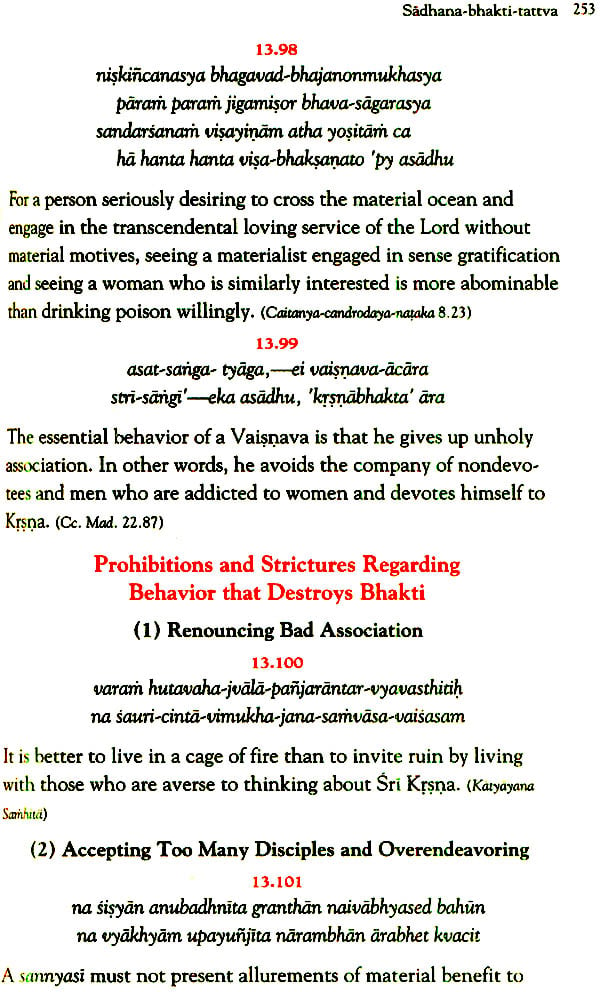
| Bad association destroys bhakti | ||
| Prohibition and strictures regarding behavior that destroys bhakti | ||
| Renouncing bad association | ||
| Avoid attachment to accepting too many disciples and overendeavoring | ||
| Remaining undisturbed by material misfortunes | ||
| Avoiding lamentation | ||
| Prohibitions on worshipping other gods | ||
| On should avoid giving pain to other living beings | ||
| Bhakti is superior to false renunciation | ||
| Things opposed or bhakti reside in five places | ||
| The different kinds of bad association that destroy bhakti | ||
| Association with women destroy bhakti | ||
| Remembrance of sexual pleasure condemned | ||
| The power of a woman to attract the mind | ||
| One should completely give up all association with women | ||
| Grhamedhi-dharma condemned | ||
| Tamasic and rajasic foods are antagonistic to bhakti | ||
| Meat-eating destroy bhakti | ||
| The senses are like wines, and the tongue is the most powerful | ||
| Misconceptions to be avoided in sadhana-bhakti | ||
| To view devotees externally is antagonistic to bhakti | ||
| Conception of good and bad are antagonistic to bhakti | ||
| Materialistic persons and their treading of Bhagavatam are condemned | ||
| Fake, show-bottle, and professional Bhagavatam reciter | ||
| Attempts as liberation will not lead to bhakti | ||
| Desires for enjoyment and liberation destroy bhakti | ||
| The senses are useless if not lead to bhakti | ||
| Without the mercy of Gauranga it is impossible to control the senses or practice bhakti | ||
| The six kinds of saranagati | ||
| Humility | ||
| The value of association with a pure devotee | ||
| The sruti state that association with saints as the only thing worth doing | ||
| Sadhu-sanga is the only way | ||
| Those who have few pious credits miss the association of great souls | ||
| A devotee has all good qualities; a non-devotee has none | ||
| From sadhu-sanga comes faith, devotional attachment, and prema-bhakti | ||
| With humility and hankering for Krsna, a devotee prays as follows | ||
| | ||
| | ||
| | ||
| Two kinds of varnasrama-divine and demonic | ||
| Divine varnasrama | ||
| The demoniac social system | ||
| The character of the followers of demonic society | ||
| The future life of the followers of demonic society | ||
| The future life of the followers of demonic society | ||
| The birth, family, and knowledge of demonic society are useless | ||
| The characteristics of each varna | ||
| Bhagavad-gita on varnasrama | ||
| Qualities of brahmanas | ||
| Qualities of ksatriyas | ||
| Qualities of vaisyas and sudras | ||
| The division of varna and asrama according to guna and karma | ||
| Evidence from Srimad-Bhagavad about the divisions of varnasrama | ||
| In satya-yuga, there was only one varna; paramahamsa | ||
| Division occur owing to guna and karma | ||
| The position of varna-dharma in Kali-yuga` | ||
| Brahmanas in kali-yuga are brahmanas in name only | ||
| The evidence from Caitanya-bhagavata | ||
| The smrti on how the Brahmana caste was debased | ||
| The opinion of the truth-loving Vedic Rsis | ||
| The sruti, smrti, Puranas, and Itihasas on Brahmana-karma | ||
| Evidence from the Mahabharata | ||
| Evidence from the Srimad Bhagavatam | ||
| The ancient commentator, Nilakantha, on the conduct of brahmanas | ||
| Srimad Svami’s opinion | ||
| Mahaprabhu’s definitions of what is and isn’t brahmana | ||
| The evidence of the Smrti | ||
| The verdict of the Mahabharata on the occupation of brahmanas | ||
| The smrti on the occupational behavior of brahmanas | ||
| An example of the conduct of a brahmana | ||
| The evidence of Vedanta-Surta and the example of Citraratha | ||
| Madhavacarya’s commentry, quoting from Padma-Purana | ||
| Members of other castes who became brahmanas | ||
| Examples from Bhagavatam on birth as a brahmana | ||
| The opinion of Lord Brahminical conduct | ||
| The seminal brahmanas of kali-yuga are impure | ||
| What is diksa | ||
| Diksa can make a common man a brahmana | ||
| The guru initiates the humble disciple | ||
| The evidence of Mahabharata | ||
| The conclusion of the Gosvamis | ||
| Three kinds of birth-seminal, brahminical, and mantra-diksa | ||
| Sridhara Svami’s remarks on the three kinds of birth | ||
| Who has done the forty-eight kinds of samskaras is a brahmana | ||
| The one branch and the many branches | ||
| Vaisnavas are not sudras | ||
| Except for paramahamsas, devotees accept the sacred thread | ||
| Those who are brahmanas in name are conceited and proud | ||
| Real brahmanas | ||
| Giving the sacred thread to those not on the Vedic path is forbidden | ||
| The consequences for the brahmanas in name only | ||
| Students and practitioners of professional brahminism are condemned | ||
| Demigod worship and other unbrahminical activities | ||
| Demigod worship by brahmanas is condemned | ||
| Demigod whorship is damned | ||
| Spiritual brahmanism | ||
| Who is a Brahmana | ||
| A Vaisnava is the best of all and the guru of everyone | ||
| A Vaisnava from a candala family is worshipable by brahmanas | ||
| Vaisnava are infallible | ||
| Differences between low-born devotees and expert brahmanas | ||
| Benefits of taking the holy name of Krsna | ||
| Advaita Prabhu instructs that a Vaisnava is guru of the brahmana | ||
| A Vaisnava is the guru for millions of brahmanas | ||
| | ||
| | ||
| | ||
| Every soul is in one of the four asrma | ||
| Definition of the four asramas | ||
| Rules for the different four asramas | ||
| Rules for brahmacaris | ||
| All asramas are meant for serving Hari alone | ||
| Scriptures make concessions for materialistic people | ||
| Grhasthas should not get bewildered by family life | ||
| A grhastha may live at home, in the forest, or on the road | ||
| The character of those too attached to family life | ||
| The destination of attached householders | ||
| Both men and women should avoid family attachment | ||
| Enjoyment of conjugal pleasures in household life is condemned | ||
| The purpose of household life | ||
| The unholy household | ||
| The duty of vanaprasthas | ||
| Homes are in different modes | ||
| Karma-sannyasa, jnana-sannyasa, and tridandi sannyasa | ||
| A dhira sannyasi | ||
| A narottama sannyasi | ||
| Prohibitions against karma-sannyasa in Kali-yuga | ||
| The meaning of the word tridandi | ||
| Rupa Gosvami’s definition of tridandi | ||
| Tridandi-sannyasa mentioned in the Vedas | ||
| Srimad-bhagavatam mention tridanda sannyasa | ||
| The tridandi attains perfection according to the Menu-samhita | ||
| The hundred and eight names of the tridandi sannyasi | ||
| A tridandi sannyasa is worshipable by all asramas | ||
| Sarvabhauma Bhattacarya’s examples | ||
| Impersonalist sannyasis are condemned | ||
| only unmotivated devotional service gives satisfaction to the soul | ||
| Fallen sannyasis are compared to vomit-eaters | ||
| Sannyasis should not become vanhtasis | ||
| Great souls are transcendental to all the asramas | ||
| The Vedic explanation of “paramahamsa” | ||
| The Supreme Lord is transcendental to all material considerations | ||
| Red cloth is in napropriatte for paramahmsas | ||
| Bhagavatam gives the characteristic behavior of a paramahamasa | ||
| The mentality of a paramahamsa | ||
| | ||
| | ||
| The proper funeral ceremony | ||
| Vaisnavas need not perform funeral rites or offer ablations to forefathers | ||
| Lord Caitanya’s internal reasons for performing the funeral ceremony | ||
| Vaisnavas must deceive the smartas for their own good | ||
| Funeral ceremony of the karmis is demonic | ||
| The behavior of Advaita Acarya | ||
| The characteristics of a staunch devotee | ||
| | ||
| | ||
| | ||
| The Supreme Lord Krsna is the root of all religion | ||
| Krsna is the only way | ||
| Chanting the holy name of the Lord is the eternal dharma for all souls | ||
| The holy name is the essence of the srutis | ||
| The constitutional nature of the holy name | ||
| The Vedas sing the glories of the holy name | ||
| The glories of the holy name in the smrti-sastras | ||
| The holy name grants all perfection in Kali-yuga | ||
| Sridhara Svami on glories of the holy name | ||
| Rupa Goswami on the glories of the name | ||
| The efficacy of gayatri and the holy name | ||
| The glories of Hari-katha | ||
| The glories of the holy name surpass that of impersonal Brahman | ||
| Kirtana of the holy name is best of all | ||
| The holy name is not regulated by time, place and circumstance | ||
| The Bhagavatam on the subject of loud kirtana | ||
| Loud kirtana is the best | ||
| Loud kirtana benefits the chanter of the holy name and those who hear it | ||
| Mahaprabhu loudly chanted the holy name | ||
| The opinion of Baladeva on the form of the maha-mantra | ||
| Hare Krsna is the maha-mantra for the age of Kali | ||
| The Upanisads on the Hare Krsna maha-mantra | ||
| The Puranas on the Hare Krsna maha-mantra | ||
| Chanting the holy name qualifies one for deliverance | ||
| The holy name is chanted in the stage of practice and in perfection | ||
| Things unafavorable for nama-kirtana | ||
| The characteristics of the principal and secondary name | ||
| The secondary names and their symptoms | ||
| Fruits of the principal and secondary name of the Lord | ||
| The principle name | ||
| The fruit of offenselessly uttering the principle name | ||
| The principle result of chanting the holy name is Krsna-prema | ||
| Nama-kirtna fulfills all aspects of bhajana | ||
| The pure name arises within the asscociation of devotees | ||
| The holy name cannot be realized through the material sense | ||
| Determination for chanting the holy name | ||
| Kirtana gradually awakens the form, qualities, and pastimes of the Lord | ||
| The four kinds of namabhasa | ||
| The results of the pure holy name and namabhasa | ||
| The results of namabhasa and namaparadha | ||
| The proper mentality for chanting without offense | ||
| The ten offenses to the holy name | ||
| The principle offense to the holy name | ||
| Apardhis are punished forever | ||
| Six kinds of Aparadha | ||
| Aparadhis should have their tongues cut out | ||
| The great fault of hearing blasphemy of Vaisnavas | ||
| The way to overcome Aparadha | ||
| The second offense to the holy name | ||
| The third offense to the holy name | ||
| The fourth offense to the holy name | ||
| The fifth offense to the holy name | ||
| Other processes of purification are a waste of time | ||
| The sixth offense to the holy name | ||
| Auspicious activities other than pure chanting are useless | ||
| The seventh offense to the holy name | ||
| The eight offense to the holy name | ||
| The ninth offense to the holy name | ||
| The tenth offense to the holy name of Krsna | ||
| The real name of Krsna can never awaken in Mayavadis | ||
| One gain life by chanting the holy name of Krsna and dancing | ||
| The qualification of jagad-guru | ||
| | ||
| | ||
| | ||
| The definition of bhava | ||
| Mahaprabhu’s verse on bhava | ||
| The cause of bhava, transcendental emotion | ||
| Where the symptoms of bhava appear | ||
| The practical symptoms of bhava | ||
| Two kinds of raga-marga-the practitioner and the perfected soul | ||
| Prema develops into Sneha, raga, anuraga, bhava and mahabhava | ||
| One with eyes of prema can see the Supreme Person | ||
| The shelter of madhurya-rasa-bhakti | ||
| The direct and indirect tasting of rasa | ||
| The definition of rasa | ||
| The qualification for madhurya-rasa | ||
| The prohibition for those who are unqualified | ||
| The separation experienced in madhurya-rasa | ||
| Extreme separation | ||
| The prayer of one who aspires to worship Krsna in madhurya-rasa | ||
| Appendix | ||
| Pramana-tattva | 399 | |
| Subjects Index | 401 | |
| Verse Index | 435 |