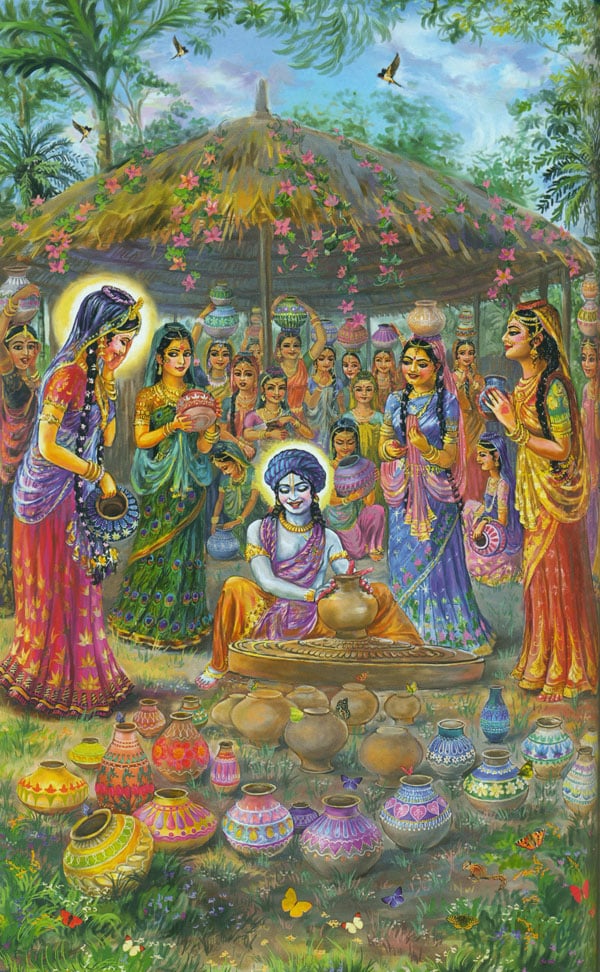


Sri Guru Darsana (Revelation of The Divine Master)
Book Specification
| Item Code: | NAM349 |
| Author: | Srila Narayana Maharaja |
| Publisher: | Gaudiya Vedanta Publications |
| Language: | English |
| Edition: | 2016 |
| ISBN: | 9781943614035 |
| Pages: | 1400 (7 B/W and 96 Color Illustrations) |
| Cover: | Hardcover |
| Other Details | 9.0 inch x 6.0 inch |
| Weight | 1.20 kg |
Book Description
A painting of the evening sky necessitates a creator, but what of the multidimensional beauty in the world around us? Who are we? Why are we here? The superiority of humankind over the animal kingdom lies in its ability to search for the truth of existence. Countless people have undergone such a quest throughout the ages. Of them most return baffled, while others paint a picture of their perceived reality. Thus sprang the myriad schools of thought found in the world today.
Faced with a vast marketplace of ideas, one can become perplexed about which beliefs to buy into. Many say that everyone is ultimately God. But then questions arise: "If we are all God, then why are we bound to suffer? Why can't we control reality?" Such a powerless God defies His definition as the Almighty Being. Others claim that God is simply a figment of the unscientific mind; however, in spite of numerous physical laws and theories, a definitive explanation on the origins of life eludes the scientists. There are those who say God is a detached observer, a clockmaker unable to interact with His creation. Others claim there is no reality at all, that everything is an illusion. Many become frustrated in the search for truth, unable to find the answers they seek. As if searching for a single needle in an endless haystack, they throw aside all possibilities, thinking, "This is not it. This is not it." Finally, they negate all meaning to naught, without realizing that the object they search for is not separate from the hay they have recklessly thrown aside.
Nothing can exist outside the Absolute Truth. Indeed, nothing can be nothing, because for nothing to exist, it is necessarily something. How do -we distinguish the relative from the absolute? From birth to death, we seek lasting happiness and love, yet must ultimately suffer the impermanence of our mortal lives. Souls drowning in the sea of relativities cannot hope to find the Shore of eternal truth without a capable guide from that land.
In the Sanskrit language of the Vedas such a guide is known as guru. Guru is one who, with the torchlight of divine knowledge, leads souls out of the frightening darkness of ignorance in a transient existence, to the blissful reality of the self in an eternal loving relationship with God. Nowadays, guru has become a term used to imply an expert of any field. The majority of these gurus only lead one further into ignorance-or a stronger attachment to material life. A genuine guru takes responsibility for the spiritual progress of the soul, transferring attachment to objects of this world to loving attachment for God.
Sri Guru is empowered with all spiritual energy from the Divine Potency. Sri means beauty or fortune. Although all people search for beauty and fortune, they accept that which swiftly fades. Everlasting Sri only exists with Her eternal possessor, the Supreme Lord, known in Sanskrit as Bhagavan. Bhagavan is He who possesses absolute beauty, wealth, strength, fame, knowledge, and renunciation. These six qualities are the potency of God. Fire cannot be separated from heat and light, for they are the potencies of fire-and the fire itself is the potent. Likewise, Bhagavan is the Supreme Potent, and Sri is His inseparable Divine Potency and Feminine Counterpart. The absolute and topmost form of Bhagavan is Krsna, meaning the all-attractive reservoir of love and sweetness. He exists in the realm of Vraja, the highest spiritual abode, where He is absorbed in loving pastimes with Srimati Radharani, the embodiment of the Divine Potency, and the source of all love, beauty, and fortune. Radha-Krsna exist in two forms for the interplay of love and also in a combined form as Caitanya Mahaprabhu to further relish the depth of love and also to spread divine love to others. Radha-Krsna send expansions of Their mercy, known as Sri Guru, to this world to attract the lost souls by giving them a taste of divine love. Sri Guru is thus Radha-Krsna's mercy incarnate in this world.
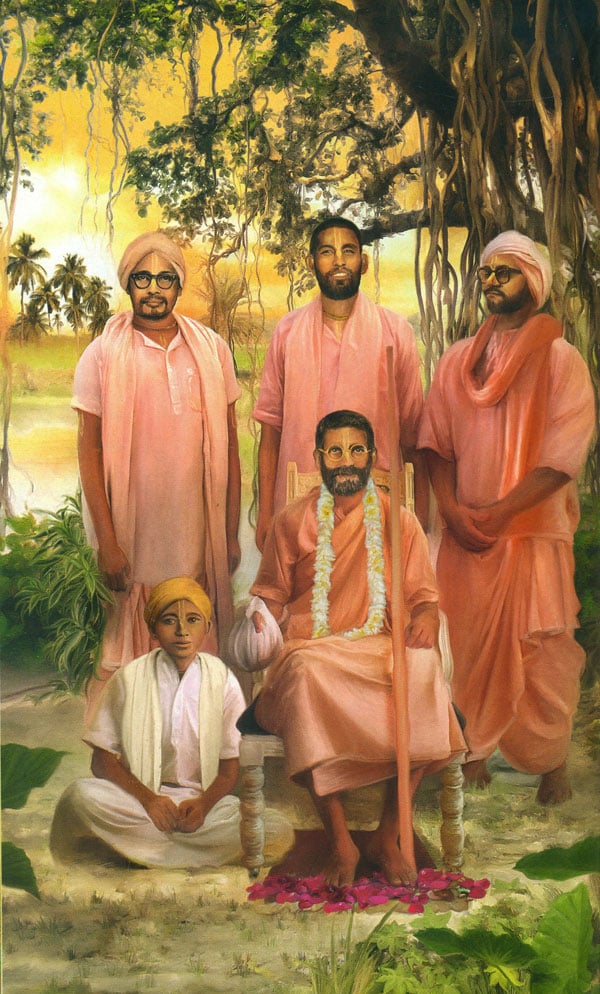
This book, Sri Guru Darsana, is a revelation or darsana of the life of Srila Bhaktivedanta Narayana Gosvami Maharaja, an eternal associate of Radha- Krsna sent from Vraja, as well as his darsana or teachings to the world. Srila Bhaktivedanta Narayana Gosvami Maharaja came in an unbroken succession of' divine masters, descending from the Supreme Lord Himself the original Divine Master. Such a spiritual lineage is considered prerequisite for a bona f'ide guru by all religious authorities throughout India. Srila Bhaktivedanta Narayana Gosvami Maharaja, renowned as Srila Gurudeva, embodies all the descriptions of a pure guru of the highest caliber, as evidenced in the Vedic scriptures, He spent five decades serving the mission of his spiritual master. Having fully assimilated his master's teachings, he then traveled the globe thirty-one times to fulfill the heart's desire of his Guru-varga (spiritual lineage of gurus) by broadcasting the message of divine love for Krsna.
Srila Gurudeva left an invaluable legacy by publishing scores of books. Concurrent to his literary legacy, the legacy of his loving dealings, humility, and purity touched the hearts of people around the world. He truly practiced what he taught; therefore he was able to transform the lives of hundreds of thousands. His pure Character is transmitted through his writings, so that, even today, we have the opportunity to come in contact with him through his empowered words. Srila Gurudeva's teachings are based on the Srimad-Bhagavatam, the ripened fruit of Vedic knowledge and the final opus of the compiler of all Vedic literature, Sri Vyasadeva. The Srimad- Bhagavatam explains that we are spiritual beings, Children of immortal Bliss; nonetheless, having turned away from the Absolute Truth, we are suffering in the transitory reality of material existence. Srila Gurudeva taught that, by following the process of pure bhakti-yoga, unalloyed devotion to God, our true nature is attained and we become eternally joyful.
All people possess faith and, as such, faith and prayer are the foundations of bhakti-yoga. Even atheists have faith in something, be it the authorities of science or their own speculations. Everyone exists under a higher power. For those without faith in any authority, the power of time awaits as death. People pray to the object of their faith for that which cannot be achieved by their own power. A baby is unable to maintain itself, but it has faith in its mother; thus it prays through the process of tearful cries. We are born in prayer, as a babe in pain, wailing to the world for joy and love-the treasure we seek from cradle to grave. In infancy, we pray with outstretched arms for the satisfaction of our needs. And in our quest for happiness, we study the world, learning a language to express our desires. As a Child we are sent to school where we are taught how to survive by our own means. Faith grows in our own abilities, and thereby we forget how to pray. As time passes, we encounter failure and our strength wanes with the onslaught of old age. Faith transforms to fear and those we love gradually forsake us. Finally, death comes to take us to the unknown.
Out of compassion, the Divine Moieties, Radha-Krsna, send teachers to this world to lead humanity from the spell of false identification with the body and mind. As parents send their Children to an appropriate school according to age and qualification, Radha-Krsna send people to different teachers and faiths to help them advance on the path of self-realization. A perfect teacher of the topmost school, Srila Gurudeva taught how we can escape the vicious cycle of karma by learning how to pray, what we Should pray for, and to whom. He bestowed faith not by arguing endlessly about whether or not God exists; but having a personal relationship with Him, Gurudeva told us exactly who He is, where He resides, what His activities are, and how we can become eternally connected to Him by love. Others may say God is unknowable, but that is only because they have no relation with Him; therefore for them, God is unknown.
Srila Gurudeva once stayed in Cebu, Philippines, for a month in the winter of 2002 working on his writings. One evening, a Christian lady came to meet with him while he was chanting on a veranda overlooking the ocean. They were introduced to each other and spoke for a few minutes. She said afterwards, "I came to get the blessings of a guru."
"Do you know the meaning of guru?" he asked.
"A spiritual teacher?" She Shyly responded.
"Yes," Srila Gurudeva said, "but more than that. A real guru is someone very powerful. He is not an ordinary teacher. He is so powerful that he can even control God with his love. How? In the spiritual world, the Supreme Person, the all-attractive Krsna, is controlled by the love of the residents of Vraja. They do not think of Krsna as God, but as their best friend, Child, or dearmost beloved. A pure guru is from that eternal world. He teaches this highest platform of love by which the soul will be united with God. Do you understand?"
She clasped her hands respectfully and nodded. Srila Gurudeva also folded his hands and said, "Do you know what this gesture means?"
"It is a symbol of prayer."
"Yes," Srila Gurudeva said. "Holding the hands together like this is an appeal to God, common to all faiths. This also symbolizes our highest aspiration."
Srila Gurudeva opened his hands and said, "Sri: Guru is the agent who brings about the meeting of the soul with God. Look, one hand represents the soul, and the other is the Supreme Soul." He again joined his palms. "We fold our hands in devotion, praying to be united in a loving relation with God. This is the process of bhakti-yoga."
Sources of Sri Guru Darsana
The Sri" Guru Darsana series was compiled and edited primarily from the dictations and lectures of a dear servant of Srila Gurudeva, who met him in 1968, and who wishes to remain anonymous. This esteemed Vaisnava heard many of the stories presented in Sri" Guru Darsana directly from Srila Gurudeva or his godbrothers, and was in attendance for the majority of the occurrences happening in India narrated from 1975 until 2010. On this Vaisnava's order, the compiler adjusted his first-person-narrations of interactions with Srila Gurudeva into third person, and also collated and translated relevant information from other authentic sources. The account of Srila Gurudeva's early years in Tiwaripura in Volume One was enriched with occasional details provided by Sri Siddhanatha Tiwari, Details of the parikrama of Navadvipa in Part Two were verified with reference to Srila Bhaktivinoda Thakura's Navadvipa-dhama-mahatmya. Significant details from Srila Gurudeva's biography of Srila Bhakti Prajnana Kesava Gosvami Maharaja, courtesy of Gaudiya Vedanta Publications, were incorporated into Part Three of Volume One and Part One of Volume Two. Excerpts in Part One of Volume Two were translated from the Hindi periodical Sri Bhagavata Patrika; the Bengali periodical Sri Gaudiya Patrika was used as reference for Volume Two and Three. Particulars from Srila Gurudeva's Sri Vraja-mandala Parikrama book were integrated into Part Three, Volume Two. Part Two of Volume Three was enriched with excerpts transcribed from the video and audio archive of Srila Gurudeva's hari-katha on purebhakti.tv, as well as from the transcribed lectures distributed online at purebhakti.com by the Harikatha Team.
Sri Guru Darsana has been made possible solely by the divine grace and inspiration of Bhaktabandhava Srila Gurudeva. Many devotees participated in this service. Together, we pray to Srila Gurudeva, who has manifested here in the form of this book, that we may always have his darsana. Offering countless prostrations before Bhaktabandhava Sri Srimad Bhaktivedanta Narayana Gosvami Maharaja, this insignificant servant begs to be eternally engaged in his service.
According to qualification, experience, and understanding, the knowers of the truth have had darsana (vision) of the non-dual Supreme Being. He is thus discerned by those who are free from mundane defects in one of the following conceptions: (I) as brahma, the all- pervasive impersonal spirit; (2) as Paramatma, the Supersoul dwelling in the hearts of all beings; and (3) as Bhagavan, the Supreme Lord, the source of both the personal and formless, effulgent expansions.
vadanti tat tattva-vidas tattvam yaj jnanam advayam
brahmeti paramatmeti bhagavan iti sabdyate
Srimad-Bhagavatam 1.2.11
Those who are knowers of the truth call the Absolute Reality advaya-jnana, non-dual Truth. Some call that very non-dual Truth brahma, some call Him Paramatma, and some call Him Bhagavan.
In accordance to their own levels of realization, great souls have eulogized the glories and activities of the Absolute Truth, as well as the truths of the spiritual masters and saintly devotees. Jiski rahi bhavana jaisi hari murat dekhatin taisi-the form of Lord Hari Shall be perceived according to one's mood.
Sri Krsna, the fountainhead of all rasa (flavors, relationships, or moods), was perceived in ten different aspects as He entered the arena of Kamsa. As described in the Srimad-Bhagavatam (10.43.17) He was thereby perceived: (I) as a thunderbolt to the heroic athletes; (2) as a superhuman being to the people in general; (3) as the god of love to the ladies; (4) as their own kinsman to the cowherds; (5) as a strict ruler and dispenser of justice to wicked monarchs; (6) as a Child to His parents; (7) as death personified to Kamsa; (8) as the universal form to the worldly-minded; (9) as the indwelling Supersoul to the yogis; and (10) as the Supreme Deity to those in the Vrsni dynasty.
All other visions are ordinary and insignificant compared to the gopis' (milkmaid residents of Vraja) darsana of Krsna. Even the gopis see Krsna differently according to their moods. Some see Him as Vraja-vallabha, some. as Radha-vallabha, Madana-mohana, Radha-ramana, Govinda, Gopinatha, Radha-kanta, Rasa-bihari, Rasika-ranjana, Giridhari, Gopala, and as countless other names and accompanying forms. The Supreme Person Krsna is one, yet He has unlimited manifestations including His personal manifestations, personal expansions, pastime forms, and various empowered living entities. In the hearts of the Vraja- devis, Krsna manifests as their dearmost beloved according to their moods of loving affection for Him.
Similarly, the disciples of Sri Guru-pada-padma perceive their spiritual master in various gradations, according to their individual qualification.The darsana of each person can never be duplicated. Srila Gurudeva is a manifestation of the root of all gurus, Baladeva Prabhu. Morever, he is an exceedingly dear maidservant of Srimati Radharani. Any glorification or description of Sri Guru expressed by a genuine authority is beneficial for the world; on the other hand, ideas expressed by an ordinary person, who has not entered the realm of devotion and spiritual practice, are not beneficial for the world.
We are fallen souls and Gurudeva has come to deliver us. Knowing that it could take millions of lives to make someone first qualified and then to connect him to God, Srila Gurudeva connected people from whatever position they currently occupied. Srila Gurudeva instructed us with these words: "You are fallen. I don't want you to develop any false pride. Be humble. Your dharma (constitutional nature) is to serve Bhagavan, not to lord it over others." Whoever sincerely practices bhakti will feel humble and fallen; while it is the nature of people bound by false ego to think they are great.
Srila Gurudeva often reminded us the instructions of Caitanya Mahaprabhu:
trnad api sunicena taror iva sahisnuna
amanina manadena kirtaniyah sada harih
Sri Siksastaka 3
Being more humble than a blade of grass, more tolerant than a tree, and ready to offer all respects to others without expecting any in return, constantly absorb yourself in Chanting the names of Krsna.
Some gurus emphasize making their disciples qualified, and many disciples eulogize their master as the great soul who raised them to a high post:
mukam karoti vacalam pangum langhayate girim
yat-krpa tam aham vande sri-gurum dina-taranam
Bhavartha Dipika
I bow down unto Sri Guru, the savior of the fallen, who turns the dumb into eloquent speakers and enables the lame to cross mountains.
Srila Gurudeva emphasized the mood expressed by Mahaprabhu:
ayi nanda-tanuja kinkaram
patitam mam visame bhavambudhau
krpaya tava pada-pankaja-
sthita-dhuli-sadrsam vicintaya
Sri Siksastaka 5
O son of Nanda, I am Your eternal servant, but I have fallen into this terrible ocean of birth and death. Kindly accept this fallen soul and consider me a particle of dust at Your lotus feet.
The more our love develops, the more we will feel fallen and insignificant. Srila Gurudeva said that the mood in the verse-mukam karoti vacalam-will not be sufficient for self-realization-rather, the fallen mood of the verse- ayi nanda-tanuja-is required. We have to accept ourselves as fallen. When we consider ourselves fallen, we can advance along the path of righteousness and help others as well. What does one gain by thinking himself a pandita, a knower of truth, and free of the Chance of making mistakes? If someone is a pandita, who knows the six philosophies, will he ever consider himself fallen? Rather, he will state, "You have the four defects-(1) false impression of reality; (2) the fault of making errors; (3) the Cheating propensity; and (4) imperfect senses. You have written incorrectly."
We cannot have complete darsana of Sri Guru unless we are under the guidance of the gopis. And the gopis accept those who surrender to Sri Guru, considering themselves fallen and unworthy. Others may look at Sri Guru with their own particular vision, but that is not necessarily a revelation of him from a spiritual viewpoint. The gopis, whose greatness is beyond compare, consider themselves fallen. At the meeting in Kuruksetra, Sri Radhika and the prominent gopis said:
ahus ca te nalina-nabha padaravindam
yogesvarair hrdi vicintyam agadha-bodhaih
samsara-kupa-patitottaranavalambam
geham jusam api manasy udiyat sada nah
O Lord whose navel is like a lotus, great yogis who possess profound intelligence meditate upon Your lotus feet within their hearts. Your lotus feet are the only means of escape for those who have fallen into the well of material existence. O Lord, please give us the benediction that, even when we perform household work, Your lotus feet Shall always reside in our hearts and we Shall never forget them, even for a moment.
Even if one knows the truth of Brahman, Paramatma, and Bhagavan, unless he comes down from the mountain of pride, he will not be able to attain the moods of Vraja.
ye 'nye 'ravindaksa vimukta-maninas
tvayy asta-bhavad avisuddha-buddhayah
aruhya krcchrena param padam tatah
patanty adho 'nadrta-yusmad- anghrayah
Srimad-Bhagavatam 10.2.32
Persons who are under the impression of being liberated, but who lack interest in devotional service to the Lord, again fall down into material existence because of their impure consciousness and for lack of Shelter in the transcendental realm.
If one who has achieved an exalted position does not have respect and a relation with Krsna and His devotees, then he will eventually fall down from that post. Hence, Srila Gurudeva trained his followers to feel humble and accept their position as mere servitors.
ye yatha patita haya, tava daya tata taya
However fallen one is, to that extent he shall be a receptacle of mercy.
The Glory of Sri Guru
The glories of Sri Guru have been explained in all scriptures and have been exemplified by the Lord. During His household pastimes as a scholar, Sri Caitanya Mahaprabhu traveled to Gaya to perform the sraddha ceremony of His father. There He met with Isvara Puri and received the diksa-mantra from him. He then prayed to him, saying:
prabhu bale, -"gaya-yatra saphala amara
yata-ksane dekhilana carana tomara
tirthe pinda dile se nistare pitr-gana
seha,-yare pinda deya, tare'sei jana
toma' dekhilei matra koti-pitr-gana
sei-ksane sarva-bandha paya vimocana
ataeva tirtha nahe tomara samana
tirther o parama tumi mangala pradhana
Caitanya-Bhagavat, Adi-khanda 17.50- 53
The Lord said, "My journey to Gaya became successful as soon as I saw your lotus feet. The forefathers are delivered when one offers oblations to the forefathers in a holy place-but only those who are offered the oblations. However, by seeing you, millions of forefathers are at once freed from material bondage. Hence, holy places are not equal to you, for you purify even the holy places."
Sri Caitanya Mahaprabhu received diksa from Isvara Puri and demonstrated how one Should respect Sri Guru. He went to the village of Isvara Puri's birth, took the dust from that place, smeared it on His body, and always kept a pouch of that dust with Him.
Sri Guru purifies the living entities; frees them from material bondage; awakens pure love of God in their hearts; and establishes them in their true spiritual nature and form. Sriman Mahaprabhu declared:
yare dekha, tare kaha 'krsna'-upadesa
amara ajnaya guru haya tara' ei desa
Caitanya-caritamrta, Adi 13•30
To whomever you see, teach the instructions of SiI Krsna. Thus become a spiritual master and endeavor to liberate everyone in this land.
That person who both accepts the responsibility of serving Bhagavan and engages others in His service is known as a guru and he is the giver of welfare to this world.
Sriman Mahaprabhu also declared:
kali-kalera dharma-krsna-nama-sankirtana
krsna-sakti vina nahe tara pravartana
Caitanya-caritamrta, Antya 7.11
A person cannot spread the glories of Bhagavan and engage others in His service without being empowered by Krsna's sakti. The Divine Potency, svarupa-sakti, has the function of engaging others in the service of the Supreme Potent, saktiman. The three branches of the Divine Potency are known as sandhini, the existence potency; samvit, the knowledge potency; and hladhini, the pleasure potency. When these three potencies of Bhagavan manifest in a person, he becomes guru.
Service and submission to the spiritual master is essential for the initiate. The independent disciple suffers, but the surrendered disciple achieves the grace of God.
diksa-kale bhakta kare atma-samarpana
sei-kale krsna tare kare atma-sama
sei deha kare tara cid-ananda-maya
aprakrta-dehe tanra carana bhajaya
Srimad-Bhagavatam 11.3.6
At the time of initiation, when a devotee fully surrenders unto guru and engages in the service of the Lord, Krsna accepts him to be as good as Himself. When the devotee's body is thus transformed into spiritual substance, the devotee, in that transcendental body, renders service to the lotus feet of the Lord.
Krsna accepts a disciple who is surrendered to a bona fide guru and blesses him with the strength necessary to perfect his spiritual practice.
In Dvapara-yuga, Krsna Himself Showed how a disciple Should be an ideal servant of his guru when He resided in the asrama of His master, Sandipani Muni. Lord Ramacandra also exhibited perfect service of the spiritual master. During His reign as sovereign, He always acted under the guidance of His guru, Vasista Rsi.
A bona fide guru is described in sastra to be himself a bona fide disciple present in one of the four Vaisnava-sampradayas. Such a guru is declared by Bhaktivinoda Thakura as a deliverer of amnaya-the pure knowledge of the scriptures. One who surrenders to such a bona fide guru receives the knowledge of the scriptures, along with his own spiritual identity and the tendency to serve the Supreme Soul. A sincere disciple also becomes detached from the objects of maya, illusion.
Vaidhi-Marga Guru and Raga-Marga Guru
Gurus are generally found to be of two categories: one is of vaidhi-marga, the spiritual path governed by rules and regulations, and the other is of raga-marga, the spiritual path of spontaneous loving attraction to the Supreme Person. A person embarked upon the path of strict discipline can gradually achieve spiritual realization. However, a sincere disciple who follows a raga-marga guru, who is an associate of Krsna in Vraja, can quickly achieve that exalted personality's unparalleled love for Krsna. The ardent greed to serve Krsna under the guidance of a Vrajavasi is a manifestation of the Divine Potency Herself. This spiritual tendency is awakened in the heart of a person who surrenders to a raga-marga guru. Caitanya Mahaprabhu gave the responsibility to spread this raga-marga bhakti to Svarupa Damodara, Gadadhara Pandita, Raya Ramananda, the Gosvamis, and His other close associates. Raga-marga gurus are found amongst the pure souls coming in the disciplic succession descending from Sri Caitanya Mahaprabhu. One cannot find such a guru by searching for him. Those seekers in whom the latent tendency to serve God has begun to awaken are attracted by the spiritual power of such a raga-marga guru.
Our beloved Srila Gurudeva, nitya-lila pravista om visnupada paramaradhbyatama Bhaktabandhava Sri Srimad Bhaktivedanta Narayana Gosvami Maharaja, is a Vrajavasi raga-marga guru of the highest caliber. For a conditioned soul to sing his true glories is impossible. Na deva devam arcayet-only a divine being can understand the nature of another divine being. That person who considers he knows everything indeed knows nothing. We understand the glories of Sri Guru from the example of his life and teachings and by the testimony of other liberated souls who Shared his company.
| Preface | xvii | Sources of Sri Guru Darsana | xx | Introduction | xxii | The Highest Darsana | xxii | The Glory of Sri Guru | xxv | Vaidhi-marga Guru and Raga-marga Guru | xxvii | Respected by Srila Prabhupada Sarasvati Thakura's Disciples | xxviii | How to Make Relation with Sri Guru | xxxi | Conclusion | xxxii | A Distant Darsana Awakens Krsna-Prema | xxxii | Volume One | Part One 1921-1946 | The Lineage of Pure Devotion | 3 | Birth | 5 | Indications of Devotion | 11 | Santi-yajna | 16 | Accepting the Sacred Thread | 25 | The Power of Prayer | 30 | A Glimpse Ahead | 33 | Gaura- Nitai and Studies | 36 | Narayana Tiwari: Police Inspector | 39 | Bhakti-yoga's Supremacy | 43 | First Encounter with Gaudiya Vaisnavas | 45 | Prayer to the All-Attractive | 47 | Symptoms of a Sadhu | 53 | Portents of Departure | 57 | Part Two 1946-1947 | Meeting His Divine Master | 65 | Path to the Supreme Goal | 68 | Friendship with Devotees | 72 | A Vessel for Pure Love | 76 | Blossoming of Pure Bhakti | 79 | Pilgrimage of the Nine Sacred Islands | 91 | Godruma | 92 | Suvarna-vihara | 95 | Harihara-Ksetra | 96 | Nrsimhapalli | 96 | Madhyadvipa | 98 | Naimisaranya | 98 | Brahmana Puskara | 98 | Koladvipa | 99 | Haritala | 101 | Samudragada | 102 | Campahati | 104 | Rtudvipa | 108 | Vidyanagara | 108 | Jahnudvipa | 110 | Bhisma-tila | 110 | Modadrumadvipa | 110 | Rudradvipa | 113 | Antardvipa | 114 | Chand Kazi | 116 | Simantadvipa | 117 | Transcendental Knowledge | 120 | Friend of All | 123 | Advent of the Golden Lord | 125 | Part Three 1947-1954 | From Whom We Beg | 127 | Seen through the Ears | 131 | Collecting Alms | 134 | Defending the Property of Sri Guru | 136 | Vaisnava Seva | 139 | Unexpected Return | 142 | Coloring the Heart | 150 | The Devotee's Pastime of Illness | 152 | The Power of Saintly Company | 158 | Sri Guru's Garden | 161 | The Golden Sadhu | 163 | Bringing Grace to the Countryside | 167 | Kartika in Ayodhya | 171 | Kartika in South India | 175 | Kartika in Vraja-mandala | 179 | Entering the Renounced Order | 185 | Awakening Anuraga | 187 | A Confluence of Saints | 194 | Travels in India | 200 | Volume Two | Part One 1954-1968 | Founding of Sri Kesavaji Gaudiya Matha | 208 | Reasons for Establishing a Temple in Mathura | 212 | Krsna, the Son of Nanda and Yasoda | 214 | Mathura, the Perfect Place for Sadhana and Smarana | 217 | Realization and Translation | 224 | Foundation of the Sri Bhagavat Patrika | 229 | The Blessed Age | 231 | Overcoming Trials | 234 | Vaisnavas who Resided in the Temple | 239 | Sri Abhaya Caranaravinda Prabhu in Mathura | 242 | Annakuta and Kartika-vrata | 244 | Arrival of the Gosvamis | 248 | Defending the Sampradaya | 251 | Sri Sri Radha-Vinoda Bihari | 253 | Interfaith Discourse | 258 | A Lesson in Humanity | 261 | Beyond Brahman | 264 | The Identity of a Servant | 268 | Appropriate Renunciation | 273 | The Sannyasa Ceremony of Srila Bhaktivedanta Svami Maharaja | 281 | Speech on Science | 285 | Outreach and Praise | 288 | Call of The Himalayas | 290 | Eternal and Temporal Religion | 293 | The Front Line | 296 | Bhaktivedanta Bhiksu Maharaja | 298 | A Candid Exhortation | 300 | The Gopi's Absorption in Krsna | 304 | A Glimpse of His Internal Mood | 308 | Departure to the West and Return | 311 | Bhajana in Govardhana | 314 | Ratha-yatra in Navadvipa dhama | 319 | Acarya Kesari Enters Nitya-Lila | 320 | Roles in Maintaining the Society | 324 | Part Two 1968-1978 | Protecting the Mission | 328 | The Three Pillars | 334 | Taking Shelter of the Divine Potency | 336 | Affectionate Care | 339 | Model Vaisnava | 343 | Sadhu's Sustenance | 345 | Protecting the Sadhus | 348 | Safeguarding ISKCON | 353 | Kirtana in Every Town and City | 356 | Baladeva Purnima and Nandotsava | 360 | The Quality of Guru | 363 | Attainment of Grace | 369 | Departure of His Divine Grace | 373 | Fixed Intelligence | 377 | Speaking Truth to Power | 381 | Love Begets Love | 383 | Part Three 1978 | Vrata is for Life | 389 | Counsel to Residents of the Dhama | 393 | Madhuvana, Talavana, Kumudavan, Bahulavana | 399 | Giriraja Govardhana | 402 | Surya Kunda, Dig, Adi Badri | 413 | Kamyavana | 415 | Annakuta | 429 | Varsana | 430 | Nandagoan | 441 | Javata | 456 | Kokilavana, Biharavana, Cira Ghata, and Surrounding Pastime Places | 459 | Bhandiravana | 463 | Baelvana, Lohavana, Mahavana | 467 | Vrndavana | 468 | Volume Three | Part One 1978-1996 | Diksa and Siksa-guru | 478 | His Strong Character | 482 | Instructions to the Brahmacaris | 484 | Self-Surrender | 484 | Pitfalls | 485 | The Arms of Maya | 487 | Transcending Time | 488 | Arcana | 490 | Mantra and Seva | 491 | The First Priority | 493 | Bhojana, Bhajana, and Sayana | 496 | I'll Give Whatever You Desire! | 498 | With Love or by Force | 499 | Jostling for Position | 499 | Sevaka-katha | 500 | Ananyata-Exclusive Devotion | 510 | Ekadasi | 512 | Dvadasi and Bhiksa | 516 | Connection with the Locals | 522 | The Master's Reappearance | 527 | Building a Shelter for the Pilgrims | 529 | The Spiritual Sun | 532 | Purports on a Real Brahmana and His Thread | 535 | Diksa and Ramanujacarya | 538 | Manasi Parikrama | 543 | The Principle of Deity Worship | 552 | Honoring the Vaisnava Acaryas | 557 | Srila Bhakti Dayita Madhava Gosvami Maharaja | 557 | Srila Bhakti Vaibhava Puri Gosvami Maharaja | 558 | Last Encounter with His Parents | 562 | Siva-Ratri | 565 | Rama-navami | 569 | Nrsimha-caturdasi | 572 | Ratha-yatra in Mathura | 574 | Ksetra Mandala Parikrama and the Gambhira | 577 | Guru-purnima | 586 | Nandotsava | 591 | Vraja's Pre-eminence and how to Cross Maya | 594 | Radhastami | 599 | Remembrance-A Powerful Force | 604 | Defending ISKCON | 606 | Washing the Heart | 613 | Establishing Sri Rupa-Sanatana Gaudiya Matha | 617 | Mahaprabhu's Fifth Centenary Celebration | 629 | Seekers of Nectar | 634 | The Struggle for Janmasthana | 641 | Concealment | 644 | Origins | 652 | Durvasa Rsi Gaudiya Asrama | 658 | Beckoning | 661 | Resolving to Estrangement | 663 | Srila Gurudeva and Srila Gour Govinda Maharaja | 675 | A Godbrother's Glorification | 679 | Anointed as Acarya | 683 | Part Two 1996-2010 | Srila Gurudeva's World Tour 1996 | 685 | The Right to Serve God | 720 | Glimpses of Vraja-mandala Parikrama | 727 | Srila Gurudeva's World Tour 1997 | 737 | Srila Gurudeva's World Tour 1998 | 749 | Srila Gurudeva's World Tour 1999 | 759 | Srila Gurudeva's World Tour 2000 | 775 | Srila Gurudeva's World Tour 2001 | 797 | Srila Gurudeva's World Tour 2002 | 810 | Srila Gurudeva's World Tour 2003 | 823 | Yugacarya | 831 | Parakiya-rasa | 839 | Srila Gurudeva's World Tour 2004 | 844 | Srila Gurudeva's World Tour 2005 | 849 | Vyasa-Puja in Hawaii | 849 | Sri Sri Kesavaji Gaudiya Matha | 849 | Srila Gurudeva's World Tour 2006 | 856 | Srila Gurudeva's World Tour 2007 | 860 | Srila Gurudeva's World Tour 2008 | 864 | Srila Gurudeva's World Tour 2009 | 870 | Srila Gurudeva's World Tour 2010 | 874 | Eternal Relation | 885 | Svarupa Darsana | 886 | Connection to Sri Guru Through Worship | 892 | The Speciality of Parakiya-rasa in this World | 892 | Volume-Four (The Gardener Divine) | Param Gurudeva Reveals Bhaktabandhava | 895 | An Important Understanding | 903 | The Gardener Divine | 905 | A Special Request | 916 | The Sankirtan Revolution | 919 | Entering Sri Radha's Kunja | 926 | Connecting to Love's Powerhouse | 934 | Engaging Desire | 942 | Giving as a Living | 948 | Srila Gurudeva Appears to Devoted Disciples | 955 | Srila Gurudeva's Advice | 972 | Srila Gurudeva's Divine Nature | 978 | Symptoms of Sri Guru | 982 | The Perfection Process | 985 | Jump in Which Ocean? | 997 | Beware! | 1006 | Beating in the Mercy | 1009 | Long Lost Love | 1016 | Sadhu's Maintenance | 1034 | Samadhi: The Guru-varga's Residence | 1040 | The Sweet and Simple Path | 1050 | The Dark and the Hope | 1059 | Volume-Five (Sri ksetra-Mandala Darsana) | The Inner Meaning and Glories of Nilacala | 1069 | The Secrets of Snana-yatra | 1076 | Cleansing the Heart | 1088 | Ratha-yatra and the Glory of the Vrajavasis' Love | 1098 | Radharani's Ratha-yatra | 1106 | Vraja's Ratha-yatra | 1114 | Nava-kalevara | 1119 | Sudarsana-tattva | 1121 | Moods and Origins | 1129 | Rohini Mata Describes the Glory of Vraja | 1134 | The Appearance of Sri Purusottama | 1151 | The Hidden Heart of Jagannatha | 1165 | Jagannatha's Maha-prasada | 1171 | Sri Ramanujacarya and Jagannatha-sevakas | 1174 | Gambhira: Radha-kanta Matha | 1179 | Gambhira: Instructions | 1187 | Gambhira: Relationship | 1199 | Gambhira: Ramya-kacid-upasana | 1204 | Gambhira: Harinama | 1212 | Gambhira: Bhava | 1221 | Sankha Dhvani | 1229 | The Root of the Bhakti Creeper | 1234 | Candana-sarovara | 1248 | Appendices | 1263 |