

The Politics of Indians' English (Linguistic Colonialism and The Expanding English Empire)
Book Specification
| Item Code: | NAF767 |
| Author: | N. Krishnaswamy and Archana S. Burde |
| Publisher: | Oxford University Press, New Delhi |
| Language: | English |
| Edition: | 2010 |
| ISBN: | 9780195669794 |
| Pages: | 224 |
| Cover: | Paperback |
| Other Details | 8.5 inch x 5.5 inch |
| Weight | 220 gm |
Book Description
The story of English in India is inextricably entangled in the politics of empire and the struggle for identity, but flourishes in the modern world of mass communications and globalization.
In this fascinating and lively study, Krishnaswamy and Burde examine how the language has changed –and is still changing-over the last two centuries. Using sociolinguistic theories, first hand research and a wide variety of different examples, the authors challenge hegemonic constructions of both ‘proper’ English as well as ‘Indian English’.
The book includes examples of Indian English, from newspaper advertisements and official letters to fiction and poetry, which are examined in the wide context of the politics of the politics of language. It will be invaluable for students of language and linguistics in South Asia.
N. Krishnaswamy was formerly of English in the Department of Linguisitcs, CIEFL, Hyderabad, and is the author of Modern English Grammar, Modern Applied Linguistics(OUP).
Archana S. Burde is Editorial Associate at IRMA, Gujarat.
The story of English in India, though an interesting one, has not been properly told because the narrators wear (or sometimes the same narrator wears) several masks while telling the story. Print-capitalism and book-trade, money and power, media and the pop-culture, nationalistic sentiments, western linguistic notions like ‘native’ and ‘non-native’ varieties, and many other factors have made the narration of the story very complex. A s a result, current research in this area is marked by an ambivalence. As one extreme, guided by nationalistic sentiments, some narrators have taken up the extreme position that English in India has been ‘Indianized’ and that it has become ‘Indian English’ (though the idea ‘nation-India’ is fundamentally in-India, a medium of expression that is not ‘a member belonging to any direct line of descent’ like Sanskrit.
The problematic of English in India has also become part of the politics of ever expanding English Empire (an Empire ‘on which the sun never sets’) , the struggle of the subaltern new varieties of English (the plotting linguistic colonies of the English Empire), the launching of several new brands like ‘South Asian Englishes’, ‘Indian English’, ‘Pakistani English’, ‘Sri Lankan English’, etc. , and the attempts to build up a myth of English as the international language and the language of science and technology. Such concepts have raised several issues like the status and meaning of the ‘non-native’ varieties of English, the reality behind the myth of the ‘native speaker of English’, the reality behind the myth of the ‘native speaker of English’, nature and form of linguistic and cultural imperialism etc. Some of these aspects have been taken up in recent studies like Tomlinson’s Cultural Imperialism (1991), Philipson’s Linguistic Imperialism (1922), Parakrama’s De-Hegemonizing Language Standards (1995), but a lot remains to be studied, especially in the case of English in India. Without belittling the importance of other research studies in this area, this book presents a data-based socio-linguisitc perspective on the role of English in India.
A comprehensive and critical review of the research that has been done so far in the area of English in India is presented in order to demonstrate the lack of wholesome perspectives due to which these studies on English in India / ‘India English’ is neither used by those who talk and write about it nor claimed as the mother tongue!) that often results in overgeneralized claims of ‘Indian/Indianized’ English, taking for granted that ‘India’ and ‘Indianized’ English, taking for granted that ‘India’ and ‘Indianness’ are pre-defined monolithic entities. The other outcome of the confusion is the dichotomy between acceptance of ‘spoken in Indian English as a distinct variety (though English spoken in India is writing oriented ) and the adherence of the written variety to the standard one-typically British or American.
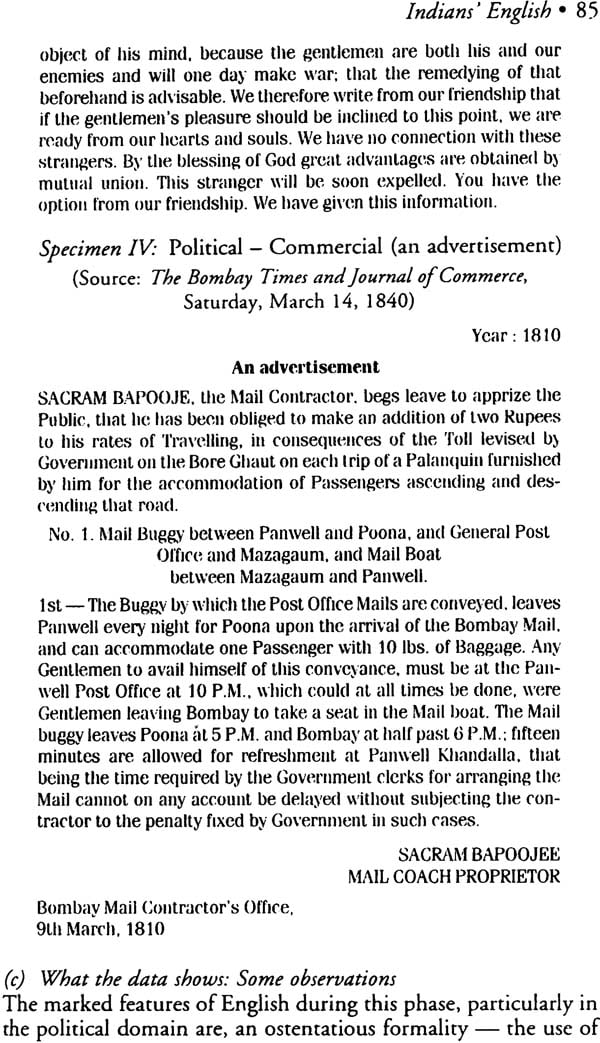
The present study argues that this disjointedness is the outcome of a lack of an integrated approach that takes into account an understanding of the history of English in India based on well documented data. That is why this work is based on chronologically documented specimens of English written by Indians from 1600 to 1900- specimens collected from a variety of archival sources-as the potential means of developing an integrated perspective on the role of English in India.
After examining the Western hegemonic dominance that divides the world into the West and the rest, the technology of power, print-capitalism and other related issues, the study examines the tactics and manipulations adopted by the weak as a part of their survival. Michel Certeau’s The Practice Everyday Life (1984) is used to reinforce the arguments about how the subcontinent ‘absorbed’ language like Sanskrit, Persian and Arabic and gave birth to new codes like Urdu and how it contained several cultural invasions.
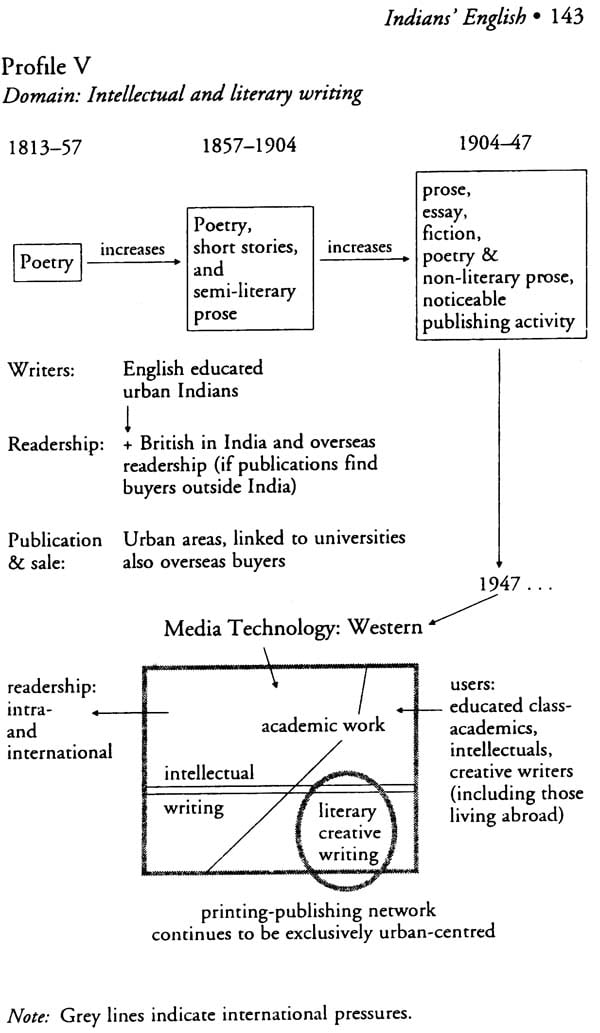
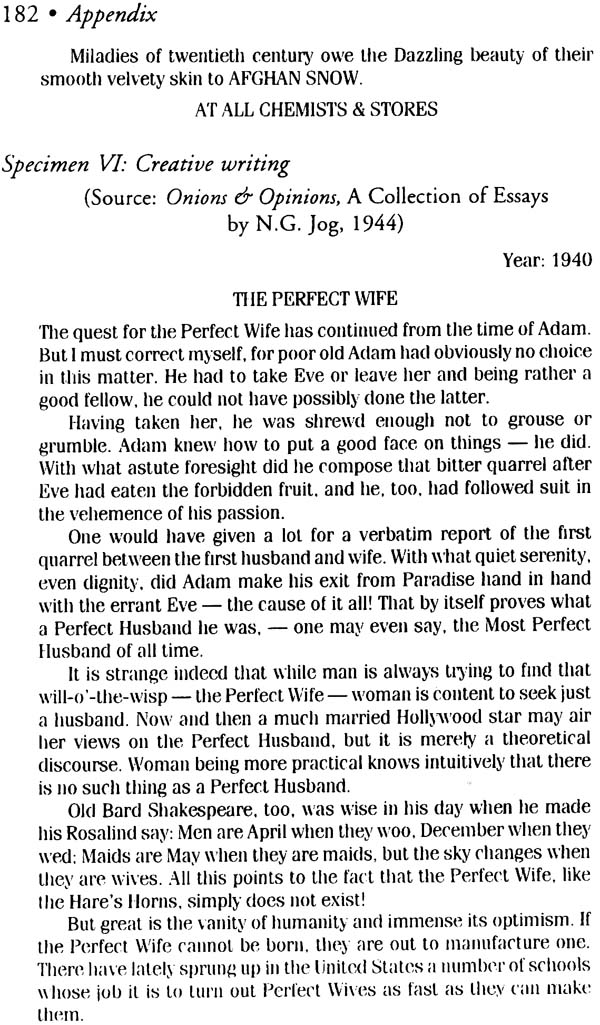
The study demonstrates, through an integrated interpretation of the data, that the basic structure of English in India continues to be the same but it is used in a different manner. The readers are invited to ‘judge’, on the basis of their reading of their reading of the six passages given, whether there is a case for ‘Indian English’. The domain-restricted use of English and its ‘creative’ function in certain areas are explained at the end.
The data was collected by Archana S. Burde for two dissertations submitted for the M. Litt and Ph. D Degrees of the Central Institute of English and Foreign Language, Hyderabad (India). The inspiration for the two projects came from N. Krishna-swami’s article ‘The Growth of “INGLISH” in India’ (1985). The interpretation of the data has undergone several modifications in the light of various publications in the recent past.
What is presented in the form of a book is a disturbing experience and the resulting agony of some colonials who have ‘humbly’ tried to laugh off their agony in English ; we hope it is reflected in the style of the book.
A justification for a fairly large number of quotations in the book: this work, being a response to the arguments of other researchers and scholars, relies on the earlier works in the area, and the authors have quoted from the neither to support or refute their arguments. Secondly, many of the works cited are not readuky available for reference to the readers, particularly in India, and it was felt that mere references will not help. More importantly , the writers from the ‘colonies’, popularly known as ‘quotation bags’, have to rely on ‘authorities’ to establish their claims or points of view; otherwise, they have no credibility. Only a writer from the West can say that his/her book ‘relies upon no authority but its own and it comes into the world naked of any scholarly apparatus’ (Turner 1995). We want to acknowledge with thanks all the authors whose are quoted and from previously published works.
We are deeply grateful to Prof R. K. Agnihotri, Delhi University, Prof t. Sriraman, C. I.E. F. L. Prof C. T. Indria, Madras University, for commenting on the manuscript and generously offering advice an detailed comments that have vastly improved the final version. We owe thanks to Revathi and kumar of San Jose State University, who shared their views as Indians who teach English to native –users of English. A final thank you to Lalitha who proofread the book and helped us to keep our cook during the frustrating journey across the labyrinth of data, drafts, and problems of existence.
| 1 | English In India: problematic of Perception | 1 |
| 1.1 | English in India: Between the Cow and the Crown | 1 |
| 1.2 | The English Empire and the Politics of World Englishes | 5 |
| 1.3 | A Few Facts about English in India | 11 |
| 1.4 | Reverence/Abhorrence: Intertwined Attitudes | 13 |
| 1.5 | English in Pakistan | 16 |
| 1.6 | Need for Reading Myths and Refining Concepts | 19 |
| 2 | Indian English: Complexities Aplenty | 25 |
| 2.1 | Research On Indian English | 25 |
| 2.2 | The Alien Insiders | 26 |
| 2.3 | Our English' | 27 |
| 2.4 | The Doublespeak | 28 |
| 2.5 | Only the Written Variety | 29 |
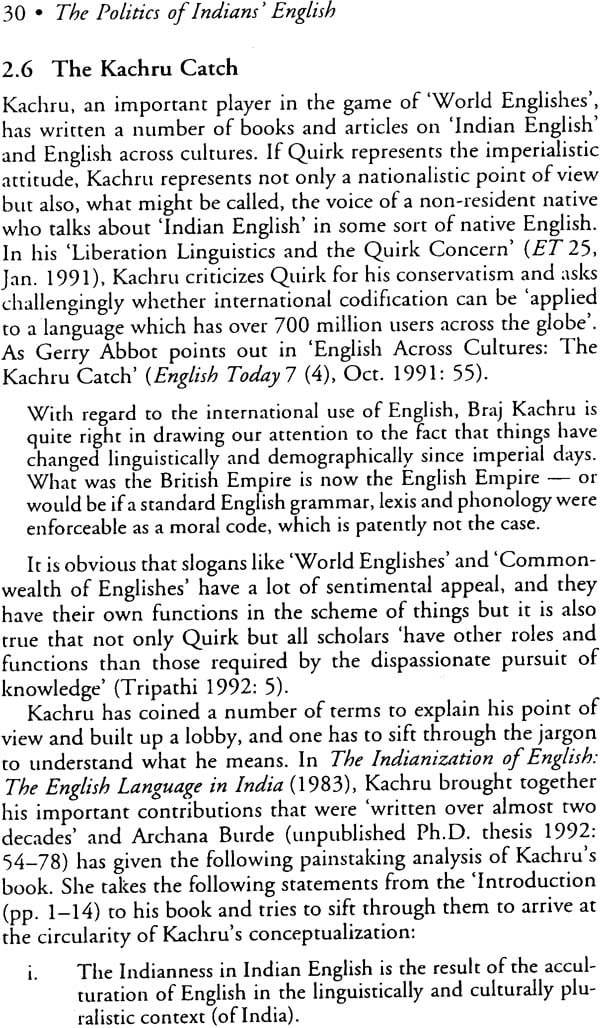
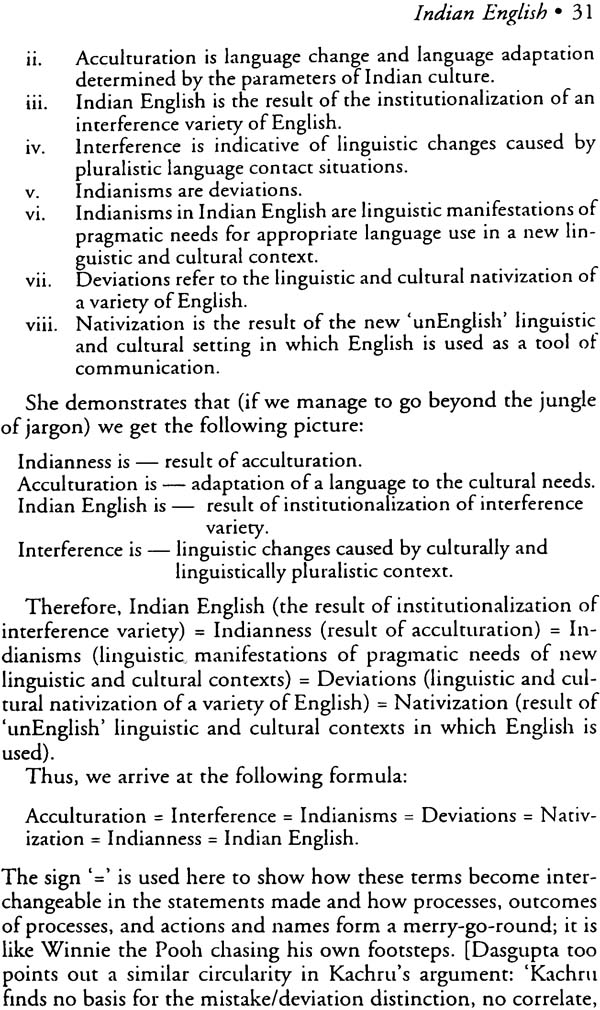
| 2.6 | The Kachru Catch | 30 |
| 2.7 | Data-Based Attempts | 36 |
| 2. 8 | Indian English' as Interlanguage- An Ethnocentric View | 36 |
| 2.9 | English as India's Auntie Tongue | 38 |
| 2.10 | The Degree-Yielding Variety | 43 |
| 2.11 | Miscellany-Notions-Conglomerate and the 'Rashmon Effect' | 44 |
| 2.12 | Prator's Prejudice | 46 |
| 2.13 | De-prejudicing the Outlook | 47 |
| 3 | The Technology of 'Power' And the Power of the Weak | 49 |
| 3.1 | The Technology of 'Power' | 49 |
| 3.2 | The 'West' and the 'Rest': Some Contemplations | 52 |
| 3.3 | The Power of the Weak | 58 |
| 3.4 | The Masks of Nationalism | 60 |
| 3.5 | Print-Capitalism in the Indian Context | 64 |
| 3.6 | The Native-speaker Myth | 74 |
| 3.7 | One for Transaction and One for Contemplation | 77 |
| 4 | Indian's English: A Sociolinguistic Contemplation | 79 |
| 4.1 | Five Phases of the History of English in India | 79 |
| 4.2 | An Investigation of the Written Mode | 80 |
| 4.3 | Summary: Restricted Domains and 'English Sustained' Features | 136 |
| 5 | Indians English: A Modulect | 145 |
| 5.1 | Is there a Case for Indian English? | 145 |
| 5.2 | English as a 'Module' in India | 152 |
| 5.3 | Nomenclature: Indian's English and English | 155 |
| Appendix | 158 | |
| Bibliography | 195 | |
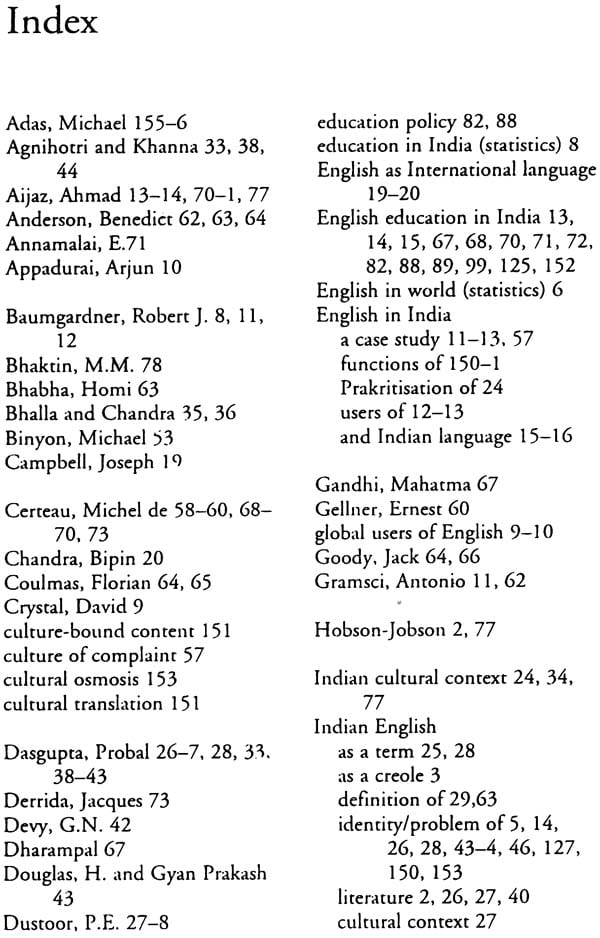
| Index | 202 |