

Early Indian Art and Architecture
Book Specification
| Item Code: | UAR044 |
| Author: | Amrender Verma |
| Publisher: | Edukeen Publisher, Noida |
| Language: | English |
| Edition: | 2019 |
| ISBN: | 9789389387070 |
| Pages: | 280 |
| Cover: | HARDCOVER |
| Other Details | 9.50 X 6.50 inch |
| Weight | 550 gm |
Book Description
The architecture of India is rooted in its history, culture and religion. From at least 3000 B.C. to the present day, many civilizations have flourished on the subcontinent of India. Each has made valuable contributions to India's rich artistic heritage. The book begins with the study of ancient civilization and rock-shelter drawings. The book focuses mainly on art and architecture of early civilization. Indian art consists of a variety of art forms, including painting, sculpture, pottery, and textile arts such as woven silk. Geographically, it spans the entire Indian subcontinent, including what is now India, Pakistan, Bangladesh, Sri Lanka, Nepal, Bhutan and eastern Afghanistan. A strong sense of design is characteristic of Indian art and can be observed in its modern and traditional forms.
Amrendra Verma (born on 28th July, 1973 at Allahabad) graduated from Allahabad University, Allahabad with First Class Honours with Distinction in History. He did his M.A. in History from Allahabad University, Allahabad securing First Class Second position. He holds Ph.D. degree in History from Allahabad university, Allahabad. He is a good teacher and a researcher. He has taught in different colleges under different universities for a decade. He has written about four books on History and Political Science. He has contributed more than ten papers to leading Journals as well as to different books and newspapers.
The Architecture of India is rooted in its history, culture and religion. Indian architecture progressed with time and assimilated the many influences that came as a result of India's global discourse with other regions of the world throughout its two millennia-old past. The architectural methods practiced in India are a result of examination and implementation of its established building traditions and outside cultural interactions. Though old, this Eastern tradition has also incorporated modern values as India became a modern nation-state. The economic reforms of 1991 further bolstered the urban architecture of India as the country became more integrated with the world's economy. Traditional Vastu Shastra remains influential in India's architecture during the contemporary era.
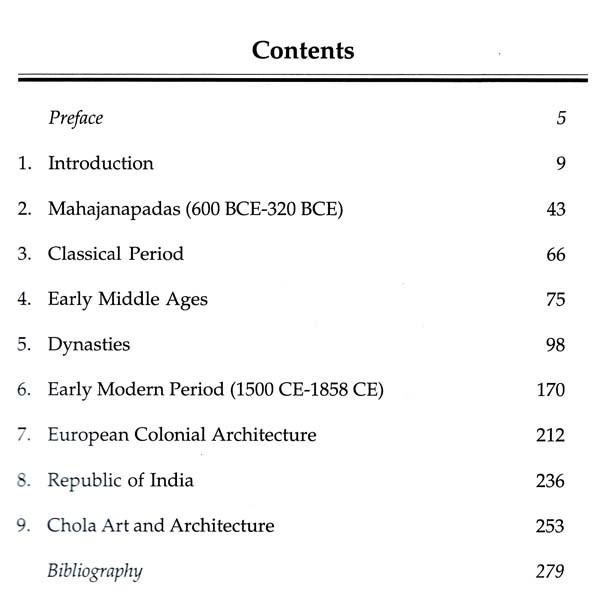
**Contents and Sample Pages**