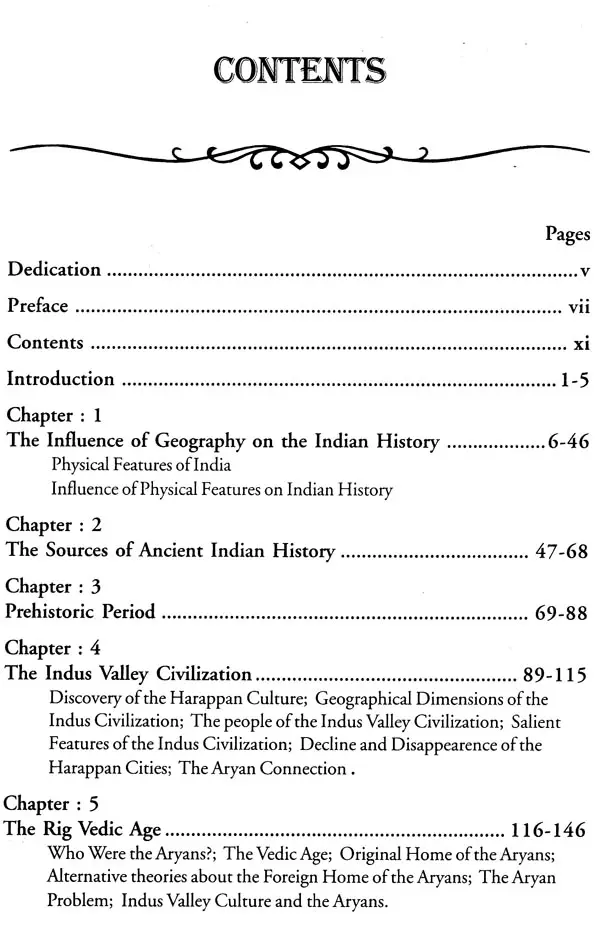
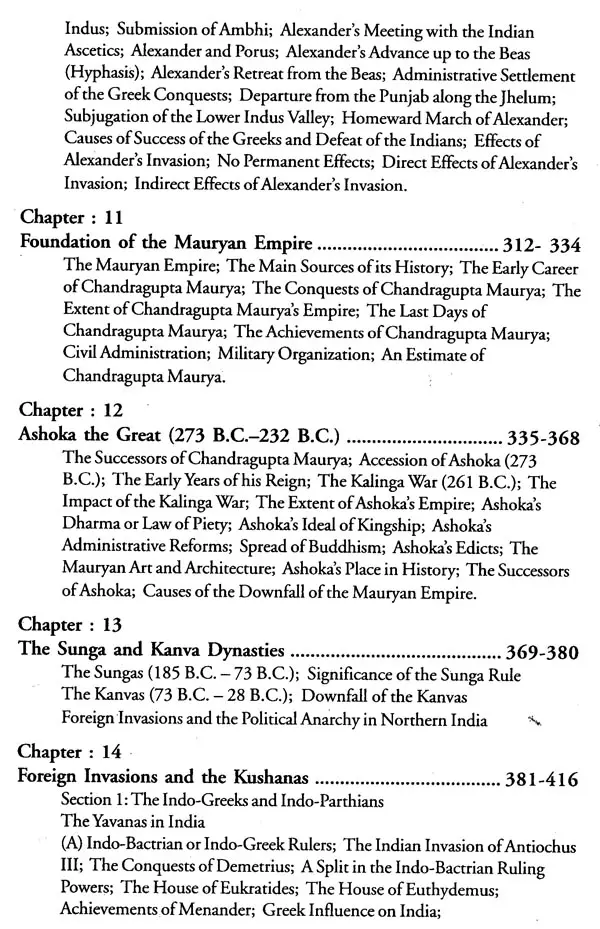
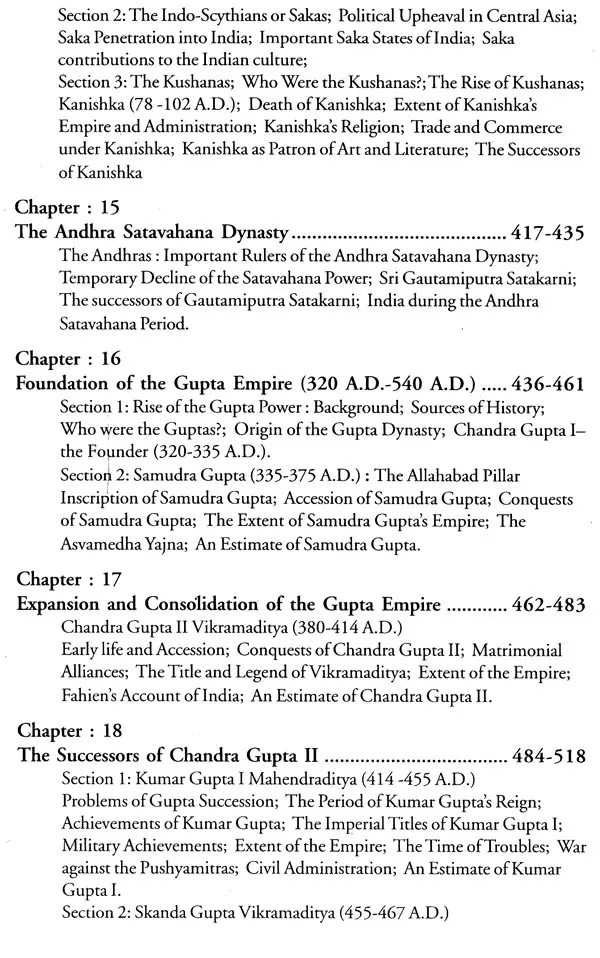
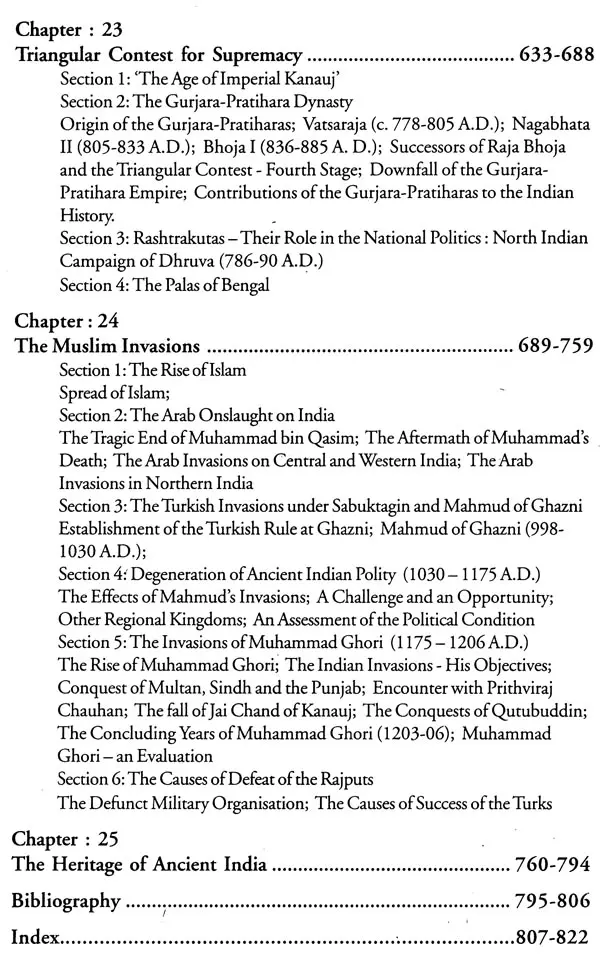
About the Book Ancient India has nothing to claim as the spectacular political and military achievements of its national governments, like the wars of aggression against foreign powers, colonial exploitation of foreign lands and the people. Ancient India was 'a civilized state'; it served as 'the cradle of human civilization', which not only nurtured on its soil as one of the earliest civilized communities of the homo-sapiens but also made a substantial contribution towards the religious, moral and material advancement of many other countries of southeast and central Asia. To match the great historic personalities of the world, like Alexander the Great and Changez Khan, ancient India offers its role models such as Ashoka the Great, Gautama Buddha and Vardhamana Mahavira with their eternal messages of love, peace, non-violence and universal brotherhood.
History of Ancient India (From the Earliest Times to 1206 A.D.) is a joint venture of two reputed academicians and university teachers, Dr. J.L. Mehta, an accomplished historian, and Dr. Sarita Mehta, a renowned Indologist.
About the Authors Dr. J. L. Mehta is an alumnus of the Punjab University, Lahore/Chandigarh. He has published a number of research papers, and books, including his four serial publications, under the caption, Advanced Study in the History of Medieval and Modern India.
Dr. Sarita Mehta, now settled in U.S.A., was educated from Punjab University, Chandigarh and Patiala. Now formally engaged in teaching Hindi in a prestigeous college of New York. She is a Director of the Vidyadham, an educational institute of the migrant Indians in New York. She obtained the Master's degree in Religious Education in June 2003. She has contributed a number of articles, research papers and monographs in the fields of ancient Indian history and culture and sociology.
Preface Our publication, entitled, History of Ancient India, was brought out (HB edition) by the Lotus Press-Publishers & Distributors of 4263/3, Ansari Road, Darya Ganj, New Delhi, very recently, but on account of enthusiastic entrepreneurship and strenuous efforts of Proprietor, A.J. Sehgal, and his illustrious son Saurabh Sehgal, it has reached every nook and corner of the country and made its presence felt among the scholars and lovers of the subject in such a short span of time. To meet the ever-increasing demand of the postgraduate students and the general reader, the Publishers have sought our permission to bring out its low-priced paperback edition to our great delight. We wish them Godspeed in this enterprise.
Introduction 'India that is Bharat' is the proud inheritor to one of the oldest and most influential civilizations of the world. In the remote past, it was called Bharat or Bharatwarsha- 'the land of the descendants of Bharata' after the name of an ancient Indian tribe of the Vedic period or lengendary emperor of the Epic age. The term 'India' itself is a legacy of her past contacts with Persia (Iran) and Europe. It is derived from the Sanskrit word 'Sindhu'. The Persians, because of their phonetic problem, pronounced the letter 'sa' of the Sanskrit alphabet as 'ha', and called the river Sindhu as Hindu. In the course of time, the word Hindu began to be used for the inhabitants of the country, and the latter received the nomenclature as 'Hind' from the Arabs and Hindustan from the Turkish invaders during the medieval period. From Persia, the word Hindu passed to Greece. Interestingly, the Greek soldiers and camp followers of Alexander the Great, during his invasion of India (326-323 B.C.), had found difficulty in pronouncing either of the words - Sindhu or Hindu, and, instead, coined the word Indos for the river Sindhu and also for the country through which it traversed, and its inhabitants were referred to as Indoi, i.e., the people who inhabited the land of the river Indos. The English equivalent to the Greek word Indos (Latin Indus) was India. Similarly, the Greek adjective to indicate something pertaining to the region was Indikos (Latin Intic), which was equivalent to the English adjective 'Indian'. Accordingly, it were the European merchants and missionaries of bygone days, particularly the Englishmen, who gave the word 'India' for this country. After the discovery of sea route to India in 1498 A.D., the Portugese and other European merchants usually referred to the Indian Peninsula as a part of the East Indies' while the term India was reserved for the mainland of the Peninsula.
Book's Contents and Sample Pages