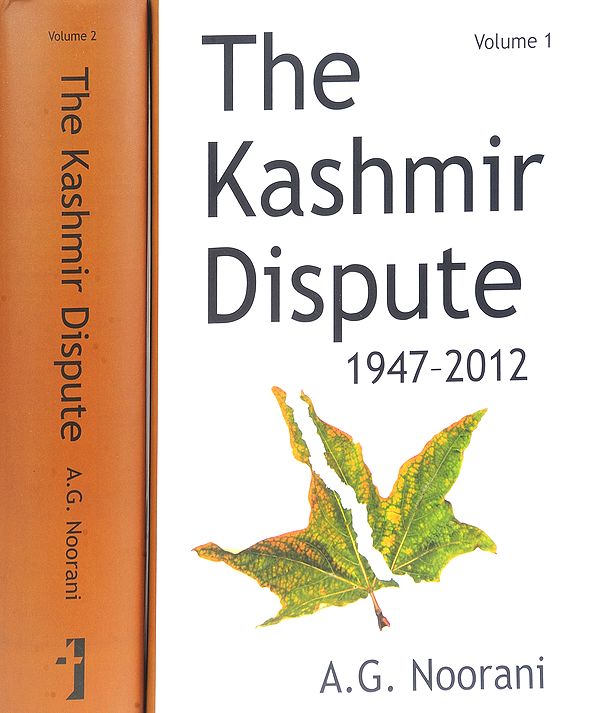


The Kashmir Dispute 1947-2012 (Set of 2 Volumes)
Book Specification
| Item Code: | NAF576 |
| Author: | A.G. Noorani |
| Publisher: | Tulika Books |
| Language: | English |
| Edition: | 2019 |
| Pages: | 1151 |
| Cover: | Paper Back |
| Other Details | 9.5 inch x 6.5 inch |
| Weight | 2 kg |
Book Description
The Kashmir Dispute 1947-2012 is a book in two volumes which traces the complex history of this long-standing dispute, and the political discontent and dissent surrounding it - relating especially to the question of the accession of the state of Jammu & Kashmir to the Union of India.
Volume 1 comprises a critical and insightful introduction by the author based on recently published material, as well as a selection of both archival and contemporary documents, which highlight some important episodes in the history of the formation of the state of Jammu & Kashmir and provide a background to the current political reality. Volume 2 is a collection of the author's articles published over the last five decades in various dailies, journals and books. Divided thematically into seven sections - namely. The Indo-Pak Dispute, The Internal Dimension, Pakistan-Administered Kashmir, The US and Kashmir, Russian Views on Kashmir and the Bomb, Foreign Models, and The Endgame - it provides an important perspective to the issues that are raised.
Through these two volumes, the author successfully brings to light many hitherto unknown or forgotten issues and facts relating to the troubled history of this state, supporting his arguments with a rigour that the readers are sure to appreciate.
A.G. Noorani is an Advocate, Supreme Court of India, and a leading constitutional expert and political commentator. He is a regular columnist for Frontline and the author of numerous books, including Islam, South Asia and the Cold War (2012), Article 370: A Constitutional History of Jammu and Kashmir (2011), Jinnah and Tilak: Comrades in the Freedom Struggle (2010), India-China Boundary Problem 1846-1947: History and Diplomacy (2010), Indian Political Trials 1775-1947 (2006), Constitutional Questions 'and Citizens' Rights (2006), The Muslims of India: A Documentary Record (2003), Islam and Jihad: Prejudice versus Reality (2003), and The Babri Masjid Question 1528-2003: A Matter of National Honour', in two volumes (2003).
This is a collection of articles on the Kashmir dispute which I wrote since 1964. The Introduction, based on recently published documents, highlights some important episodes - to wit: Mohammed Ali Jinnah's approval of the tribal raid into Kashmir and his rejection of India's written offer, made at Lahore on 1 November 1947, based on plebiscite in Kashmir, Junagarh and Hyderabad, which would have settled the dispute and altered the course of history; Jawaharlal Nehru and Vallabhbhai Patel's attempts to secure Kashmir's accession to India before the raid, using a particular Standstill Agreement as a cloak for the Instrument of Accession proper; Sheikh Abdullah's reluctance to accede to India or, for that matter, to Pakistan; his second thoughts soon after the accession to India; Nehru's intrigues against the Sheikh; his prime responsibility for ordering in 1953 Sheikh's dismissal from office as Prime Minister of Kashmir, for his arrest and long imprisonment, and for launching a false case of conspiracy with Pakistan on charges he knew to be false; his use of the army in 1953 and his false statements on the arrest to the President, Parliament and even to Indira Gandhi; her desire to meet him shortly after the arrest; Nehru's calculated and determined 'erosion' of Article 370; the reasons for the Sheikh's espousal of a Kashmir settlement in 1953 and his acceptance of accession to India in private parleys (1965-68) unknown to his followers and, not least, Nehru's decision in private in 1948 to rule out a plebiscite while promising publicly and repeatedly right till 1954 to hold one; Nehru's secret plans in 1948 for an alliance with the United States; the fundamental difference between Nehru's secular outlook and Patel's communal outlook. Nehru resisted Patel's agenda but his policy on Kashmir contributed to the growth of the very forces he had valiantly fought and continued to fight till he died.
I wrote The Kashmir Question in 1964. It is being reprinted here since it is out of print. Also included is an essay which surveys bilateral negotiations between India and Pakistan on Kashmir from 1947 to 2006. It was published in Criterion, a quarterly edited by the veteran diplomat S. Iftikhar Murshed and published from Islamabad. I should like to thank him and the editors of the journals/newspapers in which the articles appeared; namely, Opinion, The Indian Express, The Statesman, Hindustan Times and Frontline in which a good many of them appeared. Two friends who are, sadly, no more, deserve particular mention: A.D. Gorwala, ICS, Editor of Opinion, and Cushrow R. Irani, Editor of The Statesman who was extremely generous in the space he provided.
Nor must I omit to record my debt to Ved Bhasin, founder and former Editor of Kashmir Times; Fayaz Ahmad Kaloo, Editor of Greater Kashmir, Shujaat Bukhari, Editor of Rising Kashmir; and Taher Mohiuddin Editor of Chattan, an Urdu daily (formerly a weekly published from Srinagar), for keeping me informed. I owe the same to my friend S. Iftikhar Gilani. I can-not thank my friend M. Saleem Beg enough for providing me with a copy of Hafiz Jalandhari's immortal poem on Kashmir's tragic fate: Pachattar Lakh ka Sauda (The Sale for Rs 75 Lakh). I am responsible for errors of fact or interpretation exclusively.
I should very much like to thank Noor Zaheer for the pains she took in translating, at my request, the poem of the Urdu poet, Hafiz Jalandhari, on the failed deed of 1846. I bear exclusive responsibility for the revised, final version.
I thank Maya John and Rakhi Sehgal at Tulika Books for their impeccable work on the manuscript. If I reserve for the last my expression of gratitude to Indira Chandrasekhar, it is because her contribution to this book is the greatest - in patience, understanding and all the qualities one would expect in a publisher who is as highly respected as she is.
These few stanzas are from Hafeez Jalandhari's long and highly controversial poem on Kashmir, Pachattar Lakh ka Sauda (The Sale for Rs 75 Lakh). The complete poem will soon be published in book form.
Roared a lion in the valley, resonated the mountains Came alive the workers and woke up the peasants Hearing from all directions freedom of the people's call Vanished the intoxicated pride of the feudal lord In the ears of luxury carried the message of death Creating hurdles in the abundant life of luxury Gathered the old gamblers of the markets of theft Known recognized thugs, cunning clever forgerers And amongst them that paunch seated on the couch Vain in pride to be called 'Paunch son of paunch' Problem of Kashmir was brought into argument Paunch it was who initiated the discussion Why have those people created such a halaboo? Why have animals begun resisting their own slaughter? Call some of their females and a few males too Blind their eyes and break open their skulls Teach them a lesson for saying 'Leave Kashmir!' Go set them free from the imprisonment of life 'Leave Kashmir' meaning we let go Kashmir To beggars hand this hereditary kingdom of Kashmir Should we plan something new to feed our gluttony? And give away the rich sweetmeats to these dogs
They have set their eyes on our appetite and hunger This quarrel must be resolved at once, 'Kaak-ji' The deal of trade worth seventy-five lakhs Accepted and patented by none other than 'Company' Devalue the market these destitutes would Why the hearts not break of the capitalist would If this cry of 'freedom freedom' be raised Our dominance in the market would be erased Valleys, mountains, forests, rivers, fruits, flowers and grain Cattle, sheep, humans and their work and labour All traditions inherited by us from our forefathers Look at the sale deed, everything is in black and white Ownership of a country bought for seventy-five lakhs Confiscated all this booty in seventy-five lakhs Be it cattle or humans to be bought, all for sale Their sons, daughters and progeny all for sale None can ever be free, all are up for sale Homeless till doomsday, ruined, forever on sale The foreheads of grass blade and moon carry our stamp Babies in the wombs of mothers carry our stamp Ravaged stands man's destiny for seventy-five lakhs Sold is Kashmir's paradise for seventy-five lakhs Work and strength, a man's treasure for seventy-five lakhs The jewel of woman's chastity for seventy-five lakhs Country, nation, race, possession, life in seventy-five lakhs Yes for only seventy five lakhs, just seventy-five lakhs!
There is a very big question, Kashmir. Perhaps. Why 'perhaps'? - certainly, that is the most difficult of all these problems as between India and Pakistan. I say problems between India and Pakistan, certainly, but we must always remember Kashmir is not a thing to be bandied about between India-Pakistan. It has a soul of its own; it has an individuality of its own. We cannot, certainly much less can Pakistan, play with it as if it were something in the political game between the two countries. Nothing can be done without the goodwill of the people of Kashmir.
- Prime Minister Jawaharlal Nehru in the Lok Sabha, 31 March 1955 (Selected Works of Jawaharlal Nehru [SWJN], Vol 28: 318)
If, fifty-seven years later, the soul of Kashmir is in torment and cries for azadi, it is because, despite the profuse professions and pledges, Nehru cared little for the people of Kashmir; still less did Mohammad Ali Jinnah and, least of all, the British. The people have been in revolt, pelting stones rather than shooting bullets. Nobody alleges Pakistan's aid or complicity. The harsh truth which Nehru and his successors, as well as India's media and academia, suppressed for long is now out in the open. But the state of denial continues to hold the establishment in its firm grip.
This introduction is intended to serve neither as a summary of the articles in this book nor as a history of Kashmir's politics. Archival material and some milestones have been highlighted. The articles record the events in some detail.
The state of Jammu and Kashmir (J&K) was created by the British Raj for its own imperial ends. In this, it was aided by the treachery of the Dogra chieftain, Gulab Singh, to his masters in Lahore, the Sikh Darbar. When Ranjit Singh died in 1839, the Sikh empire began to come apart. The British were awaiting his death to annex Punjab, and Gulab Singh, to acquire Kashmir through them. While still in the service of the Sikh kingdom, he began ingratiating himself with the British.
On 13 December 1845, when the Governor-General, Sir Henry Hardinge, declared war on the Sikhs, the peace terms were negotiated by none other than Gulab Singh. Despite his loyalty to the Lahore Darbar, he withheld any help to his masters. Prem Nath Bazaz records in detail Gulab Singh's treachery which ensured Lahore's defeat in the first Anglo-Sikh war of 1845-46 (Bazaz 1954: 121).
By the Treaty of Lahore, dated 9 March 1846, the state was forced to cede all cis-Sutlej territories, the Beas-Sutlej Doab, and the provinces of Hazara and Kashmir to the East India Company, representing the British government. Article XII recorded Gulab Singh's treachery.
In consideration of the services rendered by Rajah Gulab Singh of Jummoo to the Lahore State, towards procuring the restoration of the relation of amity between the Lahore and British Governments, the Maharaja hereby agrees to recognize the Independent Sovereignty of Rajah Gulab Singh, in such territories and districts in the hills as may be made over to the said Rajah Gulab Singh by separate Agreement between himself and the British Government.
That separate agreement was the infamous Treaty of Amritsar - a 'deed of sale' as Gandhi called it in 1947. It was signed a week later, on 16 March 1946. Article III of the treaty said:
In consideration of the transfer made to him and his heirs. . . . Maharaja Gulab Singh will pay to the British Government the sum of seventy-five lakhs of rupees (Nanukshahee), fifty lakhs to be paid on ratification of this treaty and twenty-five lakhs on or before the 1 October of the current year AD 1846.
The treaty was enforced with British arms. Sheikh Imamuddin, the Governor of Kashmir appointed by the Sikh rulers, refused to hand over the valley of Kashmir to Gulab Singh. A struggle ensued in which Gulab Singh's forces were defeated. British troops had to be sent to instal him as ruler of Kashmir (Lawrence 1895:-201). The 1929 edition of Aitchison's Treaties says: 'thus Gulab Singh owed not only his title to Kashmir, but his actual possession of it, wholly to the support of British power' (ibid.: 3).
Cunningham describes Gulab Singh's investiture as sovereign of his new territories on 15 March 1946. He 'stood up, and with joined hands, expressed his gratitude to the British Viceroy - adding without, however, any ironical meaning, that he was indeed Zurkharid, or gold-boughten slaves' (Cunningham, vide Hassnain 1974: 16). Captain Amrinder Singh's excellent research also establishes the perfidy most ably (Singh 2009).
Gulab Singh was not the founder of the state of Jammu and Kashmir, a legend popularized by K.M. Panikkar in his fawning 'Short Memoir', published first in 1930 under the title Gulab Singh by Martin Hopkins, and later in 1953 under the title The Founding of the Kashmir State (George Allen and Unwin).
Over his protest an Officer on Special Duty was sent to the state as early as in 1852 (Huttenback 2004: 46). He became the British Resident in 1885. So rife were oppression and corruption that the British even ruminated annexing the state. The Secretary of State, Lord Kimberley, wrote to the Viceroy, Lord Ripon, on 23 May 1884:
As to the urgent need for reforms in the administration of the State of Jammu and Kashmir, there is unfortunately, no room for doubt. It may, indeed, be a question whether, having regard to the circumstances under which the sovereignty of the country was entrusted to the present Hindoo ruling family, the intervention of the British Government on behalf of the Mohammedan population has not already been too long delayed. {Accounts and Papers, East India: Papers relating to Kashmir)
Why the British created this state has been ably described by S.S. Bal in an article entitled British Interest in Creating the Dogra State of Jammu and Kashmir' (Journal of the Indian History Congress, XXX Session, 1967: 40-50). If Kimberley had gone ahead and taken back Kashmir in 1884, its fate would have been decided by a popular vote, as in the North West Frontier Province (NWFP). Kashmir was unique in that it had a choice. It could accede either to India or Pakistan. Only a plebiscite could have offered the means for exercising the choice. In Europe, with much less at stake, referenda were held on the treaty establishing the European Union in several countries.
In Kashmir a plebiscite was not a mere option or choice. It was a demo-cratic necessity. Were it not for the highly controversial Radcliffe Award, India would not have had any access by land to Kashmir. It was not Pakistan alone which contested the award. Professor R.J. Moore, one of the foremost authorities on the partition, subjected it to close scrutiny and remarked:
it seems inconceivable that Radcliffe would not have realized that a district-wise observance of the contiguous-majority principle in Gurdaspur, such as he followed to the expense of Muslim tehsils in the district of Amritsar (i.e. Jullunder Nakodar) would have closed off the Maharaja of Kashmir's option of adhering to India. (Moore 1987: 33) Radcliffe gave India three of the tehsils of Gurdaspur: Pathankot, with a 61 per cent non-Muslim majority, which he rightly assigned to India, but along with the Muslim-majority tehsils of Gurdaspur (52 per cent) and Batala (55 per cent). Only the Sakargarh tehsil was given to Pakistan. The road to Kashmir lay through Pathankot, a tenuous route at the best of times. The only all-weather road which connected, and still connects, Srinagar to the rest of world is the old Rawalpindi road. The rivers flow into Pakistan. If the geographical factor cited apropos Junagadh and Hyderabad was overwhelmingly in favour of Pakistan, so was the democratic factor - largely but not decisively.
A plebiscite in Kashmir was a moral imperative, besides being a democra¬tic necessity. A plebiscite was held in Junagadh on 20 February 1948 after the administration of the state was taken over by the Government of India on November 1947. It was called a 'referendum' (White Paper on Indian State 1950: 114), and was conducted by an ICS officer, C.B. Nagarkar. Out of an electorate of 20,1457, a total of 19,0870 cast their votes. Only 91 voted for Pakistan. Of the 31,434 votes cast in Junagadh's five princeling areas, only 39 voted for accession to Pakistan (Menon 1956: 142).
A referendum was also held in Sikkim. The Election Commission of India conducted it on 14 April 1975 'to confirm the resolution' passed in the Sikkim Assembly on the state's merger with India in 1973-74. Nari Rustomji, ICS, whose services were in 1954 placed with the Chogyal for appointment as his Prime Minister, opined that 'it would be injudicious to assess, however that the resolution respecting Sikkim's merger with India . . . necessarily represented the wishes of the people'. He recorded the demand for a 'completely impartial authority' to conduct the poll, and added that the Army and the heavy Indian presence in Sikkim were also factors that inevitably weighed in influencing the vote' (Rustomji 1987: 146, 150).
To be sure, in both these cases in which the democratic principle was formally applied, the result was a foregone conclusion. So it was in the case of Kashmir - which is why a plebiscite was never held. Indira Gandhi warned Nehru in a letter from Srinagar on 14 May 1948, while the war was on, that 'they say that only Sheikh Saheb is confident of winning the plebiscite' (Gandhi, ed. 2005: 517).
The issue in 1947 was who was to exercise the choice, the ruler Hari Singh or the people? It came to the fore on 13 June 1947, just ten days after the Indian National Congress and the All India Muslim League had accepted the partition plan of 3 June 1947. On 12 May 1946, the Cabinet Mission to India had presented a memorandum on Indian states ruled by the princes. On 13 June, leaders of both parties met under the chairmanship of the Viceroy, Lord Mountbatten. 'Mr Jinnah said that in his view the States were fully entitled to say that they would join neither Constituent Assembly. Every Indian State was a sovereign State. Pandit Nehru said he differed altogether. He spoke as a lawyer. Mr Jinnah said that he spoke as a lawyer also' {The Transfer of Power 1942-47, Vol. XI: 320-26). It had come to that.
Jinnah's stand was utterly absurd and ruined the prospects of a conciliatory beginning in relations between the two countries. As Nehru correctly pointed out, there was no trace in the Cabinet Mission's memorandum of any state being allowed to claim 'independence'. Jinnah soon discovered that his stand was adverse to Pakistan's own interests (vide Saiyid 2004: 26-45). But not before he had inflicted irreparable harm on Pakistan, on the people of Kashmir and on Indo-Pak relations. In the hour of a historic triumph he emerged, not as a statesman or even as a wise patriot, like Mustafa Kemal of Turkey after the Treaty of Lausanne in 1922, but rather as a vindictive and petty tactician. That these traits were shared by Nehru and, even more so, by his deputy Vallabhbhai Patel, could be of small consolation. They had the superior might and more options. Jinnah wrecked his best option - an overall settlement proposed to him in writing in Lahore by Mountbatten on 1 November 1947. By then the Indian troops had occupied Junagadh, and were beating back the raiders who had entered Kashmir on 22 October with Jinnah s full knowledge and approval - a fact which few Pakistanis care or dare to acknowledge.
| Preface | ix | |
| Introduction | 1 | |
| Documents | 169 | |
| 1 | Letter by Sir Chimanlal H. Setalvad to the Editor, Times of India, 30 October 1947, on the Provisional Government of Junagadh | 171 |
| 2 | Declaration on the formation of the Porvisional Government of Junagadh, drafted by K. M. Munshi, September 1947 | 171 |
| 3 | Mountbatten's offer to Jinnah in Lahore on 1 November 1947 | 174 |
| 4 | Letter by Sir Chimanlal H. setalvad to the Editor, Time of India, 3 November 1947, on Kashmir and Junagadh | 175 |
| 5 | Nehru's note ot Sheikh Abdullah ot finalize Kashmir's accession Camp Sonamarg, 25 August 1952 | 176 |
| 6 | Nehru's note ot Sheikh Abdullah ot finalize Kashmir's accession Camp Sonamarg, 25 August 1952 | 180 |
| 7 | M. O. Mathai's note to Indira Gandhi regarding her desire to visit Sheikh Abdullah in prison, 12 September 1953 | 182 |
| 8 | Jayaprakash Narayan's Letter to Nehru, 1 May 1956 | 186 |
| 9 | Dr P. Subbarayan's meeting with Sheikh Abdullah in Jail, 20 June 1956: record of the conversation | 186 |
| 10 | Letter from Sheikh Abdullah ot Nehru after his release from jail in 1958 | 200 |
| 11 | Jayaprakash Narayan's rarticle in H industan Times, 20 April 1964: 'Our Great Opportunity in Kashmir' | 202 |
| 12 | Jayaprakash Narayan's article in Hindustan Times, 15 May 1964: 'The Need to Re-think | 204 |
| 13 | Jayaprakash Narayan's letter to A.G. Noorani dated 19 February 1965, and the concerned article by A.G. Noorani | 210 |
| 14 | K. Radhakrishna's report of his visit to Sheikh Abdullah in internment, 1965 | 214 |
| 15 | Jayaprakash Narayan's letter to Indira Gandhi, Slkhodewra, 23 June 1966 | 218 |
| 16 | Jayaprakash Narayan's associate Narayan Desai's visit ot Kashmir | 224 |
| 17 | Record of Narayan Desai's conversation with Chief Minister Gulam Mohammed Sadiq at his office in Srinagar, 3 October 1967 | 225 |
| 18 | Sheikh Abdullah's talks with T. N. Kaul in 1967-68: rival version | 226 |
| 19 | Jayaprakash Narayan's article on Kashmir, 3 March 1968: 'Kashmir, a Human Problem' | 252 |
| 20 | Jayaprakahs Narayan's inaugural address at the J& K State People's Convention organized by Sheikh Abdullah ot discuss the state's future, Srinager, 10 October 1968 | 256 |
| 21 | Jayaprakash Narayan's letter to the Editor, Hindustan times 1 February 1972 | 260 |
| 22 | Letters by Sheikh Abdullah to Mirza Mohammed Afzal Beg, president of the then Plebiscite Front, and Syed Mir Qasim, then leader of the Congress Legislature Party, inviting them to join the revived National Conference | 266 |
| 23 | Correspondence between Sheikh Abdullah and leaders of the Janata Party | 271 |
| 24 | Muslims a Minority in J& K Services', Greater Kashmir, 7 May 2007 | 276 |
| 25 | K.C. efforts as Interlocutor in 2001 | 282 |
| 26 | Brinda Karat's intervention in Parliament, 15 March 2011 | 288 |
| 27 | Kashmir: manufacturing ethnic conflict', by Jean Dreaze, The Hindu, 29 March 2000 | 289 |
| 28 | Faiz Ahmad Faiz's solution to the Kashmir dispute | 292 |
|
|
||
| Contents | Page | |
| The Indo-Pak Dispute | 1 | |
| 1 | Genesis of the Kashmir Question | 1 |
| 2 | Bilateral Negotiations on Kashmir: A Record, 1947-2006 | 40 |
| 3 | Azadi or Independent Kashmir? | 66 |
| 4 | The Nehru-Liaquat Summits in 1947 | 87 |
| 5 | Partition of Kashmir: 1948 | 96 |
| 6a | The Dixon Plan | 103 |
| 6b | Justice Dixon : Mediator and Judge | 114 |
| 7 | The War Scars of 1951 | 120 |
| 8 | The 1955 Summit | 125 |
| 9 | Nehru-Ayub Murree Summit 1960 | 144 |
| 10 | Resolving Kashmir | 156 |
| 11 | India, Pakistan and Kashmir | 159 |
| 12 | The 1965 War | 163 |
| 13 | The Simla Pact, 1972 | 172 |
| 14 | The Simla Process | 182 |
| 15 | Contours of the militancy 1947-2000 | 188 |
| 16 | Exercise Brasstacks 1987: A Study in Brinkmanship | 204 |
| 17 | The Crisis if 1990 | 211 |
| 18 | Indo-Pak Dialogue 1983-1993 | 219 |
| 19 | The Male Summit 1997 | 222 |
| 20 | The Accord on 'Composite Dialogue' | 233 |
| 21 | The Working Group | 243 |
| 22 | How Gujral Wrecked the Working Groups | 252 |
| 23 | Impasse in 1998 | 257 |
| 24 | The Lahore Summit 1999 | 263 |
| 25 | Kargil Diplomacy | 275 |
| 26 | Niaz A. Naik's Talks in New Delhi in 1999 | 281 |
| 27 | The Post-Kargil Milemmas | 284 |
| 28 | Dissent and Kargil | 292 |
| 29 | Cease-fire by the Hizb in 2000 | 298 |
| 30 | The Delhi Tea before the Agra Breakfast | 323 |
| 31 | The Agra Summit 2001 | 329 |
| 32 | The BJP's Operation Parakram-I, 2001-02 | 343 |
| 33 | The Indus Water Treaty | 368 |
| 34 | The UN Resolution Today | 376 |
| 35 | The No-War Pact Parleys 1949-1988 | 384 |
| II The Internal Dimension | 398 | |
| 1 | How and Why Abdullah Fell Out | 398 |
| 2 | Nehru and Sheikh Abdullah's Arrest in 1953 | 409 |
| 3 | Karan Singh and Sheikh Abdullah's Arrest | 433 |
| 4 | Trifurcation of Jammu, Kashmir and Ladakh | 455 |
| 5 | Why Kashmir Erupts | 466 |
| 6 | The Jammu Factor | 475 |
| 7 | The Political Situation in 1968 and 1969 | 487 |
| 8 | How Sheikh Abdullah and Mirza Afzal Beg Fell Out | 490 |
| 9 | The Verghese Report 1991 | 497 |
| 10 | Deepening Alienation | 506 |
| 11 | The Pattern of Outages in Kashmir | 515 |
| 12 | Kashmir and a Farcical Human Rights Commission | 523 |
| 13 | Human Rights in Kashmir | 529 |
| 14 | I It Constitutional to Ban Demand for Plebiscite? | 536 |
| 15 | Election in Kashmir, 1951-1987: A Record of Fraud | 541 |
| 16 | Kashmir's Accords with the Centre 1947-1975 | 549 |
| 17 | How Article 370 Was Wrecked | 556 |
| 18 | Report of a Visit to Kashmir in 1995 | 568 |
| 19 | Electoral Crackdown in Kashmir | 579 |
| 20 | State Terror: Repeating Punjab in J&K | 589 |
| 21 | Kashmir Elections Under Delhi-Sponsored Terrorists | 596 |
| 22 | Kashmir's Future: Its Assembly's Rights | 600 |
| 23 | The Hurriyat's Promise and Its Breach | 607 |
| 24 | Academic Freedom in Kashmir | 620 |
| 25 | An Election without a Political Process | 623 |
| 26 | Kashmiri Opinion: Pardon for Afzal Guru | 633 |
| 27 | The BJP and Article 370 | 636 |
| 28 | The 2008 Assembly Election | 638 |
| 29 | Kashmiri Opinion in 2009 | 641 |
| 30 | The Sahgir Ahmed Report | 643 |
| III Pakistan -Administered Kashmir | 648 | |
| IV The US and Kashmir | 670 | |
| Russian Views on Kashmir and the Bomb | 696 | |
| Foreign Models | 703 | |
| 1 | The Trieste-SAAR Models | 703 |
| 2 | South Tyrol | 706 |
| 3 | The Aalands | 718 |
| 4 | The Irish Model | 733 |
| 5 | Quebec and Kashmir | 744 |
| 6 | The Aceh Accord | 752 |
| VII The Endgame | 755 | |
| 1 | A Working Paper on Kashmir | 755 |
| 2 | Interview with President Musharraf on 1 August 2006 | 770 |
| 3 | Moves towards a Consensus | 780 |
| 4 | The Penultimate Phase: Talks on Kashmir 2006-09 and Developments Inside the State | 790 |
| 5 | Agenda for Kashmir Today | 807 |
| 6 | The Crisis of 2010 | 817 |
| 7 | Sheik Abdullah, Farooq and Omar Abdullah | 827 |