

The Legacy of Caraka
Book Specification
| Item Code: | IDH473 |
| Author: | MS Valiathan |
| Publisher: | Orient Blackswan Pvt. Ltd. |
| Language: | English |
| Edition: | 2015 |
| ISBN: | 9788173716676 |
| Pages: | 710 (Line Figure With Illus:) |
| Cover: | Hardcover |
| Other Details | 8.3" X 5.6 |
| Weight | 960 gm |
Book Description
Back of the Book
Caraka, the master physician, is believed to have lived in the first century AD. The Samhita composed by him forms the bedrock of ayurvedic practice today. His contribution to India's cultural inheritance was profound.
Caraka Samhita was, in fact, a revision of an older text Agnivesa Tantra, which was written several centuries before Caraka's time. Caraka's revision became so popular that it was translated into Tibetan, Arabic, English and many Indian languages. The Legacy of Caraka retells the Samhita in a new format. Instead of adhering to the sequence of the Sthanas in the original, the author has retold the Samhita through thematically structured chapter, in contemporary idiom. The retelling has involved some degree of restructuring and condensation but ha ensured that whatever is stated can be traced back to the original. In a detailed introduction, the author has commented on specific of view of modern medicine.
This book will be special interest to students of Ayurveda, medicine and other sciences, and those interested in the history of science in India.
About the Author
A native of Kerala, Dr. MS Valiathan received his medical education in India and subsequent training in surgery and cardiac surgery in the UK and USA. During a career spanning three decades as a cardiac surgeon and investigator, his major interests were cardiac surgery in children, studies on a tropical heart muscle disease and the development of cardiovascular devices. His contributions in these areas are embodied in a monograph and many scientific papers. A Vice-Chancellorship followed before he took up the study of the Caraka Samhita as Homi Bhabha Senior Fellow at the Manipal Academy of Higher Education, Karnataka, India.
Dr. Valiathan is married to Ashima, an orthodontist. They have a daughter, Manna, and a son Manish.
This book had its origin in the Gandhi Memorial Lecture I was privileged to give at the Raman Research Institute, Bangalore. I had heard of Caraka from my school days but to read his Samhita many years later was to come under the spell of a master physician whose contribution to India's cultural inheritance was profound. I was tempted to retell Caraka Samhita in a format which, I thought, would appeal to the students of ayurveda, medicine and other sciences at the college level and all others interested in the history of science in India. The hesitation I had in an ayurvedic excursion was overcome by the encouragement I received from Sri Raghavan Thirumulpad - a renowned savant of Kerala - who never spared himself in guiding me during my two year journey through Caraka country. In the large body of Car aka literature I consulted, the commentary of Cakrapani and translation by Prof PV Sharma were of utmost help to me. However, instead of adhering to the sequence of Sthanas in the original, I have retold the Samhita through thematically structured chapters which, one hopes, would be easier on modern readers. The retelling has involved some degree of restructuring and condensation but has ensured that whatever is stated can be traced back to the original and that no chapter in the eight Sthanas of the original has been left out. In the introduction, I have commented on some aspects of Caraka's philosophy, concepts and practice which could be of interest to the academic community in the present context.
I am grateful to Dr PM Unnikrishnan of the Foundation for Revitalisation of Local Health Traditions, Bangalore for reading my manuscript and not only suggesting emendations and refinements but also assisting in the preparation of a glossary. Professor KV Sarma, whose studies on ancient science texts in Sanskrit are models of scholarship, has laid me under an obligation by making an index for this volume. It is a pleasure to acknowledge the assistance of Dr Indira Balachandran of the Arya Vaidya Sala, Kottakkal for checking the botanical names of plants (see Botanical Names). The identification and terminology of plants mentioned by Caraka are beset with great difficulties and any errors which persist are entirely mine. I am grateful to Mr Abraham Joy for preparing the illustrations and drawing inspiration for his work from the carvings of the Kusana period when Caraka is believed to have lived. The rich collection of photographs of the sculptures of the Kusana period in the American Institute of Indian Studies, Delhi, provided the material for introducing authenticity into the drawings of Mr Joy. For estimating the number of references to various disorders, 1 was generously supplied a digitised version of the Caraka Samhita by Prof Yamashita of the Kyoto University. My sincere thanks are due to him and to my daughter and a pathologist, Manna, who carried out the computer search for references. I am indebted to Prof PSVN Sharma of, the Kasturba Medical College, Manipal for facilitating my search for modern psychiatric resonance in Caraka's description of insanity I must also place on record a debt of gratitude to my family who have ungrudgingly stood by me through my busy surgical decades and subsequent digressions into unrelated territories.
I was honoured by the Homi Bhabha Council who awarded me a Senior Fellowship, and would convey my sincere thanks to the Trustees for their support. 1 am beholden to Dr Ramdas M Pai, President of the Manipal Academy of Higher Education for the facilities given 1'0 me [or carrying out the study in Manipal. It is a pleasure to extend my sincere thanks to Ms Usha Kamath for preparing the manuscript with great care and admirable efficiency and Ms. Padmaja Anant of Orient Longman Private Limited for her editorial thoroughness and excellence. If the book succeeds in drawing wider attention to the theme of Caraka's legacy, its pages will have amply rewarded one of my best hopes.
| Frontispiece | ||
| Preface | ||
| An appreciation | ||
| List of illustrations | ||
| List of Illustrations | ||
| Introduction | ||
| I | Caraka and his legacy | I |
| Historical Caraka - Philosophical moorings - Medical science - Pharmacology - Practice of medicine - Caraka the teacher - human destiny | ||
| II | Atharva Veda to Caraka | xvii |
| Atharvan echoes in Caraka - Human body in Atharva Veda | ||
| III | Diseases in Caraka's period | xxiii |
| Infectious diseases and infected conditions (disgestive disorders, fever, leprosy, smallpox, pulmonary TB, abscess, cellulites, sores) - Non-infectious diseases (seizures, piles, gaseous lumps, heart diseases, alcohol-related disorders, pallor, polyuria, bleeding disorders, insanity) | ||
| IV | Doctrines and concepts | l |
| Five constituents of matter (pancabhuta) - Three dosas (tridosa) A regimen dictated by seasons (rtucarya) - Natural urges (vegas) | ||
| V | Five evacuative procedures (pancakarma) | lxiv |
| VI | Procedures for rejuvenation and enhanced virility (Rasayana and vajikarana) | lxviii |
| VII | Medicinal Plants | lxx |
| Classification - Mechanism of action - Preparation of formulations - Anti-dosa plants | ||
| VIII | Food and drinks | lxxvii |
| XI | Habitat | lxxx |
| X | Learning to be a physician | lxxxii |
| | ||
| Mind and matter; life and death; health and disease; food and drugs; a code of living; a physician's calling | ||
| 1 | Ayurveda | 1 |
| Branches of Ayurveda - Categories in Ayurveda - Equilibrium of dhatus - Equilibrium of dosas - Settling disturbed equilibrium of dosas - Summary of drug formulations | ||
| 2 | Drugs formulations in therapeutics | 15 |
| 3 | Sense perception and well-being | 20 |
| Oiling the body - Role of smoking, food, sexual intercourse, general conduct, traditions | ||
| 4 | Life in accord with the seasons | 30 |
| 5 | Suppression of natural urges; comments on physical miscellany | 34 |
| 6 | The medical quartet | 39 |
| Types of physicians - Forecasting outcome | ||
| 7 | Three desires, means of knowledge and some triads | 44 |
| Means of knowledge (authority, perception, inference and reasoning) - Rebirth -Disease and treatment (triads of life, strength, causation, action, time, diseases, disease channels, physician and treatment) | ||
| 8 | Lubricants in therapeutics | 53 |
| Action - Candidates for therapy - Administration - Basis of dosage - Method of therapy | ||
| 9 | Fomentation | 59 |
| Choice of candidate - Techniques | ||
| 10 | Evacuative therapy | 65 |
| A house for therapy - Two forms of therapy | ||
| 11 | Imbalance of dosas - varied expressions | 73 |
| Disorders of the head - Disorders of the heart - Abscesses - Swellings - Imbalance of dosas | ||
| 12 | Slimming and building up in therapeutics | 84 |
| 13 | Obesity and leanness; stray remarks on sleep | 88 |
| Obesity - Leanness -Sleep | ||
| 14 | Blood | 92 |
| Narcosis - Fainting - Coma | ||
| 15 | Food as the source of man and his diseases | 95 |
| Origin of man and his diseases - Food as the source - Wholesome and unwholesome food | ||
| 16 | Rasas | 100 |
| Evolution and attributes - Six rasas -Action of tastes - Antagonisms in foods | ||
| 17 | Food and drink | 110 |
| Food - Drink - Water - Post-prandial drinks | ||
| 18 | the fate of food and drinks in the body | 140 |
| Food and drink - Dhatus as targets of dosa perturbation | ||
| 19 | Physicians - genuine and fraudulent | 144 |
| 20 | Rasas, dosas and a healthful diet | 146 |
| rasa-dosa interaction - Downstream aspects - Dietetic rules | ||
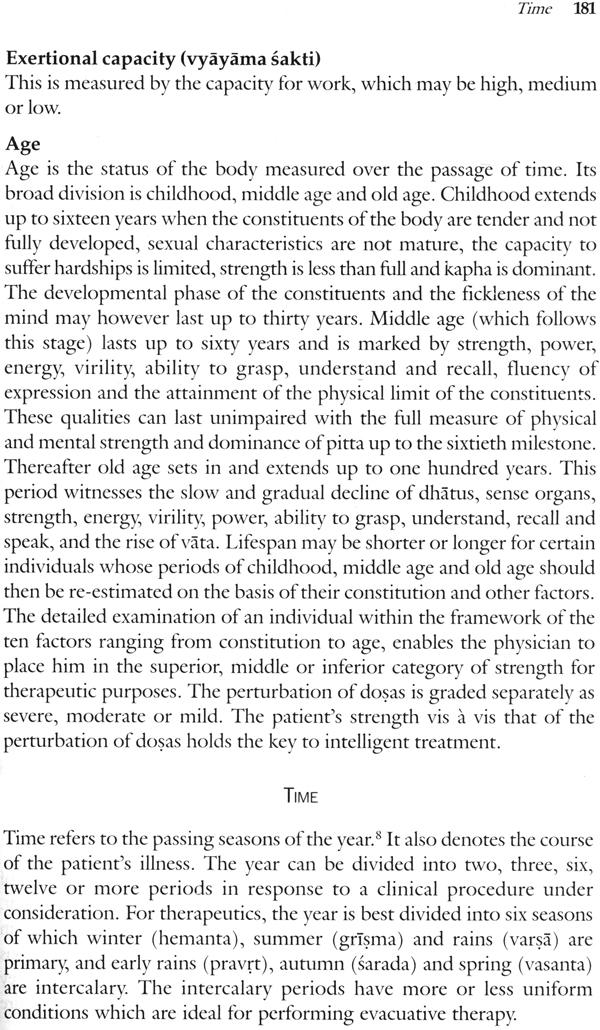
| 21 | Epidemics; reflections on lifespan | 151 |
| 22 | Norms for the quantity of meals | 156 |
| 23 | Body - a network of channels | 159 |
| Flow through body channels - The heart and its ten great vassels | ||
| 24 | Disease - Manifold expressions of deranged dosas | 163 |
| 25 | Infestation by worms (krmi) | 166 |
| Evacuative measures for intestinal and head worms - Eradicative measures | ||
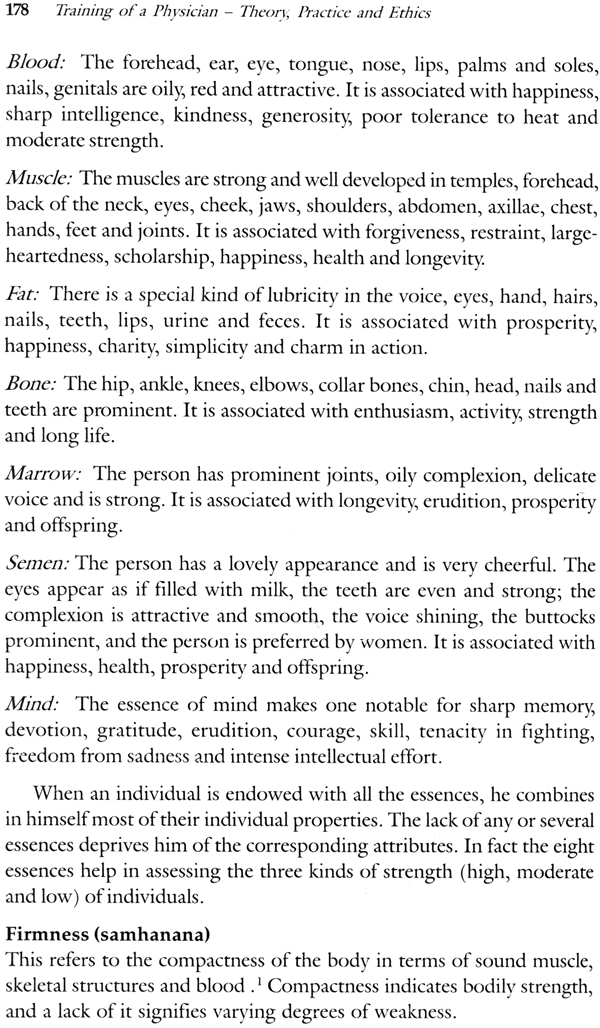
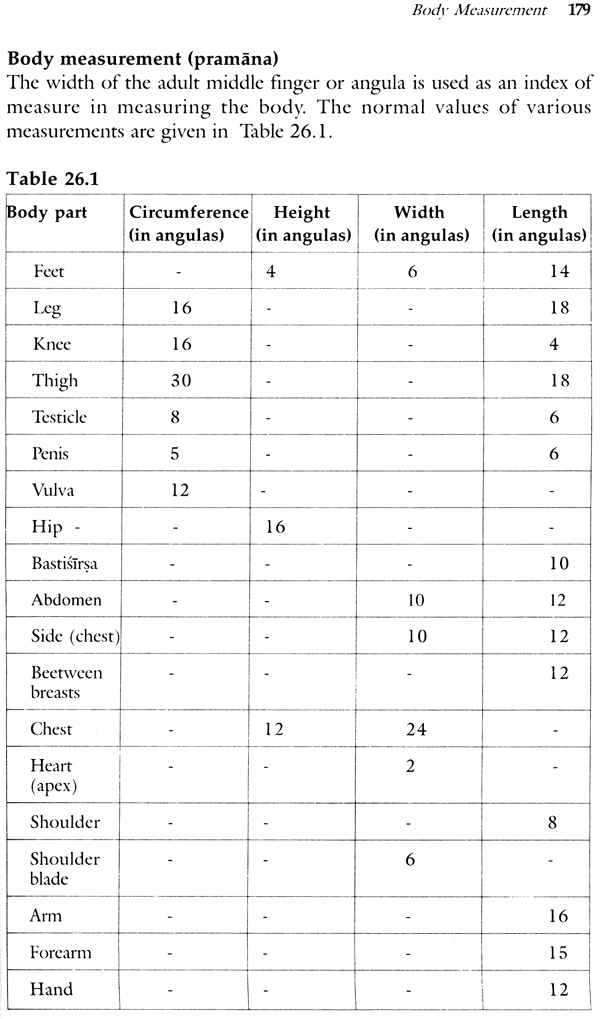
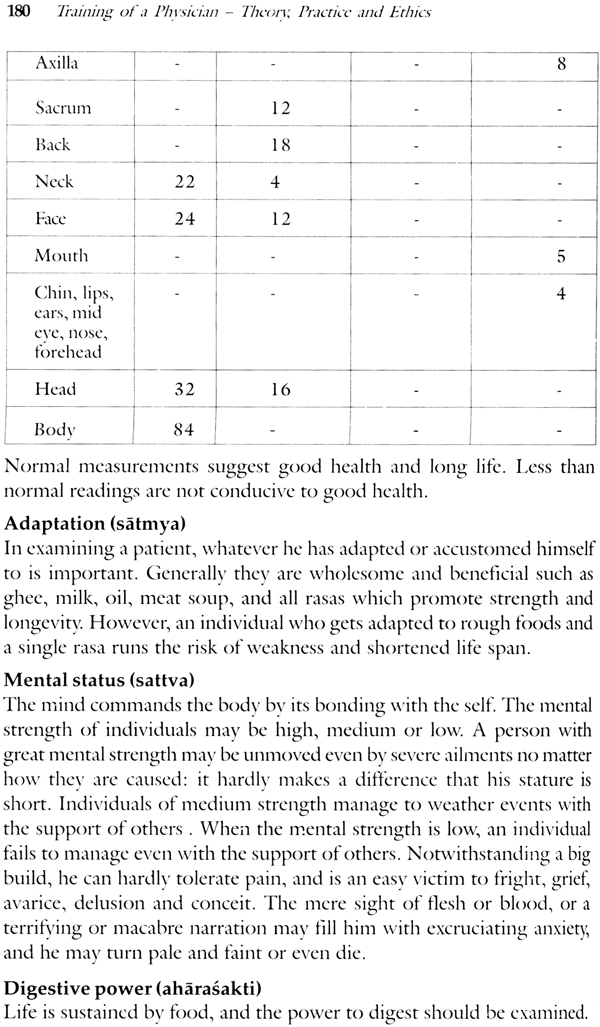
| 26 | Training of a physician - theory, practice and ethics | 169 |
| The physician at the bedside - the body of the patient - Initiation of treatment -Drugs for evacuative therapy | ||
| 27 | The body and its knower | 184 |
| The individual (mind, sense organs, intellect, prakrti) - The self - the supreme Self -Causes of sorrow and disease | ||
| 28 | Conception | 191 |
| Begetting a child - A religious ceremony - Perturbed dosas - Early pregnancy and gender of the baby-Signs and symptoms of pregnancy - The self and the embryo | ||
| 29 | Genesis of the embryo | 195 |
| 30 | Pregnancy - fetal development, anomalies and personality types | 198 |
| pregnancy (sequential development of fetus) - Fetal development and anomalies - Personality types | ||
| 31 | Antenatal and postnatal management | 204 |
| The fetus and the course of pregnancy - Antenatal care - Miscarriage - A house for delivery - Childbirth -After delivery - Breastfeeding - The nursery | ||
| 32 | The individual and the cosmos | 215 |
| 33 | A count of body parts | 218 |
| Skin, the body frontier - The parts of the body - Bones - Sense organs - Vital principles - Viscera - The body essences | ||
| 34 | The spectre of death | 223 |
| Warning signs - Sudden death - Prognostic role of a house call | ||
| | ||
| Rejuvenant and virile therapy; diseases and the regimens for treatment | ||
| 35 | Rejuvenant therapy (rasayana) | 233 |
| Celestial origin -Two regimens for rejuvenation (intramural and extramural) - Rasayana formulations - Rasayana formulation with metals | ||
| 36 | virile therapy (vajikarana) | 243 |
| 37 | Fevers (jvara) | 251 |
| Causation - Classification and clinical features - treatment - Other fevers | ||
| 38 | Pitta-induced bleeding disorders (Rakta pitta) | 269 |
| Cause - Clinical features - Clinical outcome - Treatment | ||
| 39 | Gaseous and hemorrhagic lumps of the abdomen (gulma) | 275 |
| Five types of lumps -Signs and symptoms - formulations in treatment - Abdominal lumps in women | ||
| 40 | Polyurias (pramehas) | 285 |
| Kaphaja Prameha - Pittaja Prameha - Vataja Prameha - Treatment - General measures | ||
| 41 | Skin disorders including leprosy (kustha) | 292 |
| Causation - Seven types of kustha - Other skin disorders (ksudra kusthas) - Treatment | ||
| 42 | Phthisis (sosa) | 302 |
| Causes - Premonitory signs and clinical course - Body processes as the basis of clinical features - Treatment | ||
| 43 | Insanity (unmada) | 310 |
| Classification on the basis of causation - Treatment | ||
| 44 | Epilepsy (apasmara) | 317 |
| Clinical features - Treatment - Delusional state in epilepsy - Disease begetting disease | ||
| 45 | chest injuries and their sequelae (ksata ksina) | 323 |
| Clinical features - Treatment - Diet - Formulations | ||
| 46 | Swelling (svayathu) | 328 |
| Classification - Sites - Treatment | ||
| 47 | Abdominal disease with distension (udara) | 328 |
| Classification - Treatment | ||
| 48 | Piles (arsa) | 348 |
| | ||
| 49 | Digestion and digestive disorders (grahani) | 359 |
| Digestion - Digestive disorders - Treatment | ||
| 50 | Disorders of pallor (panduroga) (anemias) | 371 |
| Kamala - Earth eating (pica) - Jaundice with white stools | ||
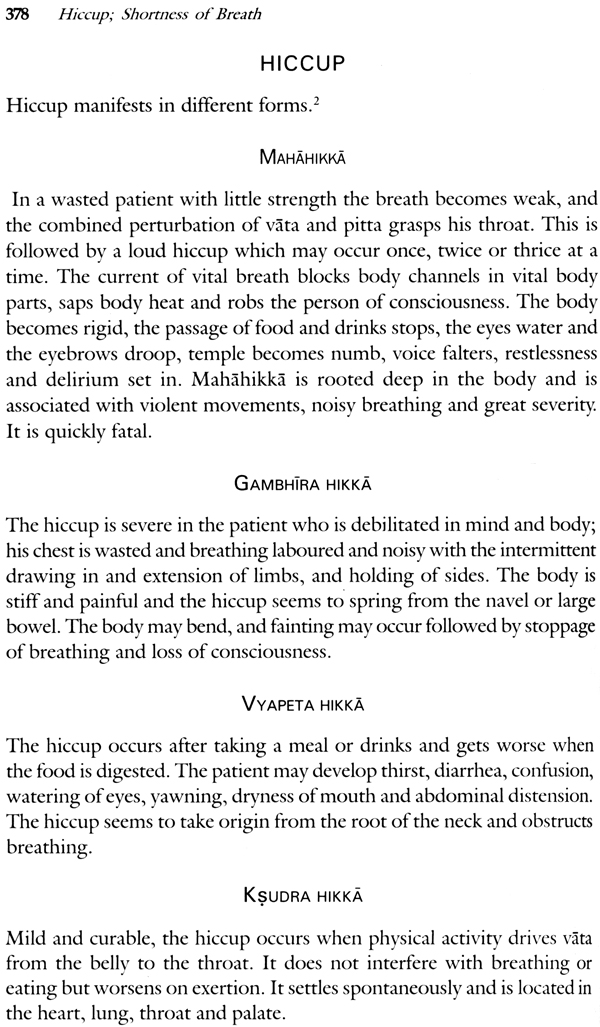
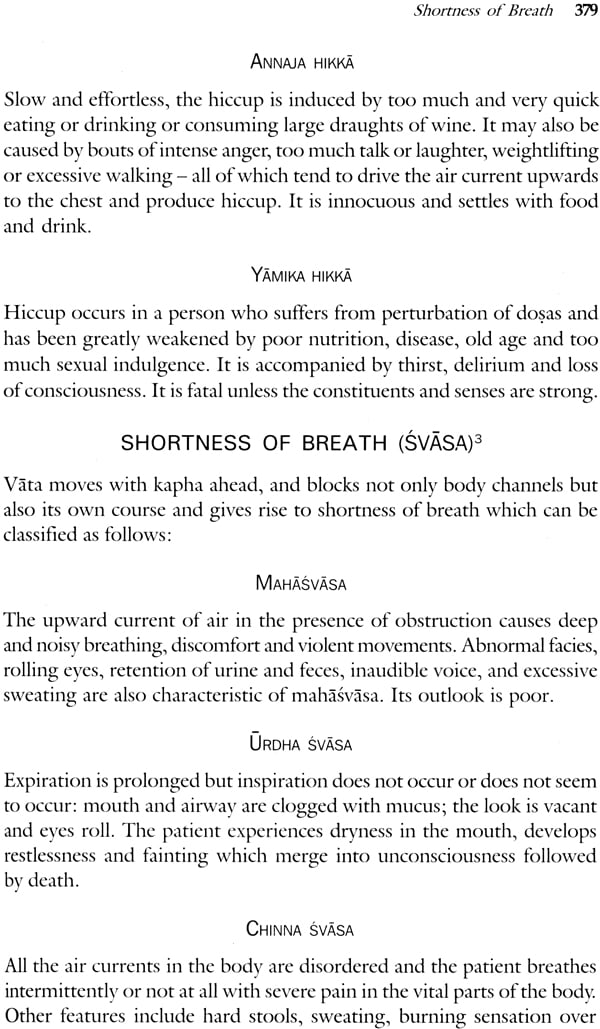
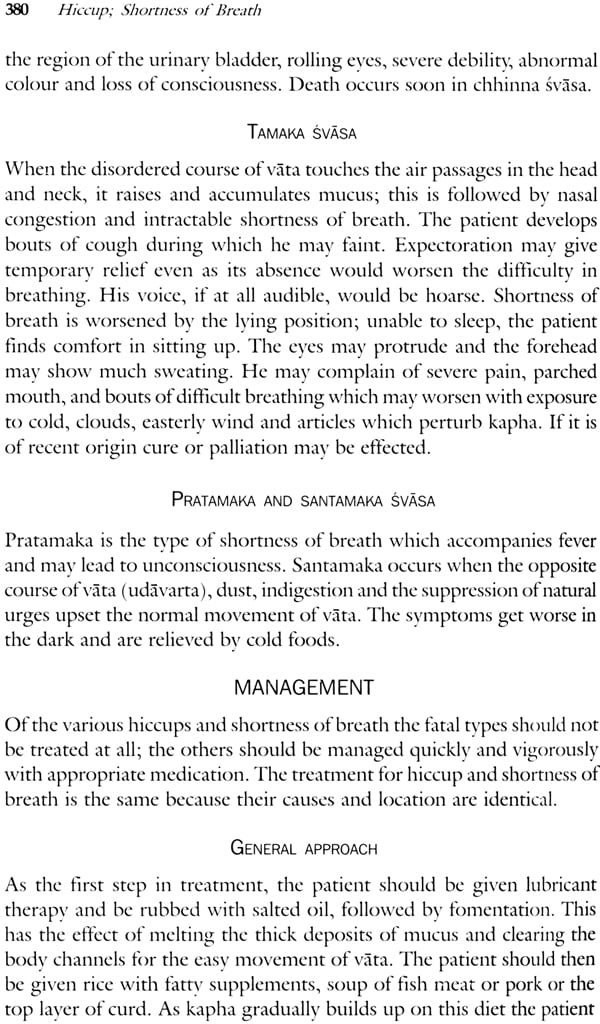
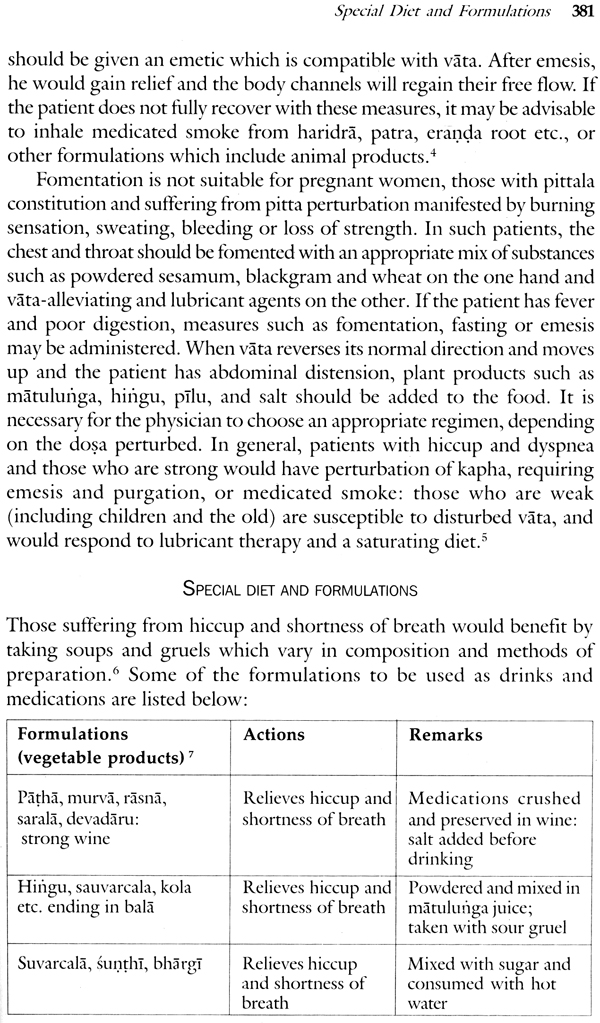
| 51 | Hiccup; shortness of breath (hikka; svasa) | 377 |
| Causes and mechanisms - Types - Management | ||
| 52 | Cough (atisara) | 396 |
| Cause - Management | ||
| 53 | Diarrhea (atisara) | 396 |
| Types - Management | ||
| 54 | Vomiting (chhardi) | 405 |
| causes - Management | ||
| 55 | Cellulitis (visarpa) | 410 |
| Types - Clinical features - Management | ||
| 56 | Thirst (trsna) | 420 |
| Clinical Feature -Management | ||
| 57 | Poisoning (visa) | 425 |
| Types - Qualities - Clinical course - Clinical features - snakes and snake bite - Bites by spiders and other creatures - Procedures - Other measures of management - Suspected bites - Homicidal poisoning | ||
| 58 | Alcoholic disorders (madatyaya) | 440 |
| Proper and other uses - Clinical features - Management - Complications | ||
| 59 | Sores and injuries (vrana) | 448 |
| Causes - Classifications - Clinical features - Clinical course - Treatment | ||
| 60 | Three regional disorders bastic, hrdaya and siras | 455 |
| Vital regions (marmas) of the body - Disorders of the vital regions - Disorders of the head - Pelvis - Heart region and chest disorders - the head region | ||
| 61 | Numb and immobile thighs (urustambha) | 478 |
| 62 | Disorders of perturbed vata (vatavyadhi) | 482 |
| Clinical features - treatment - Mixed types - Wrapping | ||
| 63 | Disorders of perturbed vata and blood (vatasonita) | 495 |
| Clinical features and types - Treatment | ||
| 64 | Disorders of the reproductive system; reflections on the principles of therapeutics | 503 |
| Disorders of the female genital organs - Disorders of breast milk (ksira dosa) - Seminal disorders and impotence (sukradosa) - Principles of therapeutics | ||
| 65 | Drugs for evacuation (emetics and purgatives) | 520 |
| Emetics - Purgatives - Preparations/formulations | ||
| 66 | Evacuative procedures (pancakarma) and formulations | 545 |
| Emesis an purgation (general guidelines, complications and management) - Head evacuation - Suitable and unsuitable clinical conditions for evacuation (emesis, purgation) - Enema (non - lubricant, lubricant) - Head evacuation - Enemas (general conditions, procedural details, formulations for non-lubricant and lubricant enemas) - Complication of enemas and guidelines for management - Special enemas - Post-evacuation management | ||
| Epilogue | 584 | |
| Botanical names | 585 | |
| Glossary | 600 | |
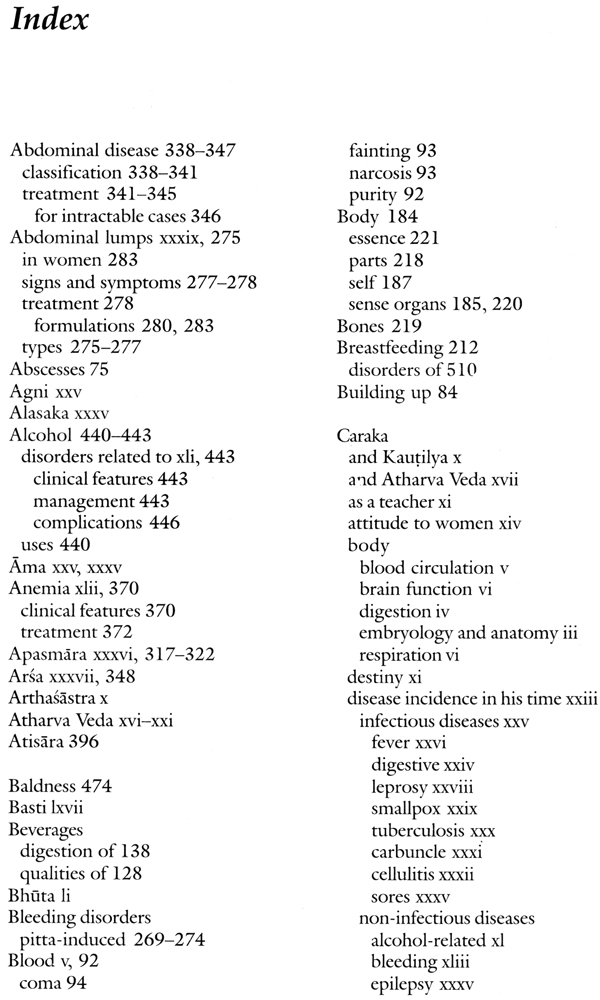
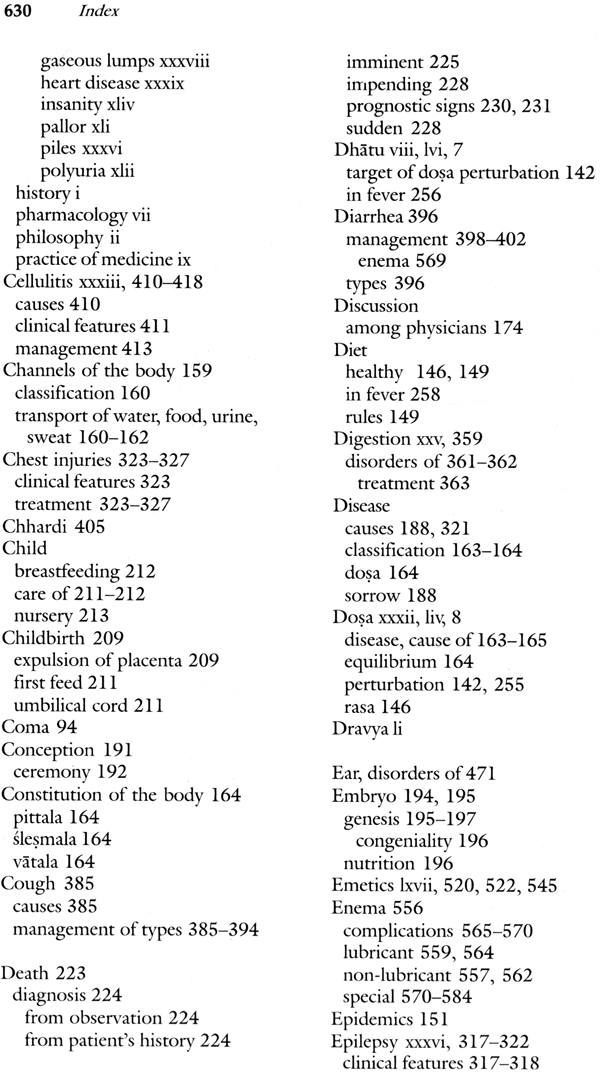
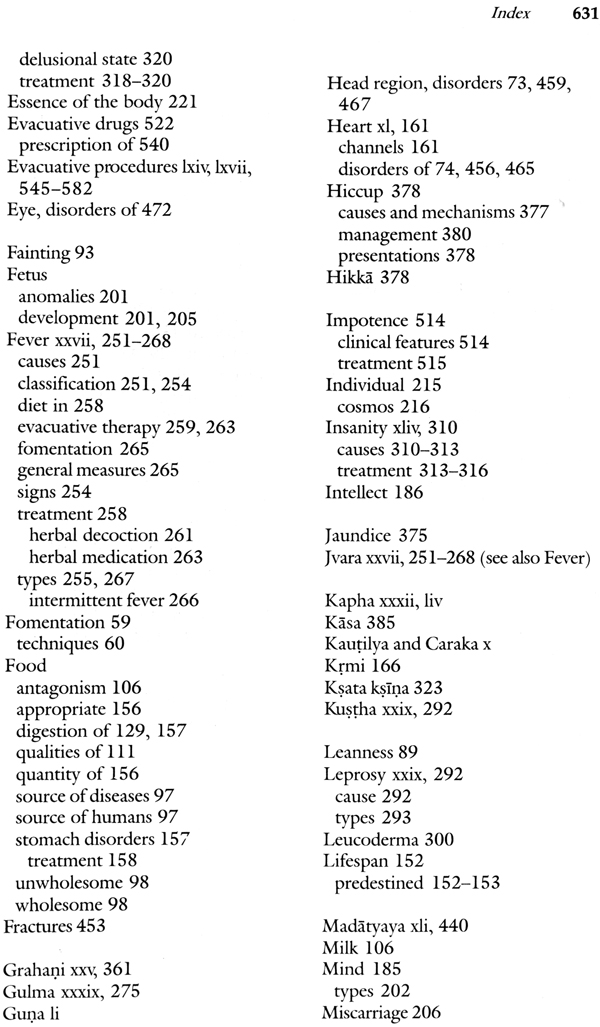
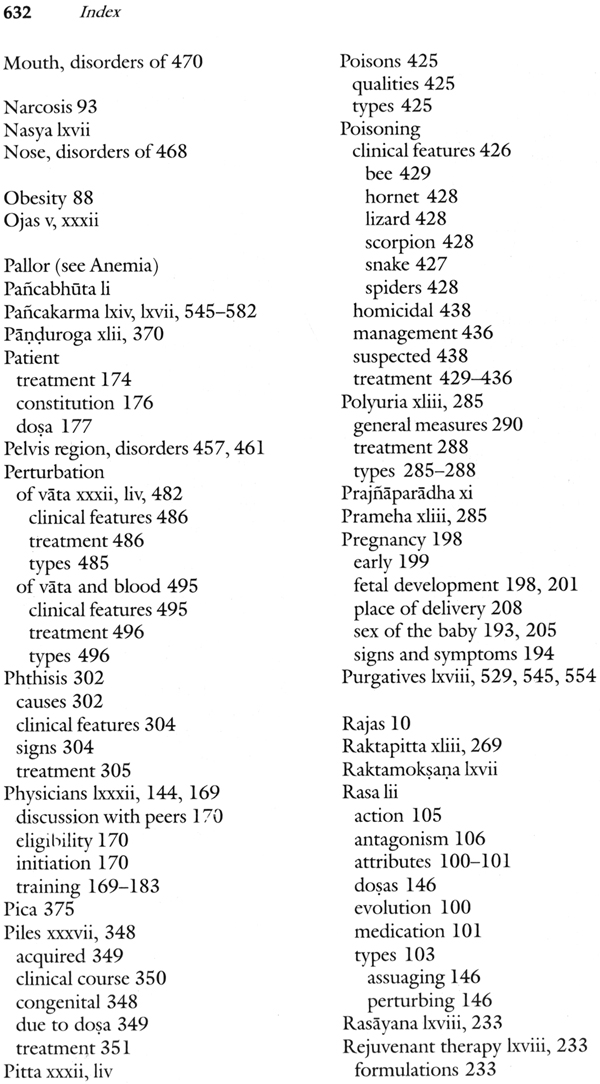
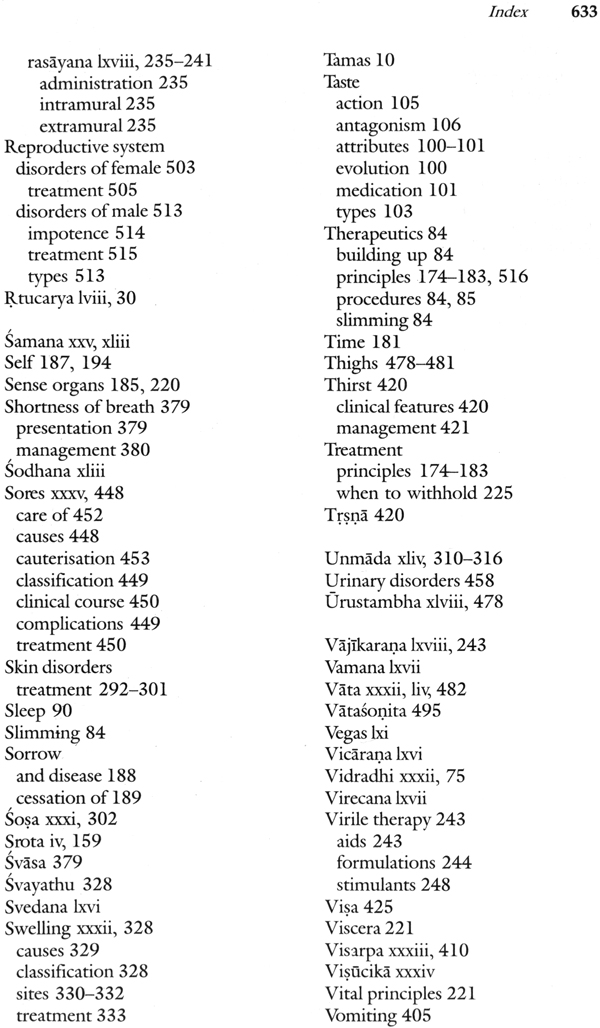
| Index | 629 |