

The Mahatma and the Poet Letters and debates between Gandhi and Tagore 1915-1941 with your friends
Book Specification
| Item Code: | IDD296 |
| Author: | Sabyasachi Bhattacharya |
| Publisher: | National Book Trust, India |
| Language: | English |
| Edition: | 2015 |
| ISBN: | 9788123722023 |
| Pages: | 231 |
| Cover: | Paperback |
| Other Details | 8.5" x 5.5" |
| Weight | 350 gm |
Book Description
This collection of letters exchanged by Mahatma Gandhi and Rabindranath Tagore, along with some essays by them, began as a modest project without any funding in 1992. While I was at VisvaBharati, the university founded by Tagore, I came across the Gandhi-Tagore correspondence in the university's archives and I was struck by the significance of these letters in terms of the differing perceptions they had of major national issues, as well as the intimate light the letters throw upon the relationship between these two friends and adversaries in debate. A collection of these letters was intended to be part of the National Book Trust's publications in the 125th Gandhi Jayanti year, 1994-95. However, as I began editing the letters I realised that the dialogue between Tagore and Gandhi needed to be contextualised by including in this collection some of the published writings in which they addressed the issues they raised in their private correspondence. Some of the sources from which material for this volume could be gathered were dispersed and not easily accessible. Thus the project demanded more time than I could devote to it until I could demit the Vice-Chancellor's office to return to my research interests. This accounts for the unconscionable delay in completing the task I had undertaken five years ago.
In the 'Introduction' to this book I have tried to sketch the historical backdrop against which we see the beginning and growth of that intellectual exchange between Gandhi and Tagore which is the focal theme of the book. I have also attempted an overview of the major issues which united or divided the two, issues which they frankly discussed in their private letters, not meant for publication, and also in a more guarded fashion in their published writings. What may be considered an unusual feature of this collection is the interweaving of the public discourse and their private communications. The documentation is designed to dovetail these two kinds of writings in the chronological framework of the four different phases into which I have periodised the narrative. Editorial notes at the beginning of each of the four parts of the collection elucidate details regarding the letters and writings which belong to each phase.
I have tried not to burden the text with footnotes which may be of no interest to most readers and redundant to the specialists of Gandhian or Tagore literature. Editorial notes, in italics, at the top of the documents indicate the source; unless stated otherwise, the letters are from the Tagore Archives in Rabindra Bhavan, Visva-Bharati. The Appendix contains letters from Tagore or Gandhi to other correspondents, statements to the Press, etc. which do not form a part of the Gandhi-Tagore correspondence but are, nevertheless, essentially relevant to that exchange. The correspondence has been reproduced in the original form, to the extent possible, with only minor editorial changes to bring consistency in the text. I may add that in transliterating non-English words diacritical marks have not been used due to technical constraints. Finally, translations from Bengali into English have been acknowledged wherever possible; in the last two decades of Tagore's life translation was done by diverse hands, not always easy to establish. Translations done by myself and not by the author or ap- proved by the author have been indicated.
This book puts together letters exchanged by Mahatma Gandhi and Rabindranath Tagore along with some essays which they wrote debating major national issues. These letters, preserved in the archives at Visva-Bharati, the University founded by Tagore, are of great historical interest. Of more than historical interest is the debate between Gandhi and Tagore over certain issues and questions which continue to be relevant to this day and age. This intellectual exchange began in 1914-15 when Mahatma Gandhi along with the students of his Phoenix School in South Africa visited Tagore's Santiniketan. Gandhi recalled later: "It was here that the members of my South African family found warm hospitality in 1914, pending my arrival from England, and I too found shelter here for nearly a month".
At that time, Tagore's school at Santiniketan was not yet 15 years old. Tagore was 53 years of age and he had received the Nobel Prize just a year earlier. Gandhi was younger by eight years and yet to attain a national stature in India, though his great work in South Africa was widely known. There were many striking contrasts between these two personalities. Yet, they found some common chord and there began a friendship which lasted till Tagore's death in 1941. As early as February 1915 we find Tagore referring to Gandhi as 'Mahatma' and Gandhi readily adopted the form of addressing Tagore as 'Gurudev'.
But theirs was not a friendship based on just mutual admiration. They had differences on fundamental philosophical questions, which led to disputation about many political, social and economic matters. Both were unsparing in their debate and, indeed, it cannot be said that either of them was very successful in persuading the other towards a path of convergence of views. Each accepted cordially the other's right to differ. These differences on public issues never affected, as far as one can judge from the letters, their personal relationship.
In editing this volume, I had to choose between two possible ways of organising the letters and essays. One could place the material before the reader simply following the chronological order. Alternatively, one could group the material around the major issues discussed by Tagore and Gandhi, e.g., the efficacy of boycott of educational institutions, the possibilities and limits of handicraft industries and the charkha, the discourse of science as opposed to that of religiosity, etc. The course adopted in this collection of writings is to present the writings within a chronological framework, but also to highlight the issues being debated in the period to which they belong. The chronological framework in the following pages is one suggested by the private and public communications included here. It broadly corresponds to the rhythms of development of the discourse of nationalist politics and culture.
What were the circumstances in which the intellectual exchange between Gandhi and Tagore commenced and developed? Rabindranath Tagore's experience as an active participant in the swadeshi movement following the partition of Bengal (1905) may have sensitised the poet to the limitations of the pre-Gandhian Congress and its politics. He saw, perhaps before many of his countrymen, that Gandhi promised to give an altogether new turn to the Indian struggle for freedom. Mohandas Karamchand Gandhi of South African fame might have sent his Phoenix School students to Tagore's Santiniketan because he saw that something was under way in that remote comer of Bengal, which shared some traits with his own endeavor and philosophy.
They were not total strangers to each other. It is on record that in 1901 at the Calcutta Session of the Indian National Congress, M.K. Gandhi moved a resolution "as a petitioner on behalf of the hundred thousand British Indians in South Africa.'? On that occasion, he met Rabindranath's elder brother Jyotirindranath and, shortly after that, a translation of one of Gandhi's articles on the Indian settlers in South Africa was published in the journal Bharati, with which the Tagores were associated.
There is no evidence of personal encounter at this time between Rabindranath and Gandhi. However, there is an affinity of spirit evident in what Tagore wrote of the Indian struggle as early as 1908: "God save us from the disastrous notion that dharma is not for the powerless. Let us not depart from the path of Truth (satya), that which is Right.... It is regrettable that the terror and upheavals of Europe are the only models before us. But the Christian saints who, by the strength of their faith: withstood the oppression of the Roman Emperor triumphed in their death over the Emperor. ... dharma can help us surpass oppression .... " In this statement and in others, Tagore's philosophical approach appears to approximate that of Gandhi's.
It was Gandhi's work in South Africa which made him known to Tagore, and in this matter Tagore's friend A.F. Andrews and one of his colleagues at Santiniketan, W.W. Pearson, played an important role. At the end of 1913, Andrews and Pearson resolved to visit Gandhi and to advance his cause in South Africa. On the eve of their journey to Durban from Calcutta, they saw Tagore to seek his blessings and two days before their departure a meeting was held at the Town Hall of Calcutta on 5 December 1913 to consider the position of Indians in South Africa. Tagore was one of the organisers, and the letter requesting the Sheriff's permission to hold the meeting bore his signature," Andrews, a prolific correspondent, regularly kept Tagore informed of Gandhi's activities in South Africa.
Few letters of this early period have survived. Nor do we have any account of Gandhi's first visit to Santiniketan except for Gandhi's own words quoted earlier and a letter Tagore wrote to him thanking him for sending the Phoenix School boys to Santiniketan-for "allowing your boys to become our boys as well."? But it is evident that from 1914 a close friendship bur- geoned rapidly.
Despite formal address till 1919 ("Dear Mr. Gandhi") Tagore refers to Gandhi as the 'Mahatma' as early as February 1915. His friend C.F. Andrews used this nomenclature for Gandhi in a letter to Tagore even earlier, in January 1914: "I had no difficulty in seeing from the first Mr. Gandhi's position and accepting it; for in principle, it is essentially yours and Mahatmaji's-a true independence, a reliance upon spiritual force, a fearless courage in the face of temporal power, and withal a deep and burning charity for all men. "
| Preface | xiii | |
| Abbreviations | xv | |
| Introduction | 1 | |
| PART I : 1915-1922 | ||
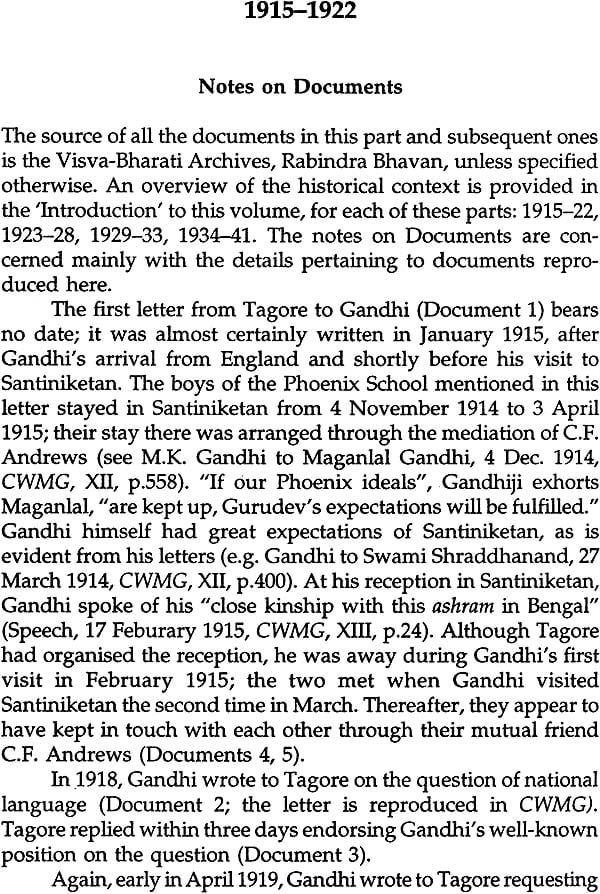
| Notes on Documents | ||
| 1 | Tagore on the Phoenix School boys (Tagore to Gandhi, undated, January 1915) | 44 |
| 2 | Gandhi on Hindi as the national Language (Gandhi to Tagore, 21 January 1918) | 44 |
| 3 | Tagore on the use of Hindi (Tagore to Gandhi, 24 January 1918) | 45 |
| 4 | Gandhi on C.F. Andrews (Gandhi to Tagore, 5 November 1918) | 46 |
| 5 | Gandhi's letter of thanks (Gandhi to Tagore, 5 November 1918) | 47 |
| 6 | Gandhi's letter asking for a message (Gandhi to Tagore, 5 April 1919) | 47 |
| 7 | Tagore's letter on the eve of the Jallianwalla Bagh massacre (Tagore to Gandhi, 12 April 1919, published 16 April 1919) | 49 |
| 8 | Gandhi's invitation to Tagore (Gandhi to Tagore, 18 October 1919) | 51 |
| 9 | Gandhi on Andrews' service to the people of Punjab (Gandhi to Tagore, 28 October 1919) | 52 |
| 10 | Gandhi renews the invitation (Gandhi to Tagore, 14 January 1920) | 53 |
| 11 | Gandhi on arrangements for Tagore's reception (Gandhi to Tagore, 11 March 1920) | 53 |
| 12 | Tagore's reflection on Non-cooperation and Cooperation (essay by Tagore in The Modern Review, May 1921, in the form of letters to C.F. Andrews) | 54 |
| 13 | Gandhi's reactions to Tagore's views (note by Gandhi entitled 'English Learning' in Young India, 1 June 1921) | 63 |
| 14 | The Poet's Anxiety (under this title, essay by Gandhi in Young India, 1 June 1921) | 65 |
| 15 | The Call of Truth (under this title, essay by Tagore in The Modern Review) | 68 |
| 16 | The Great Sentinel (under this title, essay by Gandhi in Young India, 13 October 1921) | 87 |
| PART II :1923-1928 | ||
| Notes on Documents | ||
| 1 | Tagore's telegram after Gandhi's release from prison (5 February 1924) | 97 |
| 2 | Tagore sends Andrews to Gandhi (Tagore to Gandhi, 20 February 1924) | 97 |
| 3 | Gandhi plans a visit to Santiniketan (Gandhi to Tagore, 18 May 1925) | 97 |
| 4 | Tagore on his personal relationship with Gandhi (Tagore to Gandhi, 27 December 1925) | 98 |
| 5 | Gandhi's letter of acknowledgement (Gandhi to Tagore, 3 January 1926) | 98 |
| 6 | The Cult of the Charkha (under this title, essay by Tagore in The Modern Review, September 1925) | 99 |
| 7 | Striving for Swaraj (under this title, essay by Tagore in The Modern Review) | 113 |
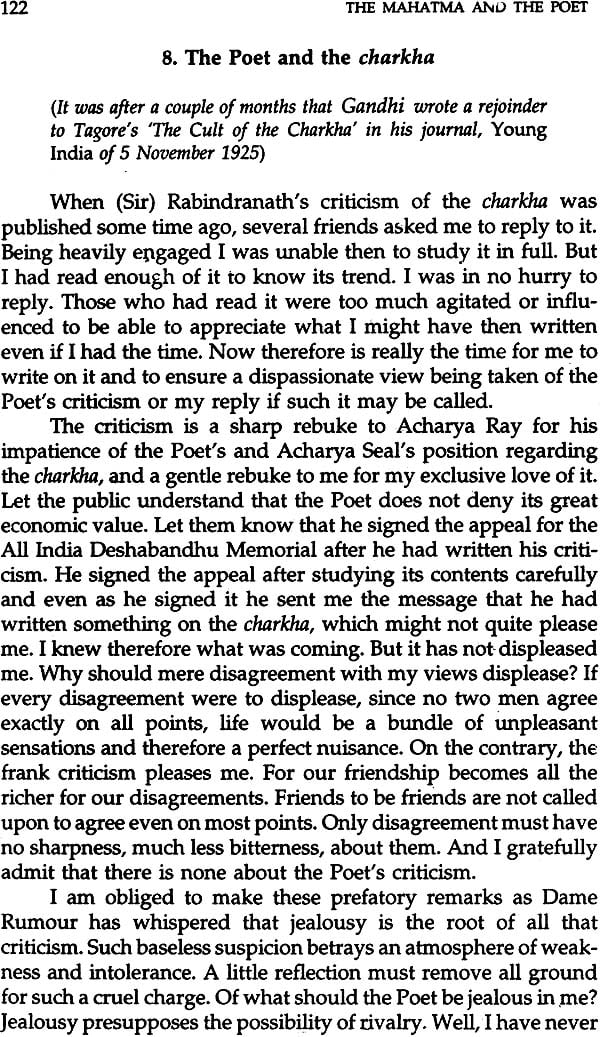
| 8 | The Poet and the Charkha (under this title, essay by Gandhi, Young India, 5 November 1925) | 122 |
| 9 | The Poet and the Wheel (under this title, essay by Gandhi in Young India, 11 March 1926) | 127 |
| PART III : 1929-1933 | ||
| Notes on Documents | ||
| 1 | Birthday Greeting telegram from Tagore (2 October 1931) | 133 |
| 2 | Gandhi to Tagore on the resumption of Civil Disobedience (Gandhi to Tagore, 3 January 1932) | 133 |
| 3 | Tagore's thoughts of Gandhi in jail on the eve of fast (Tagore to Gandhi, 19 September 1932) | 133 |
| 4 | Gandhi seeks Tagore's blessings before starting a fast (Gandhi to Tagore, 20 September 1932) | 134 |
| 5 | Tagore's relief at abandonment of fast (Tagore to Gandhi, 30 September 1932) | 135 |
| 6 | Gandhi's letter of thanks (Gandhi to Tagore, 9 October 1932) | 135 |
| 7 | Gandhi on the fast (Gandhi to Tagore, 10 November 1932) | 136 |
| 8 | Tagore on the impact of the fast (Tagore to Gandhi, 15 November 1932) | 137 |
| 9 | Gandhi on Tagore's comforting letter (Gandhi to Tagore, 24 November 1932) | 138 |
| 10 | Tagore on Hindu sects and the prayer hall at Santiniketan (Tagore to Gandhi, March 1933) | 138 |
| 11 | Gandhi's thoughts contemplating yet another fast (Gandhi to Tagore, 2 May 1933) | 140 |
| 12 | Tagore on Gandhi's fasts (Tagore to Gandhi, 9 May 1933) | 141 |
| 13 | Tagore on the moral aspects of the fast (Tagore to Gandhi, 11 May 1933) | 142 |
| 14 | The message of the Fast (under this title, essay by Tagore, Harijan, 10 June 1933) | 143 |
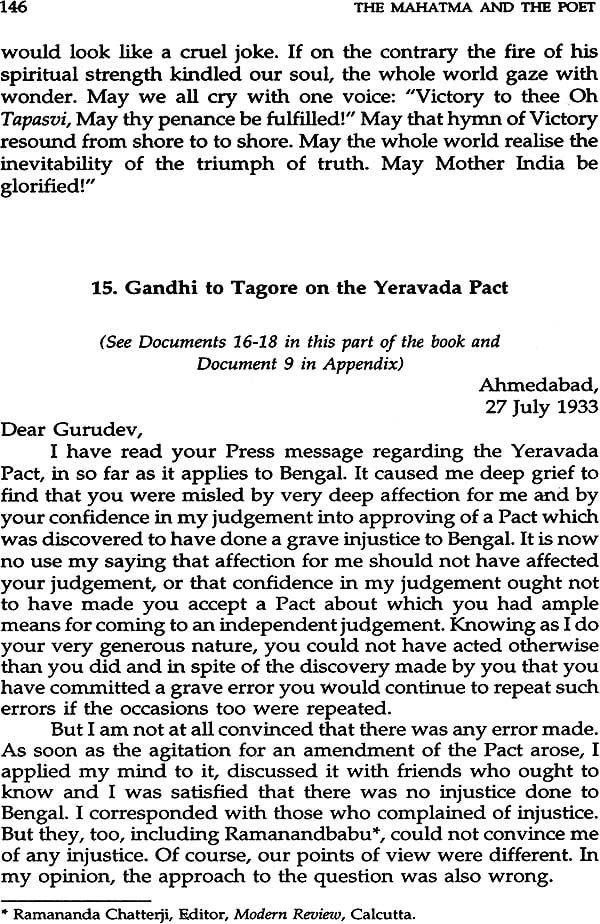
| 15 | Gandhi to Tagore on the Yeravada Pact (Gandhi to Tagore, 27 July 1933) | 146 |
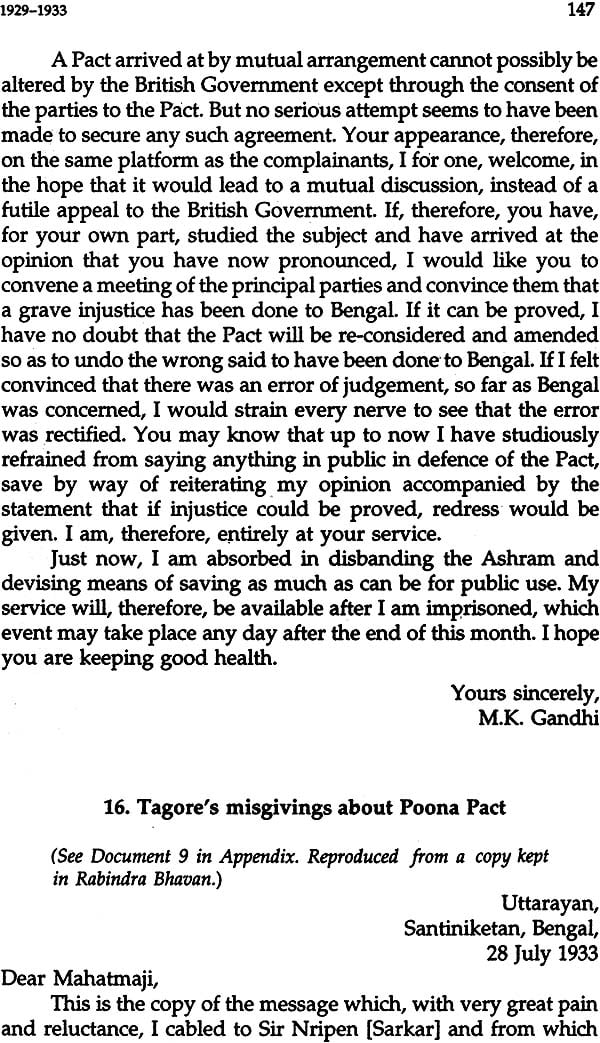
| 16 | Tagore's misgivings about Poona Pact (Tagore to Gandhi, 28 July 1933) | 147 |
| 17 | Gandhi's acknowledgement of Tagore's letter (Gandhi to Tagore, 7 August 1933) | 148 |
| 18 | Tagore on inclusion of Bengal in Poona Pact (Tagore to Gandhi, 8 August 1933) | 149 |
| PART IV :1934-1941 | ||
| Notes on Documents | ||
| 1 | Gandhi on repression in Bengal (Gandhi to Tagore, 21 January 1934) | 155 |
| 2 | Tagore on the "lawlessness" of the Government (Tagore to Gandhi, 31 January 1934) | 155 |
| 3 | Tagore on "divine chastisement" of Bihar (Tagore to Gandhi, 28 January 1934) | 156 |
| 4 | Gandhi's telegram to Tagore (2 February 1934) | 156 |
| 5 | Tagore's statement in defence of Gandhi (6 February 1934) | 157 |
| 6 | The Bihar Earthquake (Tagore's statement to the Press, including Harijan, 16 February 1934) | 158 |
| 7 | Superstition vs. Faith (under that title, essay by Gandhi in Harijan, 16 February 1934) | 159 |
| 8 | Tagore's appeal to Gandhi (Tagore to Gandhi, 12 September 1935) | 161 |
| 9 | Gandhi undertakes to help Tagore (Gandhi to Tagore, 13 October 1935) | 162 |
| 10 | Gandhi arranges required funds for Santiniketan (Gandhi to Tagore, 27 March 1936) enclosing Donors' letter to Tagore (27 March 1936) | 163 |
| 11 | Tagore nominates Gandhi as a Life-Trustee of Visva-Bharati (Tagore to Gandhi, 10 February 1937) | 164 |
| 12 | Gandhi asks Tagore to recall Life-Trusteeship (Gandhi to Tagore, 19 February 1937) | 164 |
| 13 | Tagore's reply (undated, posted on 26 February 1937) | 165 |
| 14 | Gandhi on Tagore's 'begging expedition" (Gandhi to Tagore, 2 March 1937) | 166 |
| 15 | Tagore thanks Gandhi for his message of "affectionate anxiety" (Tagore to Gandhi, 19 September 1937) | 167 |
| 16 | Gandhi writes a letter with his left hand (Gandhi to Tagore, 23 September 1937) | 168 |
| 17 | Tagore's birthday greetings to Gandhi (telegram, 2 October 1937) | 168 |
| 18 | Tagore's letter requesting "balm to the wound" inflicted on Bengal (Tagore to Gandhi, 29 March 1939) | 168 |
| 19 | The Congress (under this title, essay by Tagore in The Modern Review, July 1939, in the form of a letter to Amilya Chakraborty, originally in Bengali in Pravasee) | 169 |
| 20 | A telegraphic invitation from Tagore (Tagore to Gandhi, 20 January 1940) | 177 |
| 21 | Prompt acceptance by telegram (Gandhi to Tagore, 23 January 1940) | 177 |
| 22 | "My life's best treasure": Tagore on Visva-Bharati (Gandhi to Tagore, 2 February 1940) | 177 |
| 23 | Their "common endeavour": Gandhi on Visva-Bharati (Gandhi to Tagore, 19 February 1940) | 178 |
| 24 | Gandhi's telegram about the health of Andrews (26 February 1940) | 179 |
| 25 | Tagore to Gandhi (telegram, 27 February 1940) | 179 |
| 26 | Proposal for a joint appeal (Gandhi to Tagore, 5 May 1940) | 179 |
| 27 | Gandhi's last letter to Tagore (1 October 1940) | 180 |
| 28 | Tagore's last letter to Gandhi (undated, during Tagore's last illness, September-October 1940) | 181 |
| 29 | Gandhi and Tagore exchange telegraphic greetings (on Tagore's 81st birthday, 13 April 1941) | 181 |
| APPENDIX | ||
| Notes on Documents | ||
| 1 | Tagore's letter to the Viceroy renouncing his Knighthood (Tagore to Viceroy, 30 May 1919) | 187 |
| 2 | The conditions of Swaraj (under this title, essay by Gandhi, Young India, 23 February 1921) | 188 |
| 3 | The Poet's Visit (under this title, report by Mahadev Desai on Tagore's visit to Satyagraha Ashram in Ahmedabad, Young India, 23 January 1930) | 190 |
| 4 | Tagore on Gandhi's absence at the Round Table Conference (Tagore's letter to the Editor, The Spectator of London, 15 November 1930) | 194 |
| 5 | Tagore's telegram of good wishes for the "penance" (Tagore to Gandhi, 22 May 1933) | 198 |
| 6 | Telegram about Gandhi's condition (Amiya to Tagore, 23 May 1933) | 198 |
| 7 | "Your prayer great help in this ordeal": (Gandhi, message to Tagore through Amiya Chakraborty, 23 March 1933) | 199 |
| 8 | Tagore's telegram on the conclusion of a fast by Gandhi (27 May 1933) | 199 |
| 9 | Tagore's press statement on Bengal and the Poona Pact (24 July 1933) | 199 |
| 10 | Gandhi on inability to visit Calcutta (telegram from Gandhi to Tagore, 13 July 1934) | 200 |
| 11 | Gandhi on breaking fast at Wardha (telegram from Gandhi to Tagore, 14 August 1934) | 201 |
| 12 | Gandhi seeks Tagore's consent to Andrews' visit to Poona (telegram from Gandhi to Tagore, 10 September 1934) | 201 |
| 13 | Tagore thanked for compliance with Gandhi's request (telegram from Gandhi to Tagore, 11 September 1934) | 202 |
| 14 | Moral Wraefare (under this title, an essay by Tagore in, The Modern Review, September 1934) | 202 |
| 15 | Mahadev Desai seeks Tagore's views on conversion of Harijans to Sikhism (M. Desai to Tagore, 30 December 1936) | 203 |
| 16 | Tagore's clarification (Tagore to M. Desai, 4 January 1936 (sic.)) | 204 |
| 17 | Gandhi's assurance to Tagore about Andaman prisoners (Telegram, 16 August 1937) | 205 |
| 18 | About donations to Visva-Bharati (Gandhi to Tagore, 8 November 1937) | 207 |
| 19 | Tagore thanks Gnadhi for aid to Visva- Bharati (Tagore to Gandhi, 7 November 1937) | 207 |
| 20 | Tagore's message to the Press about Gandhi's health (21 January 1938) | 208 |
| 21 | Tagore's Welcome Address to Ghandhi (during Gandhi's visit to Santiniketan, 17 February 1940) | 208 |
| 22 | The Santiniketan Pilgrimage (under this title, report by Mahadev Desai on Gandhi's visit, Young India, 9 March 1940) | 209 |
| 23 | Rathindranath Tagore's letter to Gandhi about a memorial for Andrews (Rabindranath's son writes to Gandhi, n.d., April 1940) | 214 |
| 24 | Tagore on a suitable memorial to Andrews (Tagore to Gandhi, 13 May 1940) | 214 |
| 25 | Gandhi's telegram thanks Tagore for a song (undated, approx. May 1940) | 215 |
| 26 | Gandhi's enquiry about Tagore's health (telegram, Gandhi to Tagore, 16 July 1941) | 216 |
| 27 | Gandhi's telegram to Rathindranath Tagore (1 May 1941) | 216 |
| 28 | Obituary of Tagore by Mahatma Gandhi (7 August 1941, published in Bombay Chronicle, 8 August 1931) | 216 |