

Psychology in the Indian Tradition
Book Specification
| Item Code: | NAN236 |
| Author: | K. Ramakrishna Rao and Anand C. Paranjpe |
| Publisher: | D. K. Printworld Pvt. Ltd. |
| Language: | English |
| Edition: | 2017 |
| ISBN: | 9788124608845 |
| Pages: | 406 |
| Cover: | Hardcover |
| Other Details | 10.0 inch X 6.5 inch |
| Weight | 930 gm |
Book Description
Professors Ramakrishna Rao and Anand Paranjpe are two distinguished psychologist- philosophers who pioneered what has come to be known as Indian psychology. In this authoritative volume, they draw the contours of Indian psychology, describe the methods of study, define the critical concepts, explain the central ideas, and discuss their implications to psychological study and application to life.
The main theme is organized around the theme that psychology is the study of the person. They go on to present a model of the person as a unique composite of body, mind, and consciousness. Consciousness is conceived to be qualitatively and ontologically different from all material forms. The goal of the person is self-realization, which consists in the realization of the true self as distinct and separate from the manifest ego. It is facilitated by cultivating consciousness, which leads to some kind of psycho-spiritual symbiosis, personal transformation, and flowering of one's hidden human potentials.
Prof. Koneru Ramakrishna Rao is currently Chancellor of GITAM University, National Fellow of the Indian Council of Social Sciences Research and Distinguished Honorary Professor at Andhra University. His earlier academic appointments include Professor of Psychology and Vice-Chancellor at Andhra University; Executive Director, Foundation for Research on the Nature of Man, USA; Chairman, A.P. State Council of Higher Education, and Advisor on Education, Government of Andhra Pradesh. He published 20 plus books and nearly 300 research papers. His more recent books include Cognitive Anomalies, Consciousness and Yoga (Matrix Publishers, 2011), Gandhi and Applied Spirituality (Indian Council of Philosophical Research, 2011), and Gandhi's Dharma (Oxford University Press, in press).
Prof. Rao served for two terms as the Chairman of the Indian Council of Philosophical Research. He received numerous honours that include the national award Padma Shri from the President of India and Honorary Doctoral degrees from Andhra University, Acharya Nagarjuna University and Kakatiya University.
Prof. Anand Paranjpe obtained his PhD from Pune University and conducted post-doctoral research at Harvard University. In 1967 he started teaching at Simon Fraser University in Canada, where he is currently Emeritus Professor of Psychology and Humanities. His work over the past many years involves an attempt to articulate the psycho-logical insights of the Indian tradition. His main publications include Theoretical Psychology: The Meeting of East and West (Plenum, 1984), Self and Identity in Modern Psychology and Indian Thought (Plenum, 1998), and the Handbook of Indian Psychology (Cambridge University Press, India, 2008) co-edited with Professors K.R. Rao and Ajit Dalal.
Although the history of Indian psychology goes back to millennia, its modern phase - or revival, if you will - began only recently. Of the many psychologists who had realized the painful neglect of the indigenous tradition, about 150 came together at a conference in' Pondicherry in 2002 and unanimously proclaimed the Manifesto of Indian Psychology. It was a declaration of their conviction that psychological concepts and ideas inherent in Indian tradition have much to contribute to advance psychological knowledge in general and that their neglect by psychologists in India is responsible in a large measure to the current unsavoury state of psychology in the country. They reiterated their resolve to reorient psychology along the lines shaped by India's intellectual and spiritual history and ethos. About a year later, a smaller group assembled in Visakhapatnam and worked out a plan to prepare a set of three volumes, a handbook, a textbook, and a sourcebook of Indian psychology.
The first to be published was the handbook. The Handbook of Indian Psychology, edited by K. Ramakrishna Rao, Anand C. Paranjpe, and Ajit, K. Dalal, was published by Cambridge University Press, India, in 2008. Despite some serious attempts and significant support from the Indian Council of Philosophical Research when K.R. Rao was the Chairman, the project for developing the sourcebook has languished. This is so mainly because it has not been easy to find either psychologists who have deep knowledge of the classic works in Sanskrit, Pali, and Ardhamagadhi or classicists sufficiently aware of the perspectives and needs of psychology today. The plans to complete this work are still on, and we hope that the sourcebook project would soon be completed.
The authors of the present volume took upon themselves to write the textbook. Due to our various other commitments, both of us could not focus on the textbook project; it dragged along for almost a decade. During this long period we thought and rethought about what should go into this volume and how it may be presented. The result is what we are presenting here. As the readers will note, it is not exactly a typical textbook. In some places, it may read like a monograph. We think, however, that it serves the main purpose it is expected to address, which is to provide a basic grounding in Indian psychological thought and its place in current psychological science.
One of the major trends relating to psychology in the world at large is that consciousness has become an active interdisciplinary field of study rather than being a topic within psychology. This change in approach is clearly reflected in the contents of the Journal of Consciousness Studies, which attracts contributions from relatively few psychologists and a whole lot of philosophers, neuropsychologists, neurobiologists, and researchers from a variety of related disciplines. The concept of pure consciousness, which is at the core of psychology in the Indian tradition since the time of the Upanisads, has now found a place in discussions about the nature of consciousness by scientists and scholars belonging to diverse disciplines. Against the backdrop of the current debates on the nature of consciousness, our discussion of this topic had to address neuropsychological and a host of other perspectives.
Another emerging trend of the past decade is the increasing popularity of meditation as a technique in the toolbox of contemporary clinical psychologists. Needless to say, varied techniques of meditation, whether yogic or along the lines of Buddhist vipasyana, are primarily products of the rich spiritual traditions of India. Whether we are addressing our writing to our students or colleagues, it is essential that we convey to the readers the classical views on meditation, as well as the way it is being used in psychological study and research today.
A third emerging trend is positive psychology, which focuses on happiness, fulfilment, bliss, and various other desirable aspects of human experience as opposed to the strong focus on various forms of psychopathology that were the focus in earlier years. This trend is clearly consistent with one of the core aspects of psychology in the Indian tradition, and this had to get reflected in our writing.
Our overview of the recent research on meditation took us deeply into data and data analysis. Clearly, this is an area where a typically traditional Indian concept and technique has been subjected to wide-ranging empirical scrutiny. The current zeitgeist of psychology in the world at large is clearly more data-driven than theory-loaded, and as such it is but natural that our readers would ask us to tell them more about facts than just concepts. Surely the main sources of Indian psychology have more concepts and theories than empirical data. But then the Indian emphasis has been more on practice than on gathering data. There has always been a connection between theories and practices even though this is often implicit rather than explicit. Traditional theories are not always pure speculations. They are often grounded in observations of human behavior. However, the observations made by Indian psychologists through millennia were not recorded or statistically analyzed in the popular contemporary format. As our survey of the burgeoning literature on meditation indicates, the Western demand for empirical evidence complements the Indian emphasis on practice. A related issue is the evidence of the relative effectiveness of traditional techniques, and this is reflected in our overview of the relevant literature.
The traditional focus on human development has been on self-realization and the major forms of yoga aim at total personal transformation of a person in real life. This is different from the current interest in measuring the gradual changes in specific aspects of individuals brought about in the course of the therapeutic uses of traditional techniques such as meditation. The Indian perspective is more holistic than molecularistic and piecemeal. As such, from the traditional Indian viewpoint, the proof of the pudding lies in the lives of people who successfully practiced various forms of yoga leading to the state of self-realization. Against this background, the life histories of sages and saints present crucial data about the effectiveness of some of the major forms of application of psychological knowledge in the Indian tradition.
The three case studies presented in Chap. 9 of this book constitute significant data about ideal forms of human behavior as conceived in the Indian tradition. Although such behavior emphasizes spirituality, it does not imply focus on some other-worldly gain; it clearly involves behaving in this world. The last chapter, which is on Mahatma Gandhi, attempts to demonstrate that spirituality as conceived in the Indian culture is not aimed at some other-worldly gain; rather it aims at positive changes in the individual as well as the society here and now. Indeed, the life history of M.K. Gandhi clearly shows that psychology in the Indian tradition is not only alive and well, it is capable of presenting to the world innovative ways of solving major problems in today's troubled world.
In concluding this preface, we express our gratitude to all those who directly or indirectly helped us in this enterprise. We learned much from the writings of several scholars who wrote on the subject of Indian psychology, from Jadunath Sinha to S.K. Ramachandra Rao. We are equally benefitted by our association with colleagues who share our interest in Indian psychology. These include Sudhir Kakar, Girishwar Misra, Matthijs Cornelissen, Ajit K. Dalal, and a host of others. Shinjini Chatterjee of Springer has been a source that kept us on track with her interest in the project. Also, we express our appreciation and thanks to Smt. V.K.V. Prasanna, who ungrudgingly typed various drafts of the manuscript.
Finally, if this modest attempt by us could stimulate interest in Indian psychology among psychologists in India as well as among those psychologists around the world who are looking for an alternate model to study human nature, we would feel well rewarded for the several years of intellectual labor that went into bringing out this book.
CONTENTS
| Reviewers' Comments | v | |
| Preface to the Indian Edition | vii | |
| Preface to the First Edition | ix | |
| Chapter I | Scope, Substance, and Methods of Study | 1 |
| What is Psychology in the Indian Tradition? | 2 | |
| Indian Psychology and Psychology in India | 3 | |
| Indian Psychology and Indigenous Psychology | 4 | |
| A Model of Indian Psychology | 5 | |
| Metatheoretical Base | 9 | |
| Scope and Subject Matter | 11 | |
| Sources of Indian Psychology | 15 | |
| Methods of Study | 20 | |
| On the Nature of Research in Psychology | 20 | |
| Research Methods in Indian Psychology | 25 | |
| Experimental Methods | 26 | |
| Phenomenological Methods | 28 | |
| Other Methods of Relevance | 31 | |
| How is it Different? | 32 | |
| Chapter II | Cultural Climate and Conceptual Roots of Indian Psychology | 37 |
| The Beginning | 37 | |
| Rtam: Truth and Order | 40 | |
| Pluralism and the Notion of Multiple Perspectives | 41 | |
| States of Consciousness and Types of Knowledge | 42 | |
| Relationship between Humans and Nature | 44 | |
| The Concept and the Doctrine of Karma | 46 | |
| The Concept of Dharma and its Role | 50 | |
| Implications of Dharma and Karma for Psychology | 55 | |
| Ubiquitous Suffering: The Existential Anguish | 57 | |
| The Human Quest | 60 | |
| Self-realization | 67 | |
| Chapter III | Centrality of Consciousness | 71 |
| Consciousness in Indian Psychology | 75 | |
| Advaita Metaphysics of Consciousness | 75 | |
| Buddhist Phenomenology of Consciousness | 78 | |
| Elements of Consciousness | 80 | |
| Four Planes of Consciousness | 82 | |
| Forms of Consciousness | 83 | |
| Psychology of Consciousness in Samkhya- Yoga | 85 | |
| Concluding Comments | 92 | |
| Chapter IV | Mind-Body Complex | 95 |
| Mind in Indian Psychology | 95 | |
| Vedic Conception of the Mind | 96 | |
| Samkhya Yoga Conception of Mind | 97 | |
| Mind in Advaita Vedanta | 101 | |
| Mind in Nyaya-Vaisesika (N-V) System | 105 | |
| Mind in Buddhism | 108 | |
| Mind in Jainism | 111 | |
| Common Thread | 113 | |
| Indriyas and the Sensory-Motor Apparatus | 114 | |
| A Model of the Mind-Body Complex | 118 | |
| Contrast of East and West | 121 | |
| Two Ways of Knowing | 124 | |
| Complementarity of East and West | 126 | |
| Chapter V | Self, Person, and Personality | 129 |
| Theories of the "Self' in Indian Thought | 129 | |
| The Concept of Anatta and the Denial of the Self in Buddhism | 133 | |
| Assertion of Atman in Nyaya-Vaisesika | 136 | |
| The Affirmation of the Self in Vedanta | 139 | |
| Visistadvaita of Ramanuja | 142 | |
| Samkhya-Yoga Conception of the Self | 143 | |
| Jaina Conception of the Self | 145 | |
| Some Western Parallels of the Concept of Jiva | 149 | |
| Svabhava, Prakrti, and Personality | 154 | |
| Three Types of Personality in the Bhagavadgita | 156 | |
| Constitution (Prakrti) and Personality According to Ayurveda | 157 | |
| A Buddhist Perspective on Personality Types | 159 | |
| Overview of Personality Typologies from the Indian Tradition | 160 | |
| Psychometric Studies of Guna and Dosa Typologies | 161 | |
| Chapter VI | Cognition, Emotion, and Volition | 167 |
| Cognition | 167 | |
| Sankara's Views of Cognition and Knowledge | 168 | |
| From Perception to Cognition | 174 | |
| Advaita View of Cognition in Terms of Contemporary Concepts | 175 | |
| Applications of Cognitive Psychology in India and the West | 177 | |
| Cognitive Deconstruction of the Ego through Meditation | 179 | |
| Emotion | 180 | |
| Bharata on Emotions and Aesthetic Moods | 181 | |
| The Paradoxical Nature of Aesthetic Mood | 184 | |
| Implications of the Concept of Rasa | 185 | |
| Transformation of Emotion in Religious Devotion | 186 | |
| Rasa in the Context of Modem Psychology | 191 | |
| Emotions and Culture | 193 | |
| Volition | 196 | |
| Karma-Yoga as Means to Liberation | 199 | |
| Karma- Yoga and Contemporary Psychology | 200 | |
| The Various Pathways to Moksa: Separate or Together? | 202 | |
| Chapter VII | Applied Indian Psychology | 205 |
| Indian Model of Applied Psychology | 205 | |
| Implications | 211 | |
| Implications for Human Development | 213 | |
| Pedagogic Implications | 214 | |
| Therapeutic Implications | 216 | |
| Exploring Extraordinary Human Experience | 217 | |
| Applications | 218 | |
| Mental Health and Hygiene: Prevention of Illness | 218 | |
| Cure: Servicing the System | 221 | |
| Indian Psychology and Positive Psychology | 225 | |
| Chapter VIII | Meditation and Applied Yoga | 229 |
| What Is Meditation? | 233 | |
| Yogic Meditation | 234 | |
| Buddhistic Meditation | 236 | |
| Neurophysiological Aspects of Meditation | 237 | |
| Meditation and Attention | 241 | |
| Effects of Meditation | 244 | |
| Spiritual and Psychic Effects | 245 | |
| Cognitive Effects | 247 | |
| Conative Effects | 247 | |
| Emotional effects | 248 | |
| Therapeutic Applications | 251 | |
| Health Benefits of Meditation | 251 | |
| Yoga and Hypertension | 252 | |
| Other Healing Effects | 253 | |
| What Does it All Mean? | 254 | |
| Chapter IX | Self-realization: lllustrative Case Studies | 261 |
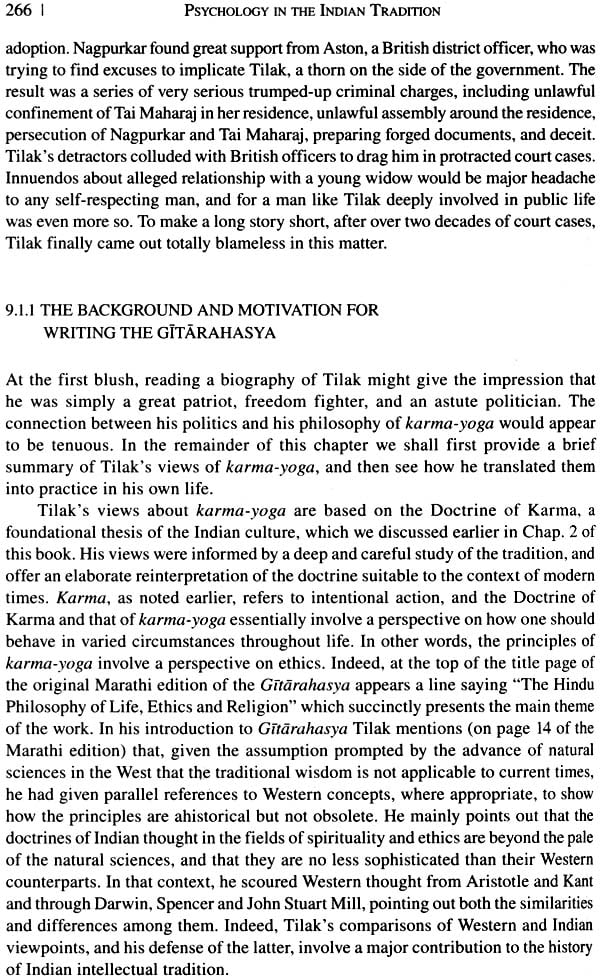
| B.G. Tilak: A Modem Interpreter and Practitioner of Karma Yoga | 262 | |
| The Background and Motivation for Writing the Gitarahasya | 266 | |
| An Outline of Tilak's View of Karma- Yoga | 267 | |
| The Emotional and Cognitive Elements in Karma | 272 | |
| Understanding Tilak as a Practitioner of Karma-Yoga | 273 | |
| Saint Tukarama: Self-transformation through Devotion | 276 | |
| Historical Background of Tukarama's Life and Work | 277 | |
| The Life of Saint Tukarama | 278 | |
| The Background and Nature of Tukarama's Spiritual Practice (Sadhana) | 280 | |
| God and the Nature of Relationship with Him | 282 | |
| Tukarama's Enigmatic Expressions about His Own Death | 285 | |
| Theory and Practice of Bhakti- Yoga | 288 | |
| Bhakti in Relation to Other Major Paths to Spiritual Uplift | 289 | |
| Tukarama's Boundless Compassion | 291 | |
| Ramana Maharsi: A Case of Self-realization | 292 | |
| Life Sketch of Sri Ramana | 293 | |
| Teachings of Sri Ramana | 295 | |
| Ramana Viewed from Advaita Perspective | 296 | |
| Ramana's Perspective in Western Context | 298 | |
| Chapter X | Personal and Social Transformation: Gandhi's Psychology of Nonviolence | 301 |
| The Background | 301 | |
| Gandhi on Human Nature | 304 | |
| Gandhian Dialectic | 307 | |
| Truth | 309 | |
| Nonviolence | 311 | |
| Satyagraha: A Psycho-Spiritual Tool for Conflict Resolution | 315 | |
| Psychoanalysis and Satyagraha | 321 | |
| Gandhi's Transformation | 328 | |
| Gandhi: An Organizational Guru | 331 | |
| Summary | 338 | |
| Glossary of Sanskrit and Pali Terms | 341 | |
| References | 349 | |
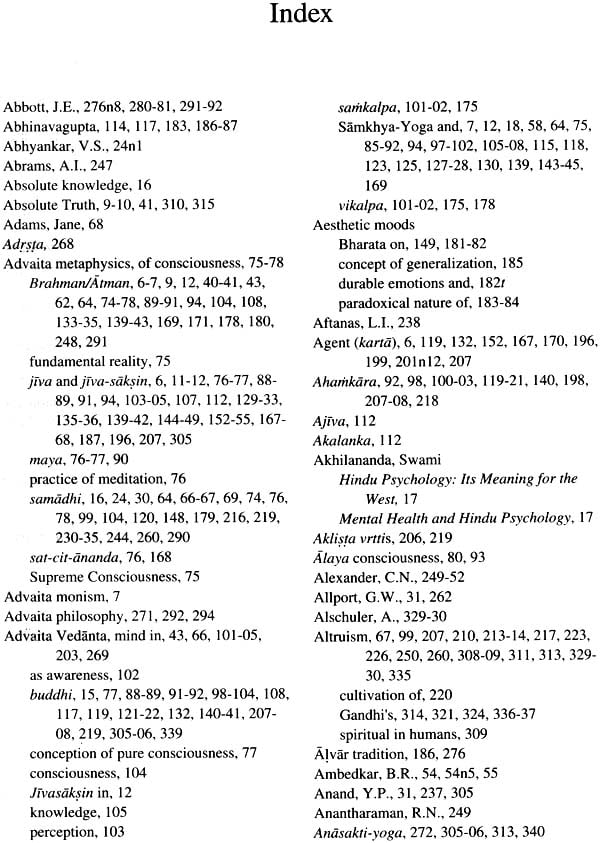
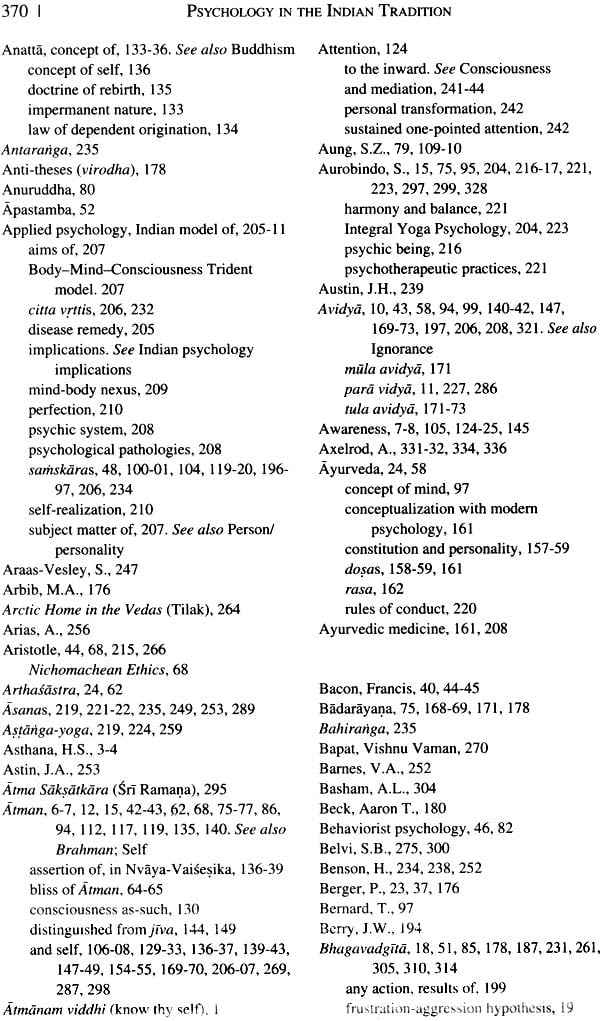
| Index | 369 |