

Social Ecology
Book Specification
| Item Code: | NAH544 |
| Author: | Radhakamal Mukerjee |
| Publisher: | D. K. Printworld Pvt. Ltd. |
| Language: | English |
| Edition: | 2014 |
| ISBN: | 9788124607480 |
| Pages: | 392 |
| Cover: | Hardcover |
| Other Details | 8.8 inch x 5.8 inch |
| Weight | 600 gm |
Book Description
This book of Radhakamal Mukerjee, with an "introduction" of Klaus Seeland, is an authoritative study on "social ecology". Social ecology is different in scope from human ecology. Since there is whole gamut of confusion about the term social ecology and its relation with sociology, here is an attempt to detail the essential principles of social ecology and its scientific fruitfulness for sociology.
This volume is an endeavour to present the major ecological concepts and processes which may help in refashioning the framework of sociology. It is also an attempt to deal with a comparative social ecology on which rest the foundations of comparative economics and sociology. Social ecology studies the place, occupation and time relations of persons and groups in their processes of competition, co-operation, conflict, accommodation and succession. It is a vast and virgin field orienting social phenomena on the basis of the give- and-take between life, mind and region.
This book is so comprehensive that it should contribute to a scientific classification of social-ecological concepts and to the development of a methodology according to which social economy may form the basis of a new functional and quantitative sociology. Therefore, it should be a referral book for sociology students, teachers and researchers.
Radhakamal Mukerjee (1889-1968), professor of economics and sociology, was Vice-Chancellor of the University of Lucknow. He was one of the founders of Lucknow School of Sociology. A prolific writer, he has to his credit numerous titles on economics and sociology. Principles of Comparative Economics (2 vols.), The Foundations of Indian Economics, Rural Economy of India, Democracies of the East, Food Planning for Four Hundred Million, Regional Sociology, The Theory and Art of Mysticism, Groundwork of Economics, Migrant Asia, The Regional Balance of Man, The Land Problems of India, The Changing Face of Bengal, Man and His Habitation, The Institutional Theory of Economics, and The Political Economy of Population were his other books. Prof. Mukerjee also co- authored Introduction to Social Psychology (with N.N. Sen Gupta). He edited two books - Economic Problems of Modern India (2 vols.), and Fields and Farmers in Oudh.
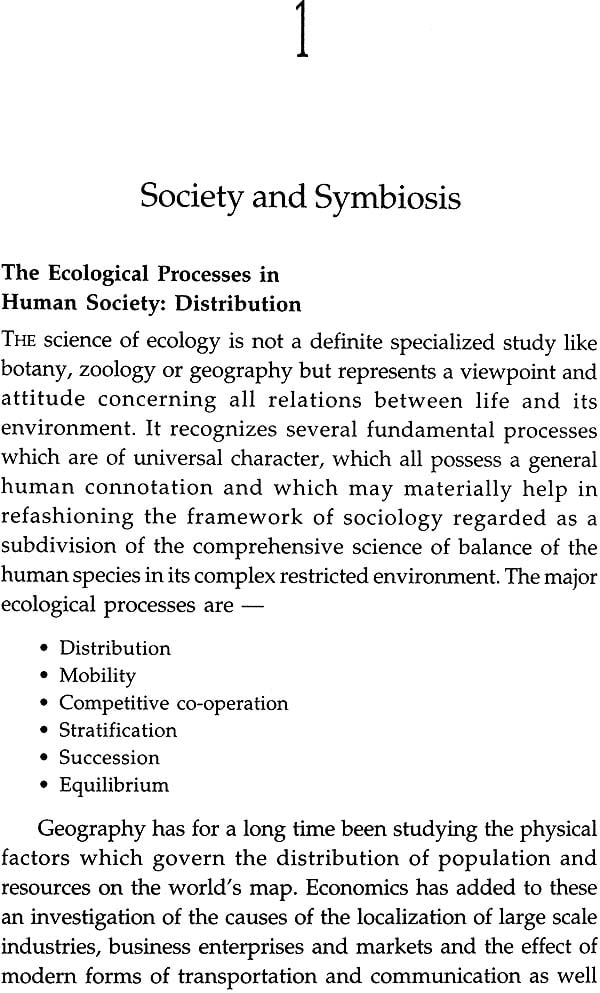
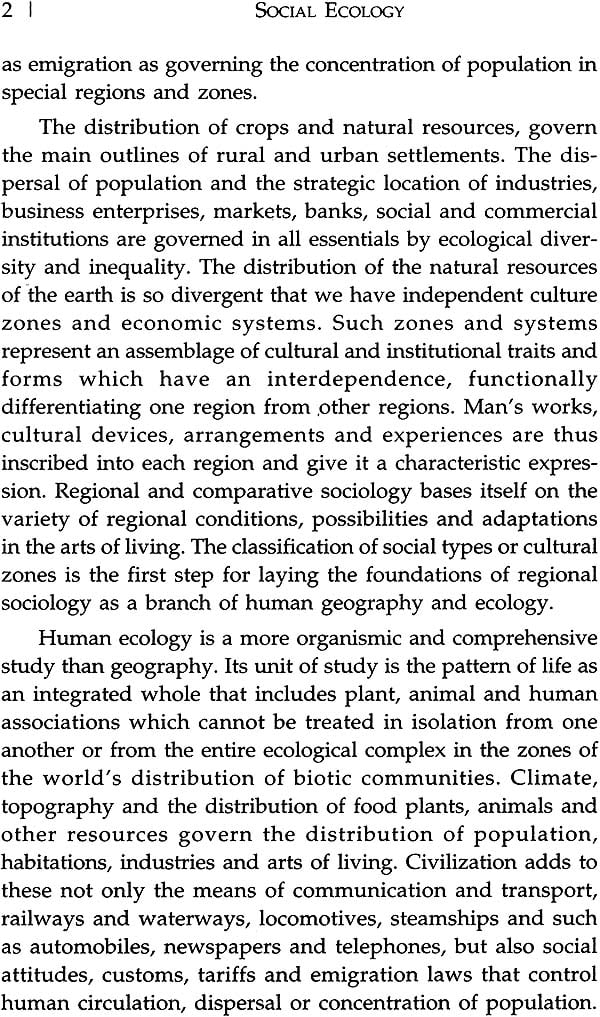
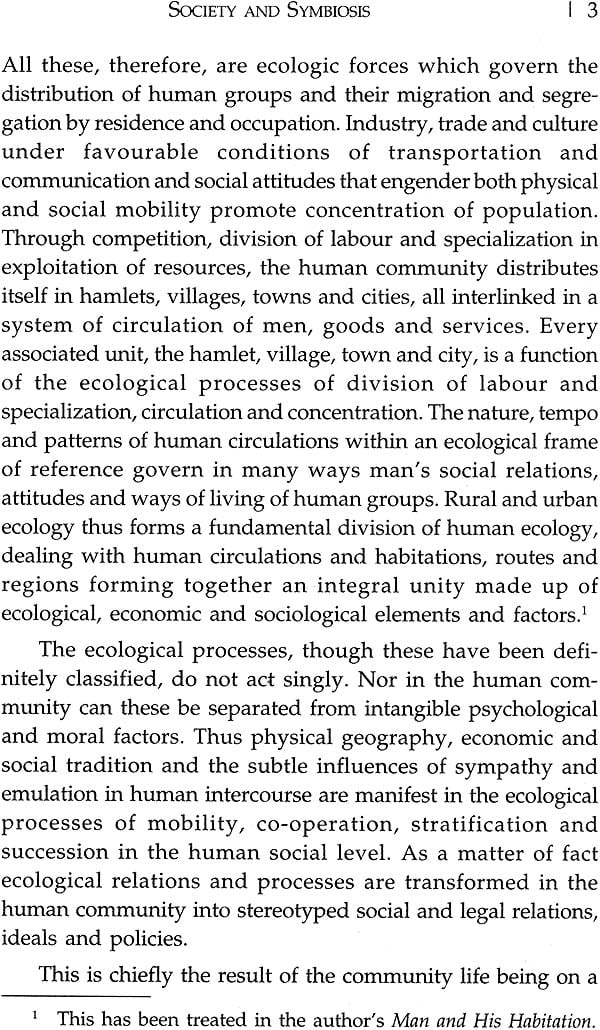
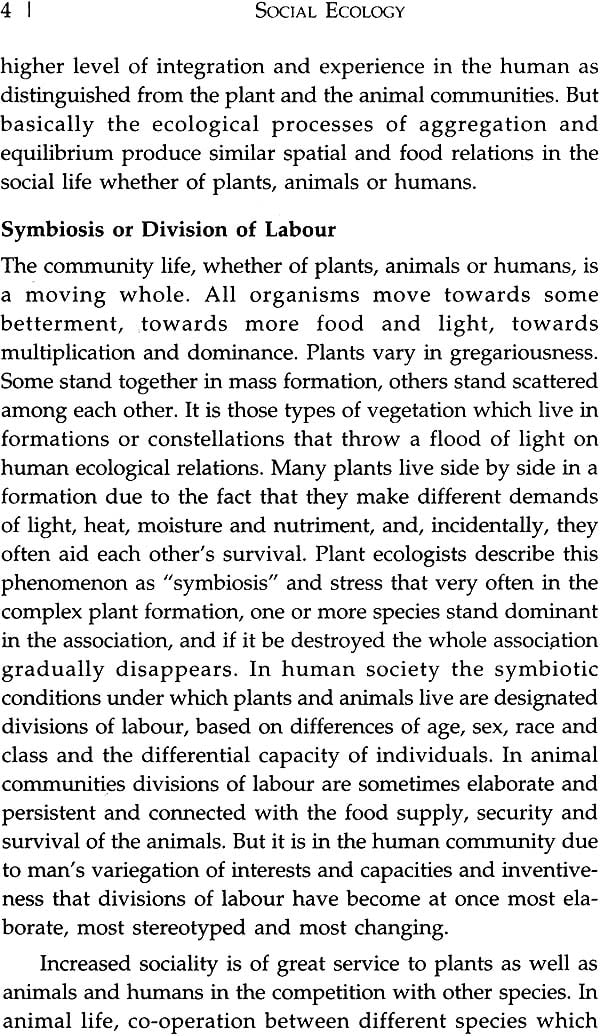
Human ecology is an infant science which has obtained rather quick recognition as a basic discipline for all social sciences. It has emerged as a synthetic study that deals with the triadic balance of the environment-function-organism, and seeks to unify and co-ordinate all the sciences of man. Human ecology, like plant and animal ecology, is a sub-division of general ecology. Social ecology is different in scope from human ecology which deals with the forms and processes of human individual adjustments to the environment. The field of social ecology is the study of the adjustments of man's social structures and functions, of the processes of interaction between region, occupation and society - the sociological equivalents of environment, function and organism - out of which arise all social phenomena. The community aspect of human ecology may also be called synecology, a term used by the plant ecologists who differentiate this from autoecology that deals with the study of the individual in relation to the environment, physical and organic. There has been considerable disagreement in respect of both the conception and scope of human ecology. The reason is not far to seek. Since human ecology rests on a close working relationship between geography, biology, economics and demography, each one of which deals with some part of the environment-function- organism triad, different investigators have stressed fundamental ecological concepts for sociology from different fields and angles. The time has certainly come for a clarification of the essential principles of social ecology and their scientific utility and fruitfulness for sociology.
I have endeavoured in this volume to present the major ecological concepts and processes which may help in refashioning the framework of sociology. The fundament, unit of study for sociology is the region. The region is at once an ecological aggregation of persons, an economic framework and a cultural order. It is at once a faithful expression of the distribution of population, resources and occupations, and the interrelated cultural unity. The spatial pattern of the community, the typical arrangement of population, service and institutions and social stratification determine the type and direction of social values and culture. The region shows a basic organic unity, first, in respect of its natural differentiation from other regions; second, in the spatial relationships of population; and, third, in the pattern of social processes, relations and values, moulded by the interchange between region and people in the context of history and heritage. Thus the region as a physical and cultural Gestalt * is a dynamic system in which are balanced and epitomized in their operation all the formative factors of social life. Social ecology is the sociological method which gives us the region or ecological order as the natural frame of reference for the classification of social phenomena and cultural processes. It has implication for all societies and cultures, but at the same time brings into the forefront social types and cultural variations which influence social behaviours and organizations. In a sense therefore, the volume may be regarded as an attempt to write a comparative social ecology on which rest the foundations of comparative economics and sociology.
Region, population and society are not three separate factors. They mutually influence one another and form a natural balance, each part of which can be understood in terms of the other. Resource pattern, population type and growth, and pattern of living are reciprocally inter-dependent. Social ecology considers society as man's response to an increase of population, which initiates and improves division of labour, social organization and the transmission of the legacy of tools, occupations, patterns of living and traditions. On the other hand, society regulates its population growth, social stratification and role of individuals so as to fit harmoniously into the region.
Within each region the unit of investigation of sociology is the community rather than man, the relationship rather than the individual. Georg Simmel, indeed, observed long ago: "Society exists wherever a number of individuals enter into reciprocal relations with one another". Similarly, according to A. Vierkandt, sociology is concerned with the analysis of fundamental relationships between persons, such as leadership, deference, submission, struggle and power. The method adopted is described as "phenomenological" according to the usage of the term by the philosopher Husserl. With this emphasis of inter-personal relations, sociology finds its proper subject matter in the processes of man's role, status and mobility, and turns from speculation to concrete investigation. Just as the region is a typical resource pattern for population and a typical system of interrelated roles or occupations of individual inhabitants, so society is a configuration of interrelated statuses. Status is assigned by the community not merely to individuals, groups and occupations but also to objects, institutions, concepts and beliefs in ecological and social space.
Status, to be sure, is the single primary datum of socio- logy; it is a reality at once universal, concrete and measurable within the social milieu including animal society. From Comte’s explanation of social physics to the Marxian theory of class consciousness and conflict, from Herbert Spencer's account of social differentiation as a universal bio-social process to the Eugenist's correlation of socio-economic status and innate ability, from Sorokin's theory of social mobility to Pareto’s concept of the elite we have the recognition of status as universal and basic social uniformity. It is the task of sociology to study the nature of the status system and domination deference relations as well as the behaviour of individual (mobility) within their ecological and social boundaries, both quantitatively and qualitatively. Status is the index at once, individual achievement and social continuity, social dominance or distance, the index of differential achievement of individuals, selected by the ecological processes of competition, specialization and segregation in the dynamic social world.
Status and distance both imply the acceptance or recognition by the society of the position or role of the individual, and group in collective life. Society is something more than an ecological aggregate of individuals or an economic framework of division and specialization of labour. It is characterized by a legacy of culture, a hierarchy of norms and values which introduce status-seeking, status-gaining, status-losing and status-regaining as universal social processes with their ecological, economic and cultural aspects. Status which is begotten by ecology and nurtured by culture converts an individual into a person, his position, role or job into a wished for pattern of social behaviour, his mobility into a moral striving and achievement. There is a give-and-take between the community and the person's goals and purposes which make status assignment the sine qua non of the social process.
Stratificatory status, rooted as it is in the adjustment of population to the region, weaves the characteristic group pattern, interpersonal relations and ways of living of a people. It not only provides each person with incentives and opportunities to rise in the social scale in order that he may not only attain status, privilege and self-competence, but also expresses an integral system of attitudes and goals and the moral evaluation of the regional community. Each man's ecological and social status is different from his fellow man's. It is defined by his membership of group life; while groups and classes form and reform, and the status system undergoes alteration in obedience to basic ecological, occupational and social adjustments. Not only his own position or status and occupation but also those of his segregated group, whether dominant or subordinate, are in perpetual flux. Social ecology studies the place, occupation and time relations of persons and groups in their processes of competition, co-operation, conflict, accommodation and succession. These reveal both symbiosis and equilibrium as well as disorganization and disequilibrium with contrasted human relations, attitudes and values. In social ecology the spatial position or status of individuals and social groups, indeed, provide the key to the delineation of the community and of social relations, behaviours and attitudes.
| Foreword | v | |
| Preface | ix | |
| 1 | Society and Symbiosis | 1 |
| The Ecological Processes in Human Society: Distribution | 1 | |
| Symbiosis or Division of Labour | 4 | |
| Mobility | 6 | |
| Competitive Co-operation | 8 | |
| The Evolution of Co-operation | 9 | |
| Co-ordination of Different Biological Needs of Individuals and the Group | 11 | |
| Mind and Sociality | 13 | |
| Ecologic, Sexual and Family Integration | 14 | |
| Its Combination in the Social Life of Early Man | 15 | |
| Evolution of Tools and Traditions in Social Animals | 18 | |
| Distinction between Society and Culture | 22 | |
| Disharmony between Sex and Gregariousness | 23 | |
| 2 | Limits of Competition and Specialization | 26 |
| The Contrasted, Fundamental Habit Patterns of Competition and Symbiosis | 26 | |
| Stratification, a Fundamental Law | 28 | |
| Reduction of Competition | 30 | |
| Stratified Specialization among the Social Insects | 32 | |
| Specialization and Constraint of the Single Organism | 34 | |
| Specialization versus Plasticity in Human Society | 37 | |
| 3 | Functions of Dominance and Distance | 39 |
| Social Stratification of Trees, Animals and Men | 39 | |
| Circularity of Dominance Relationships in Bird Society L | 41 | |
| The Biting or Bullying Order in Mammalian Society | 43 | |
| Serial Subordination in Anthropoid Society | 43 | |
| The Biological Significance of Dominance | 45 | |
| The Role of the Leader in Animal Society | 46 | |
| Female Societies, Animal and Human | 47 | |
| Ways of Expression of Dominant Behaviour | 50 | |
| The Roles of Social Distance | 53 | |
| Measurement of Social Proximity and Distance | 55 | |
| Social Distance and Social Progress | 60 | |
| 4 | Ecological and Social Pyramids | 61 |
| The Universality of Stratification and Integration | 61 | |
| The Pyramids of Industrial and Agricultural Communities | 63 | |
| The Social Pyramid as an Expression of the Scheme of Values | 67 | |
| Transformation of Ecological Base and Values | 69 | |
| Succession and Invasion, Ecological and Social | 71 | |
| 5 | The Dynamics of Human Aggregation and Circulation | 78 |
| The Hierarchy of Habitations | 78 | |
| Difference between Concentration and Co-ordination | 81 | |
| The Central-Place Scheme of Distribution of Habitations | 83 | |
| Measurement of Centrality | 86 | |
| The Flow of Human Circulation | 87 | |
| The Route of Circulation | 89 | |
| The Expansibility of Cities | 90 | |
| The Centrifugal Forces | 94 | |
| The Role of the Village in Human Circulation | 96 | |
| The Tributary Area of Towns | 98 | |
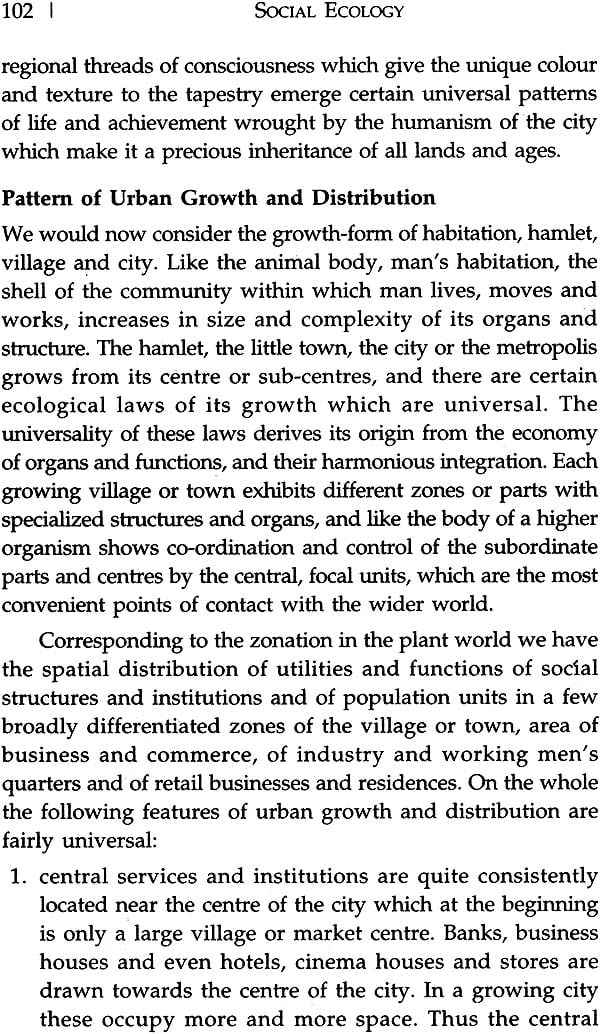
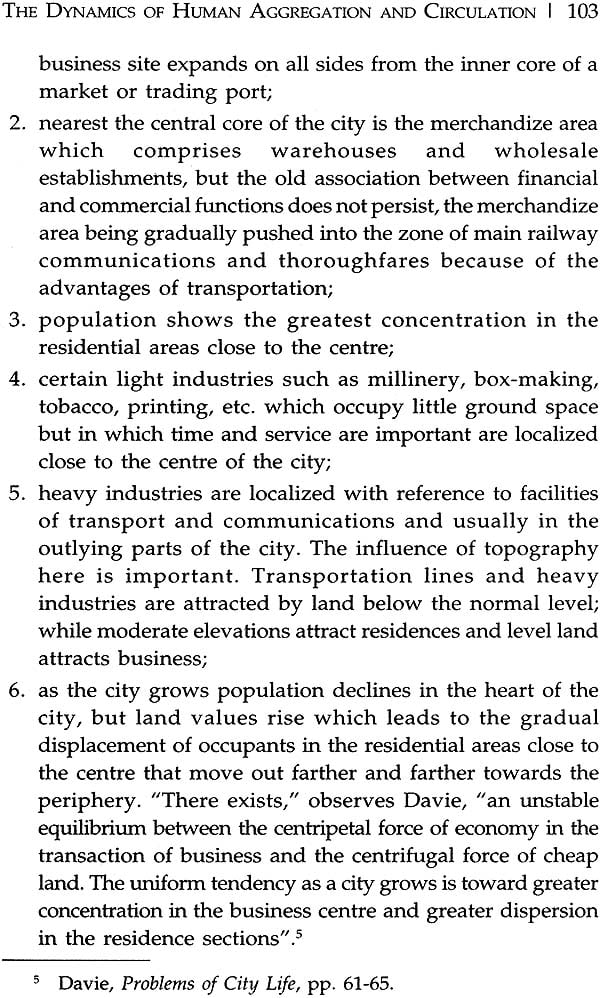
| Pattern of Urban Growth and Distribution | 102 | |
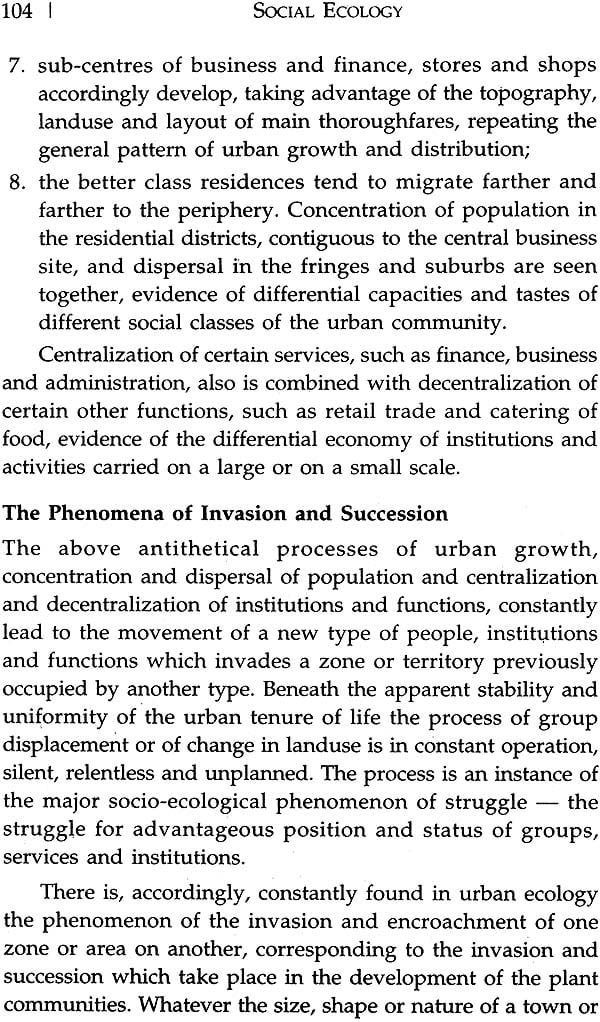
| The Phenomena of Invasion and Succession | 104 | |
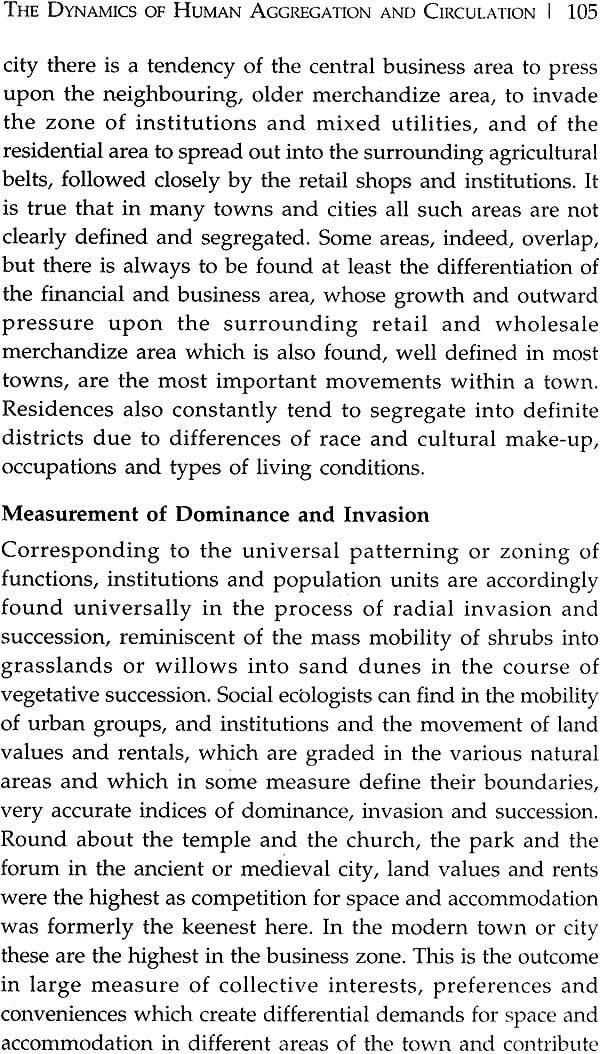
| Measurement of Dominance and Invasion | 105 | |
| Relation between the Growth-Structure of a City and its Physical Features | 108 | |
| Central and Axial Growth | 109 | |
| 6 | The Ecological Balance of Population | 113 |
| Synecology: The Science of Interdependent Populations | 113 | |
| The Circulation of Population Elements in an Ecological System | 115 | |
| The Organization of Animal Populations in Grasslands | 116 | |
| Animal Communities in the Tropical Forest | 120 | |
| Checks of Animal Populations | 123 | |
| The Pyramidal Structure of Animal Communities | 125 | |
| Man's Disturbance of the Balance of Nature | 127 | |
| Man's Failure in the Dry Grasslands | 129 | |
| Biological Status of Population | 133 | |
| The Depletion and Disintegration of the Region | 135 | |
| Limitations of Man's Dominance: Climate and Disease | 138 | |
| Climatic Controls for Cereals | 142 | |
| Ecological Principles of Colonization | 143 | |
| Instances of the Failure of Agriculture | 145 | |
| Climatic Controls for Domesticated Animals | 148 | |
| The Need of a Planned Ecology for Man's Permanence | 150 | |
| 7 | Status: Ecological and Social | 154 |
| The Universality of Stratification | 154 | |
| Distinction between Status and Position | 155 | |
| Threefold Relationship Involved in Status | 157 | |
| Status and Mobility, the Primary Data of Sociology | 159 | |
| Status and Personality | 161 | |
| Status Determination in Animal and Human Society | 163 | |
| Criteria of Status Assignment | 165 | |
| Conquest and Status | 167 | |
| The Predominance of Stratification over Mobility | 169 | |
| The Open and Closed Groups: Class and Caste | 170 | |
| Class Divisions in Industrial Society | 172 | |
| Patterns of Culture and Status | 174 | |
| 8 | Man's Social and Moral Boundaries | 176 |
| Man's Limited Field of Activity and Goals | 176 | |
| Social Pathological Features in Caste and Class | 177 | |
| The Standard of Living, the Symbol of Status | 179 | |
| The Conflict between Status and Family Life | 182 | |
| Intermingling of Class and Caste in the East and the West | 182 | |
| Stratification in Relation to Technology | 185 | |
| The Role of the Individual in Status Acquisition | 187 | |
| Interweaving of Ecological and Social Relationship | 188 | |
| The Dynamic Concourse of Ecology, Mind and Culture | 190 | |
| The Ethics of Appropriation and Participation | 192 | |
| The Apotheosis of Status into a Religion in China and India | 193 | |
| The Reconciliation of Limited Social Space or Status with Universalities in the East | 198 | |
| Life-Planning in Terms of Definite and Restricted Life-Goals | 200 | |
| 9 | Mobility: Ecological and Social | 204 |
| Types of Ecological Mobility | 208 | |
| Ecological and Social Relationships | 209 | |
| Ecological and Social Mobility in Village and City | 211 | |
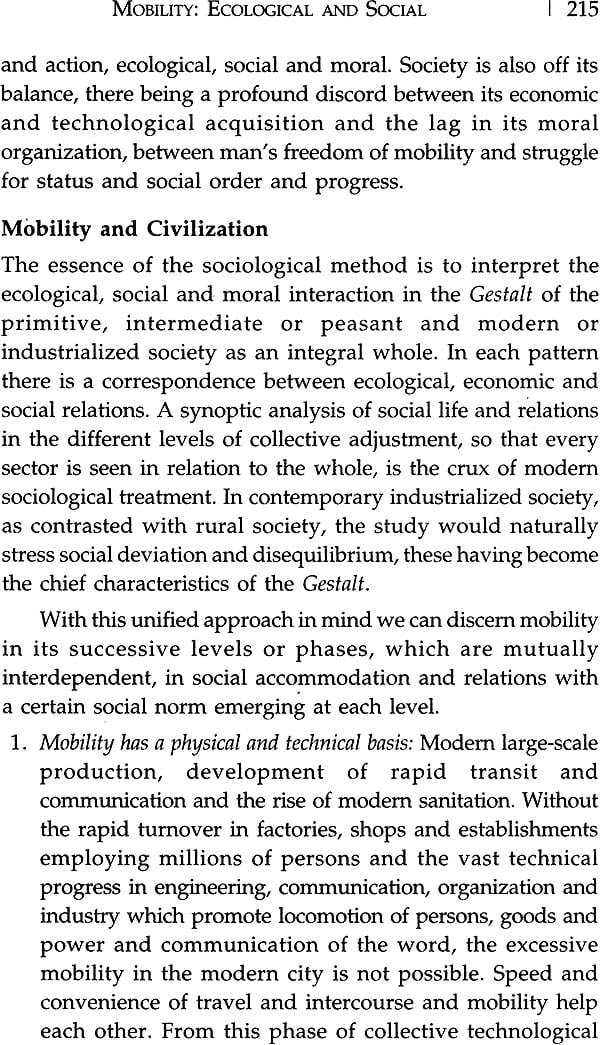
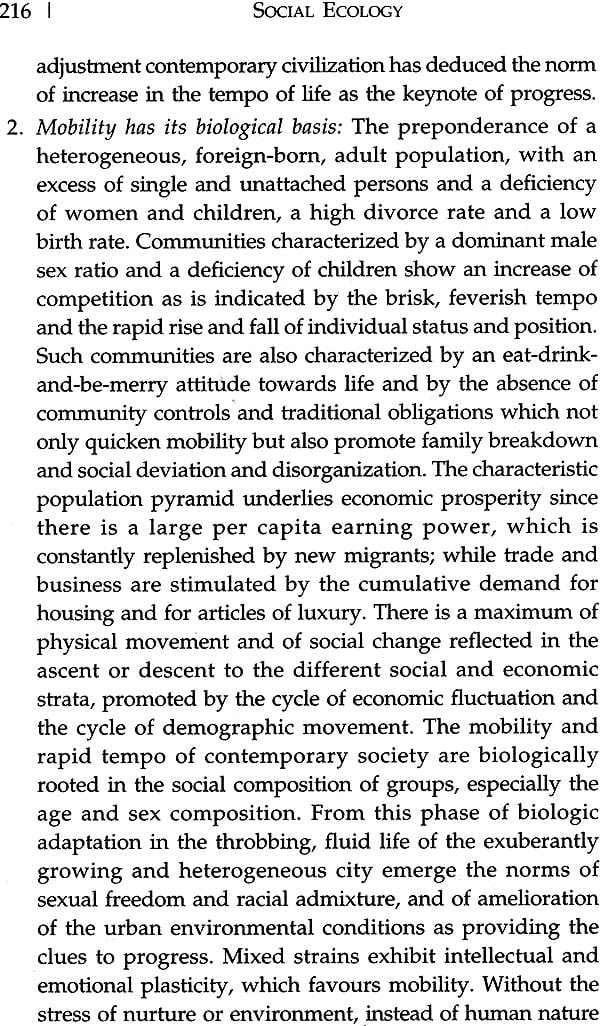
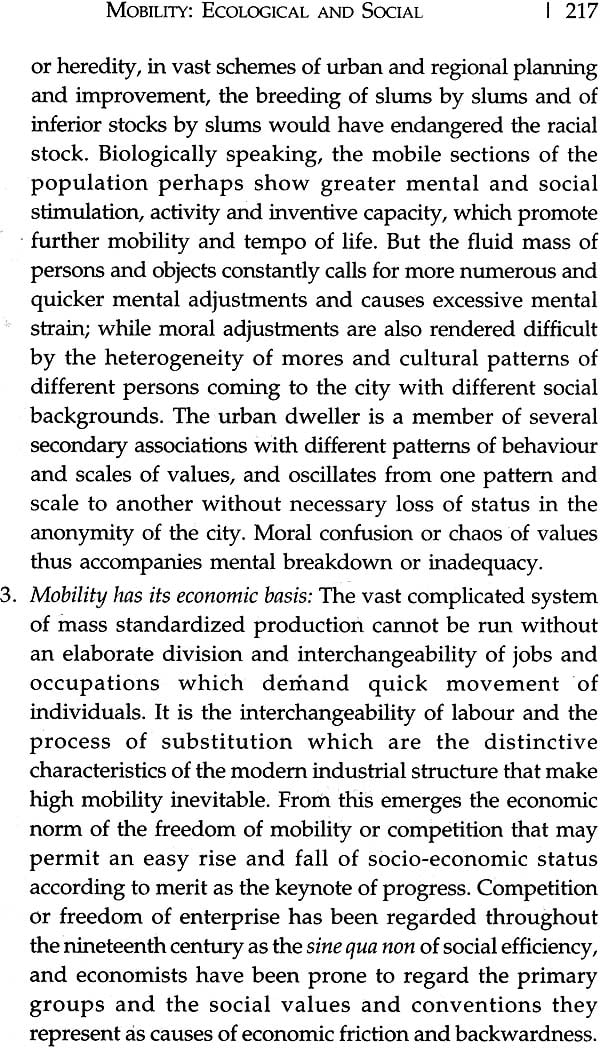
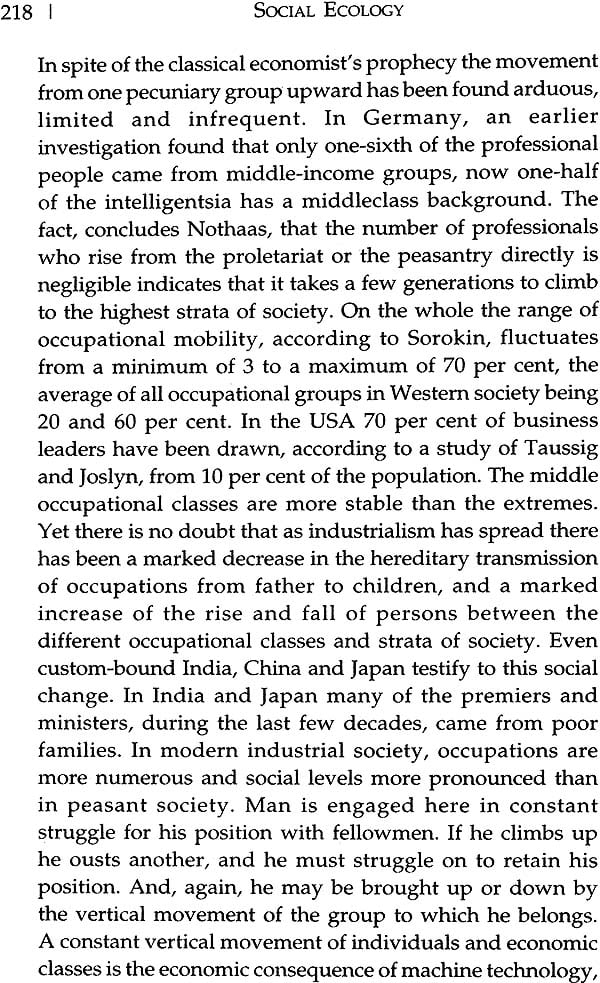
| Mobility and Civilization | 215 | |
| 10 | Time, Technics and Society | 224 |
| Ecological and Personal Time | 224 | |
| The Genesis of Social Time | 226 | |
| Coincidence of Agricultural and Social Rhythms | 229 | |
| The Imperatives of Mechanical Time and Rhythm | 234 | |
| Punctuality as a Social Habit | 236 | |
| Effects of Machine and Speed upon Human Body and Mind | 238 | |
| Disintegration of the Rhythm of Life | 241 | |
| The Need of a Planned Technology | 245 | |
| Technological Idleness | 247 | |
| 11 | Freedom of Social Mobility | 251 |
| The Modem Stratified Class System | 251 | |
| Dangers to Democracy and Culture | 253 | |
| Contrasted Methods in Democratic and Dictator States | 254 | |
| Contrasted Means of Social Control in the Primary and Secondary Group Environment | 256 | |
| The Need of Revaluation and of a New Ethical Personality | 259 | |
| Old Primary Group Mores as Misfits | 261 | |
| Ethical Demands of the Secondary Group Environment | 264 | |
| Mystical Religion as the Inspiration of Social Idealism | 266 | |
| 12 | Ecological and Cultural Patterns of Social Organization | 268 |
| The Contrast between Ecological and Cultural Behaviour | 268 | |
| Types of Habitation and Community Life | 272 | |
| Contrasted Types of Institutions | 274 | |
| The Intermingling of Ecological and Cultural Principles | 275 | |
| Misfits of Old Mores in the Community Framework | 277 | |
| Causes of the Present Cultural Crisis | 279 | |
| Recovery of Small Communities | 280 | |
| 13 | The Ecology Behind Economics | 285 |
| The Concept of a National Economic Region | 285 | |
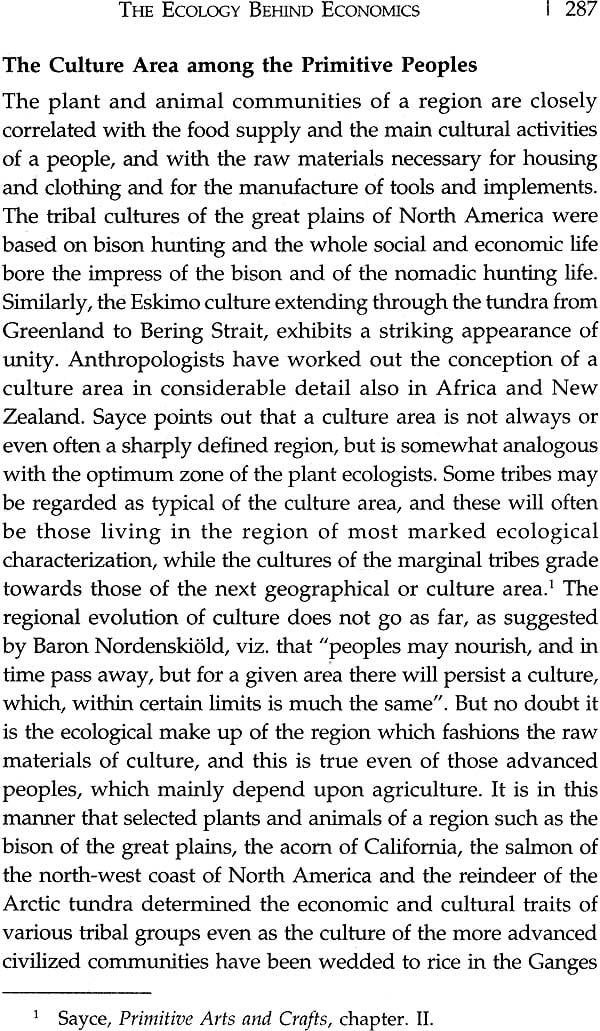
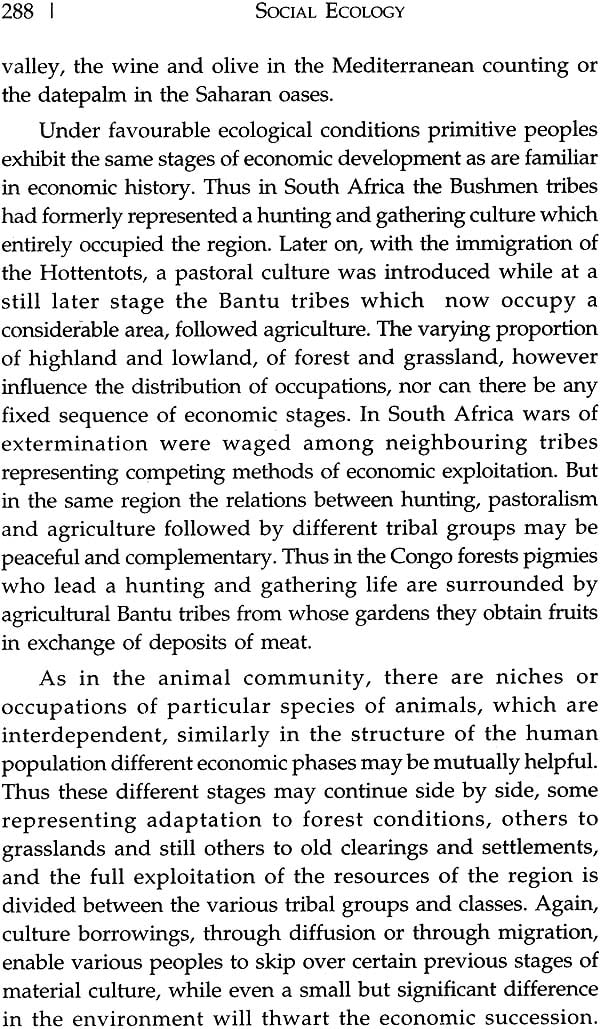
| The Culture Area among the Primitive Peoples | 287 | |
| Mixture of Economic Stages and Types | 289 | |
| Cultural Type and the Ecological Resource Pattern | 290 | |
| Social Contrasts between Rice and Wheat Cultures | 293 | |
| The Development of the Rural Community | 296 | |
| The Autonomous vs. Feudal type of Agrarian Organization | 302 | |
| The Rural Community in Transition | 305 | |
| Social Anomie | 309 | |
| 14 | The Ecology Behind Politics | 312 |
| Needs of Economic Diversity and Orientation | 312 | |
| The Tasks of Regionalism | 315 | |
| Schemes of National Regional Planning | 318 | |
| Regionalism in Politics | 323 | |
| Dissociation of Nationality from its Ecological Background in Europe | 329 | |
| Localism vs. Centralization | 331 | |
| 15 | Social Equilibrium | 335 |
| Progressive Uplift of the Equilibrium Processes | 335 | |
| The Web of Life | 336 | |
| The Web of Institutions | 337 | |
| Criteria of Social Equilibrium | 339 | |
| Disequilibrium, Inherent in the Modern Economic System | 342 | |
| The Scheme of Social Status and Values | 344 | |
| Towards Greater Wholeness | 347 | |
| The Mechanisms of Social Equilibrium | 349 | |
| Social Equilibrium, an Integral Personality-Social Experience | 352 | |
| Index | 355 |