

Sodhala Nighantuh
Book Specification
| Item Code: | NAI411 |
| Author: | Acarya Sodhala |
| Publisher: | Chowkhamba Krishnadas Academy |
| Language: | Sanskrit Text With English Translation |
| Edition: | 2019 |
| ISBN: | 9788121802741 |
| Pages: | 572 |
| Cover: | Hardcover |
| Other Details | 10 inch X 7.5 inch |
| Weight | 1 kg |
Book Description
Currently global attention is being increasingly focused on rediscovering and developing the indigenous system of medicine, Ayurveda, and its utilization for Primary Health Care. In the course of thousands of years, Ayurveda continued to exist, its basic principles never changed, because they are derived from the universal laws of nature which are true. Ayurveda is said to be anadi (one which has no known beginning) and sasvata (one which has no end or it is eternal). This contradicts with the modern scientific paradigm, where new theories often render previous understanding completely obsolete within a short period of time.
Ayurveda has much to offer to the modern world. Many synthetic drugs are of herbal origins which were well mentioned in ancient Ayurvedic texts regarding their specific properties and actions. Ayurveda has recently been rediscovered in the pursuit of holistic healing and natural" health. The globalization of Ayurveda offers evidence that the basic principles and theories described in it has much more to offer to this modern world.
Ayurveda provides knowledge of aetiology, symptomatology and therapeutics, best way for both the healthy and the sick, tri-aphorismic (trisutra) continuing from the lime immemorial. The significance of drugs in medical science possesses its key role in clinical management of diseases.
'A physician who knows all the diseases well, who has expertise with regard to drugs (and therapeutics) will cure all diseases, and does not get confused.'
Its proper study is undertaken in Dravyaguna vijnana, the science of drug, pharmacology and materia medica, which begins in Caraka Samhita with the quadruplet of drugs (bhesaja-catuska), covering various aspects of pharmacology, pharmacognosy and therapeusis.
The interest towards Ayurveda is mainly because of its drugs, which are of herbal origin, and are said to be having less adverse effects in comparison to synthetic drugs. Ancient texts related to Ayurveda can be categorised into two types, one related to treatment and other related to information regarding drugs and diet, being called as Cikitsa (treatment) and Nighantu (materia medica) granthas (texts) respectively, written in devanagari script or regional languages. Nighantu described drugs, in a typical manner, by mentioning group of synonyms, reflecting tye properties, actions and uses of the drug. These synonyms and technical terms of Ayurveda mentioned in Nighantus needs interpretations for better understanding and development of new role of medicinal plants. 'A physician without knowledge of Nighantu, a scholar without the knowledge of grammar, and a soldier without knowledge of weapons are ridiculed by people.'
So now it is time for us to increase followers of this science and there is more than one way to do so like.
• Translation of original texts and presentation of the information in a modern, practical yet authentic manner is vital.
• Inclusion of new herbal drugs, mentioned in Nighantus, in to the Ayurvedic pharmacopoeia, by describing them in terms of Rasaparicaka.
• Use of proper standardization techniques to prevent adulteration of Ayurvedic drugs.
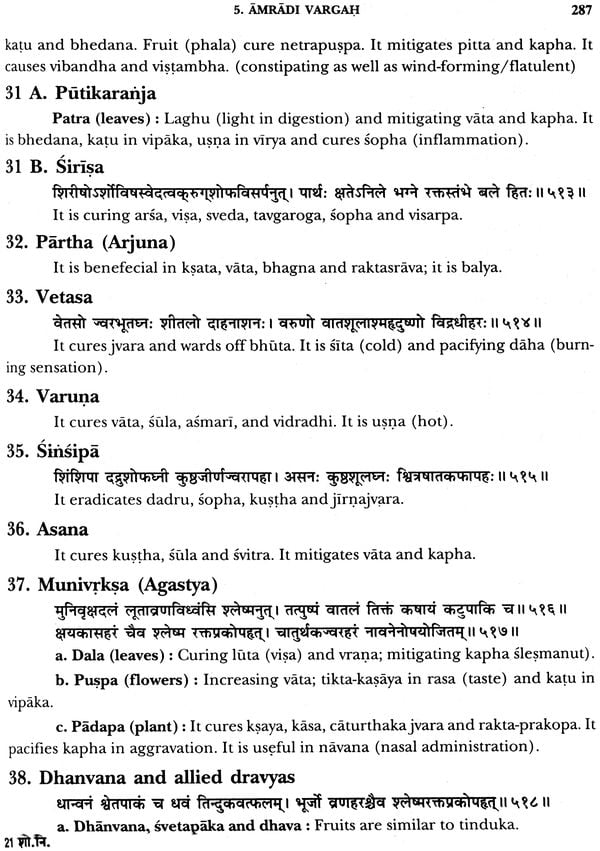
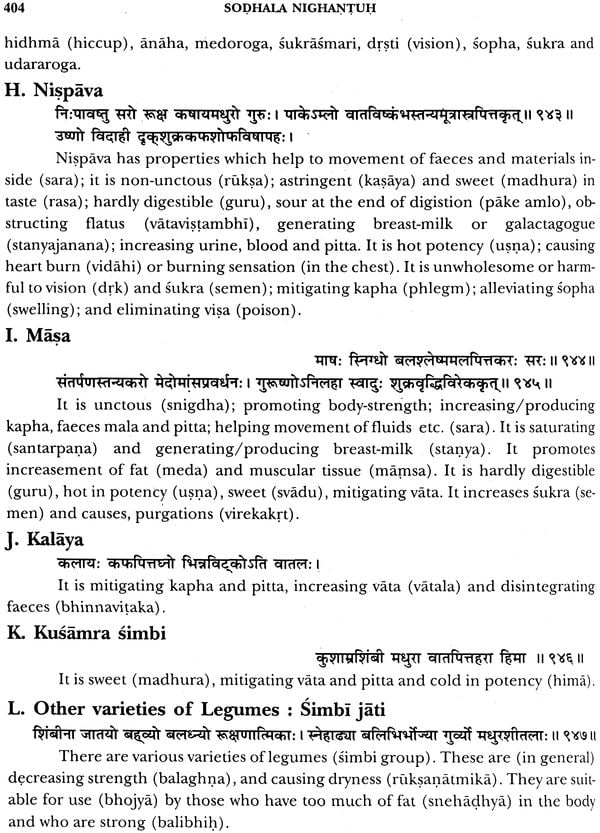
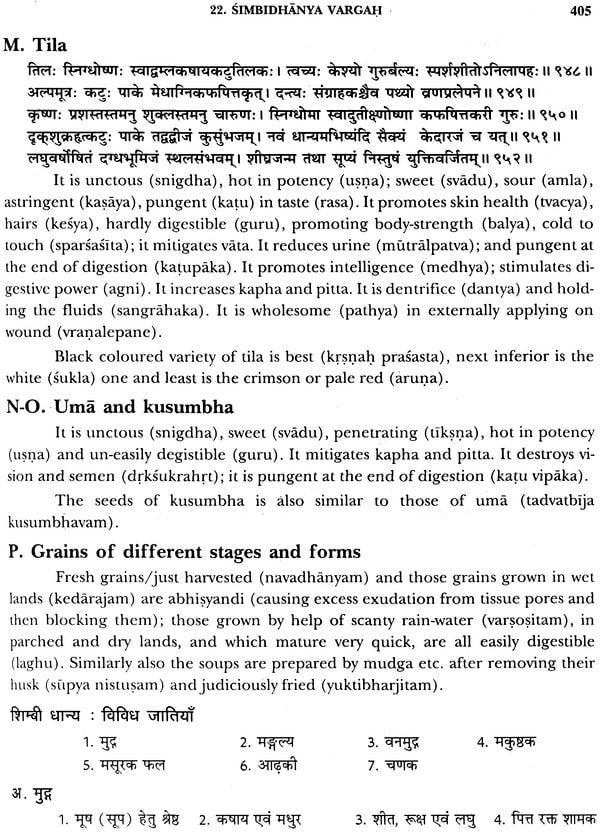
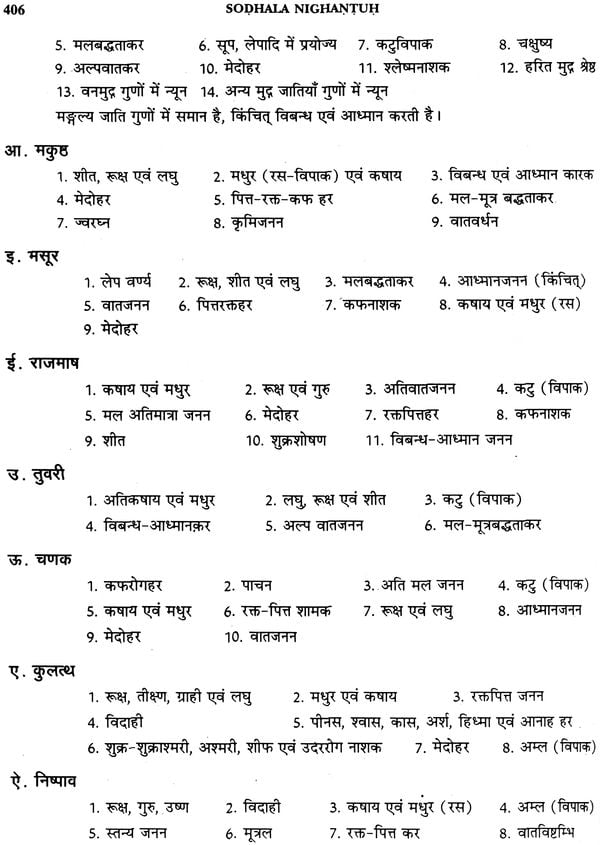
In this context, a project on Sodhala Nighantu has been undertaken by Prof. Gyanendra Pandey who is exhaustively studying the text, doing editing and working for commentary (in English and Hindi) with critical notes supported with various index, lists etc. This is an unique work on Sodhala Nighantu and being done first time. Sodhala Nighantu in the present form may contribute in the field of Dravyaguna Vigyana, which will be helpful in promoting knowledge of classical drugs, useful in clinical pharmacology, therapeutic medicine, ultimately approaching to development of Ayurveda.
It is matter of pride that our institution is a pioneer school of learning in various disciplines of Ayurveda attaching international, significance; and I feel honoured to express my views on the scholarly work of it's a brighter alumni, devoting whole career most sincerely, like Prof. Gyanendra Pandey who needs no introduction or appreciation since his dedication, contribution, long experience with, diversified exposures and painstaking efforts themselves make him a reknowned authority, actively engaged in teaching, research and other various technical activities, exerting with his sound textual base and scientific vision, for the cause of development, scientific advancement and attaiment of highest status of Ayurveda in global perspectives.
I congratulate Dr. Gyanendra Pandey and wish for every success of this venture and its benefit to Ayurveda in various ways, to the areas of medicine, science and all other related disciplines which are integral parts of wealthy treasure of knowledge inherited by glorious India, the ancient teacher of whole world (visvaguru).
| A | Foreword | v-vii |
| B | Prologue | viii-xxviii |
| Nama Sangrah | ||
| Part First : Drugs Names | 1-158 | |
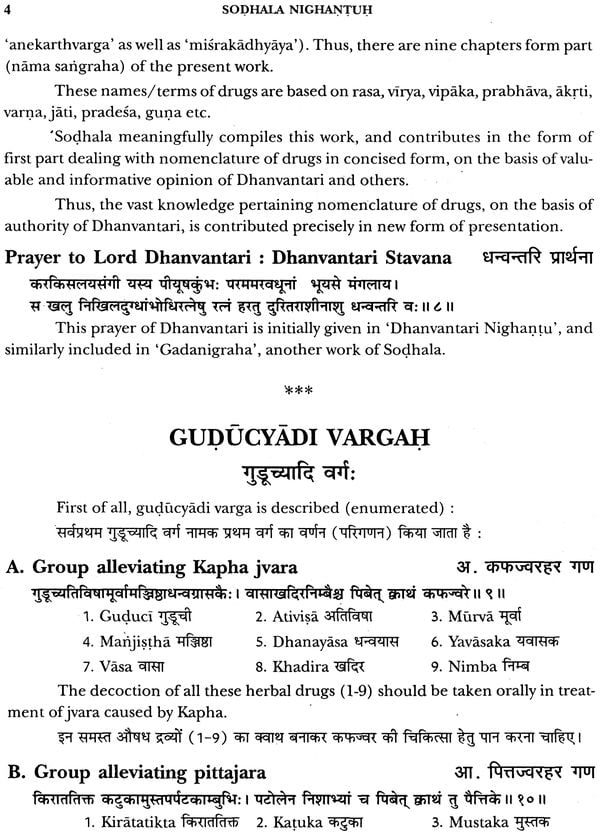
| Suryastuti - Prelude- Dhanvantari stavana | 3-4 | |
| Dravyavali | 4-22 | |
| 1 | Guducyadi vargah | 4-8 |
| 2 | Satapuspadi vargah | 8-10 |
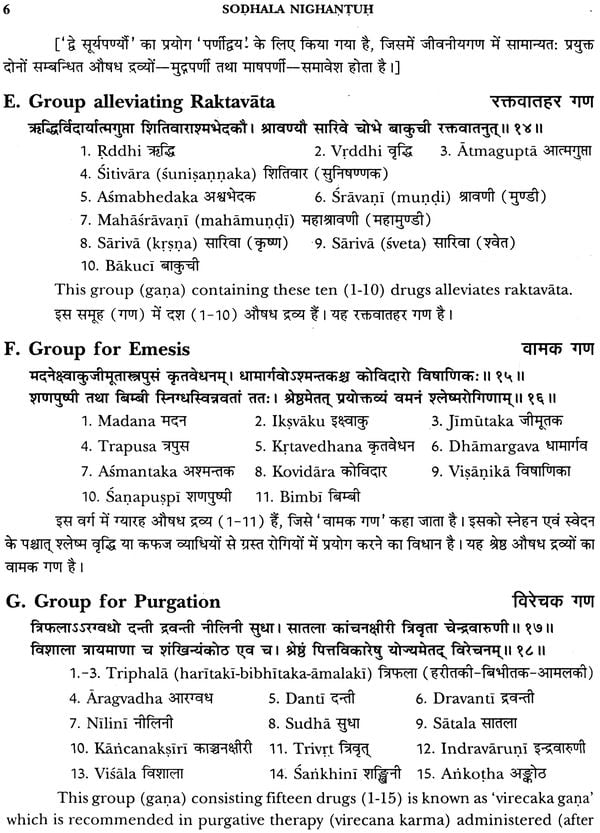
| 3 | Candanadi vargah | 10-11 |
| 4 | Karaviradi vargah | 12-14 |
| 5 | Amradi vargah | 14-16 |
| 6 | Suvarnadi vargah | 16 |
| 7 | Laksmanadi vargah | 17-22 |
| Namavali | ||
| I. | Cud ucyadi vargah | 22-55 |
| II. | Satapuspadi vargah | 55-68 |
| III. | Candanadi vargah | 68-90 |
| IV. | Karaviradi vargah | 91-107 |
| V. | Amradi vargah | 107-124 |
| VI. | Suvarnadi vargah | 124-126 |
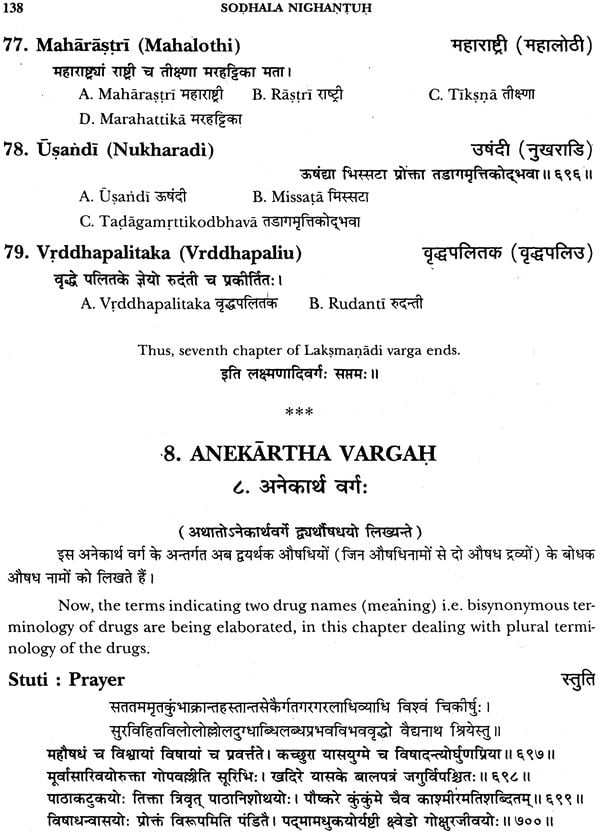
| VII. | Laksmanadi vargah | 127-138 |
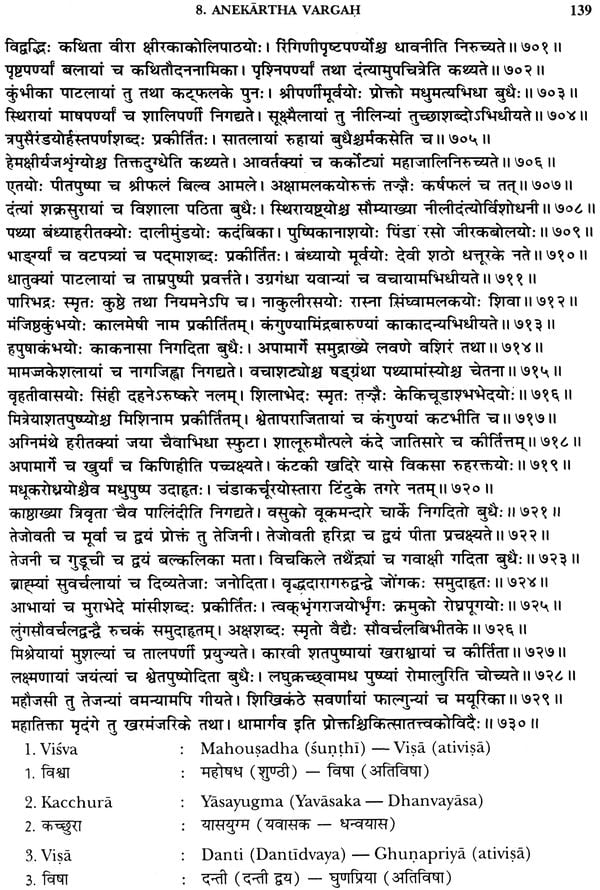
| VIII | Anekarth vargah | 138-149 |
| Dvayarthaka | 138-144 | |
| Trayarthaka | 145-147 | |
| Caturarthaka | 147-148 | |
| Pancarthadhikara | 148-149 | |
| IX | Misrakadhyayah | 150-155 |
| Concluding Summation | 155 | |
| Parisistam : Supplement | 156-157 | |
| D | Guna Sangrah | |
| Part Second: Drugs Properties | 158-490 | |
| Prelude | 161-164 | |
| Dravyavali -Content of Drugs (Groups) | 164 | |
| 1 | Guducyadi varga | 164-168 |
| 2 | Satapuspadi varga | 168-170 |
| 3 | Candanadi varga | 170-172 |
| 4 | Karaviradi varga | 172-174 |
| 5 | Amradi varga | 174-176 |
| 6 | Suvar~adivarga | 176 |
| 7 | Laksmanadi varga | 176-178 |
| 8 | Paniya varga | 178 |
| Rasa-Virya-Vipaka-Prabhava Karana Jnanam | ||
| Knowledge of Pharmacodynamics | 179-196 | |
| Ausadha Dravya Varga Prakarana | 197-490 | |
| Chapter of Drugs Groups | ||
| 1 | Guducyadi varga | 197-229 |
| 2 | Satapuspadi varga | 230-246 |
| 3 | Candanadi varga | 247-262 |
| 4 | Karaviradi varga | 263-279 |
| 5 | Amardi varga | 280-298 |
| 6 | Suvarnadi varga | 299-301 |
| 7 | Laksmanadi varga | 302-315 |
| 8 | Paniya varga | 316-337 |
| 9 | Ksira varga | 338-345 |
| 10 | Dadhi varga | 346-350 |
| 11 | Takra varga | 351-353 |
| 12 | Navanita varga | 354-354 |
| 13 | Ghrta varga | 355-359 |
| 14 | Taila varga | 360-366 |
| 15 | Madhu varga | 367-372 |
| 16 | Iksu varga | 373-378 |
| 17 | Madya varga | 379-389 |
| 18 | Mutra varga | 390-393 |
| 19 | Sukadhanya varga | 394-399 |
| 20 | jurna varga | 399-400 |
| 21 | Trnadhanya varga | 400-401 |
| 22 | Simbidhanya varga | 402-407 |
| 23 | Krtanna varga | 408-427 |
| 24 | Anupana varga | 428-433 |
| 25 | Mamsa varga | 434-460 |
| 26 | Misrakadhyaya varga | 461-490 |
| Enumerative Section | 491-538 | |
| A | Breakup of Vargas (Groups) | |
| Part First: Prathama Bhama - Namasangraha - Group I, II, III : Varga - Group - Verses - sloka | 491 | |
| Part Second : Dvitiya Bhama : Gunasangraha | 491 | |
| B. | Gana (Group of Drugs) : | 493 |
| C. | Varieties - Kinds -Types of Drugs | 494 |
| D. | Dietetics | 496-497 |
| E | Drug Index | 498-510 |
| Enlistment: A-H | 511-532 | |
| A | Animals - Group of Fauna: Source of Meat | 511-514 |
| B | Minerals - Metallic Drugs Section A & B (Suvarnadi Varga) | 515-516 |
| C. | Minerals - Metallic Drugs (General: N & G - Verses) | 517-517 |
| D | Other (Non-Plant) Drugs | 518-518 |
| E | Herbal Oils - Padapa Taila | 519-520 |
| F | Dhanya-Dravyas | 521-524 |
| G | Other Vargas | 525-525 |
| Anupana | ||
| Indices of Drugs And Plants | ||
| A | Regional Drug Terminology | 527-532 |
| B | Botanical Nomenclature (Plant Drugs Identification | 533-538 |