

Ramacaritamanasa in South Africa
Book Specification
| Item Code: | IDF254 |
| Author: | Usha Devi Shukla |
| Publisher: | Motilal Banarsidass Publishers Pvt. Ltd. |
| Language: | English |
| Edition: | 2002 |
| ISBN: | 9788120818934 |
| Pages: | 247 |
| Cover: | Hardcover |
| Other Details | 8.6" X 5.5" |
Book Description
From the Jacket:
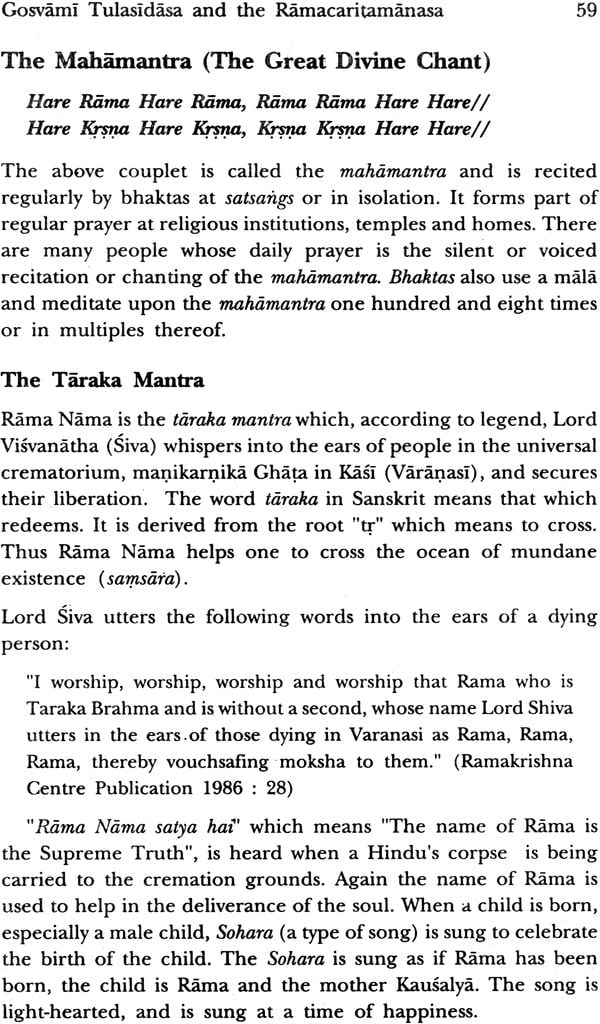
Gosvami Tulsidasa's Ramacaritamanasa projected the message of Ramabhakti and ideas of Ramarajya to the world through the forceful medium of Awadhi. Three hundred years following its composition, the Ramacaritamanasa was carried to all parts of the world by indentured labourers from Uttar Pradesh and Bihar. From 1860 to 1911, many thousands of these labourers arrived in South Africa with their copies of Ramacaritamanasa as their pillar of Faith.
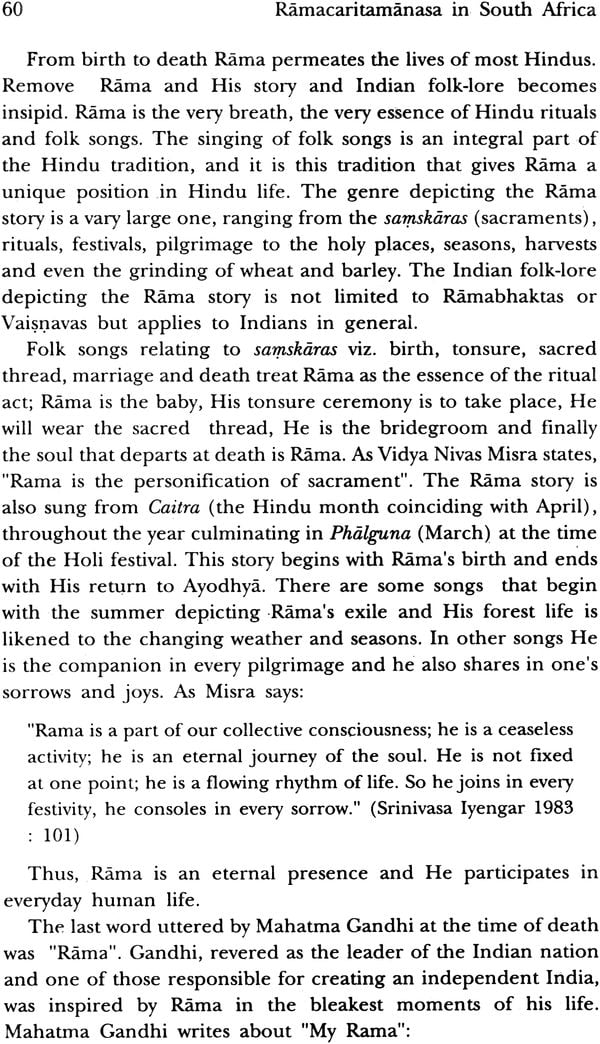
This book details the role of the Ramacaritamanasa in the lives of the Hindi-Speaking indentured labourers and their progency in South Africa: and their perceptions of Sri Rama and the Ramacaritamanasa. It emerges that the Ramacaritamanasa continues to fulfil Tulsidasa's aim of inculcating selfless devotion to Sri Rama as the Supreme. The social and political message of Tulsidasa also had gained tremendous acclaim.
The South African Hindus of Hindi-Speaking origin cherish the Ramacaritamanasa as scripture, and delve deep into the lake of Sri Rama's Act to gain solace and guidance. Its role as an agent of religio-cultural continuity amongst Hindi-Speaking Hindus Clearly indicates its importance in the year to come.
About the Author:
Usha Shukla was born and educated in Natal, South Africa. Her nurture in a culturally family and environment led her to study Hindi as one of her major subjects at the University of Durban Westville, South Africa. She soon joined the former Department of Indian Languages as Lecturer in Hindi; and obtained the M.A. and D. Lit. degrees in Hindi Literature.
Shukla's research into the Ramacaritamanasa in South Africa and the Hindi Diaspora opened many vistas of research and contact with Indians of indentured origin. This created greater enthusiasm for the propagation of Hindi; and in her academic and community -based work in this field, she has been hailed as one of the most successful teachers of Hindi in South Africa.
Her inspiring lectures and public addresses have done much to create new interest in the cultural sphere amongst Hindus in South Africa. She continues in her research and teaching programmes as Senior Lecturer in the School of Languages and Literature at the University of Durban Westville.
| Preface | VII |
| Acknowledgements | XIII |
| List of Tables | XXI |
| Scheme for Romanization of Words in Nagari | XXIII |
| Chapter One: Introduction | 1 |
| 1.1 Subject of Study: Perceptions of the Ramacaritamanasa of Gosvami Tulsidasa amongst Hindi-Speaking South Africans | 1 |
| 1.2 Scope | 2 |
| 1.3 Aims | 3 |
| 1.4 Methodology | 3 |
| 1.5 Some Problems | 4 |
| Chapter Two: The Evolution of the Rama Story and the Bhakti Movement | 7 |
| 2.1 The Origin of the Rama Story | 7 |
| 2.2.1 Valmiki | 10 |
| 2.2.2 The Ramayana | 10 |
| 2.3.1 Bhakti and its Origin | 15 |
| 2.3.2 The Bhakti Movement | 17 |
| 2.3.3 The Reformer Saints of The Bhakti Movements | 19 |
| 2.4.1 Ramanujacarya | 20 |
| 2.4.2 Ramananda | 22 |
| 2.4.3 Kabirdasa | 24 |
| Chapter Three: Gosvami Tulsidasa and the Ramacaritamanasa | 27 |
| 3.1 Childhood and Education | 27 |
| 3.1.1 Marriage | 29 |
| 3.1.2 Tulsidasa and the Ramacaritamanasa | 32 |
| 3.2 The Ramacaritamanasa | 35 |
| 3.3 The Religious Influence of Ramacaritamanasa | 37 |
| 3.3.1 Avatara | 41 |
| 3.2.2 Religious Harmony in the Ramacaritamanasa | 43 |
| 3.3.3 Conciliatory Attitude of Tulsidasa | 45 |
| 3.3.3.1 Vaisnavas and Saivites | 45 |
| 3.3.3.2 Questions Regarding the Divinity of Sri Rama | 46 |
| 3.3.3.3 Nirguna and Saguna Isvara | 48 |
| 3.3.3.4 Vrdanta: Jivatma - Paramatatma, Maya | 50 |
| 3.3.3.5 Karma | 51 |
| 3.3.3.6 Gunas | 52 |
| 3.3.3.7 Bhakti | 54 |
| 3.3.4 Impact of the Ramacaritamanasa 56 | |
| 3.3.5 Present Day Influence of the Ramacaritamanasa | 57 |
| 3.3.5.1 Worship | 57 |
| 3.3.5.2 Akhanda Kirtan at Janmasthana in Ayodhya | 61 |
| 3.3.5.3 "Ramayana" Video Series | 64 |
| 3.3.5.4 Festivals connected with Sri Rama and His Life | 65 |
| 3.4 Social and Political Influence of the Ramacaritamanasa | 66 |
| 3.4.1 Caste System | 70 |
| 3.4.2 The World | 72 |
| 3.4.3 Equality | 73 |
| 3.4.4 Status of Women | 74 |
| 3.4.5 Family Life | 76 |
| 3.4.6 The Asramas | 76 |
| 3.4.7 Characters | 78 |
| 3.4.7.1 Laksmana | 78 |
| 3.4.7.2 Bharata | 78 |
| 3.4.7.3 Hanuman | 79 |
| 3.4.8 Ramarajya - Perfect Rule of Sri Rama | 81 |
| 3.4.9 Social and Political Influence Today | 83 |
| 3.4.9.1 The "Ramayan" of Ramanand Sagar | 83 |
| 3.4.9.2 "Do or Die" Campaign | 84 |
| 3.5 Literary Influence of the Ramacaritamanasa | 86 |
| 3.5.1 The Epic - Mahakavya | 89 |
| 3.5.2 Dharma Grantha (Scripture) | 90 |
| 3.5.3 Form, Style, Literary Motifs of the Ramacaritamanasa | 90 |
| 3.5.4 Decorum (Maryada) | 92 |
| 3.5.5 The Impact of the Ramacaritamanasa on Literature | 94 |
| 3.5.5.1 Hindi Version of the Ramayana | 95 |
| 3.5.6 The Ramacaritamanasa Today | 99 |
| Chapter Four: The Ramacaritamanasa and The Early Settlers in South Africa | 103 |
| 4.1 Earl Period of the Indians in South Africa | 104 |
| 4.1.1 The Hindi Speaking Immigrants - Religious | 106 |
| 4.1.2 The Hindi Speaking Immigrants and the Ramacaritamanasa | 112 |
| 4.1.3 Literacy amongst the Hindi Speakers | 117 |
| 4.2 Perceptions of the Ramacaritamanasa amongst the Early Hindi Settlers | 120 |
| 4.3 The Establishment of Ramayana Sabhas | 124 |
| 4.3.1 The Shree Ramayan Sabha (SRS) of Overport | 128 |
| 4.3.2 Sri Luxmi Narayan Temple Ramayan Sabha | 129 |
| 4.3.3 Ramayana Sabhas in the Springfield Area | 130 |
| 4.3.4 Ramayana Sabhas in the Verulam Area | 131 |
| 4.3.5 Ramayana Sabhas in the Stanger Area | 131 |
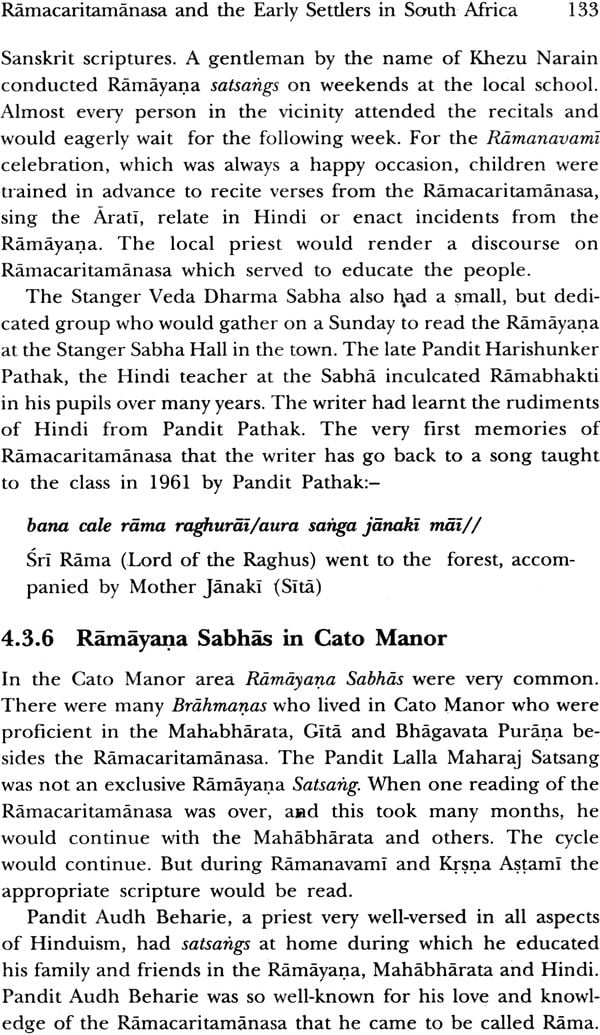
| 4.3.6 Ramayana Sabhas in the cato Manor | 133 |
| 4.4 Development in Perceptions of the Ramacaritamanasa | 135 |
| 4.5 Dislocation and Decline of Ramayana Sabhas | 138 |
| 4.5.1 Natural Causes | 138 |
| 4.5.2 Group Areas Act | 139 |
| 4.6 The Institutionalization of the Ramacaritamanasa | 141 |
| 4.7 The Ramayana in the 1980s | 143 |
| 4.7.1 The Ramayana Sabha | 143 |
| 4.7.2 Akhanda Ramayana | 145 |
| 4.8 Festivals in Honour of Rama | 146 |
| 4.8.1 Ramanavami | 146 |
| 4.8.2 Dipavali | 148 |
| 4.8.3 Hanuman Jayanti | 148 |
| 4.9 General Observations | 148 |
| Chapter Five: Present Day Present Day Perceptions of The Ramacaritamanasa | 151 |
| 5.1 General Information | 152 |
| 5.1.1 Hindi Education | 154 |
| 5.2 Religious Affiliation | 156 |
| 5.3 Satsang | 156 |
| 5.3.1 General Satsang | 156 |
| 5.3.2 Ramayana Satsang | 158 |
| 5.4 Ramayana and Personal Life | 162 |
| 5.5 Ramayana and Family Life and Social Life | 170 |
| 5.5.1 Family Life | 170 |
| 5.5.2 Social Life | 172 |
| 5.6 Knowledge of the Ramayana: Its Characters and Concepts | 173 |
| 5.6.1 Attitude to Sri Rama | 175 |
| 5.6.2 Attitude to Sita and Women in General | 176 |
| 5.6.3 Attitude to Sri Rama's Actions | 177 |
| 5.6.4 Attitude to Caste in the Ramayana | 179 |
| 5.6.5 Ramarajya - Ideal Government | 179 |
| 5.6.6 Likes and Dislikes about the Ramayana | 181 |
| 5.6.7 Ramayana as Religious and Moral Guide | 185 |
| 5.6.8 Feelings stirred through the Rama Story | 187 |
| 5.7.1 Worship | 188 |
| 5.7.2 Forms of Prayer | 190 |
| 5.7.3 Hanuman Worship | 192 |
| 5.7.4 Nirguna Rama and Saguna Rama | 193 |
| 5.7.5 Influence of Ramayana in Daily Life | 194 |
| 5.7.6 Adherence to Doctrines of Hinduism | 195 |
| 5.7.7 Summary of Findings | 196 |
| Chapter Six: Conclusion | 199 |
| Appendices | 203 |
| I. Hanuman Arati by Swami Ramananda | 205 |
| II. Invocation to Tulasidasa by Nandadasa | 207 |
| III. Eulogy of Tulsidasa and his Ramacaritamanasa by Suradasa | 209 |
| IV. Eulogy of Tulsidasa and his Ramacaritamanasa by Rasakhan | 211 |
| V. Sri Rama Bhajan by Pandit Ramnath Shukla | 213 |
| VI. Sri Ramayanaji Ki Arati by Gosvami Tulsidasa | 215 |
| Bibliography | 217 |
| Index | 223 |