

Record of All The Quranic and Non-Historical Epigraphs on The Protected Monuments in The Delhi Province
Book Specification
| Item Code: | NAL331 |
| Author: | Maulvi Muhammad Ashraf Husain |
| Publisher: | Archaeological Survey of India |
| Language: | English |
| Edition: | 1999 |
| Pages: | 159 |
| Cover: | Hardcover |
| Other Details | 10.5 inch x 8.5 inch |
| Weight | 710 gm |
Book Description
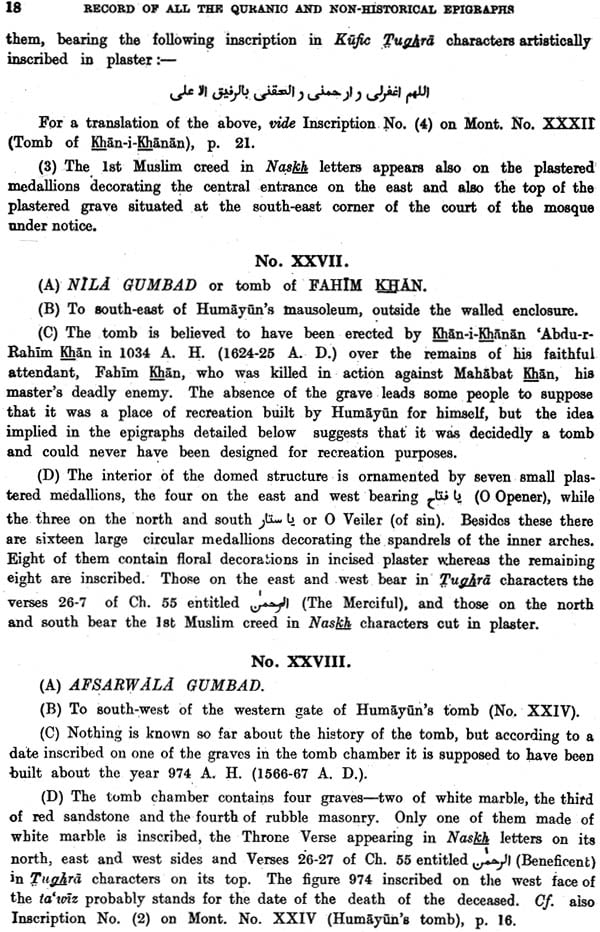
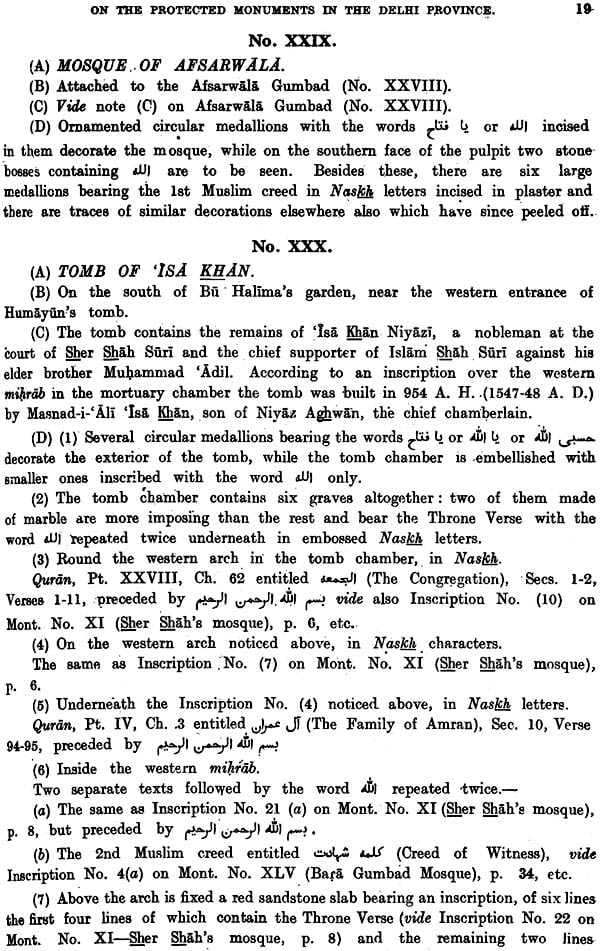
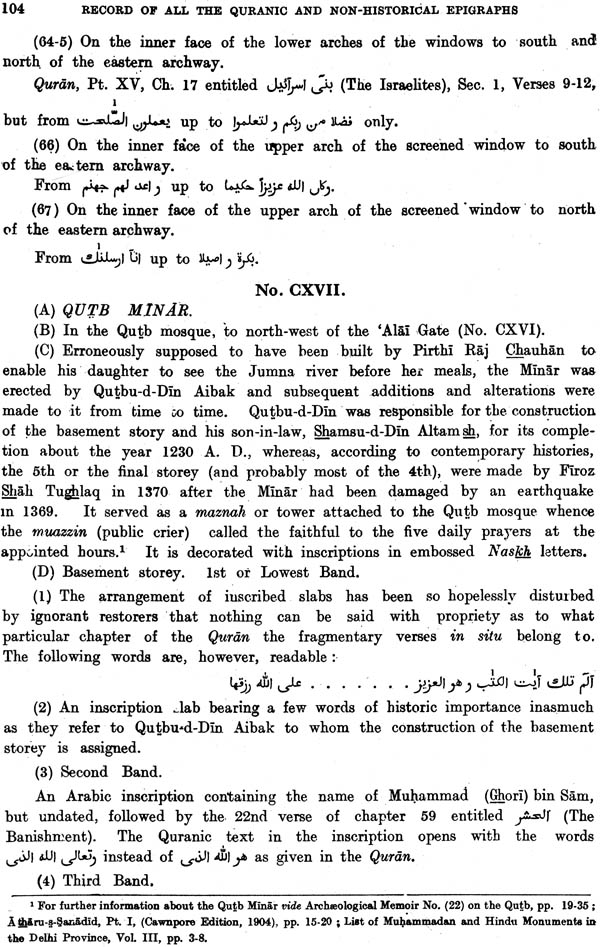
In this Memoir, which embodies all the non-historical epigraphs so far collected from the protected monuments in Delhi, “No” refers to the number of the monument, “A” the name of the monument, “B” the position of the monument, “c” a brief history of the monument and its founder, based chiefly on the original historical records, and “D” the inscriptions.
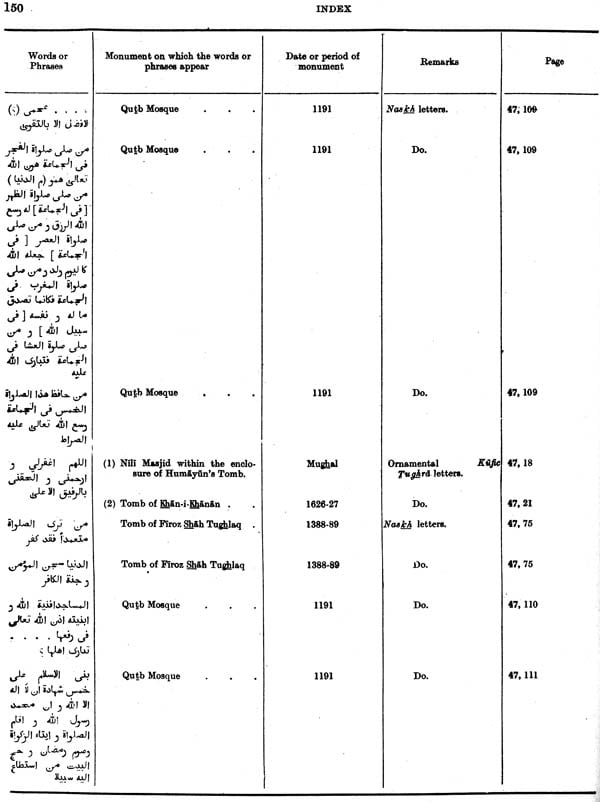
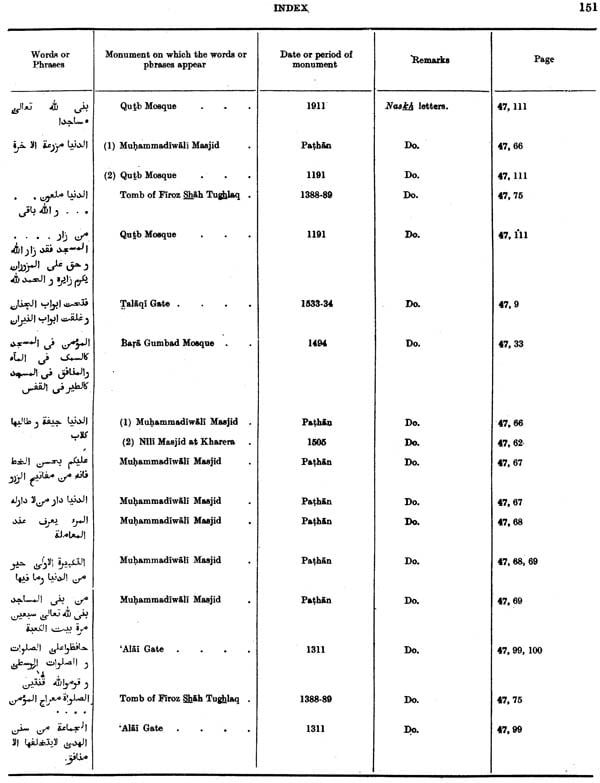
Starting from the Delhi Fort the monuments have been arranged so far as possible in a sequence decided by their position. The monuments have been numbered serially and the inscriptions on each monument then numbered afresh. The Memoir contains in all about 900 epigraphs. For every Quranic verse, tradition of the Prophet, prayer, or passage from standard books of Arabic or Persian literature, full references have been quoted in footnotes or in the body of the report, so as to enable those interested in epigraphy to check them with the original books, or to study them in the translation with reference to the context. The footnotes also contain critical and explanatory remarks and an exhaustive index has been appended to the Memoir for the convenience of the readers.
(a) The Muslim rulers of India loved to ornament their mosques and tombswith inscriptions consisting of Quranic texts, traditions of the Prophet, Muslim creeds, moral teachings and passages of a religious character from standard authors. The monuments of the Pathan period are more profusely decorated than those of the Mughal period. Under the Slave, Khalji and Llodi kings, and more particularly in the reigns of Altamsh, ‘Alu-d-Din Khalji and Sikandar Lodi, inscriptional decoration was the chief characteristic of a building. In stances of this are to be seen in several buildings, especially in monuments Nos. CXIX (tomb of Altamsh), CXVI (‘Alai Gate) and XLV(Bara Gumbad mosque)bearing about sixty, seventy and a hundred and thirty inscriptions respectively.
Quranic quotations-(b) In regard to the Quranic quotations the following texts are most often to be seen. It is difficult to decide which verses were meant exclusively for mosques and which for mosques and which for tombs as such a distinction does not seem to have been in the mind of the builders:-
(i) The Throne Verse or Ayatu-l-Kursi.
(ii) The ninetynine attributes of God preceded by verses 22-3 of chapter 59 entitled “Al-Hashr” (the Banishment).
(iii) Verses 17-8 and 25-6 of chapter 3 entitled “Al-i-‘Imran” (The Family of Amran).
(iv) Verses 285-6of chapter 2, entitled “Al-Baqarah” (The Cow).
(v) Chapters 1, 109, 113, 114 and several long quotations from chapters 17, 36, 48, 55, 62, 67, 71 and 73.
(vi) The 1st and 2nd Muslim creeds, entitled “Kalima-i-Taiyib” (Creed of Excellence) and “Kalima-i-shahadat” (Creed of Witness), particularly the 1st Kalima.
(vii) The words ‘Allah, ‘Ya Allah,’ ‘Ya Fattahu’ ‘Al-Mulkulillahi,’ ‘Subhanallah,’ ‘Hasbiyallahu.’
(c) On the gravestones also the ‘Throne verse’ and the 1st Muslim creed are frequently found, but on the graves of the later of the later Lodi and Mughal periods the phrase ‘Huwal Haiyu-l-lazi Ia yumutu’ (He is living, never to die), verse 26-7 of chapter 55 entitled “Ar-Rahman” (The Beneficent) and verses 53 of chapter 39 entitled “Azzumar” (The Companies) are often inscribed.
(d) The tombs of martyrs are mostly graced by verses 154-5 of chepter 2 entitled “Al-Baqarah” (The Cow), and verses 168-9 of chapter 3 entitled “Al-i-‘Imran” (The Family of Amran). A question may arise as to why these verses embellish the tomb of Mirza ‘Aziz Kokaltash (No. XXXIV) when it is a fact that he was never a martyr but died a natural death in 1033 A. H. (1623-4 A. D.). The reply in all probability is that he built his own tomb about the same time as that of his father Shamsu-d-Din Atgah Khan (No. XXXV) and the verses were carved under the impression that, like his fater, he might also be killed by the supporters of his father’s assassin Adham Khan, the youngest son of Akbar’s wet-nurse Maham Anagah.
(e) Among the religious inscriptions under the Pathan kings right up to the close of the Saiyid dynasty, the traditions of the Prophet formed a chief factor, and regard seems often to have been paid to the fact that only such traditions were inscribed on te mosques or tombs as were connected with their character, e.g., the divine bliss promised to those who erected a mosque or provided it with a lamp or a prayer carpet, etc. The monuments of Sikandar Lodi largely bear Quranic texts, but traditional epigraphs, though sparingly used, are not entirely wanting.
(f) The fact that most of the traditions of the Prophet which grace the monuments are no traceable in the six recognized books o f Hadith (vide foot notes) supports the common belief that the ‘Ilm-i-Hdith in India was system-atized early in the 11th century A. H. by Shah ‘Abdu-l-Haq Monuments, Dehlvi. Hence the authenticity of the traditions inscribed on the monuments, specially in regard to the exact words of the Prophet, cannot be guaranteed.
Scripts- (g) The study of various scripts in different periods is no less interesting. Of the Kufic and Naskh characters a number of varieties has been noticed they may be supposed to have their peculiar value in regard to historical research: the Kufic scripts, both plain and decorative, seem to have become less fashionable aiter the slave dynasty, for with a few exceptions all the Persian and Arabic epigraphs are to be found in various styles of Naskh only. A rare example of Kufic Tughra incised in plaster has, however, been discovered in monument No. XXXII(tomb of Khan-i-Khanan) where an appropriate text, viz., the Prophet’s last prayer on his deathbed, is recorded.
(h) Under the Mughals the (Naskh) Tughra style was prized most, and besides others the tomb of Atgah Khan bearing hymns in Arabic composed by a didactic author provides us with a well preserved specimen of it. The Nastalig lettering is the most modern of all scripts and is not traceable in inscriptions dating prior to 1530, the years of Humayun’s accession.
| Author's Introduction | 3 |
| Delhi Fort, Bridge No. (1) | 3 |
| Delhi Fort, Khwabgah | 3 |
| Delhi Fort, Muthamman Burj | 4 |
| Delhi Fort, Balcony | 4 |
| Delhi Fort, Dian-i-Khas | 4 |
| Delhi Fort, Bridge No. (2) | 5 |
| Jami' Masjid | 5 |
| Lal Darwaza or Kabuli Darwaza | 5 |
| Mwsque of Shai'kh Abdu-n-Nbi | 6 |
| Sher Shah's Mosque | 9 |
| Talaqi Gate | 9 |
| Bara Darwaza | 10 |
| Humayun Darwaza | 10 |
| Kahiru-l-Manazil Mosque | 10 |
| Mosque (Nameless) | 11 |
| Unknown Tomb known as Sundarwala Burj | 11 |
| Unknown Tomb known as Manhariwala Gumbad | 11 |
| Chhota Batashewala Mahal | 12 |
| Unknown Tomb known as Chhota Batashewala Gumbad | 13 |
| Lakkarwala Gumbad | 14 |
| Bara Batashewala Mahal | 14 |
| Nili Chatri | 15 |
| Sabz Burj | 15 |
| Humayun's Tomb | 17 |
| Tomb of the Barber | 17 |
| Nila Masjid in the enclosure of Humayun's tomb | 18 |
| Nila Gumbad or tomb of Fahim Khan | 18 |
| Afsarwala Gumbad | 19 |
| Mosque Afsarwala | 19 |
| Tomb of 'Isa Khan | 20 |
| Mosque of ' Isa Khan | 20 |
| Tomb of Khan -i-Khanan 'Abdur-Rahim Khan | 21 |
| Kali Masjid or Sanjar Masjid | 21 |
| Chaunsath Khamba | 23 |
| Tom of Atgah Khan | 26 |
| Eastern Gateway to the enclosute of Amir Khusru's tomb | 26 |
| Tomb of Hazrat Amir Khusru | 27 |
| Tomb of Jahanara Begam | 28 |
| Tomb of Emperor Muhammad Shah | 29 |
| Tomb of Mirza Jahangir | 30 |
| Barah Khamba | 31 |
| Tomb of Muhammad Shah or Mubarak Khan -ka -Gumbad | 31 |
| Bara Gumbad | 32 |
| Bara Gumbad Mosque or the Jami 'Masjid of Sikandar Lodi | 33 |
| Shish Gumbad | 47 |
| Tomb of Sikandar Lodi | 47 |
| Mosque of Basti | 48 |
| Tomb of Basti | 48 |
| Gateway to the enclosur containing the Mosque, Tomb and Baoli of Basti | 49 |
| Masjid Ugar Sen | 49 |
| Tomb of Safdar Jang | 49 |
| Tomb of Najaf Khan | 50 |
| Tomb of Darya Khan | 50 |
| Bare Khan-ka-Gumbad | 51 |
| Chhote Khan-ka-Gumbad | 56 |
| Kale Khan-ka-Gumbad | 56 |
| Tomb of Mubarak Shah | 59 |
| Masjid Mubarakpur Kotla | 60 |
| Bhure Khan-ka-Ghasiwala Gumbad | 60 |
| Dhaura Gumbad | 60 |
| Kala Gumbad | 60 |
| Moth-ki-Masjid | 62 |
| Nili Masjid | 63 |
| Idgah | 64 |
| City wall of Siri | 64 |
| Mosque of Makhdum Sahib | 64 |
| Unknown Tomb or a Domed Pavilion | 65 |
| Muhammadiwali Masjid | 69 |
| Tomb of Shaikh Kabiru-d-Din Auliya Know as Rikabwala Gumbad or Llal Gumbad | 70 |
| Tomb of Hazrat Yusuf Qattal | 70 |
| Unknown Grve to east of the tomb of Hazrat Yusuf Qattal | 70 |
| Tomb of Bahlol Lodi | 72 |
| Tomb of Zafar Khan or Dad Khan | 74 |
| Biwi or Dadi-ka-Gumbad | 74 |
| Tomb of Firoz Shah Tughlaq | 76 |
| Firoz Shah's College | 77 |
| Grave of Yusuf bin Jamal | 77 |
| Chhatri No. (1) to east of the tomb of Firoz Shah in the same emclosure | 77 |
| Chhatri No. (2) to north of Chhatri no. (1) noticed above | 78 |
| Chhatri No. (3) opposite the main entrance to the enclosure of Firoz Shah's tomb | 78 |
| Chhatri No. (4) to north-west of the old gate to the enclosure of Firoz Shah's tomb | 78 |
| Chhatri No. (5) to north of Chhatri No.(4) noticed above | 78 |
| Old Cemetery to east of the old gate to the enclosure of Firoz Shah's tomb | 78 |
| Bagh-i-Alam-ka-Gumbad | 79 |
| Tin Burjiwala Gumbad | 80 |
| Unnamed Gumbad in village Muhammadpur | 81 |
| Wazirpur-ka-Gumbad | 81 |
| Unnamed Tomb to south-east of Wazirpur-ka-Gumbad | 81 |
| Unnamed Tomb to west of Wazirpur-ka-Gumbad | 81 |
| Unnamed Mosque to south-west of Wazirpur-ka-Gumbad | 82 |
| Parlegaonwala Gumbad | 82 |
| Unnemed Tomb known as Chhota Munirka-ka-Gumbad | 82 |
| Unnamed Mosque in village Munirka | 83 |
| Attewala Gumbad | 83 |
| Masjid Kalu Sarai | 84 |
| Begampuri Mosque | 84 |
| Tomb of Adham Khan | 84 |
| Mosque at the Rajon-ki-Bain | 85 |
| Chhatri at the Rajon-ki-Bain | 86 |
| Grave of Sha 'Alam II | 87 |
| Grave of Akbar Shah II | 88 |
| Grave of Shahabadi Begam | 88 |
| Hujra now called Tosha Khana | 88 |
| Lal Mahal or the Palace of Bhahdur Shah | 89 |
| Jahaz Mahal | 89 |
| Tomb of Sultan Ghari | 89 |
| Mosque attached to tomb of Sultan Ghari | 90 |
| Mosque known as Mandiwali Masjid | 91 |
| Tomb of Jamali | 92 |
| Unknwn Grave known as Chhatri | 94 |
| Mosque of Jamali Kamali | 94 |
| Tomb of Muhammad Quli Khan known as Metcalfe House | 95 |
| Tomb of Imam Zamin | 96 |
| Alai Gate | 96 |
| Qutb Minar | 104 |
| Qutb Mosque or Masjid Quwatu-l-Islam | 106 |
| Tomb of Altamsh | 114 |
| Tripolia | 119 |
| Qudsiya Bagh Mosque | 119 |
| Pirghaib | 120 |
| Tomb of Makhdum Shah 'Alam | 120 |
| Mosque to west of the tomb of Makhdum Shah 'Alam | 120 |