

Hidden Wealth- The Strategy of Foraging Farmers in the Upper Arun Valley, Eastern Nepal
Book Specification
| Item Code: | UAT717 |
| Author: | Ephrosine Daniggelis |
| Publisher: | Mandala Book Point, Nepal |
| Language: | English |
| Edition: | 1997 |
| ISBN: | 9789993310099 |
| Pages: | 274 (Throughout B/w Illustrations) |
| Cover: | HARDCOVER |
| Other Details | 10.00 X 7.00 inch |
| Weight | 670 gm |
Book Description
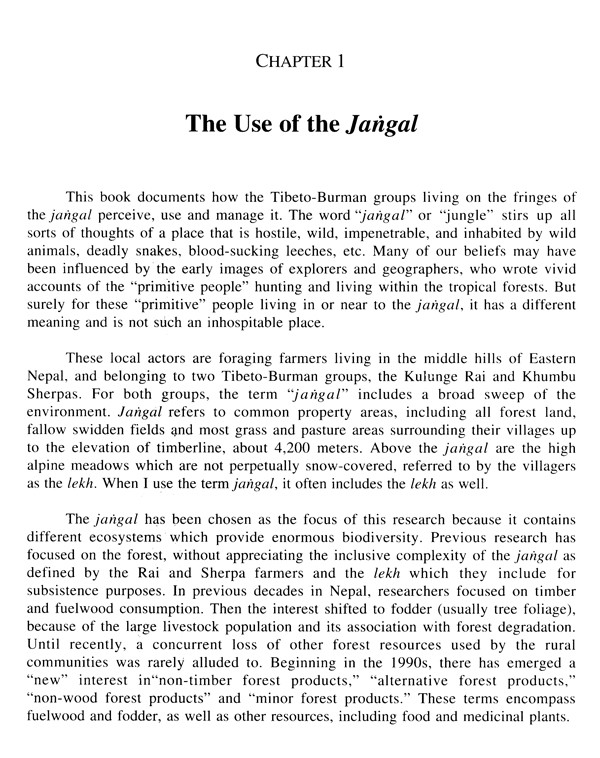
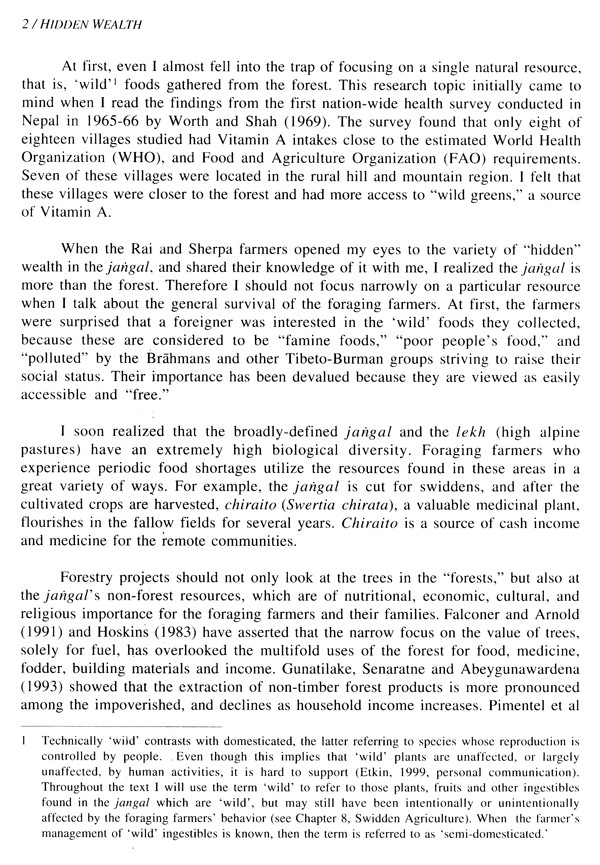
The Jangal provides an economic buffer by allowing swidden cultivation and the trade in chiraito (a medicinal plant) to alleviate the impact of food scarcity peri ods. Traditional swiddens increase, rather than degrade, biodiversity. Oral history links 'wild' tubers to Rai cultural identity. 'Wild' tubers are nutritionally rich, but are devalued by outsiders. Women depend on the gathering of such ingestibles to provide staples and micro-nutrients for their household food security. "Wild greens are often held in disdain by groups hoping to improve their social status. These groups often suffer from nutritional deficiencies as a result. The fact that the jangal contains sacred forests and many deities helps ensure that the Rais and Sherpas will carefully protect its resources.
This study used an integrated approach to look at the non-farm environment as the ultimate polycrop system. This environment has high diversity and is a repos itory of many valuable nutritional, medicinal, economic (subsistence and cash), reli gious and cultural major resources. External agencies often see resources of the jangal as minor and miss its wealth. The changing of boundaries by the government has threatened the farmers' access to common property resources. If the jangal's diversity is to be protected and the people's use of it assured, co-operation between the government and the local people is essential.
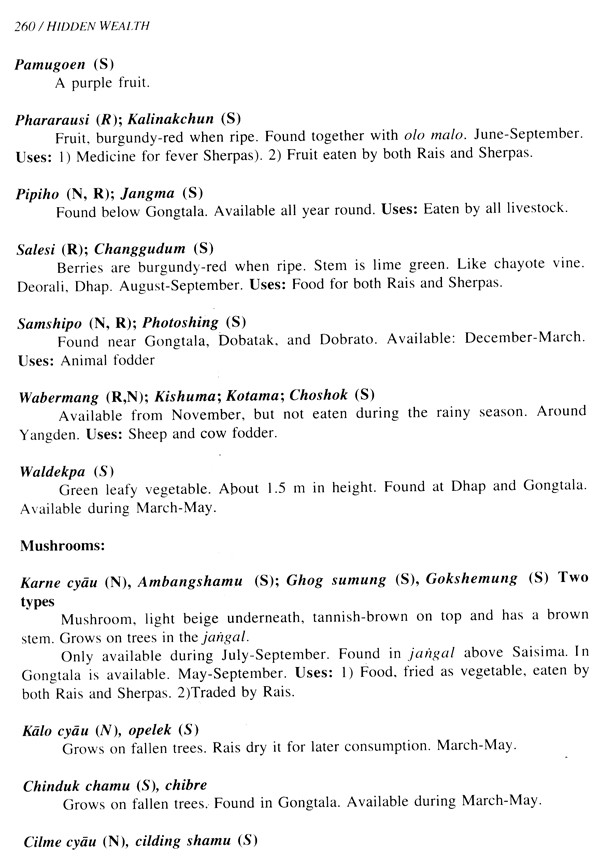
All Nepali words have been transliterated following the method of R.L.. Turner (1980), and with the assistance of Gregory Maskarinec. Sherpa, Tibetan and Rai words will be identified by the letters "S", "T", and "R" respectively. Tibetan spellings for Sherpa words, when equivalents could be found, have been transliterated by Tinley Dhondup.
Ephrosine Daniggelis spent twenty months living and working among the Rai and Sherpa communities of the upper Apsuwa Valley, learning from them about their sustainable uses of the jangal, a mosaic of natural forests and agricultural fields in a little known part o Nepal. Her work is a landmark in furthering our understanding of the complex survival strategies of mountain people. Understanding how local people value and manage their own natural resources is the first step in designing new models of sustainable resources management something that. The Mountain Institute is committed to and has been doing for almost 30 years in the Himalaya, the Andes and the Appalachian ranges.
It is a pleasure for The Mountain Institute to co-publish this work, which adds importantly to learning about sustainability strategies in mountains. The research was supported by the Makalu Barun Conservation Project, an innovative project of HMG Nepal and The Mountain Institute to help local people manage and protect a globally significant natural treasure just east of the Mount Everest eco-system. The Mountain Institute has been working with the government of Nepal and especially with local people to help document these important indigenous knowledge systems. It is our hope that disseminating this knowledge will help conserve these and other biologically rich mountain areas, while creating opportunities for mountain people to earn sustainable livelihoods.
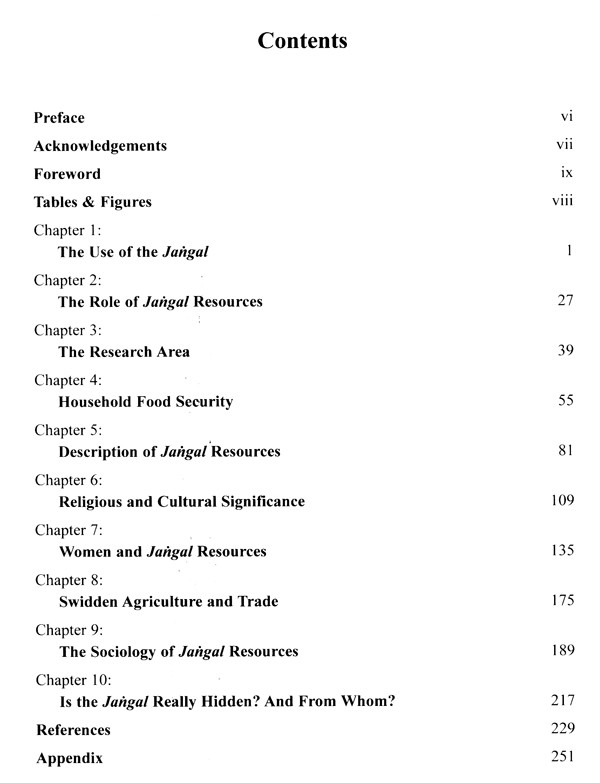
**Contents and Sample Pages**