

Hindi For Non-Hindi Speaking People
Book Specification
| Item Code: | IDI763 |
| Author: | Kavita Kumar |
| Publisher: | Rupa Publication Pvt. Ltd. |
| Language: | hindi |
| Edition: | 2019 |
| ISBN: | 9788171673506 |
| Pages: | 411 |
| Cover: | Paperback |
| Other Details | 8.1" X 5.1 |
| Weight | 460 gm |
Book Description
Back Of The Book
Hindi for Non-Hindi Speaking People is an original two-in-one monograph that covers grammar and is a reader for beginners. The book has virtually sprung from Kavita Kumar's long experience of teaching Hindi to foreign students of several nationalities. It can be used both as a classroom text and for self study. It is designed to meet the needs of the novice, taking him/her gradually to intermediate and upper-intermediate levels of proficiency. The book can be gainfully used even by fairly advanced students who, nevertheless, still sometimes make grammatical mistakes in speech and writing.
The book is a complete course in an easy-to-follow style comprising of a series of meticulously arranged and graded lesions (units). A complete course in spoken and written Hindi - a practical course that is both fun and easily comprehensible. A journey to the Hindi alphabet, its vowels, consonants, conjunct letters and phonetic transliteration, through the sections of practice reading tailored to fit interesting and practical daily life situations in India. She explains everything clearly along the way with many opportunities to practice what you learn, gives exercises of reading based on rules explained earlier in the text, lists of antonyms and synonyms, sound words and phrases, and idioms and essentials of grammar dealt with a minimum of jargon.
The book fulfills a long-felt need for reference Hindi grammar for non Hindi-speaking people in or outside the country.
Kavita Kumar was born in November 1936 in Rawalpindi (now in Pakistan). A Master's degree holder from Delhi University, she taught at Directorate of Correspondence Courses, Delhi University; Lady Irwin College, Delhi; Degree College, Panipat; Janaki Devi College, Delhi and Government Girls College, Gorakhpur. She has also taught Hindi to students from England, USA, Germany, Sweden, Norway, France, Switzerland, Japan, Korea and Thailand.
She is married and lives in Varanasi. She has two daughters.
Preface
Having been engaged for over a decade in teaching Hindi to foreign students of several nationalities, I was concerned at the lack of a satisfactory text which would fully meet a student's requirements. I have attempted to design these lessons with a view to introduce the readers to vowels, consonants, phonetic transliteration and speech patterns, in an easy-to-follow, readable style. Grammar structures have been explained first and are then followed by reading and comprehension passages. Glossaries and exercises have been given to enable the learners to assess their performance from time to time.
Situational dialogues have been included in order to enhance the utility of the book for tourists and other visitors to India. The dialogues should equip the reader to cope with routine tasks happening in daily life.
The English translation of Hindi structures may, in some cases, be found to be not very precise or accurate by English speaking people. I am conscious of this anomaly which arises form the inherent bilingual organization; the accuracy has had to be occasionally sacrificed with a view to teaching good Hindi for which a word-for-word translation was considered essential, and which may not exactly be the same as a native speaker might use.
Because of differences in syntax and speech patterns between Hindi and various foreign languages, I have ad to respond to a variety of queries, questions, and doubts from my students; this kind of interaction has been a strong motivation and driving force for undertaking and completing this venture. I have had the good fortune of interacting with a number of discerning, critical, and enthusiastic students, some of whom have themselves been involved in teaching their own native language as a foreign language in other countries; they have read portions of the manuscript and given valuable comments, criticisms, and suggestions, which I greatly value. In fact, the teaching plan incorporated in this book has been successfully tested and as enabled many students, without any prior knowledge of Hindi, to learn to read, write and speak the language fairly fluently.
Apart from my former and present students to whom I am greatly indebted, I wish to thank Mr. Kamal Malik of the Affiliated East West Press Pvt. Ltd., New Delhi, and the editorial staff of Rupa and Company, for their helpful discussions, advice, and encouragement. Gyanendra Prasad Shukla deserves special mention for typing both Hindi and English scripts.
Any comments or suggestions for improvement of the text will be greatly appreciated.
Hindi uses the Devanagri script of Sanskrit, believed to be a divine language. Its alphabet is arranged in a fascinating, scientific order, beginning with the velars, moving forward through the prepalatals, palatals and dentals to the labials. Each row has five consonants produced in distinctly separate regions of the mouth, again very scientifically arranged; the aspirates following the non-aspirates, ending in nasal consonants, thus giving a soothing rest to the learner.
Devanagri script is written from left to right. There are no capital letters.
Being a phonetic language it has no pronunciation ambiguities. There are no silent letters. The language is almost read the way it is written.
Indian perception of life in every object is imbibed in the language; hence only two genders, masculine and feminine are recognized grammatically. The native speakers grow up with the language and learn the genders naturally without any special effort. Foreign students are advised to learn the gender with every new noun-word. The sound of a word is the master key initiating the intuitive lead to accurate gender-determination.
During my years of teaching the Hindi language to foreign students, particularly from European countries and America, I have often noticed the difficulties caused by several constructions where the subject is followed by (ko), the causative verbs as well as the use of the same word (kal) for tomorrow as well as yesterday.
Language is after all a mirror reflecting the culture, religion, philosophy and social structure of a country. The basic Hindu belief admitting the supremacy and omnipotence of the creator of the universe, accepting Him as the doer of all activity and assuming for the people a very humble passive role as recipients of His grace or wrath is reflected in the language. Instead of the subject in the nominative case, language constructions with the dative case of the subject (i.e. subject followed by ) are found in plenty; the underlying concept is that the subject is not actively doing the action but things are actually happening to him. For instance while an English language speaker says, 'I am hungry.', 'I hurt myself.', or 'I like it', the corresponding constructions by a Hindi language speaker are 'mujhko bhOkh lagT hai ., 'mujhko cot lagi hai' etc., meaning respectively 'To me hunger is.', 'To me injury is.', or 'To me it pleasing is.'
The profuse use as well as availability of the causative verbs does not sound strange in a society like ours with ages'-Iong, deeply-ingrained caste structure where a class of people has been recognized as mainly existing for providing service to those higher up in the caste hierarchy - without any guilty conscience perhaps! Naturally the native speakers did not consider it worth their effort to devise any syntactic formation to express the meaning of having something done by somebody; instead they learnt dexterously to form causative verb roots by a quick morphological process, in fixing between the transitive or intransitive verb roots and their (na) endings.
Our impressions of the Time as an eternally revolving wheel without any beginning or end never presented any justification for the use of two distinctly separate words for the time past or immediately following the present The verb endings are enough of a clue to help the smooth functioning of our worldly business.
Students will certainly come across several similar constructions while learning the language. However, if interpreted and understood in the religio socio-philosophical background as briefly explained above, they are easily comprehended and mastered.
| Preface | ||
| Abbreviations | ||
| Unit | ||
| Introduction | 1 | |
| 1 | Hindi Alphabets | |
| Vowels | 3 | |
| Consonants | 4 | |
| Nasal vowels | 5 | |
| Use of 'candrabindu' | 5 | |
| Nasal consonants | 5 | |
| Use of 'anuswar' | 5 | |
| Modified letters from the Persian Language | 7 | |
| Syllabic, intrasyllabic use of the vowels | 7 | |
| Visarga | 8 | |
| Guidelines for pronunciation | 8 | |
| Vocabulary -1 : Adverbs, adjectives | 9 | |
| Consonants and intrasyllabic forms of vowels written together | 10 | |
| Conjunct letters | 11 | |
| Names of days | 12 | |
| 2 | Pronouns: Nominative case - 1 | 13 |
| Pronouns : Oblique case | 14 | |
| Simple postpositions | 14 | |
| 3 | Verbs of being | 15 |
| Vocabulary - 2: Adverbs | 17 | |
| Vocabulary - 3: Verbs | 18 | |
| 4 | Present Simple | 19-24 |
| Language structures and models | 19-20 | |
| Uses of the present Indefinite tense in Hindi | 21 | |
| Reading - 1; Reading - 2 | 22-24 | |
| 5 | Past Habitual | 25-27 |
| Language structures and models | 25-28 | |
| Compare and comprehend | 27 | |
| 6 | Imperative | 28-31 |
| Language structures | 28-30 | |
| Uses of Imperative | 31 | |
| 7 | Compound postpositions | 32-36 |
| Use of | 36 | |
| Comprehension - 1; Comprehension - 2 | 34-36 | |
| Use of as adverbs | 36 | |
| 8 | To have | 37 |
| Inanimate objects | 38 | |
| 9 | Present and past progressive tenses | 39-40 |
| Language structures | 39 | |
| Examples | 40 | |
| 10 | Present and past perfect continuous tenses | 41-42 |
| Language structures | 41 | |
| Examples | 42 | |
| 11 | Past simple present perfect and past perfect tenses | 43-54 |
| Nominative case -2 | 43 | |
| Changing the verb infinitive to past participle | 44 | |
| Language structures: past simple, present perfect, past perfect | 45-48 | |
| Examples : Past simple, present perfect, past perfect tense | 48-51 | |
| Uses of past simple tense | 52 | |
| Uses of past perfect tense | 52 | |
| Uses of present perfect tense | 53 | |
| 12 | Future simple tense | 55 |
| Language structures: 1 Future simple | 55 | |
| Future continuous tense | 57 | |
| Future perfect tense-1; Future perfect tense-2 | 58 | |
| 13 | Presumptive language structures | 59-62 |
| Language structures | 59-61 | |
| Examples | 61-62 | |
| 14 | Use of the verbs | 63-65 |
| English equivalent 'have already + PP' | ||
| 15 | (To like) | 66 |
| (To like) | 67 | |
| (To like) | 68 | |
| 16 | Use of 'v. r.'- As soon as | 69 |
| Use of - As soon as | 71 | |
| Use of 'v. r. No sooner than | 72 | |
| 17 | Ability structure - can, could, be able to | 73-77 |
| Language structures | 73-75 | |
| Uses of | 76 | |
| Use of the verb | 77 | |
| 18 | Probability - Use of | 78-82 |
| Language structures | 79-80 | |
| Examples: Present, past, future | 80-82 | |
| 19 | Planned future: 'X' | 83-85 |
| 20 | Apprehensions | 86 |
| 21 | Use of - want | 87-90 |
| 22 | Use of present and past participle constructions | 91-96 |
| 23 | Use of the suffix | 97-101 |
| 24 | Use o the absolutive participle; - conjunct | 102-104 |
| 25 | Continuative compound: 'v. r. 'keep on v ing' | 105-109 |
| 26 | Possessive case | 110-112 |
| 27 | Compulsion compounds : Use of | 113-116 |
| Language structures expressing probability and compulsion | 117-118 | |
| Use of to express need or desire | 119-121 | |
| 28 | Inceptive compound: 'v. r. | 122-124 |
| 29 | Permissive compound 'v. r.' | 125-131 |
| 30 | Conditionals: use of | 132-135 |
| 31 | Expressing wishes: use of | 136-137 |
| 32 | 'X' / 'X' | 138-142 |
| To be used to doing something | ||
| 33 | Verbs | 143-165 |
| Verb agreement | 143 | |
| Intransitive and transitive verbs | 144 | |
| Causative - 1: Causative -2 | 144-155 | |
| Compound verbs | 156-159 | |
| Conjunct verbs | 159-161 | |
| Sense verbs | 162-163 | |
| Sound verbs | 163-164 | |
| Nominal verbs | 165 | |
| 34 | Passive voice | 166-178 |
| 35 | Nouns | 179-192 |
| Gender | 179-184 | |
| Cases | 185 | |
| Number | 186 | |
| Declension of the noun | 186-191 | |
| Use of infinitive as noun | 192 | |
| 36 | Pronouns | 194-201 |
| Personal pronouns | 194-195 | |
| Definite pronouns; Indefinite pronouns | 195-200 | |
| Interrogative pronouns | 200-203 | |
| Relative pronouns | 204-205 | |
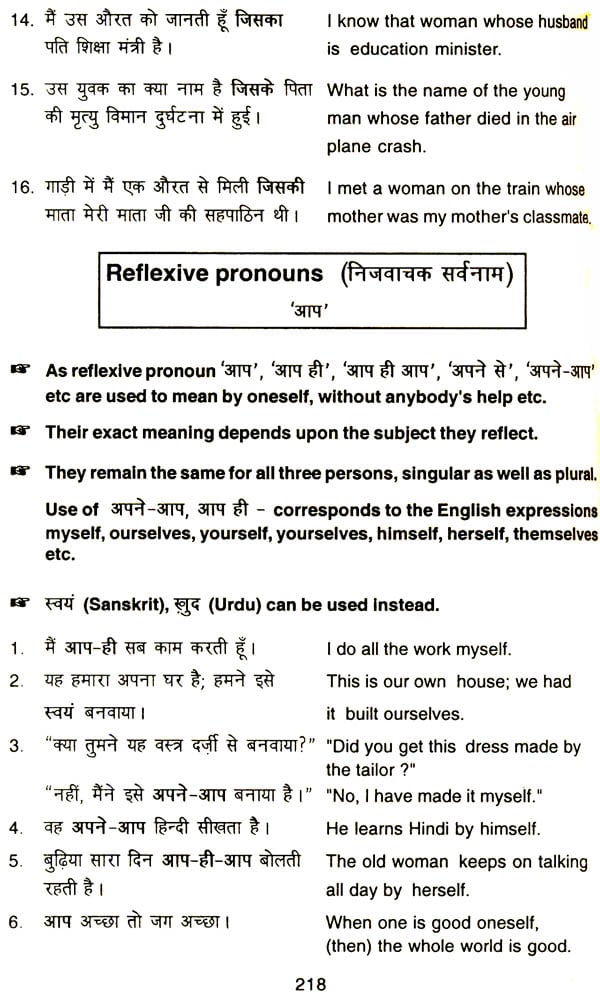
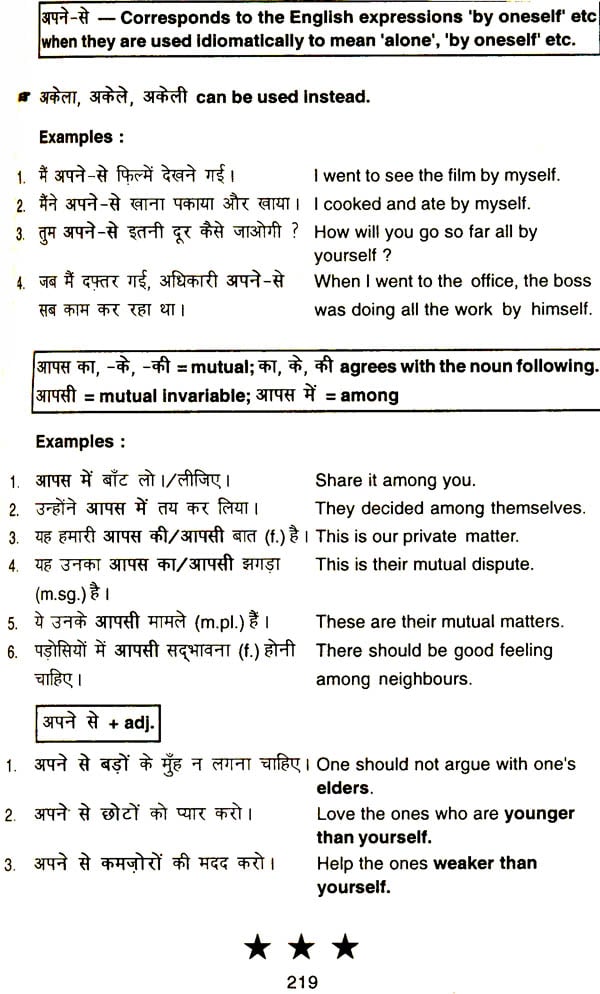
| Reflexive pronouns | 205-207 | |
| 37 | Adjectives | 208-226 |
| Pronominal adjectives | 208-211 | |
| Adjectives of quality | 211-213 | |
| Adjectives : base from, comparatives, superlatives | 214-218 | |
| Declinable adjectives; Indeclinable adjectives | 218-220 | |
| Adjectives of number: cardinals; ordinals | 221-222 | |
| Multiplicatives; Aggregatives; Fractions | 223-224 | |
| Distributive adjectives | 225 | |
| Indefinite quantity adjectives | 225-226 | |
| Participles used as adjectives | 226 | |
| 38 | Adverbs | 227-232 |
| Classification | 227-229 | |
| Adverbial usages | 230-232 | |
| Participles used as adverbs | 232 | |
| 39 | Use of postpositions | 233-246 |
| Use of | 233 | |
| Use of | 233-237 | |
| Use of | 237-240 | |
| Use of | 240-242 | |
| Use of | 242-244 | |
| Use of | 244-246 | |
| 40 | Time expressions | 247-253 |
| What time is it ? How long does it take | 247-248 | |
| Use of time expression etc. | 249-253 | |
| 41 | Usages | 254-281 |
| When else, what else etc. | 254 | |
| God knows | 254 | |
| Echo words | 255 | |
| Uses of | 256 | |
| Uses of | 257-258 | |
| Use of 'or else' 'Not even' | 259 | |
| Use of (only) | 260 | |
| Use of (also) | 261 | |
| Use of (purpose clause); (reason clause) | 261 | |
| (neither nor) | 262 | |
| Use of (either or) | 263 | |
| (although - concessive clause) | 261 | |
| (After all), (certainly) | 264 | |
| (not at all); (of course) | 265 | |
| Use of (without); (even if) | 266 | |
| (because of) | 267 | |
| (instead of); | 268 | |
| (much more than) | 268 | |
| conditional; (on the contrary) | 269 | |
| (introductory use); (somehow) | 270 | |
| (as soon as) | 271 | |
| (progressive) | 271 | |
| (exactly the same as before) | 272 | |
| 'X' 'X' 'X' (not to speak of X) | 72 | |
| (for a long time); | 273 | |
| (for no reason or purpose) | 273 | |
| 'X' 'X' - nothing but 'X' | 274 | |
| 'X' - 'Y' (whether X or Y) | 274 | |
| 'X'- 'Y' (whether X or Y) | 274 | |
| (hardly) | 274 | |
| (come what may); | 275 | |
| (Do what you like) | 275 | |
| (in spite of) | 276 | |
| (v. r.) + (v. r.) + (it almost happened) | 276 | |
| (in no time) | 276 | |
| Reduplicative expressions | 277 | |
| Use of | 278 | |
| Relative adverbs: | 278 | |
| Relative pronouns: | 279 | |
| Use of some abstract nouns and their adjectival forms | 280 | |
| (to be visible); (to be audible) | 281 | |
| 42 | Compare and comprehend | 282-294 |
| Use of stative verbs, change of state verbs | 282 | |
| Use of | 282 | |
| Use of | 283 | |
| Use of | 284 | |
| More on pres. Cont. tense | 285 | |
| Use of | 287 | |
| Use of | 288 | |
| Use of | 290 | |
| Use of | 291 | |
| Use of IPC. PPC | 292 | |
| Use of -emphatic | 293 | |
| 43 | imperatives and exclamations | 294 |
| 44 | Punctuation | 295 |
| 45 | Antonyms | 296-297 |
| 46 | Synonyms | 298-300 |
| 47 | Sound words | 301 |
| 48 | Idioms | 303-311 |
| 49 | Proverbs | 312-313 |
| 50 | READINGS | Page |
| R-1 | Pres. Simple | 314 |
| R-2 | Imperative | 317 |
| R-3 | Pres. Prog. tense | 318 |
| R-4 | Pres. Prog. tense | 319 |
| R-5 | Recapitulation | 321 |
| R-6 | Past progressive | 322 |
| R-7 | Possessive case | 323 |
| Vocabulary: Blood relations | 324 | |
| R-8 | Time | 325 |
| R-9 | Past tense | 326 |
| R-10 | Past tense | 328 |
| R-11 | Miscellaneous | 330 |
| R-12 | {Press. Perf.} | 331 |
| R-13 | {Press. Perf. Cont.} | 332 |
| R-14 | Can, Could | 333 |
| R-15 | Can, Could | 334 |
| R-16 | Fut. tense | 336 |
| Vocabulary: Planets, zodiac signs | 337 | |
| R-17 | Planned fut. | 338 |
| R-18 | PPC; IPC | 339 |
| R-19 | Cont. comp. | 343 |
| R-20 | Prog. Comp. | 346 |
| R-21 | Adjectives | 348 |
| R-22 | Adjectives | 350 |
| R-23 | Adjectives | 352 |
| R-24 | Letter | 354 |
| R-25 | Letter | 356 |
| R-26 | Letter | 358 |
| Recipes | 361-362 | |
| Vocabulary: fats, grains, species, cooking | 362-365 | |
| 51 | EVERYDAY EXPRESSIONS | |
| EE-1 | 366 | |
| EE-2 | 367 | |
| 367 | ||
| EE-3 | Hiring a rickshaw | 368 |
| Appointment | 368 | |
| EE-4 | Hospitality | 369 |
| EE-5 | Asking directions | 370 |
| 371 | ||
| EE-6 | 1 Changing money | 373 |
| 2 Opening an account | 374 | |
| 3 Encashing Traveller's cheques | 375 | |
| EE-7 | Consulting the doctor | 376 |
| Vocabulary: body parts | 377 | |
| Buying medicine | 378 | |
| Buying medicine | 379 | |
| EE-8 | 1 Buying envelopes, stamps | 380 |
| 2 Sending parcels abroad | 381 | |
| EE-9 | Buying vegetables | 384 |
| Vocabulary: vegetables | 385 | |
| EE-10 | Buying fruit | 386 |
| Vocabulary: Fruit | 387 | |
| EE-11 | Dialogue - marriage in India | 388 |
| EE-12 | 1 Railway station | 391 |
| 2 Railway -information | 391 | |
| 13 | Weather | 394 |
| Appendix - 1 Hindu calendar months, dates; mathematical calculations | ||
| Appendix - 2 (Sandhi), (compound words) | ||
| Glossary Of Grammar Terms | ||
| Index - English | ||
| Index - Hindi |