![Sadhana [A Text Book of the Psychology and Practice of the Techniques to Spiritual Perfection]](http://occultnthings.com/cdn/shop/products/idk191_{width}x.jpg?v=1677771203)
![Sadhana [A Text Book of the Psychology and Practice of the Techniques to Spiritual Perfection]](http://occultnthings.com/cdn/shop/products/idk191_580x.jpg?v=1677771203)
Sadhana [A Text Book of the Psychology and Practice of the Techniques to Spiritual Perfection]
Book Specification
| Item Code: | IDK191 |
| Author: | Swami Sivananda |
| Publisher: | THE DIVINE LIFE SOCIETY |
| Language: | English |
| Edition: | 2019 |
| ISBN: | 8170520037 |
| Pages: | 752 |
| Cover: | Hardcover |
| Other Details | 8.7 X 5.7" |
| Weight | 930 gm |
Book Description
Om Salutations to that adorable Lord Hari, than Whom there is nothing greater, and Who is above all this universe.
The term "Sadhana" comes from the root "Sadh," which means to "exert," "to endeavour to get a particular result or Siddhi." He who does th practices or attempts is called a Sadhaka. If he achieves the desired result, Siddhi, he is called Siddha. A fully-developed siddha is one who has attained full knowledge of Brahman. Self-realisation or Darshan of God is not possible without Sadhana. Any Spiritual practice is called Sadhana is obtained through Sadhana is Sadhya or Goal the realisation of God or Brahman. Most comprehensive in its scope, this book presents almost every known form of Sadhana for the Experience of the Divine of Brahman.
If you want to evolve quickly you must have the right kind of Sadhana. If you are a student of the path of Self-reliance, you can yourself select the Sadhana for your daily Practice. If you are a student of the path of self-surrender, you should get the right kind of Sadhana from a Guru and practise the same with intense faith. < P> Why should you prolong the bondage unnecessarily? Why should you not claim your divine birthright right now? Why should you not break you bondage now? Delay means prolongation of your sufferings. You can break it at any moment. This is in our power. Do it now. Stand up. Gird up your loins. Do rigorous and vigorous Sadhana and attain freedom, which is immortality or eternal bliss.
Make the lower nature the servant of the higher through discipline, Tapas, self-restraint and meditation. This is the beginning of your freedom.
The divine within you is stronger than anything that is without you. Therefore, be not afraid of anything. Rely on your own Inner Self the Divinity within you. Tap the source through looking within.
Without renunciation you can never be happy. Without renunciation you can never be at your ease. Therefore renounce everything. Make happiness your own. Hold renunciation as the foremost of things.
Improve yourself. Build your character. Purify your heart. Develop divine virtues. Eradicate evil traits. Conquer all that is worthy and noble.
Only when you have purified the heart, silenced the mind, stilled the thoughts and surging emotions, withdrawn the outgoing senses, thinned out the Vasanas, you can behold the glorious Atman during deep meditation.
There are five means by which perfect tranquility or emancipation can be attained. These from the highest happiness. They are Satsanga or association with the wise, discrimination between the real and unreal, dispassion, enquiry of 'Who am I?' and meditation. These are called heaven. These are religion. These form the highest happiness.
Become a good man first. Then control the senses. Then subdue the lower mind by the higher mind. Then the divine light will descend. Only then the vessel will be able to receive and hold the divine light.
Practise meditation persistently and calmly without haste. You will soon attain Samadhi or the Nirvikalpa state.
Spiritual life is toilsome and laborious. It demands constant vigilance and long perseverance before substantial progress is made.
You have yourself built the walls of your prison-house through ignorance. You can demolish the walls through discrimination and enquiry of 'Who am I?'
Sufferings purify the soul. They burn up the gross material, sins and impurities. The Divinity becomes more and more manifest. They give inner spiritual strength and develop the will-force, the power of endurance. Hence sufferings are blessings in disguise.
Even a ray of inner light during meditation will lighten your path. It will give you great deal of encouragement and inner strength. It will goad you to do more Sadhana. You will experience this ray of light when the meditation becomes more deep and when you rise above body-consciousness.
Life is the unfolding of the latent capacities of the soul. Lead of the divine life. Generate sublime divine thoughts in your mind through meditation, Japa, Kirtan and study of sacred scriptures.
Bathe in the river of life everlasting. Plunge in it. Take a dip in it. Swim in it. Float in it. Rejoice.
Bask the body in the physical sunlight. Bask the soul in the sunlight of the Eternal. You will have good health and everlasting life.
Worship is the unfolding of the bud of the flower of the soul. Worship is life. Worship bestows life eternal. You may conquer millions of persons in a battle, but you will become the greatest conqueror only if you can conquer your own lower self or mind.
So long as your senses are not subdued or weakened you will have to practise Tapas or self-restraint, Dama or Pratyahara.
When the electric lamp is covered by many wrappings of cloth, there will be no bright light. When the cloth is removed one by one, the light grows brighter and brighter. Even so, when the self-resplendent Atman which is covered by the five sheaths is stripped off the sheaths by meditation on the pure Self and the practice of 'Neti Neti' doctrine, the Self-luminous Atman reveals itself to the meditator.
Sit down with a composed mind. Assert your mastery over the body and mind. Plunge deep into the chambers of your heart, and enter into the stupendous ocean of Silence. Listen to the voice which is soundless.
Purify the heart first and then climb the ladder of Yoga steadily with courage and undaunted spirit. Climb onwards swiftly. Attain Ritambhara Prajna and reach the summit of the ladder, the temple of wisdom, where the cloud of virtue of nectar dribbles from Dharmamegha Samadhi.
Build your spiritual life on a sure foundation, on the rock of the divine grace and strength of character. Take refuge in the Lord and His eternal Law. There is no power in heaven or on earth that can bar your path now. Success in Self-realisation is certain. Failure exists not for you. There is light on your path. All is brilliant.
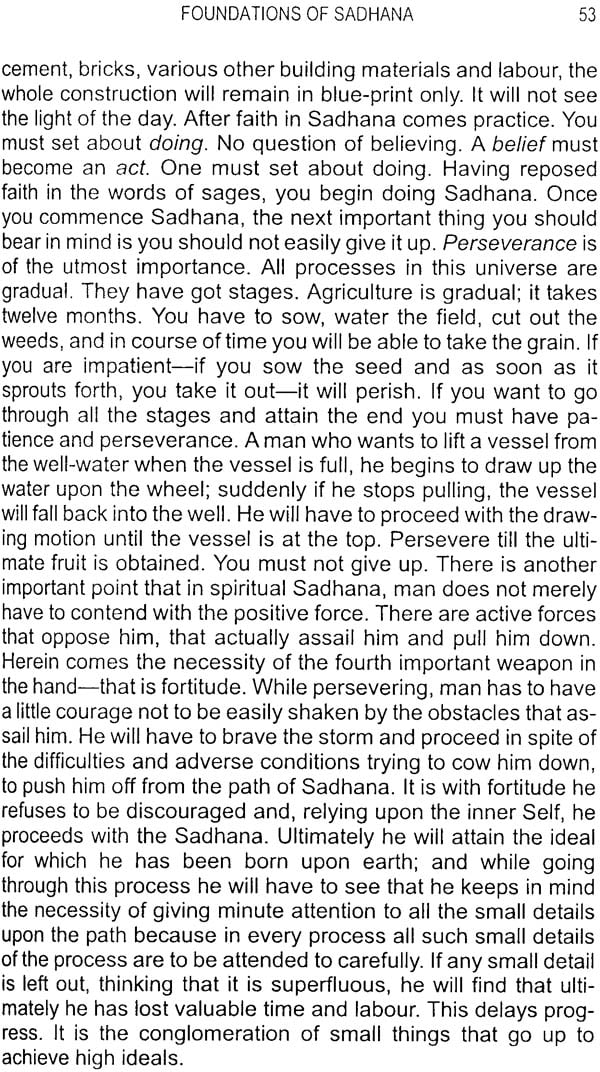
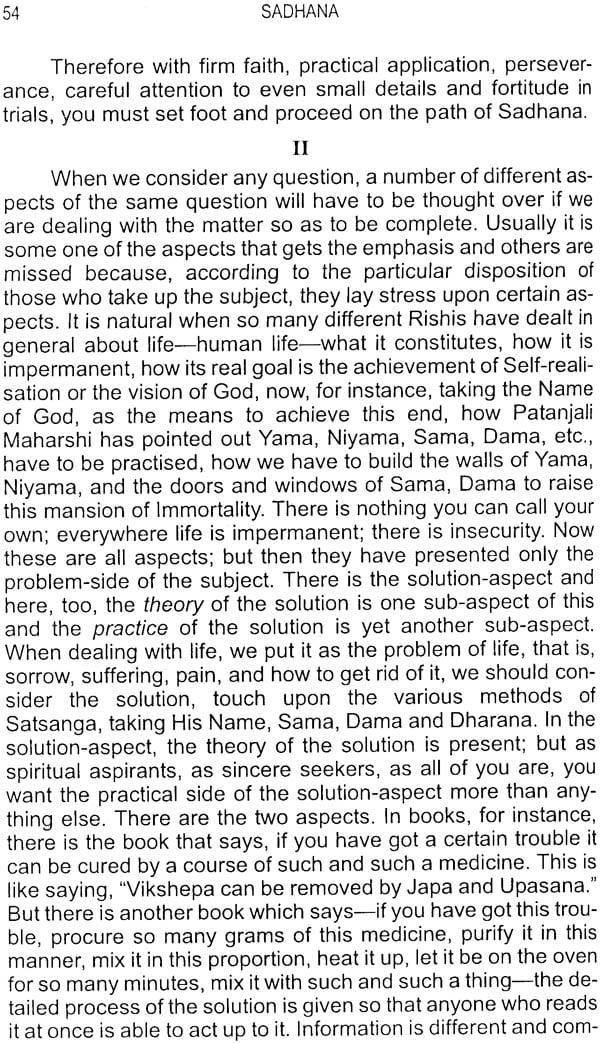
Sadhana means any spiritual practice that helps the Sadhaka to realize God. Abhyasa and Sadhana are synonymous terms. Sadhana is a means to attain the Goal of human lie. Without Sadhana no one can achieve the purpose of life. Sadhana differs in different individuals according to the capacity, temperament and taste. Every one must take to some kind of Sadhana to attain the state of final beatitude. Sadhya is hat which is attained through Sadhana. It is God or Atman or Purusha. If you want to evolve quickly you must have the right kind of Sadhana. If you are a student of the path of self-reliance, you can yourself select the Sadhana for your daily practice. If you are a student of the path of self-surrender, you should ge right kind of Sadhana from a Guru and practise the same with intense faith.
Those who follow the path of devotion should do Japa, read the holy scriptures such as the Bhagavata or the Ramayana. By the practice of Nava Vidha Bhakti, the Bhakta should develop Bhakti to a very high degree. Sravana, Smarana, Kirtana, Vandana, Archana, Padasevana, Sakhya, Dasya and Atma-Nivedana are the nine methods to develop Bhakti. Bhaktas should observe Vrata, Anushthana and do prayers and Manasic Puja. They should serve others, realising that the Lord recites in the hearts of all. This is the Sadhana for those who tread the path of Bhakti Yoga.
Those who follow the path of Karma Yoga should do disinterested selfless service to the suffering humanity and society in various ways. They should surrender the fruits of action to the Lord as Isvararpana. They should give up agency by realising that they are the instruments in the hands of God. They should get rid of their selfishness and control their Indriyas. They should completely consecrate their lives in the service of humanity. They should consider that the whole world is a manifestation of the Lord. If they serve people with such a Bhava, their hearts get purified in the long run. Eventually they get knowledge of the Self through Chitta Suddhi.
This is the Sadhana for the Karma Yogins. This is very important for all beginners in the spiritual path. This is not the goal itself. Many erroneously think so and neglect the higher courses of Sadhana. They should advance still further and through Dharana, Dhyana and Samadhi reach the highest goal.
A Raja Yogi slowly ascends the Yogic ladder through the eight steps. He gets ethical training in the beginning to purify himself by the practice of Yama and Niyama. Then he steadies his posture. Then he practises Pranayama to steady his mind and to purify the Nadis. Then by the practice of Pratyahara, Dharana and Dhyana, he gets Samadhi. Through Samyama, he gets different Siddhis. He restrains all the mental modification that arise from the mind.
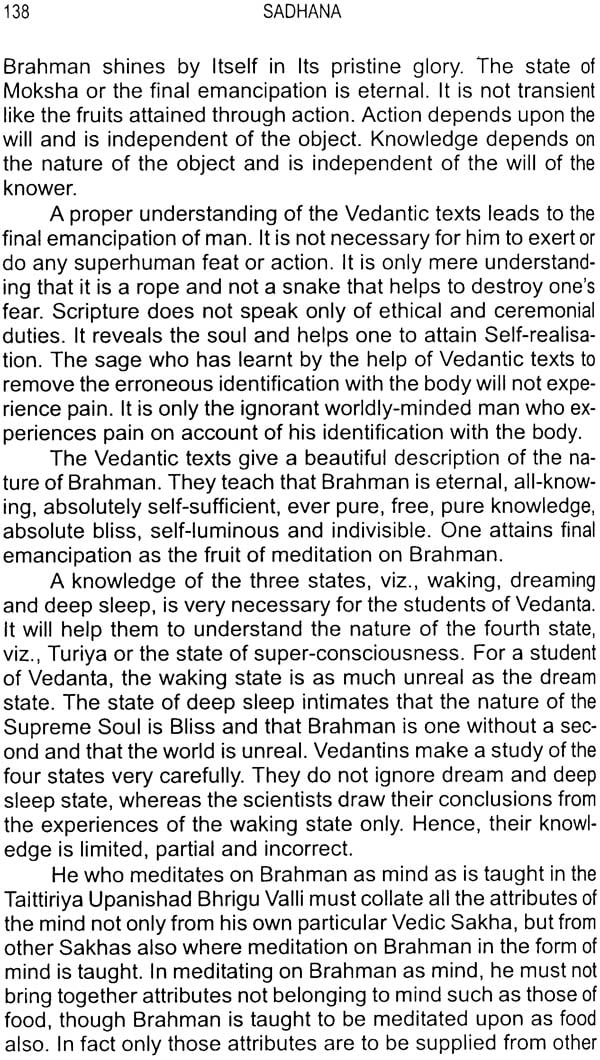
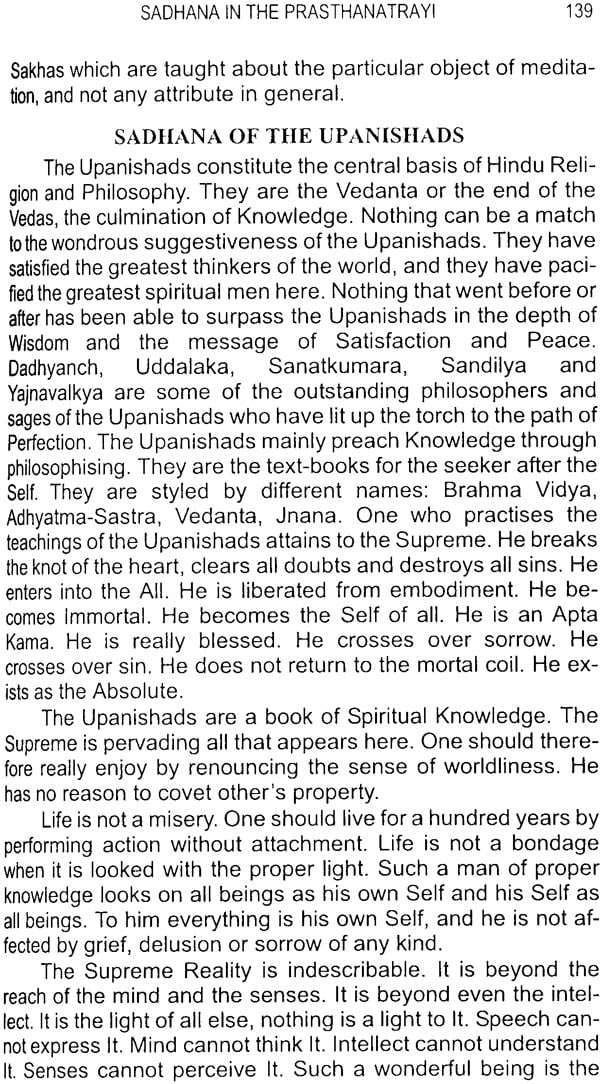
Those who take up the path of Vedanta or Jnana Yoga should acquire first the four means of salvation (Sadhana Chatushtaya)- Viveka, Vairagya, Shat-Sampat and Mumukshutva, Viveka is discrimination between the real and unreal. Vairagya is indifference to sensual enjoyments. Shat-Sampat is the sixfold virtues, Sama, Dama, Uparati, Titiksha, Sraddha and Samadhana. Then they approach a Brahma-Nishtha Guru who has realized the Supreme Self and hear the Srutis from him. Then they reflect and mediate on the Self and attain eventually Atma-Sakshatkara. Then the Jnani exclaim with joy: "The Atman alone is, one without a second. Atman alone is the one Reality. I am Brahman, Aham Brahma Asmi. Sivoham Sarvam Khalvidam Brahma." The liberated Jivanmukta sees the Self in all beings all beings in the Self.
The student of Hatha Yoga should try to awaken the Kundalini Sakti that lies dormant in the Muladhara Chakra by Mudras, Bandhas, Asanas and Pranayamas. They should try to unite the Prana and Apana and send the united Prana-Apana through the Sushumna Nadi. Heat is increased by retention of breath and Vayu ascends up along with Kundalini to the Sahasrara Chakra through the different Chakras. When Kundalini is united with Lord Siva at the Sahasrara Chakra, the Yogi attains supreme peace, bliss and immortality.
Born on the 8th September, 1887, in the illustrious family of Sage Appayya Dikshita and several other renowned saints and savants, Sri Swami Sivananda had a natural flair for a life devoted to the study and practice of Vedanta. Added to this was an inborn eagerness to serve all and an innate feeling of unity with all mankind
His Passion for service drew him to the medical career; and soon he gravitated to where he thought that his service was most needed. Malaya claimed him. He had earlier been editing a Health Journal and wrote extensively on health problems. He discovered that people needed right knowledge most all; dissemination of that knowledge he espoused as his own mission.
It was divine dispensation and the blessing of God upon mankind that the doctor of body and mind renounced his career and took to a life of renunciation to qualify himself for ministering to the soul of man. He settled down at Rishikesh in 1924, practised intense austerities and shone as a great Yogi, saint, sage and Jivanmukta.
In 1932 he started the Sivanandashram. In 1936 was born The Divine Life Society. In 1948 the Yoga-Vedanta Forest Academy was organised. Dissemination of spiritual knowledge and training of people in Yoga and Vedanta were their aim and object. In 1950 he undertook a lightning tour of India and Ceylon. In 1953 he convened a 'World Parliament of Religions'. He is the author of over 300 volumes and has disciples all over the world, belonging to all nationalities, religions and creeds. To read his works is to drink at the Fountain of Wisdom Supreme. On 14th July 1963 he entered Mahasamadhi.
| Publishers' Note | 7 |
| Preface | 10 |
| Prayers | 15 |
| INTRODUCTORY | |
| A Survey of the Evolution of the Ancient Indian Spiritual Techniques | 31 |
| CHAPTER - ONE | |
| FOUNDATIONS OF SADHANA | |
| Prerequisites of Spiritual Sadhana | 51 |
| The Three Governing Factors of Sadhana | 58 |
| Primary Principles of Sadhana and Their Perversions | 60 |
| Abhyasa: The First Phase of Sadhana | 66 |
| Four Points for Memory in Sadhana | 66 |
| Bases of Spiritual Sadhana | 67 |
| Aspects of Spiritual Sadhana | 69 |
| Sadhana: Its Techniques of Applied Psychology | 81 |
| Easy Method of Sadhana in Worldly Environment | 82 |
| Some Secrets of Sadhana | 83 |
| The Essence of Sadhana | 85 |
| CHAPTER - TWO | |
| SIGNIFICANT PROCESSES IN SADHANA | |
| The Movement of Vasanas in Sadhana | 86 |
| Role of Restraint in Sadhana | 90 |
| Repression in Sadhana and Its Effects | 94 |
| Triple Withdrawal in Sadhana | 100 |
| Patience in Sadhana | 101 |
| Perseverance in Sadhana | 106 |
| Continuity in Sadhana | 108 |
| Four Progressive Stages in Sadhana | 108 |
| CHAPTER - THREE | |
| TYPES OF SADHANA | |
| Fourfold Sadhana | 109 |
| The Simple Sadhana | 113 |
| Most Important Sadhana | 115 |
| A Dynamic Sadhana | 116 |
| Antaranga Sadhana | 118 |
| Ethical Sadhana | 118 |
| Mouna Sadhana | 120 |
| Brahmacharya Sadhana | 126 |
| Sadhana of the Antarmukha Vritti | 128 |
| Sadhana by Circumspection | 129 |
| Sadhana in Self-analysis | 129 |
| Sadhana of Pratipaksha Bhavana | 130 |
| Sadhana of Spiritual Vision | 131 |
| The Disciplines of Universal Love | 131 |
| CHAPTER - FOUR | |
| SADHANA IN THE PRASTHANATRAYA | |
| The Sadhana of the Veda | 133 |
| Sadhana in the Brahma Sutras | 134 |
| Sadhana of the Upanishads | 139 |
| Sadhana of the Bhagavad-Gita | 145 |
| CHAPTER - FIVE | |
| SADHANA IN THE SMRITIS, EPICS AND PURANAS | |
| Sadhana in the Manusmriti | 152 |
| Sadhana in the Ramayana | 153 |
| Sadhana in the Mahabharata | 157 |
| Sadhana in the Bhagavata Purana | 159 |
| Vishnupurana: Sadhana for Liberation | 171 |
| Sadhana in Garuda Purana | 173 |
| The Sadhana of the Yogavasishtha | 173 |
| CHAPTER - SIX | |
| SADHANA IN THE VARIOUS SCHOOLS | |
| Sadhana in Veerasaivism | 177 |
| Sakti Yoga Sadhana | 177 |
| Sadhana in Saivasiddhanta | 179 |
| Sadhana in Kashmir Saivism | 180 |
| Sadhana in Pasupata Yoga | 181 |
| CHAPTER - SEVEN | |
| SADHANA IN SIVANANDA SUTRAS | |
| Sadhana of Sivananda Upadesamritam | 182 |
| Sivananda Mano-Vijnana Sadhana Sutras | 187 |
| Sivananda Hatha Yoga Sadhana Sutras | 188 |
| Sivananda Karma Yoga Sadhana Sutras | 189 |
| Sivananda Bhakti Yoga Sadhana Sutras | 189 |
| Sivananda Yoga Sadhana Sutras | 190 |
| Sivananda Vedanta Sadhana Sutras | 190 |
| Integral Yoga Sadhana | 191 |
| CHAPTER - EIGHT | |
| SARVA-SADHANA-SANGRAHA | |
| Triplets in the Four Main Paths of Sadhana | 194 |
| Svara Sadhana | 194 |
| Laya Yoga Sadhana | 198 |
| Pranava Sadhana | 201 |
| Soham Sadhana | 203 |
| Vichara Sadhana | 205 |
| Dhyana Yoga Sadhana | 211 |
| Japa Yoga Sadhana | 221 |
| Gayatri Sadhana | 226 |
| Mantra Yoga Sadhana | 230 |
| Sankirtan Sadhana | 236 |
| Tantra Yoga Sadhana | 237 |
| Sava Sadhana | 238 |
| Kriya Yoga Sadhana | 239 |
| Sangita Sadhana | 241 |
| Sadhana by Prayer | 246 |
| Sadhana of the Yoga of Synthesis | 248 |
| CHAPTER - NINE | |
| IMPORTANCE OF SADHANA | |
| Spiritualisation of Human Nature | 254 |
| Life's Supreme Purpose | 258 |
| The Struggle for Perfection | 260 |
| Need for Sadhana | 260 |
| Outgoing Tendencies of the Senses and the Need for Self-control | 263 |
| Qualification for Sadhana | 264 |
| Sadhana ? The Main Purpose of Life | 267 |
| Brahmamuhurta: The Best for Sadhana | 269 |
| A Sermon on Sadhana | 270 |
| CHAPTER - TEN | |
| SADHANA FOR THE CONQUEST OF LOWER NATURE | |
| Sadhana for Mastering the Mind | 272 |
| Various Methods of Mind-control | 277 |
| Sadhana for Controlling the Ten Senses | 278 |
| Sadhana for Developing Vairagya | 280 |
| Sadhana for Elimination of Egoism | 281 |
| Six Sadhana for Eradicating Jealousy | 289 |
| Sadhana for Annihilation of Arrogance | 292 |
| Sadhana for the Subjugation of Hatred | 294 |
| Sadhana for Controlling Anger | 295 |
| Sadhana for the Conquest of Fear | 296 |
| CHAPTER - ELEVEN | |
| SADHANA FOR VARIOUS SIDDHIS | |
| Four Sadhanas for God-realisation | 299 |
| Sadhana for Developing Will-power | 299 |
| Sadhana for Sense-control | 302 |
| Sadhana for Conquest of Raga-Dvesha | 304 |
| Sadhana for Freedom from accidents | 309 |
| Sadhana for Success, Prosperity and Enlightenment | 310 |
| The Nineteen Factors of Sadhana for Peace | 311 |
| Sadhana for Samadhi in Six Months | 314 |
| Sadhana for Awakening Kundalini | 315 |
| Sadhana for Realisation of Oneness | 315 |
| CHAPTER - TWELVE | |
| OBSTACLES TO PROGRESS IN SADHANA | |
| The Mind of the Aspirant: A Psychological Study | 317 |
| Sadhana and the Vagaries of the Practitioner | 321 |
| Temptations in Sadhana | 321 |
| The Difficulty of Progress in Sadhana | 322 |
| Main Impediments to Sadhana | 324 |
| CHAPTER - THIRTEEN | |
| KARMA YOGA SADHANA | |
| Service is Essential | 327 |
| Karma Can be Transformed into Yoga | 331 |
| Results of Karma Yoga Sadhana | 333 |
| CHAPTER - FOURTEEN | |
| BHAKTI YOGA SADHANA | |
| Outlines of Bhakti Yoga Sadhana | 336 |
| A Few Facets of Bhakti Yoga Sadhana | 340 |
| Faith, Aspiration and Self-surrender | 343 |
| Nine Modes of Bhakti Yoga Sadhana | 344 |
| Essential in Bhakti Yoga Sadhana | 349 |
| The Role of Faith in Bhakti Sadhana | 351 |
| Important of Sadhana in Bhakti Yoga | 352 |
| The Gist of Bhakti Yoga Sadhana | 355 |
| CHAPTER - FIFTEEN | |
| YOGA SADHANA | |
| Yoga Sadhana: Introductory | 357 |
| Yoga Sadhana Explained | 360 |
| Yoga Sadhana: Its Eight Fundamentals | 361 |
| Mental Purification: An Essential Condition | 365 |
| Need for Yoga Sadhana | 365 |
| Structure of Yoga Sadhana | 368 |
| Practice of Yoga Sadhana | 373 |
| Practical Yogic Instructions | 374 |
| Inner Yogic Discipline | 383 |
| Light on Yoga Sadhana | 393 |
| Main Obstacles in Yoga Sadhana | 394 |
| CHAPTER - SIXTEEN | |
| VENDANTIC SADHANA | |
| Vedantic Sadhana: Introductory | 401 |
| Aspects of Jnana Sadhana | 402 |
| The Seven Stages of Jnana | 403 |
| Methods of Vedantic Sadhana | 405 |
| Obstacles in Vedantic Sadhana | 406 |
| The Nature of the Jnani | 407 |
| Hints on Vedantic Sadhana | 407 |
| Vedantic Aphorisms | 424 |
| Essence of Vedantic Sadhana | 429 |
| CHAPTER - SEVENTEEN | |
| COURSES OF PRACTICAL SADHANA | |
| Twelve Aspects of Saguna Dhyana Sadhana | 431 |
| A Programme of Sadhana | 431 |
| Practical Sadhana: A Discussion | 434 |
| Sadhana for Ten Days | 449 |
| Sadhana for Forty Days | 450 |
| Daily Routine | 450 |
| Ten Minutes Sadhana on Twelve Virtues | 454 |
| Twenty Important Spiritual Instructions | 455 |
| The Science of Seven Cultures | 457 |
| Everyday Guide to Sadhakas | 460 |
| Importance of Spiritual Diary | 463 |
| Resolves for Quick Spiritual Progress | 468 |
| The Resolves Form | 468 |
| Secret of success in Sadhana | 470 |
| An Ideal Grihastha Sadhaka | 470 |
| Some Hints on Sadhana | 471 |
| Kabir's Method of Sadhana | 475 |
| CHAPTER - EIGHTEEN | |
| QUESTIONS AND ANSWERS ON SADHANA | |
| Religion, Saint and Yogi | 476 |
| Prerequisites for Realisation | 477 |
| The Science of Mantra Repetition | 477 |
| Japa Yoga | 482 |
| Problems of Sadhana | 482 |
| What Should Be Our Goal? | 484 |
| Methods of Mental Purification | 485 |
| Problems of Self-realisation | 486 |
| Hatha Yoga | 487 |
| The Need for a Spiritual Guide | 489 |
| Definition of Faith and Development of Devotion | 491 |
| Questions in Bhakti Yoga | 192 |
| Questions in Vedanta | 498 |
| Questions in Raja Yoga | 499 |
| Yoga and the life Divine | 500 |
| World and Renunciation | 501 |
| CHAPTER - NINETEEN | |
| INTIMATE ADVICE TO ASPIRANTS | |
| Aspirants ? A Distinct class by Themselves | 503 |
| Advice to Sadhakas | 506 |
| Instructions to Sannyasins | 512 |
| Guiding Lights | 518 |
| Sweetness in Sadhakas | 521 |
| Spiritual Guidance for Aspirants | 522 |
| Need for Great Vigilance | 524 |
| The Voice of Spiritual Aid | 526 |
| Sadhana and Samadhi | 528 |
| Some Spiritual Don' ts | 531 |
| Sadhana and the Guide | 531 |
| Guidance from the Scriptures | 536 |
| Sadhana Panchakam of Sri Sankaracharya | 542 |
| CHAPTER - TWENTY | |
| INSPIRING SVADHYAYA FOR ASPIRANTS | |
| Physical Body and Life Divine | 543 |
| Repetition of Divine Name | 543 |
| Man and His Stepping Stones | 543 |
| Peace, Salt of Life and Sankirtan | 543 |
| The Sage, Happiness and Power | 544 |
| Life, The Melting Heart and Divine Grace | 544 |
| Humanity, Love and Goodness | 545 |
| Purity, Aspiration, Realisation | 545 |
| Sadhana and Sakti | 545 |
| Anger, Mind and Self-conquest | 546 |
| Compassion, Satsanga and Discrimination | 546 |
| Truth, Vedanta and Human Imagination | 547 |
| Inner Happiness and Omnipresence of the Lord | 547 |
| God and His name | 548 |
| The Body and the Blessing of Human Birth | 549 |
| The Main Supports in Sadhana | 549 |
| The Demands of Yoga and the Worldly-minded | 550 |
| Difficulties in Life and the Messages of the Saint | 550 |
| God-consciousness and Sat-Chit-Ananda | 550 |
| Patience, Contentment and Divine Light | 551 |
| Love and Secret of God-realisation | 552 |
| Wisdom and Perfection | 553 |
| The Lord, His Form and His Presence | 554 |
| Analogies and Some Forms of Blessing | 555 |
| Life on Earth and the Liberated Sage | 556 |
| Self-control and Brahma Jnana | 556 |
| Virtues and Bhakti | 557 |
| Rewards of Japa and Upanishadic Study | 558 |
| Vairagya, Abhyasa and Meditation | 558 |
| Ignorance and the Corroding Human Passion | 559 |
| Representatives of the Divine Beauty | 560 |
| Pathway to Purity | 560 |
| The Sage and Equal Vision | 561 |
| Thoughtfulness and Sweet Disposition | 561 |
| Cheerfulness and the Oneness with the divine | 562 |
| Main, The Architect of Circumstances | 562 |
| Yoga, The Epitome of Religious Experience | 563 |
| The Origin of Desire and Brahmic Realisation | 563 |
| Good Conduct and Obstacles on the Path | 564 |
| The Pervasive Brahman, The Astral Body | 564 |
| Vedanta, The Path of Wisdom | 565 |
| Faith and the Love of God | 565 |
| The Inner light and the Truly Wise | 566 |
| Definition of Religion and a Life in the Lord | 566 |
| Obstacles to Spiritual Progress and the Value of Suffering | 567 |
| World, Mind and Prayer | 568 |
| Attributes of the Divine Consciousness | 569 |
| Indiscrimination, Anger and the Language of the Heart | 570 |
| Saintliness and the Tender in Heart | 570 |
| Art, Life and Bhakti | 571 |
| A Rational Knowledge of the Divine | 572 |
| The Search for Immortality | 573 |
| Gauranga and the Miracles of Name | 573 |
| Ethical Life and Control of Emotions | 574 |
| Ideals in Nature | 575 |
| Importance of Virtue and Prem | 575 |
| Silence, Its Meaning and Its Place | 576 |
| The Middle Path | 576 |
| Steps of Aspiration | 577 |
| Byways of Blessedness | 577 |
| Manasic Puja Sloka by Sri Sankaracharya | 578 |
| Excellent Slokas from Avadhuta Gita for Meditation | 578 |
| The Life Triumphant | 579 |
| The Tree of Self, Sadhana and Samadhi | 579 |
| CHAPTER - TWENTY ONE | |
| SONGS OF SADHANA | |
| The Gist of Sadhana | 580 |
| Practice of real Sadhana | 584 |
| Intimate Advice | 584 |
| Song of Sadhana Week | 584 |
| Song of a Sadhaka | 586 |
| Phases of Sadhana | 587 |
| Twenty Precepts for Practice | 587 |
| CHAPTER - TWENTY TWO | |
| SOME EXPERIECES OF ASPIRANTS | |
| Purpose of Sadhana | 590 |
| Experiences of Sadhakas | 593 |
| Collective Sadhana | 594 |
| Instructions to Sadhakas | 597 |
| APPENDIX - I | |
| A DRAMA IN SADHANA | |
| The Path of a Sadhaka | 603 |
| APPENDIX - II | |
| A GARLAND OF PRECEPTS IN SADHANA | |
| Foundations of the Life Divine | 614 |
| The Discipline of Detachment | 614 |
| Practice of Yoga Sadhana | 614 |
| The Easiest From of Sadhana | 615 |
| Qualifications of Aspirants | 615 |
| Sense-control and Self-purification | 617 |
| Obstacles in Sadhana | 619 |
| Egoism-The Seed for Birth and Death | 619 |
| Desire ? The Root-cause of All Miseries | 621 |
| The Three Principal Enemies | 6222 |
| Selfishness-A Deadly Vice | 626 |
| Cardinal Principles of Practical Sadhana | 626 |
| The Inner Spiritual Discipline | 627 |
| Jnana Yoga Sadhana | 628 |
| Light on the Path | 633 |
| Special Spiritual Instructions | 635 |
| Nivritti Sadhana | 639 |
| Science of Yoga Sadhana | 641 |
| Self-effort and Destiny | 642 |
| Brahmacharya ? The Basis of All Sadhana | 643 |
| Goodness, Purity and Truthfulness | 644 |
| Charity ? An Aspect of Sadhana | 646 |
| Suffering ? A Stepping-stone to Success | 647 |
| Sadhana and Self-realisation | 648 |
| Essentials of Spiritual life | 648 |
| Importance of Spiritual Practices | 649 |
| Important Sadhanas | 650 |
| Secret of Success in Sadhana | 652 |
| Overcome Temptations | 653 |
| Meditate and Realise | 655 |
| The Ideal Aspirant | 656 |
| Light on Sadhana | 657 |
| Advice to Aspirants | 660 |
| Realisation of the Self | 661 |
| The Way to Kaivalya | 662 |
| Progress on the Path | 664 |
| Sadhana ? The Only Purpose of Life | 666 |
| Concentration and Meditation | 667 |
| Brahmic Consciousness | 668 |
| The Key to Blessedness | 671 |
| Sadhana and Some Experience | 672 |
| APPENDIX - III | |
| SIVANANDA SADHANA SARA | |
| Fundamental Aspects of Sadhana | 674 |
| The Nature and Processes of Sadhana | 675 |
| Concentration and Need for Vigilance | 676 |
| Conditions for Yoga Sadhana | 677 |
| Sadhana, The Divine Name and Equanimity | 678 |
| The Results of Real Love | 679 |
| Formula in Higher Sadhana | 680 |
| Sadhana and the spiritual Destiny | 681 |
| Sadhana and the Mind | 681 |
| Requisites for Spiritual Progress | 682 |
| Guidance in Sadhana | 684 |
| The Principles of Spiritual Progress | 686 |
| Elements of Sadhana | 687 |
| Background of Thought | 688 |
| Sadhana and Samadhi | 689 |
| Phases of Spiritual Practice | 690 |
| APPENDIX - IV | |
| Only with an Invincible and powerful arrow of yogic concentration can you kill the seven faculties that trouble you | 692 |
| APPENDIX - V | |
| Sivananda's Synthesis of Sadhanas (Sri K.S. Ramaswami Sastri) | 695 |