

Sri Ramanuja Nootrandhadhi
Book Specification
| Item Code: | NAM954 |
| Author: | K. R. Krishnaswami |
| Publisher: | A & K PRAKASHANA |
| Language: | Kannada and Tamil Text With Transliteration and Word-to-Word Meaning English Translation |
| Edition: | 2016 |
| Pages: | 128 |
| Cover: | Paperback |
| Other Details | 8.5 inch X 5.5 inch |
| Weight | 140 gm |
Book Description
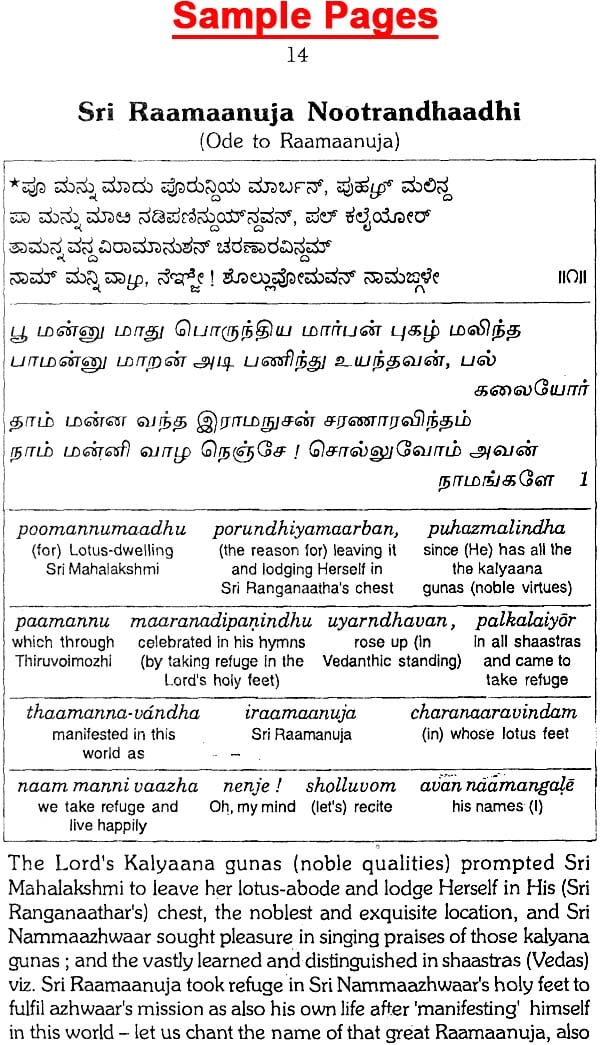
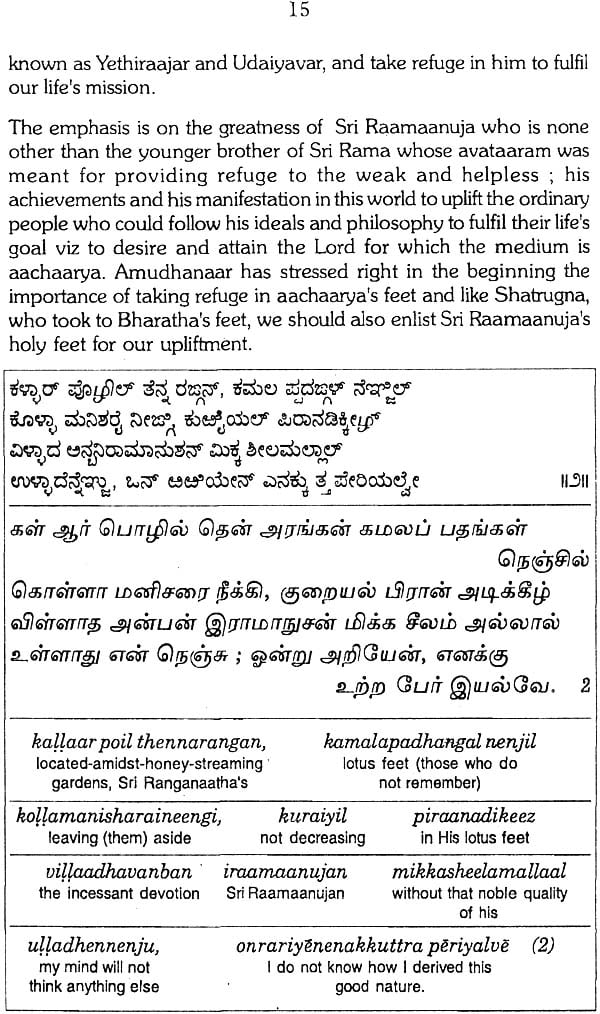
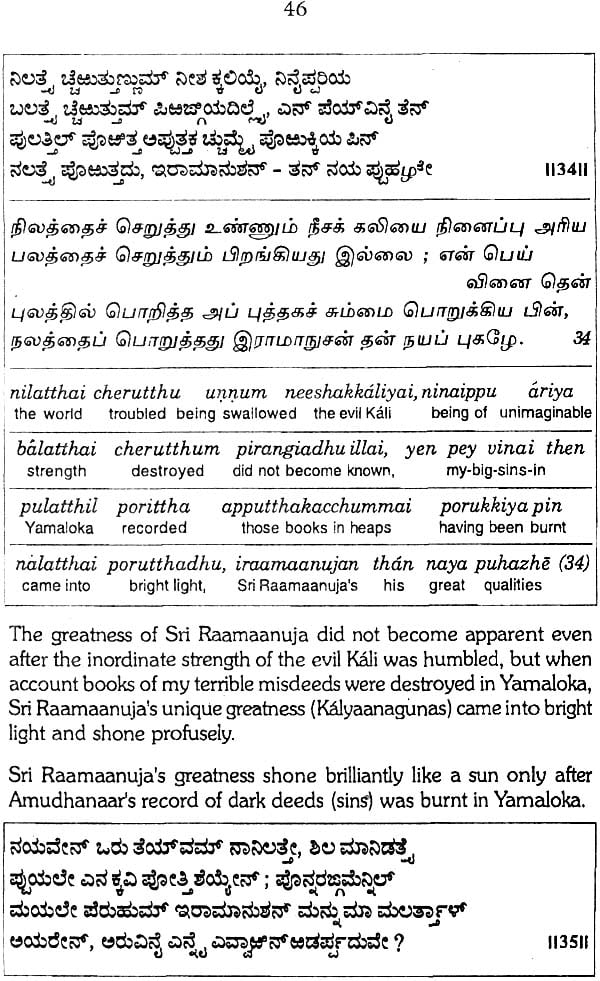
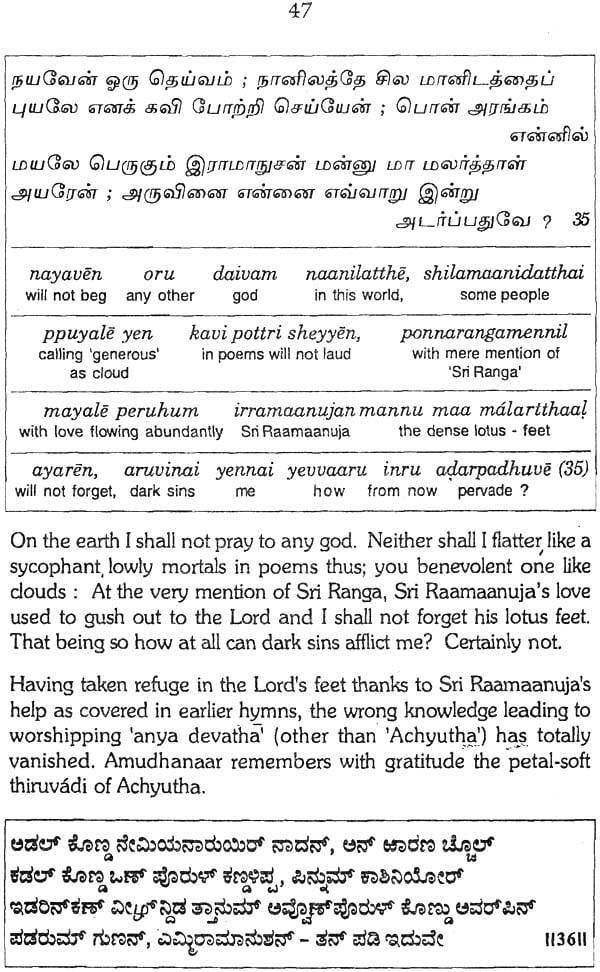
We welcome with Naarayana Smaranas this beautiful edition of Sree Raamaanuja Nootrandhaadhi adorned with the original text in Tamil, Kannada and English, as well as word- by-word meanings and explanatory notes in English. The author himself at the outset puts forth the salient features of the sacred work and its significance in our devotional literature. We commend this excellent work to all the members of the Srivaishnava fraternity, who have taken refuge in the Lotus feet of Bhagavaan Sri Raamaanujaacharya.
The author’s acknowledgement to previous commentators on the text shows his honesty and humility. The Raamaanuja Nootrandhaadhi shines as the final part of the illustrious Dravida Divya Prabhandham and serves as a divine composition for recitation during the Utsava-outings of the Lord and the aacharyas.
These verses conjure up before our mind’s eye the resplendent picture of the great aachaarya Bhagavaan Raamaanuja, his golden character, and his position as an aachaarya par excellence. They also served as an inspiration to later stothra- works such as: Yathiraja Vaibhavam, Yathiraja Prapatthi, and Yathiraja Bhajanam. The revered Vedantha Desika himself prays to God to qualify him to sing these verses.
The following are the qualifications of an aacharya, according to Sri Vedantha Desika:
1. An aacharya should be an accomplished soul.
2. He should belong to a good tradition.
3. He should be firm-minded and be free from sins.
4. He should be a man of light and learning.
5. He should have seen the truth face-to-face.
6. He should be rooted in ‘sattva guna’. He should be truthful in thought, word and deed.
7. He should be leading a saintly life as described in the shastras.
8. He should be free from ostentation, envy and jealousy.
9. He should have conquered the senses.
10. He should be an ocean of mercy.
11. He should have the closest and long-stretching relation with his disciple.
12. He should correct the disciple when the latter goes out of the way. He should remove the darkness of ignorance and destroy the sins in his disciple, thereby lifting him to the position of spiritual equality.
13. He should be considered by the disciple as God himself. There is no god greater- than such an aachaarya:
“aachaaryaadiha devataam samadhikaam anyaam namanyaamahe”
Sree Raamaanuja, as portrayed in Nootrandhaadhi, was the home of all the above virtues. Though very soft towards the devotees of true religion, he was a terror to the followers of six heretic faiths, like the charvakas, whom he purified. He was free from all blemishes and a home of all that is good and golden. Works on the life and works of the revered Raamaanuja can be counted on our fingers. The Raamaanuja Nootrandhaadhi was a contemporary work of Sri Raamaanuja, Written by one who was one of the closest to him. The Raamaayana and Vishnu Sahasranama were recited in the presence of their heroes themselves, receiving their approval and blessings.
The same is the case with Raamaanuja Nootrandhaadhi. The authenticity of this blessed work is unquestionable. The Svethaasvathara Upanishad declares that he alone gets enlightenment [on the teaching of the Upanishads] who has the greatest devotion to the Lord and has the same devotion to the spiritual teacher.
Sri Raamaanuja was like a father, mother, son, friend; teacher, master, assets and even the very self to his disciples. His ability to lead his disciples to liberation is beautifully pictured in the following anecdote in his life.
‘Once the child prodigy Raamaanuja was very eager to know from Lord Varadaraja Himself whether he would attain Moksha or not. He sent his heartfelt application of enquiry to the Lord Himself through his dearest devotee Thirukkacchi Nambi and, lo! and behold, he received the following reply: “whether Raamaanuja gets liberation or not, is a different .matter, but we assure liberation to all those who are recommended for salvation by Raamaanuja”.’
In its faith and devotion to the aacharya, the Raamaanuja Nootrandhaadhi can be compared to the lyric Kanninun Shirutthaambu of Madhura Kavi, in which the poet praises the teacher Nammaazhwaar as being equal to God and even superior to God.
The “Gayathri” is hailed as the mother of Vedas, (Vedamaataa) and the greatest among the manthras: “Na Gayathrya samomanthrah’’. When chanted With devotion, 108 times, with an understanding of its meaning, it bestows all the fourfold goals of life. Same is the case with chanting of the Raamaanuja Nootrandaadhi with 108 verses, and having the sacred name of Raamaanuja imprinted in every stanza of the lyric. It is highly praised as ‘Prapanna Gayathri’.
The commentary of the author, Sri Nallaan Chakravarthy Krishnaswami, inspiring this spirit in the hearts of devotee is undoubtedly a praiseworthy book. May it bring name and fame to the author like his other works for the glory of Sree Raamaanuja Darshanam and Sreevaishnava Dharma.
‘Sri Raamaanuja Nootrandhaadhi by Thiruvarangatth- amudhanaar (Amudhanaar, to be short) is a very important book of hymns on Sri Raamaanuja forming the last composition in 4,000 Divya Prabhandham. One would do well to recall that just as Raamaayana was sung in the presence of Sri Raamaa Himself, this work also has had the distinction of being recited in front of Sri Raamaanuja, who in fact permitted it to be included under the Divya Prabhandham of Aazhwaars.
Unfortunately, we do not have many authentic works telling us about Sri Raamaanuja, and his unique and remarkable achievements, which changed the course of the lives of multitudes and woefully even poorer is the number written by contemporaries or near-contemporaries. Nootrandhaadi has the distinction of being written during his lifetime by someone who had become very close to him.
Sri Raamaanuja Nootrandhaadhi stands alongside ‘Sri Kanninun Shirutthaambu’ of Madhura Kavi Aazhwaar, both devoted to the undivided loyalty to an aachaarya by even consigning the Lord Himself to a comer! While the former runs into 108 stanzas, the latter has a mere 11 stanzas. Just like Madhura Kavi who says that the perfect soul of Thirukkuruhoor (Sri Nammaazhwaar) is all that that is material and important in this world, so does Amudanaar, proclaim that there is nothing beyond Sri Raamaanuja.
Amudanaar’s Nootrandhaadhi has the name of Raamaanuja etched in each stanza and he has raised it to the level of Gaayathri - some people call it as ‘Prapanna Gaayathri’ - the third thanian has compared the Raamaanuja’s name with Gaayathri (or Saavithri, meaning the same.)
Amudanaar has composed the Nootrandhaadhi in Kalitthurai Andhaadhi style. The picture painted about himself is not far from our own caught in the web of material enjoyments etc. resulting in our negligence to ponder over ‘here and hereafter’. Just as Sri Raamaanuja readily uplifted Amudanaar, there are aachaaryas even to-day keenly waiting to help us to overcome the cycle of births and deaths by getting us sharanaagathi at the lotus feet of the Lord.
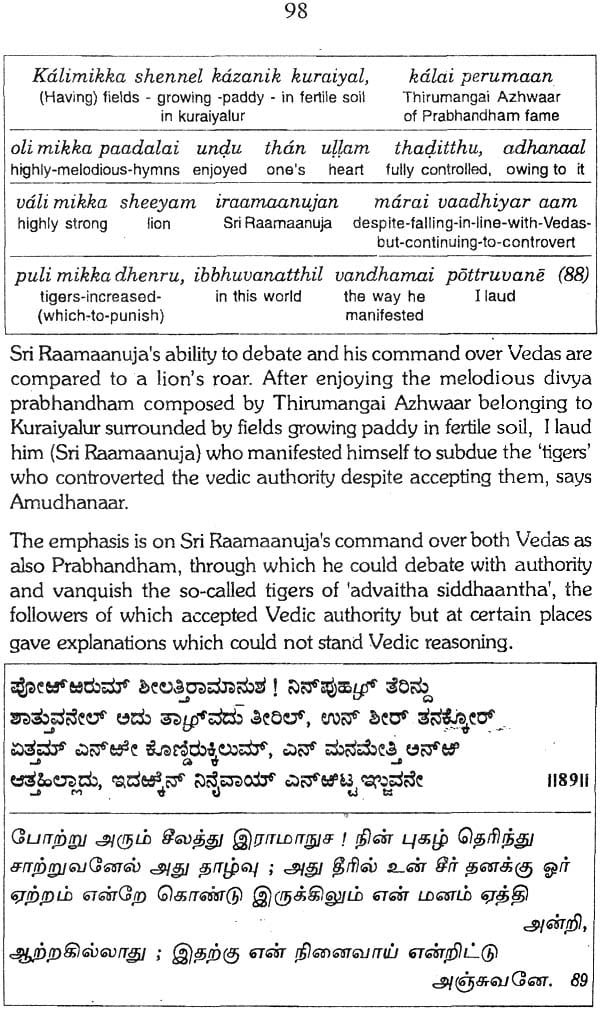
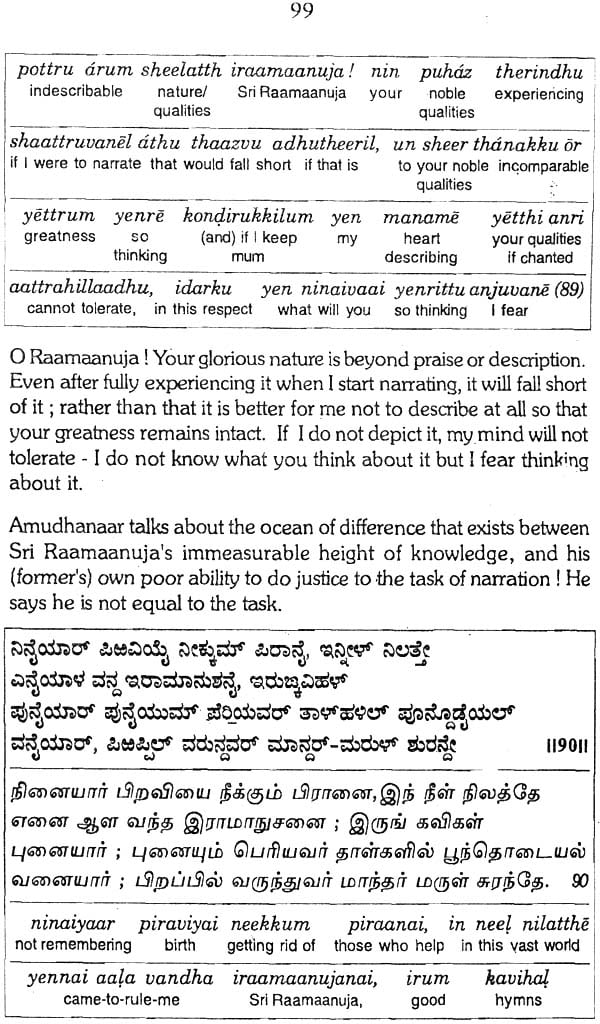
To enable the preference of the reader for the script he is most comfortable with the original text (moolam) has been given in three languages: Tamil, Kannada and English. The word-to-word meanings and explanations are provided in English. I have had recourse to refer to three important books on the subject: Pillai Lokachaarya’s commentary as edited by Kandhadai Thiruvenkataachaary in Tamil (1889), Utthamoor Viraraaghavachaarya’s book in Tamil (1975) and Mysore Andavan’s book in Kannada (1959). As usual I have drawn on the support from my wife, Smt. Vasanthi, in referring to relevant portions in Tamil books.
The DTP work has been ably handled by Ms. Sudha - I thank her and Sri S. Swaminathan of M/s. Sri Maruthi Graphics. My thanks are also due to Sri A. Sharada Prasad and Sri Kiran for timely printing and cover- design respectively.
1. Nootrandhaadhi - Charama Prabhandham : The devotional outpourings of the 12 aazhwaars go under the name of ‘Naalaayira Divya Prabhandham’. The subject work by Amudanaar forms the last part of this collective work (Charama Prabhandham) and it has to its credit of being heard by the one on whom it was written thereby obtaining what may be termed ‘a seal of approval’. Further this holy work was authorised to be included under Divya Prabhandham by Sri Raamaanuja himself. Vedantha Desika makes mention of the author and this work in his ‘Prabhanda Saara’ thus:
........ mun, bhoosurarkon thiruvarangatthamudanaarun
ponnadimel andhaadhiyaaha potri peshiya nal kalitthurai
nootthettu paattum pizhaiyarave yenakkarul shey penineeye!
Here Vedantha Desika requests Sri Raamaanuja to bless him to be able to recite the Nootrandhaadhi regularly, without break. Such is the holiness of this work!
2. An Important Source Book : Amongst the prominent source books on Sri Raamaanuja which provide an authentic picture of Sri Raamaanuja, there are only a few! One can cite besides Nootrandhaadhi, Vedantha Desika’s ‘Yethiraaja Sapthathi’ (74 slokas), Manavaala Maamuni’s ‘Yethiraaja Vimshathi (21 slokas) and Vaduhanambi’s ‘Yethiraaja Vaibhavam’ (114 slokas). All the works eulogise Sri Raamaanuja’s contribution in developing Vishistaadvaita Philosophy and Raamaanuja being described as ‘samsthaapana aachaarya’ of the concept of Lord Sriman Naaraayana being the Supreme Lord and everything being subservient to Him.
3. Amudanaar, the Composer : Amudanaar belonged to a family bearing the name ‘Moongilkudi’, He was born under the star ‘hastham’ in the tamil month of Panguni, and the year of birth is not known.
He (as also his ancestors) served Lord Ranganaatha at Sri Rangam and his name Thiruvarangattamudanaar owes to this connection with Sri Rangam Temple.
He was well-versed in ‘shaastras’ and ‘Prabhandham’ and deserved the prefix ‘Ubhaya Vedanthin’. He came to be known as ‘Peria Koil Nambi’ and he had become a ‘purohitha’ for the temple wielding great influence amongst the people.
4. Initial Discord with Sri Raamaanuja : Interestingly the period prior to his becoming a ‘shishya’ of Raamaanuja / Koorathaalwaan, there seems to have been some ‘unwelcome vibes’, between the two. To the chagrin of Sri Raamaanuja, Amudhanaar’s position of being a purohita witnessed, or was interpreted as, interference in Raamaanuja’s activities. It is said that The Lord Ranganaatha Himself appeared in a dream, to Raamaanuja and pleaded on behalf of Amudhanaar! Raamaanuja was said to be preparing himself to leave Sri Rangam. However as he was thinking loudly of discussing the matter with his shishya Koorathaalwaan, Amudhanaar had come to (recognise and) realise the greatness of Sri Raamaanuja, whose fame was spreading far and wide. He came to Raamaanuja and sought to become his shishya, but the former asked his ‘shishya’ Koorathaalwaan to take charge of Amudhanaar and accept him as his ‘shishya’.
As desired by Raamaanuja, Amudhanaar became wholeheartedly Koorathaalwan’s shishya. With time Koorathaalwaan.prevailed upon Amudanaar to hand over the temple keys to Raamaanuja setting at rest the discord that had existed before.
5. Kalitthurai Style: Amudhanaar has composed the nootrandhaadhi in Kalitthurai andhaadhi style. As in the case of any andhaadhi style the last word of the previous hymn becomes the first word of the succeeding hymn. For example - the last word of the previous hymn: Shollumine (43) becomes the first word of the next hymn: Shollaar (44). This helps in memorising the text.
6. Reciting Nootrandhaadhi : The style of reciting nootrandhaadhi calls for some practice and when sung properly it is quite appealing. As in the case of other Prabhandham works, •this also calls for the help of a teacher.
It is the accepted practice of the ‘bhaagavatha goshti’ to sing Nootrandhaadi during ‘Thirunakshathram’ festivals of aazhwaars/ aachaaryas and is the preferred prabhandham during Lord’s outing (purappaadal / Thiruveedhi Uthsavam). In fact, the Prabhandha goshti leads the Lord while Veda goshti follows him from behind.
| Foreword | Preface | 1 | Introduction | 3 | Prapanna Gayathri | 6 | The Nootrandhaadhi and Kanninun Shirutthaambu | 6 | Heretic faiths | 7 | The Picture of Raamaanuja Emerging from Nootrandhaadhi | 8 | Thanians | 10 | SriRaamaanuja Nootraandhaadhi (Ode to Raamaanuja) | 14 |