

CONSCIOUSNESS AND THE INTEGRATED BEING: Sartre and Krishnamurti
Book Specification
| Item Code: | IDG107 |
| Author: | M. M. AGRAWAL |
| Publisher: | Indian Institute of Advanced Study, Shimla |
| Language: | English |
| Edition: | 1991 |
| ISBN: | 8121404266 |
| Pages: | 106 |
| Cover: | Hardcover |
| Other Details | 8.9" X 5.8" |
| Weight | 290 gm |
Book Description
About the Book:
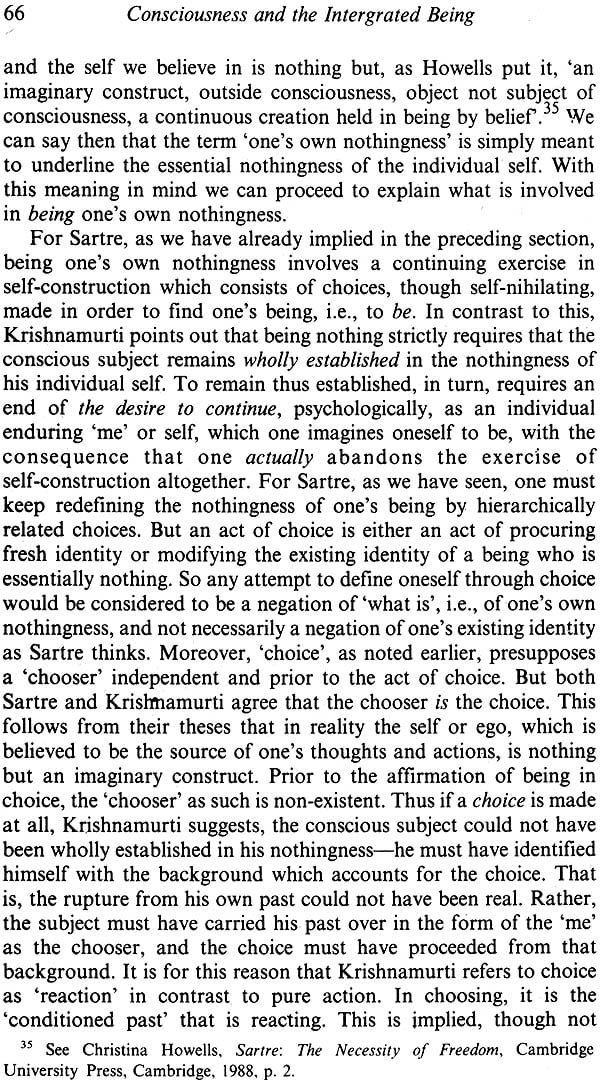
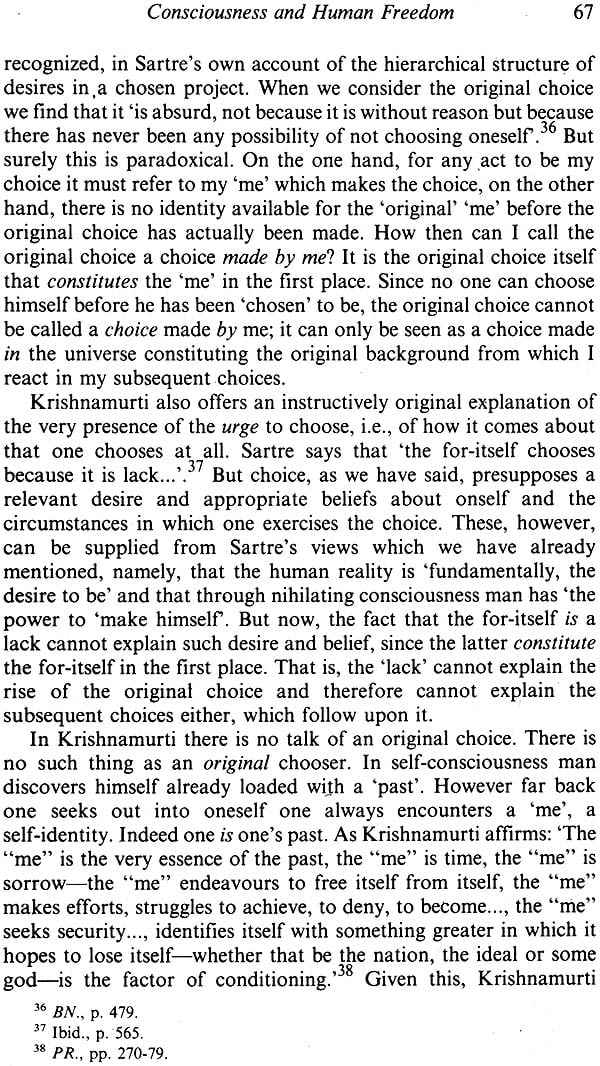
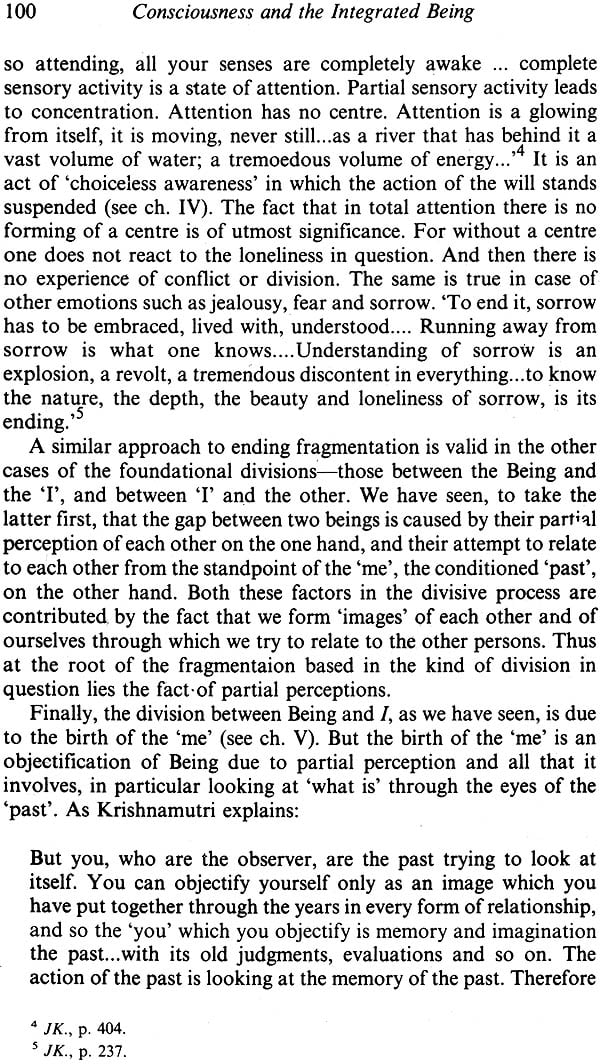
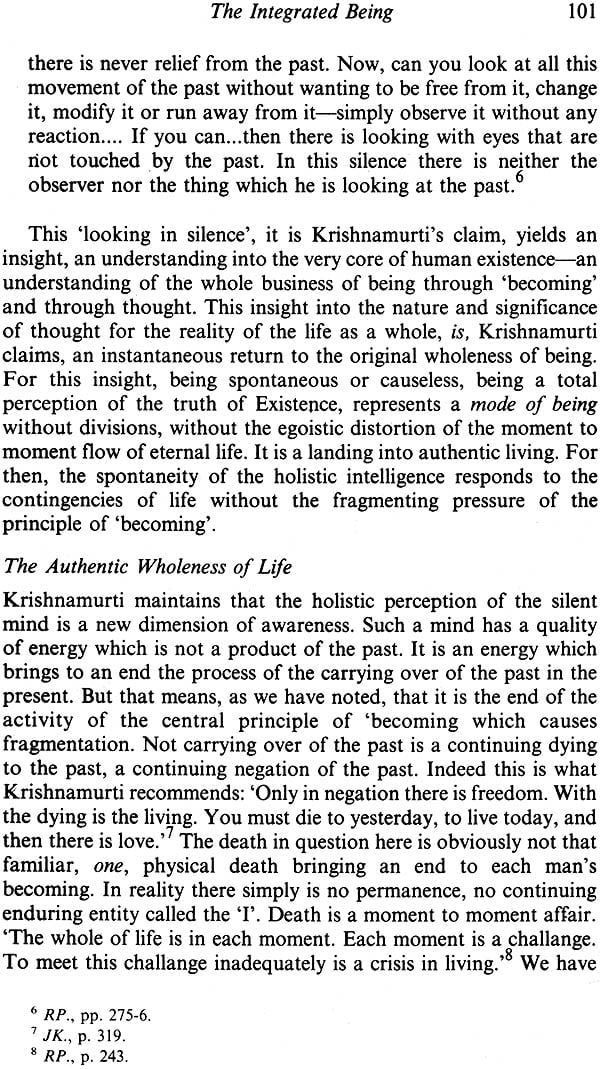
Going into the nature of consciousness in general and the structure of the ago in particular, the author traces the primary source of fragmentation in the self as a psychological construct. Following Krishnamurti, he looks upon spiritual freedom in terms of 'integration' within the fragmented being so that 'freedom' does not remain freedom for the self but from the self. The ideas of Sartre and Krishnamurti are compared and utilized in the construction of 'the integrated being'.
It is discerned that 'self-seeking' or 'becoming' (in the psychological sense) is the central principle of fragmentation in the individual, and also the cause of all the divisions within the society. Thus, the author stresses, that the answer lies in the elimination of the principle of 'becoming' from the spontaneity of 'being'. When 'becoming' ends the individual enters into a state of 'selflessness' which is the sole principle of integration within the individual.
About the Author:
DR M.M. AGRAWAL, at present Professor in Philosophy, North-Eastern Hill University, Shillong, was a Fellow of the Indian Institute of Advanced Study, Shimla. He read philosophy at Birkbeck College, University of London. Subsequently, he has taught for nearly twenty years at various universities in Africa.
In teaching and writing, his central concern in the understanding and re-evaluation of the world's spiritual Philosophy in the light of contemporary systems of thought, to construct a holistic picture of human life. Among his many publications, The Philosophy of Non-Attachment is an outstanding example of his approach.
From its very inception in 1965, Fellows of the Indian Institute of Advanced Study have pursued serious studies in the field of philosophy. Dr M.M. Agrawal’s Consciousness and the Integrated Being is a link in that rather long chain.
Going into the nature of consciousness in general and the structure of the ego in particular, Dr Agrawal traces the primary source of fragmentation in the self as a psychological construct. Following Krishnamurti, he looks upon spiritual freedom in terms of ‘integration’ within the fragmented being so that ‘freedom’ does not remain freedom for the self but from the self. The ideas of Sartre and Krishnamurti are compared and utilized in the construction of ‘the integrated being’.
This book should be of great interest not only to the researcher in the philosophy of the mind but also to the general reader interested in spiritual philosophy.
In a moment of quiet awareness the unburdened mind perceives its being-in-the-world- its fears, anxieties, quarrels and concerns. All our actions seem to be motivated by ‘self-concern’, which appears to be the fundamental mode of being. One is hardly ever aware of the beauty of the earth or one’s own ways of being in the world without the motive of self-concern. Most of all, ‘thought’ is put to the service of self-concern. There is thought about technical matters and there is thought about personal psychological matters. The latter kind of thought is ‘reflexive’ in the sense that its aim is to somehow satisfy the ‘me’ or the ‘I’. Often one is directly involved in thinking out plans of self-promotion, self-advancement. But even when thoughts are arising at random, with no apparent aim or purpose, careful attention reveals that they are also, obliquely, self-concerned. Such thoughts are self-assuring or self-indulgent, procuring a sense of continuing identity for the imaginary construct of the self or ego, the ‘I’ and the ‘me’. The instrumentality of thought as a whole is used to perpetuate self-concern.
Yet, despite this ruthless self-concern, the ‘I’ remains empty; a bottomless lack haunts its being and compells it to search for ever new identities. This attempt to fill the emptiness finds a foothold in all forms of relationship. We are well familiar with the phenomenon of social conformity, when people by virture of simply belonging to a professional group, a caste, religion or pedigree feel inwardly compelled to think, feel and behave in certain set manners –to wear certain style of clothes, read certain magazines, visit certain restaurants, clubs and become members of certain organizations etc. They have constructed a certain self-image, derived from the demands of their group-identity, which they try to make real.
Yet for all our self-concern, the life devoted to self-seeking remains a web of miseries, endless travail and perpetual conflict. The ‘I’ hides in every fold of being, and struggles to fill its emptiness with ‘achievements’-a bit more money, a bit more prestige, power, recognition and respectability. To attain all these he turns obstinate ‘disciplines’ himself, fits himself into a strait-jacket, a routine or a ‘system’, all of which involve in some form or the other violence to oneself and to others. We in India are only too well familiar with the brutalities of sectarianism, communalism and the politics of ‘identity’ and ‘survival’. For all his technological achievements, knowledge and enterprise, the self-seeking individual succeeds only in breeding more mischief at two levels. There is first the bio-physical level, where caring for oneself, protecting one’s life is a necesity. Man must satisfy certain ‘needs’ to live a healthy life. He must avoid dangers to himself from the contingencies of the environmental hazards. He needs food, shelter, clothes, medicine, and an enriching social environment to enable him to realize human potentialities creatively. But unfortunately his activities also manifest at another level- the psychological level- in seeking continuity and satisfaction of the ‘me’ through ‘achievements’. The latter comes about mainly through the process of ‘social’ conditioning. From the early childhood we are conditioned to obey, to believe, to conform etc. All these may be ‘technically’ necessary for transfer of scientific knowledge and skills of survival to help human well being. But what we are told to believe and practise is not limited to such scientific and practical matters. We are also brought up to believe who we are and what we ought to become, not simply as human beings, but as entities labled as Hindus, Muslims, Asians, Brahamins, Labourers etc. we are given identities in terms of social categories created by man, and then supplied with goals to be attained individually. Not surprisingly, then, the fulfilment of these goals turn into ‘psychological’ necessities, making us ambitious, cunning, violent and exploitative, and thus, adding a new (fundamentally unnecessary and undesirable) dimension to man’s being in the world. For then, inwardly, we feel impelled to use our skills, knowledge and creativity, not just for the love of life, but for the psychological satisfaction of the imaginary self, the ‘I’ or the ‘me’, which we (wrongly) believe to be a permanent entity, continuing to be the same throughout its changing biography. Thus, when an artist uses his art, a musician uses his violin, to become famous and rich, his motive in realizing his art is reflexive in the sense that while his consciousness is directed towards the impersonal end of creativity, transversally it intends the fulfilment of the ego, the ‘I’, itself. The ‘I’ by its very nature tends to be self-seeking. This striving to ‘become’, this psychological self-seeking, adds an extra dimension to the natural and authentic concern of man to live creatively. It is this ‘extra’ that turns out to be the whole source of sorrow and affliction.
| Acknowledgements | v |
| Foreword | vii |
| I Introduction | 1 |
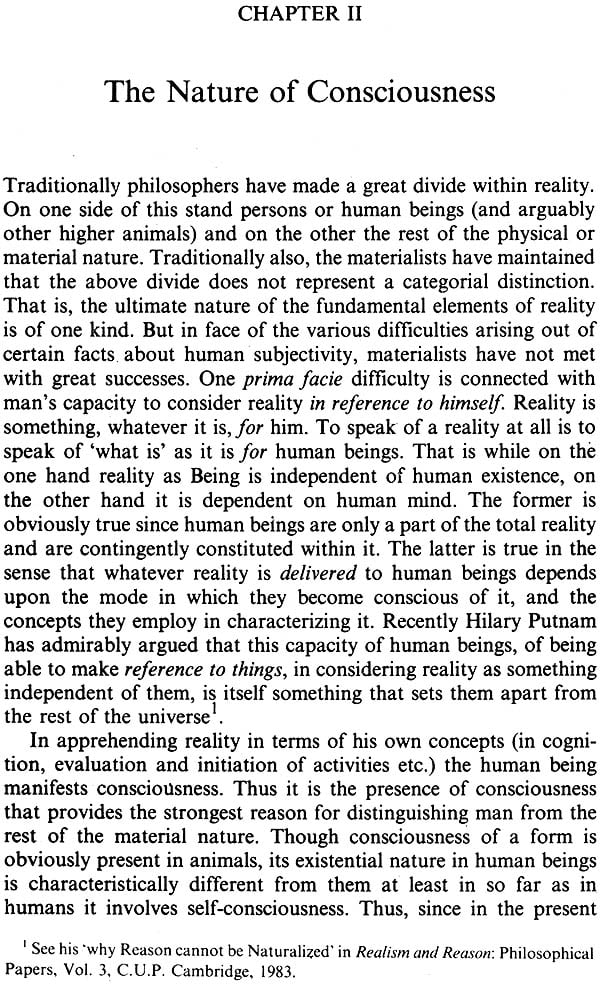
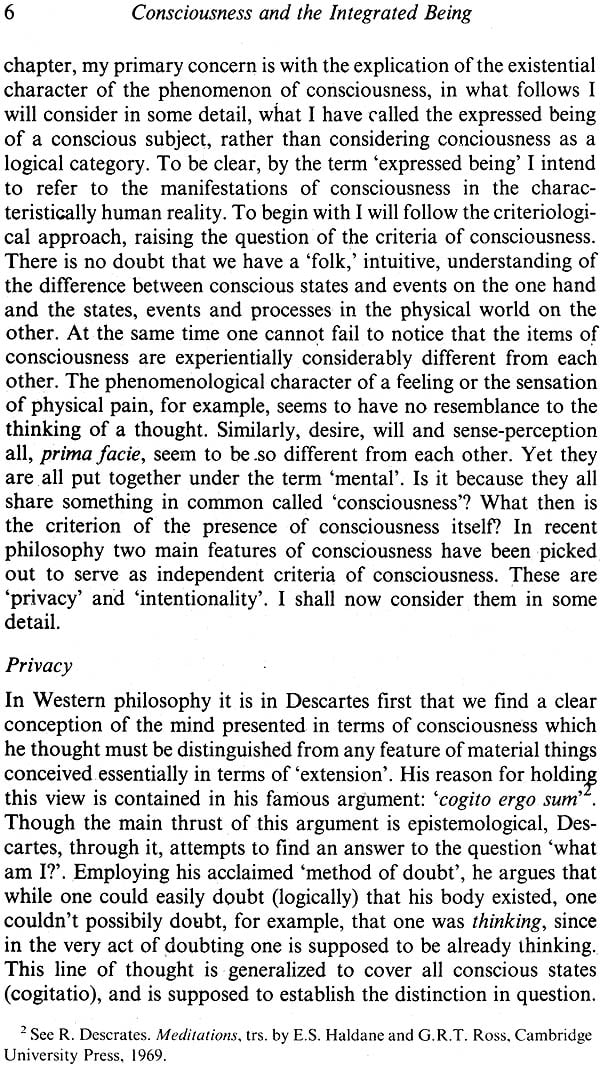
| II The Nature of Consciousness | 5 |
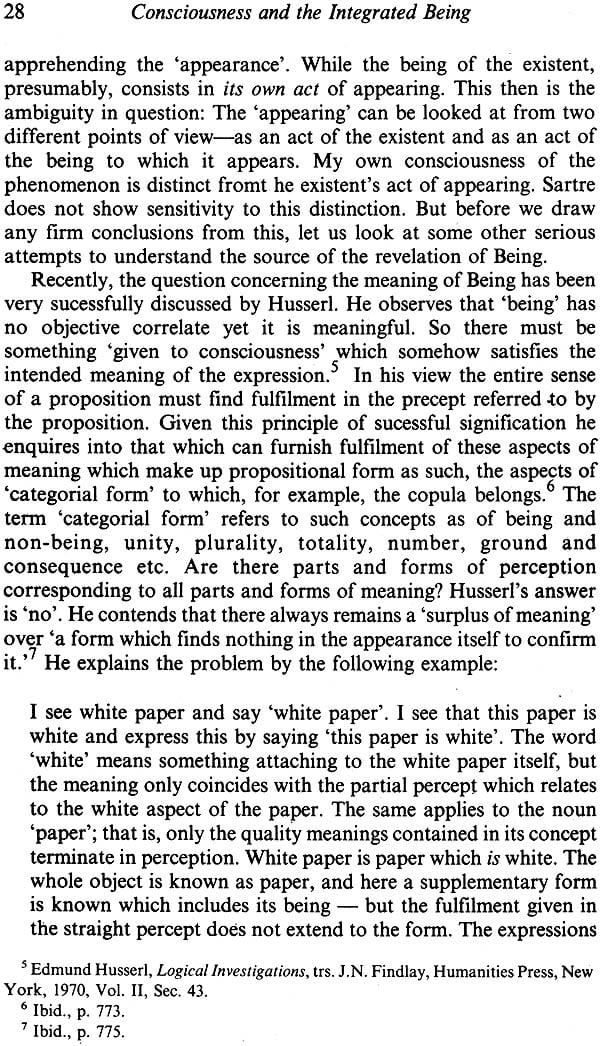
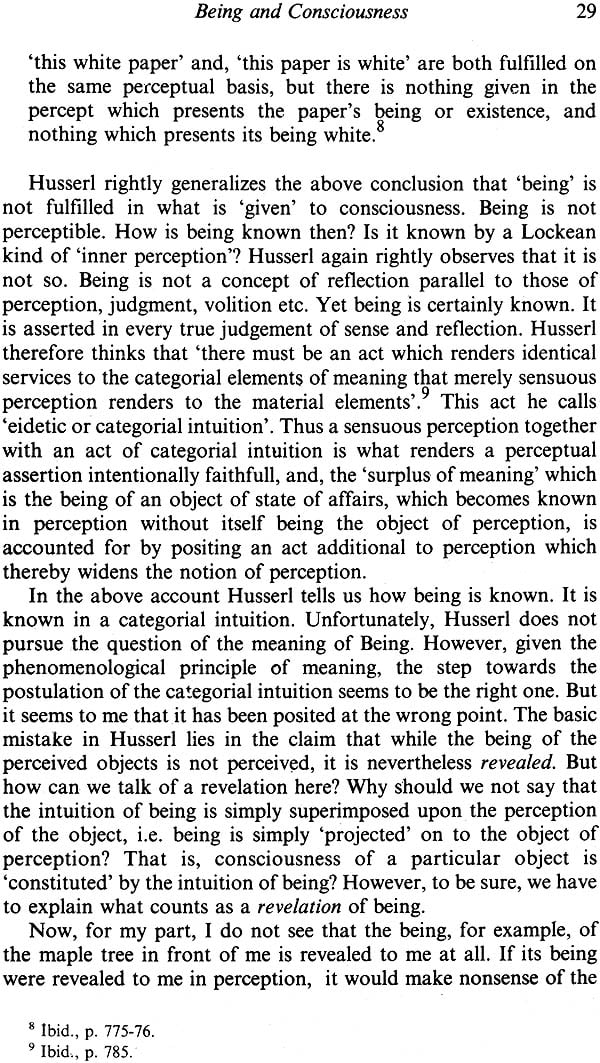
| III Being and Consciousness | 26 |
| IV The Self | 36 |
| V Consciousness and Human Freedom | 49 |
| VI Authenticity and Wholeness | 73 |
| VII The Integrated Being | 97 |
| Epilogue | 105 |