

India's Ballistic Missiles Defence Proponents and Principles
Book Specification
| Item Code: | UAU138 |
| Author: | S.C. Narang |
| Publisher: | Prashant Publishing House, Delhi |
| Language: | English |
| Edition: | 2021 |
| ISBN: | 9788195292394 |
| Pages: | 258 |
| Cover: | HARDCOVER |
| Other Details | 9.50 X 6.50 inch |
| Weight | 590 gm |
Book Description
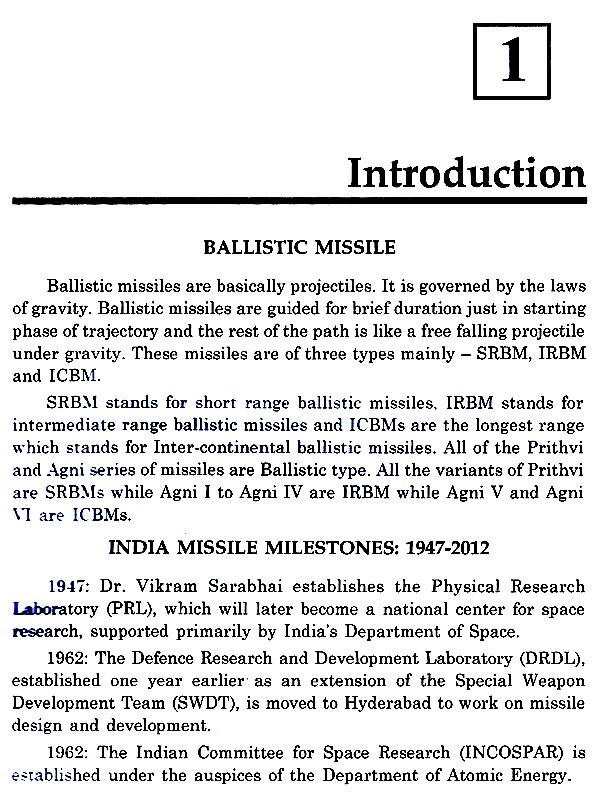
The Ballistic Missile Defence Program is an initiative to develop and deploy a multi-layered ballistic missile defence system to protect India from ballistic missile attacks. Ballistic missiles are basically projectiles. It is governed by the laws of gravity. Ballistic missiles are guided for brief duration just in starting phase of trajectory and the rest of the path is like a free falling projectile under gravity. These missiles are of three types mainly - SRBM, IRBM and ICBM. Strategic ballistic missiles can be divided into two general categories according to their basing mode: those that are launched from land and those launched at sea (from submarines beneath the surface). They also can be divided according to their range into intermediate-range ballistic missiles(IRBMs) and intercontinental ballistic missiles(ICBMs). Ballistic Missile Defence programme was launched in 1999 in the wake of Pakistan's maiden nuclear test in 1998 and China's leaps in this sphere. BMD works on two levels - endo-atmospheric (within Earth's atmosphere) and exo-atmospheric (the space stretching beyond the Earth's atmosphere). While phase one deals with destroying incoming missiles at endo-atmospheric level, phase two deals with the same in exo-atmospheric level. India's BMD arsenal consists of a Prithvi Air Defence (PAD) missile to take out incoming missiles at a range of about 80 km in altitude and an Advanced Air Defence (AAD) missile for altitudes of 15-25 km. It is hoped that the book would be of great value to the researchers and students of defence studies and the common readers.
The Ballistic Missile Defence Program is an initiative to develop and deploy a multi-layered ballistic missile defence system to protect India from ballistic missile attacks. Ballistic missiles are basically projectiles. It is governed by the laws of gravity. Ballistic missiles are guided for brief duration just in starting phase of trajectory and the rest of the path is like a free falling projectile under gravity. These missiles are of three types mainly - SRBM, IRBM and ICBM. Strategic ballistic missiles can be divided into two general categories according to their basing mode: those that are launched from land and those launched at sea (from submarines beneath the surface). They also can be divided according to their range into intermediate-range ballistic missiles(IRBMs) and intercontinental ballistic missiles(ICBMs). Ballistic Missile Defence programme was launched in 1999 in the wake of Pakistan's maiden nuclear test in 1998 and China's leaps in this sphere. BMD works on two levels - endo-atmospheric (within Earth's atmosphere) and exo-atmospheric (the space stretching beyond the Earth's atmosphere). While phase one deals with destroying incoming missiles at endo-atmospheric level, phase two deals with the same in exo-atmospheric level. India's BMD arsenal consists of a Prithvi Air Defence (PAD) missile to take out incoming missiles at a range of about 80 km in altitude and an Advanced Air Defence (AAD) missile for altitudes of 15-25 km. It is hoped that the book would be of great value to the researchers and students of defence studies and the common readers.
**Contents and Sample Pages**