

Thanjavur Paintings: Materials, Technique and Conservation
Book Specification
| Item Code: | IHK027 |
| Author: | C.B. Gupta |
| Publisher: | National Museum, New Delhi |
| Language: | English |
| Edition: | 2005 |
| ISBN: | 9788185832234 |
| Pages: | 76 (Illustrated Throughout In Full Color) |
| Cover: | Paperback |
| Other Details | 11.0 inch X 8.8 inch |
| Weight | 670 gm |
Book Description
Preface
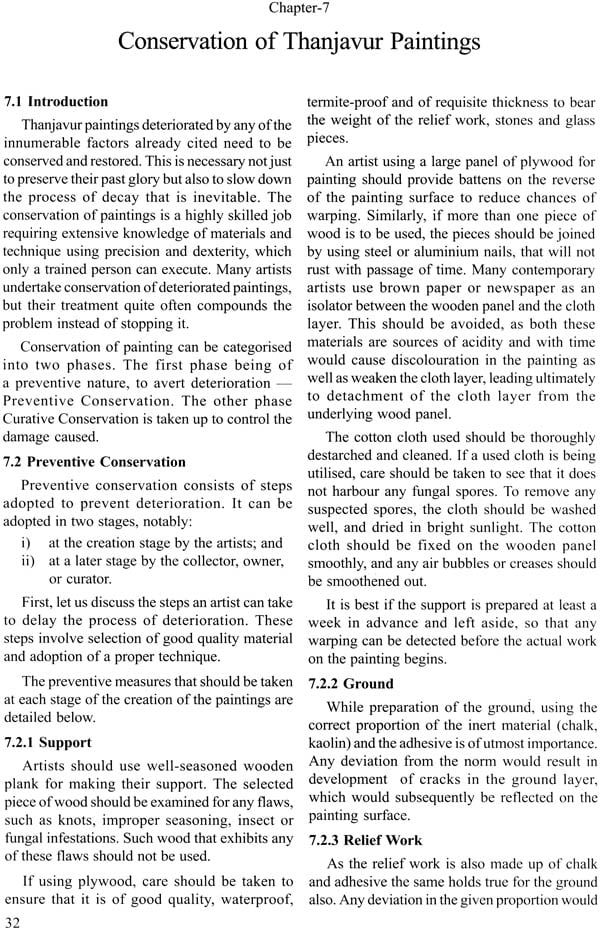
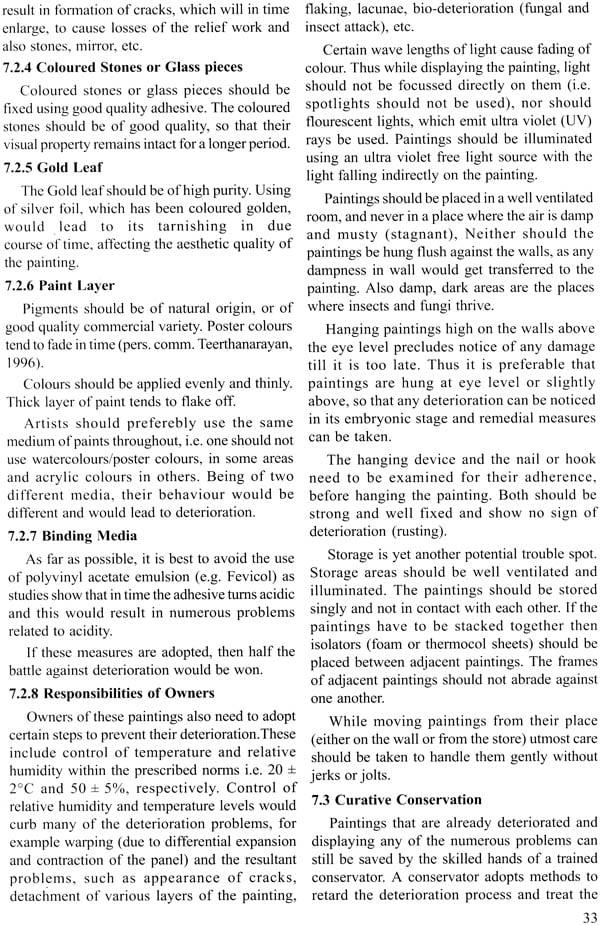
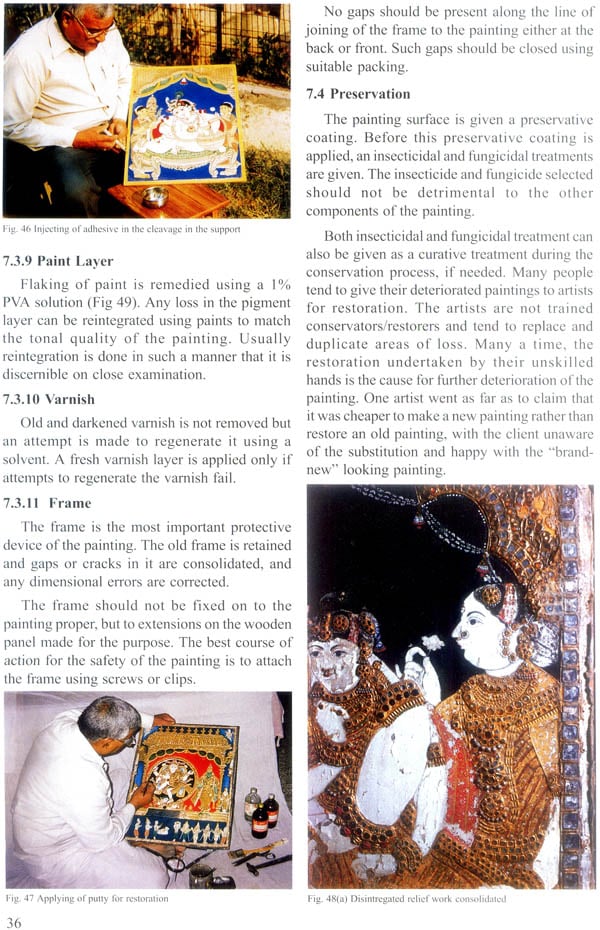
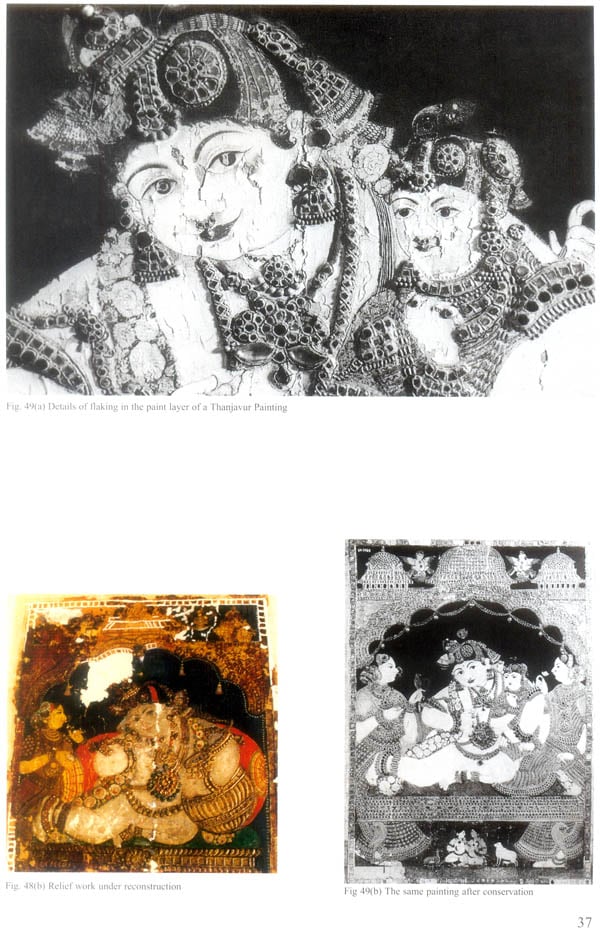
The religious iconic paintings of Thanjavur, popularized during the Maratha rule, were unknown till a couple of decades outside Tamil Nadu. The gem-encrusted, gold-covered paintings hung in the puja room of many a home, darkened and obscured under layers of dust and grime, away from prying eyes. The possession of these paintings was more for religious reasons than their aesthetic value. However, in the late 20th century, these paintings were coveted for their aesthetic uniqueness. The booming demand for these precious artifacts, resulted, on the one hand, in their preservation and restoration, and on the other, in the flooding of the market with fakes.
The renewed interest in this treasured art, saw the emergence of contemporary artists. The dying generation of traditional artists, their reluctance to reveal secrets of this family art to outsiders, the time consuming techniques and non-availability of traditional materials, compelled these contemporary artists to make do with existing and compromises on techniques.
The prestige linked to the possession of the antique Thanjavur Paintings, led the buyers to become an easy prey to unscrupulous dealers and forger. The near-scientific techniques of detection. These situations gave rise to an imminent need for greater and indepth knowledge of the technique, materials utilized, and the distinguishing features of this specialized school of art, as well as problems associated with their preservation. However, literature regarding these paintings is exiguous. Added to this, the reluctance of the surviving traditional artists to reveal the secrets of this art to all and sundry, created a need for a compilation of the available information.
This book seeks to meet this requirement. An effort has been made to collect all available information, by contacting existing traditional practitioners and culling from other sources all relevant material.
An attempt has been made to shed light on various aspects like historical evolution of paintings at Thanjavur, materials and methods used by both traditional and contemporary artists, problems of deterioration of these paintings and their conservation by detecting and combating fakes. The authors hope that this book would be an eye-opener to the various aspects of this traditional art and would create necessary impetus for further research to fill the existing lacunae.
About the Authors
Shri. C. B. Gupta was born on 13 March 1943, in the village of Tauru, Gurgaon district, Haryana. In addition to B.Sc degree from Punjab Technical University, LLB degree, and Diploma in Administration Law, he has acquired professional qualification in preservation and restoration of works and antiquities from ICCROM, Rome, and various institutions and conservation laboratories in Italy and London. He was deputed to All Unions Research Institute of Restoration, Moscow (USSR), as an Indian Expert. He was deputed to collect Thanjavur and Mysore paintings from throughout India for the Festival of India, held at Leningrad and has treated and restored all the paintings sent for the Festival.
He has traveled widely, visiting various institutions, conservation laboratories, museums, archives and libraries in Brussels, Amsterdam, Geneva, Paris, Moscow, Leningrad, Irewan (USSR), Nepal, Singapore, USA, and Japan. He has published 38 papers in various journals as well as 4 papers, in French, on the technique, materials, and conservation of paintings, published by ICCR.
He is a visiting faculty member at the National Museum Institute, New Delhi, and Delhi Institute of Heritage Research and Management (Govt. of N.C.T. of Delhi) teaching Art Conservation; Vice President, Indian Association for the study of Conservation of Cultural Property (IASC); Life Member, Museum Association of India; Member of Indian Heritage Society, and Member for eastern Paintings.
Mrinalini Mani, after an M.Phil degree in Conservation and Restoration of Works of Art, from the National Museum Institute of History of Art, Conservation and Museology (Deemed to be a University), New Delhi. She was awarded the T.R. Gairola Gold Medal for topping the course. Having learnt the art of Thanjavur painting, she pursued it as a topic for her dissertation. She was granted the Small Study and Research Award (India) by Nehru Trust for the Indian Collections at the Victoria and Albert Museum.
She has presented papers on conservation at various national seminars, which have been subsequently published. As a freelance conservator, she has been involved in various conservation projects notable being those at Veerabhadraswamy temple, Lepakshi, Andhra Pradesh; IGNCA, New Delhi; Bagore ki Haveli, Udaipur, Rajasthan and Sri Rangji Temple, Vrindavan, Uttar Pradesh.
| Foreword | V | |
| Acknowledgement | VI | |
| Preface | VII | |
| About the Authors | VIII | |
| 1 | Introduction | 1 |
| 2 | Thanjavur Paintings-A Literature Review | 4 |
| 3 | Historical Evolution of Paintings at Thanjavur | 6 |
| 4 | Traditional Materials and Technique | 10 |
| 5 | Contemporary Materials and Technique | 19 |
| 6 | Deterioration of Thanjavur Paintings | 26 |
| 7 | Conservation of Thanjavur Paintings | 32 |
| 8 | Authentication of Thanjavur Paintings | 39 |
| Glossary | 41 | |
| Reference | 43 | |
| Appendix | 45 | |
| Maps | 49 | |
| Plates | 55 |