About the Book The present work by Dr. Subhasis Barua provides a comprehensive study of Buddhism in China. The book focuses on the introduction of Buddhism in China and its spread and development in China up till C.E., 1000. The book explores how Buddhism in China attained fresh meaning of the Triple Gem. The book reflects how Buddhism developed in China and resistance faced by Buddhism in different tenures and forms. The book discusses on Chinese Tripitak, impact of Buddhism on the cave paintings in China as well as on Chinese art and architecture, translation of Buddhist sculptures in Chinese language etc. The books have further discussion on Indian Buddhist scholars in China and Chinese Buddhist Scholars and Pilgrims in India with special reference to Xuan Zang. Focus made on the cultural experience of Buddhism in China. We, therefore, believe that it will be received enthusiastically by scholars and students of Indian Buddhism as comprehensive work on the subject with a new approach from an authoritative pen.
About the Author Dr. Subhasis Barua alias Ven. Bhikkhu Sumanapal (monkhood name) obtained his Ph. D degree from Calcutta University in the year 2011. He was also honoured with Diploma in Chinese, Tibetan and Hindi Languages from esteemed Calcutta University. Further he is certificate course in Manuscript logy and Paleography from Jadavpur University. He also acquired Monastic education qualification on subject - Pali viz., Vinay Adya, Vinay Madhya & Vinay Upadhi, Sutta Adya, Sutta Madhya, Sutta Upadhi, and Abhidhamma Adya.
In his short career he participated in around thirty five national conferences and around fifteen International Conferences, seminars and workshops held at West Bengal, Visva-Bharati University, Rabindra Bharati University, Jadavpur University, Mumbai University, Nava Nalanda Demmed University etc. in addition to sixteen workshops on National International Levels. He also preside several UGC national seminars.
Among his other major works includes Research Publications and editor of twenty publications. He is also editor of "Nalanda" a Buddhist Journal apart of editor/co-editor with the study of History with Buddhism in particular. He has published ten Volumes along with eight Book reviews. About hundred articles are published in English and Bengali.
Dr. Subhasis Barua has been honoured with national scholarship from Calcutta University, and two time enjoy ICCR scholarship, Govt of India. He is also Life Member of Asiatic Society, Indian History Congress, Institute of Historical Studies, Paschimbanga Itihas Samsad, Bangiya Sahitya Parisat, Kolkata. Apart from his publication, review works he is also guest lecturer, Dept. of Languages, Calcutta University.
Foreword Ashoka the great helped Buddhism to spread throughout India, South Asia and South-East Asia as well. An shi gao who carried many Buddhist texts to Lou-yang in C.E. 148 and translated 555 of them. San Kou shih says that the teaching of the Buddha was transmitted by Yi Tsun to Ching Lu (c.2 B.C.E.). This is definitely more plausible than Emperor Ming Ti's dream. An shi gao made his translations at Lou-yang city which was established as a capital. Many Chinese Buddhist monasteries were established at Lou-yang, the Buddhists bad to flee tough opposition in China. Despite this challenge, Buddhism in China never ceased to exist. In a sense Buddhism became the bond of common interest between two great cultures -Indian and Chinese. The author has explained cultural ties between India and China since Buddhism in China entered a new phase with the printing of Tripitak. The learned author Bhikkhu Sumanapal (Subhasis Barua) has undertaken an excellent study of Buddhism in China up till 10th century C.E. It should be recognized as a source material for researches on Buddhism.
Preface Despite the fact that the boundless Himalayas, the table land of Tibet and the cruel desert separate the two neighboring countries Indian and China, they are closely related to each other with cultural ties since time immemorial. The first link between the two cultures took place through the spread of Buddhism in China, as early as during the first century after Christ. The presence book focuses on the introduction of Buddhism in China and its spread and development in China till C.E. 1000. It seeks to explore how Buddhism in China attained fresh meanings of the Triple Gem, which have been reflected in Chinese literature and art during the period of our study. And it goes without saying that the Sinicised version of Buddhism still lingers in China and leads the masses on from the encircling gloom.
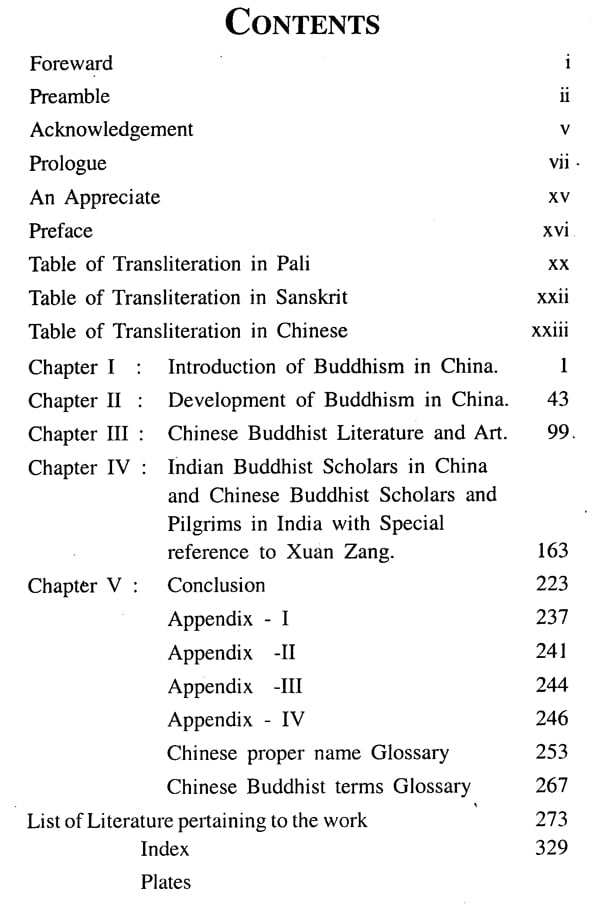
In the first chapter of this work is entitled 'Introduction of Buddhism in China.' I have dwelled on the geographical chasm of China and I have tried to trace how Buddhism reached China as early as in the first century C.E.
The second chapter is Development of Buddhism in China. In this chapter I discuss how Buddhism developed in China and the first century have been traced. Dynasties came and went. Buddhism had to face royal displeasure four times in the main. It 'was out lowed again and again. The third chapter of the present work deals with 'Chinese Buddhist literature and art' which mainly consists of translation of Buddhist scripture into Chinese language. It constitutes the Chinese Tripitak, while the Tripitak or canonical literature which consists of Buddhavacana in Pali language. The third chapter describes on the impact of Buddhism on the cave paintings in China as well as on Chinese art and architecture. The fourth chapter of the present work focuses on 'Indian Buddhist Scholars in China and Chinese Buddhist Scholars and Pilgrims in India with special reference to Xuan Zang.'
Book's Contents and Sample Pages