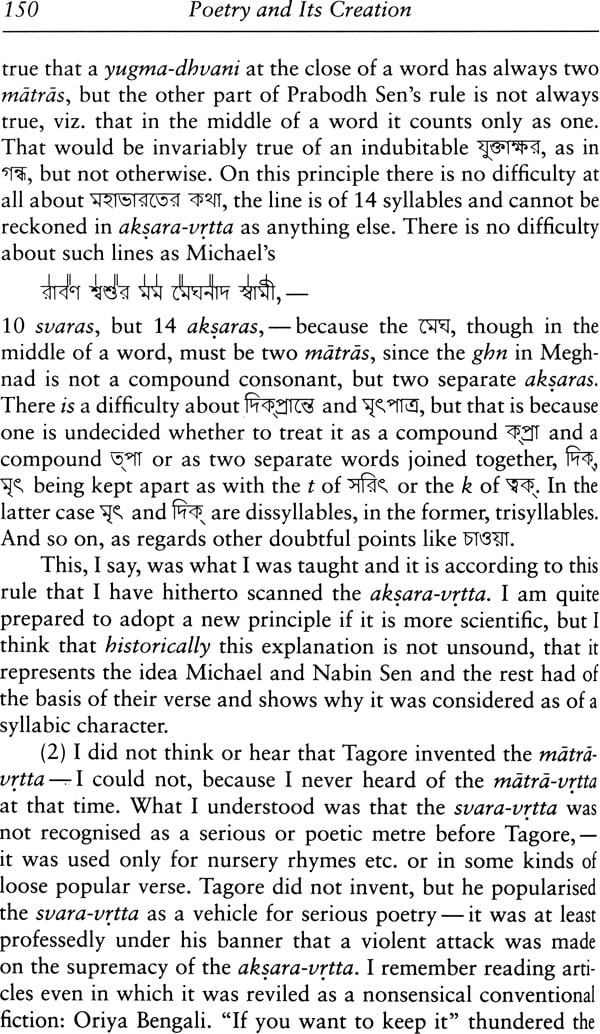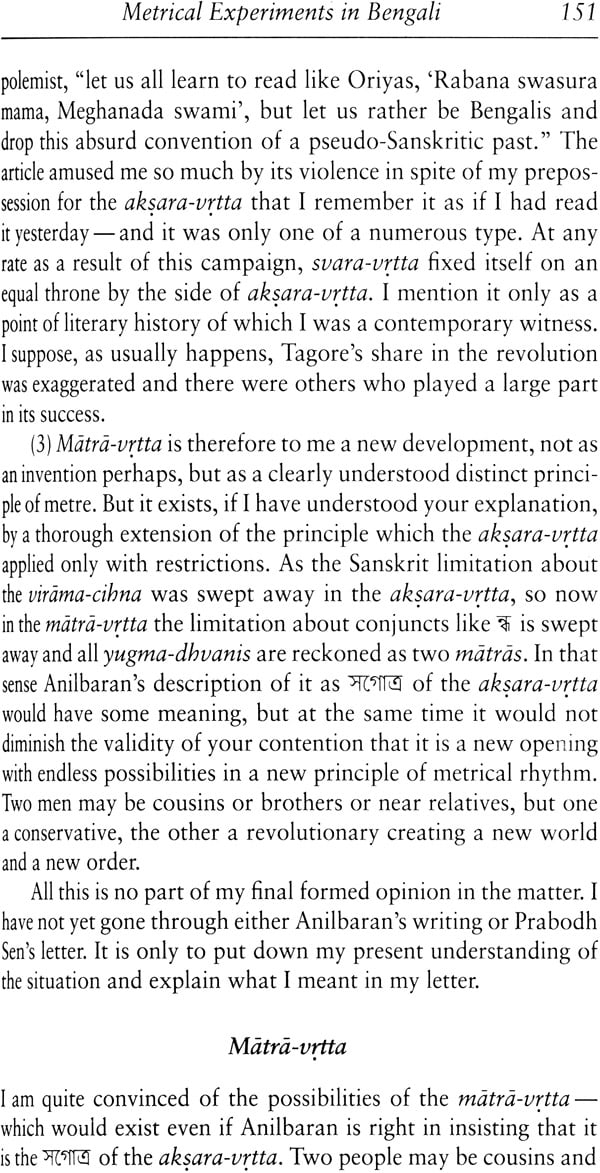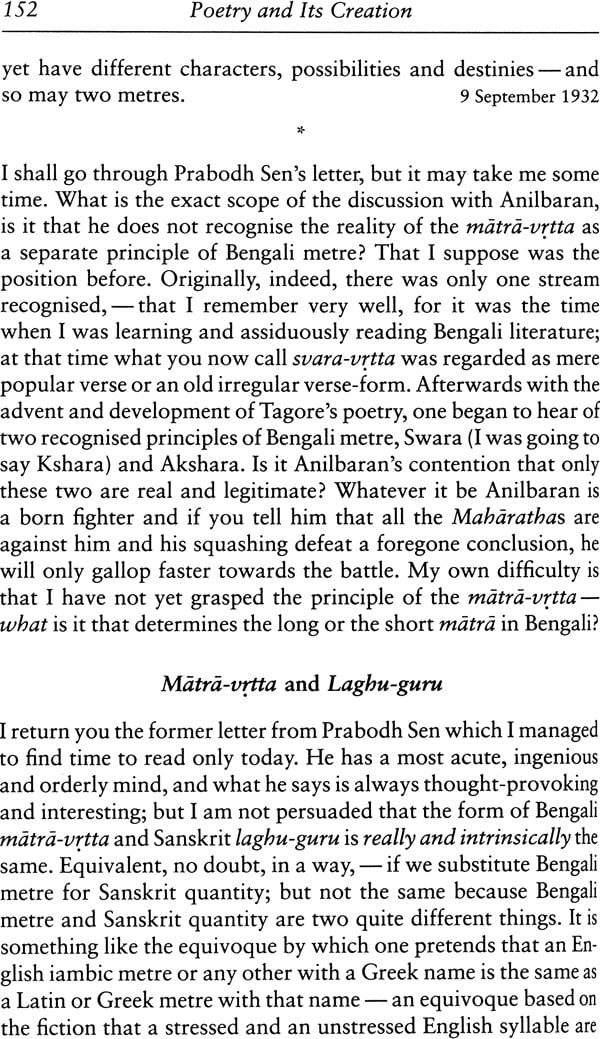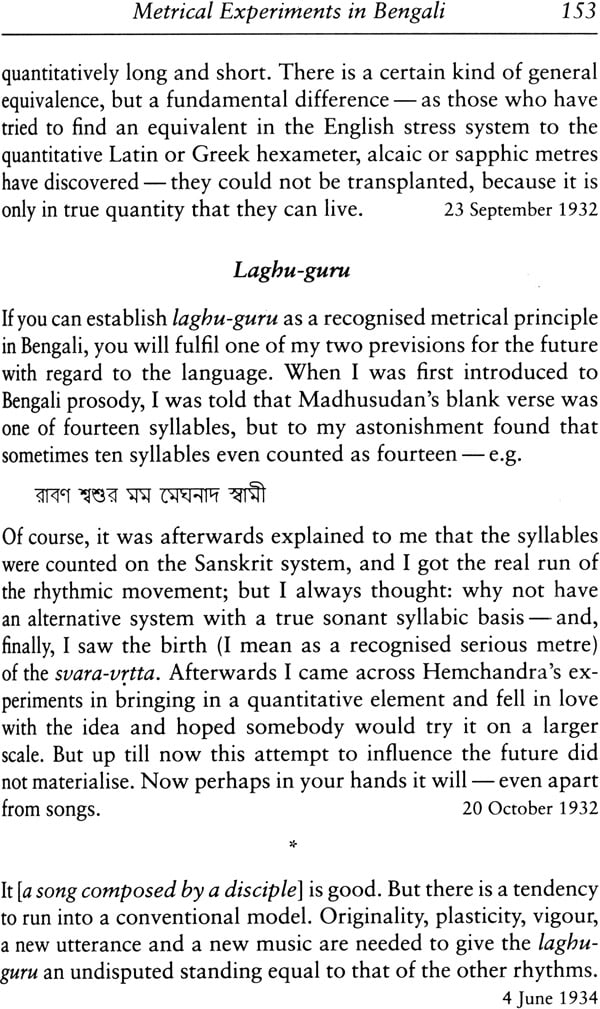


Letters on Poetry and Art
Book Specification
| Item Code: | NAH915 |
| Author: | Sri Aurobindo |
| Publisher: | Sri Aurobindo Ashram, Pondicherry |
| Language: | English |
| Edition: | 2016 |
| ISBN: | 9789352100989 |
| Pages: | 777 |
| Cover: | Paperback |
| Other Details | 8.5 inch X 5.5 inch |
| Weight | 1 kg |
Book Description
About The Book
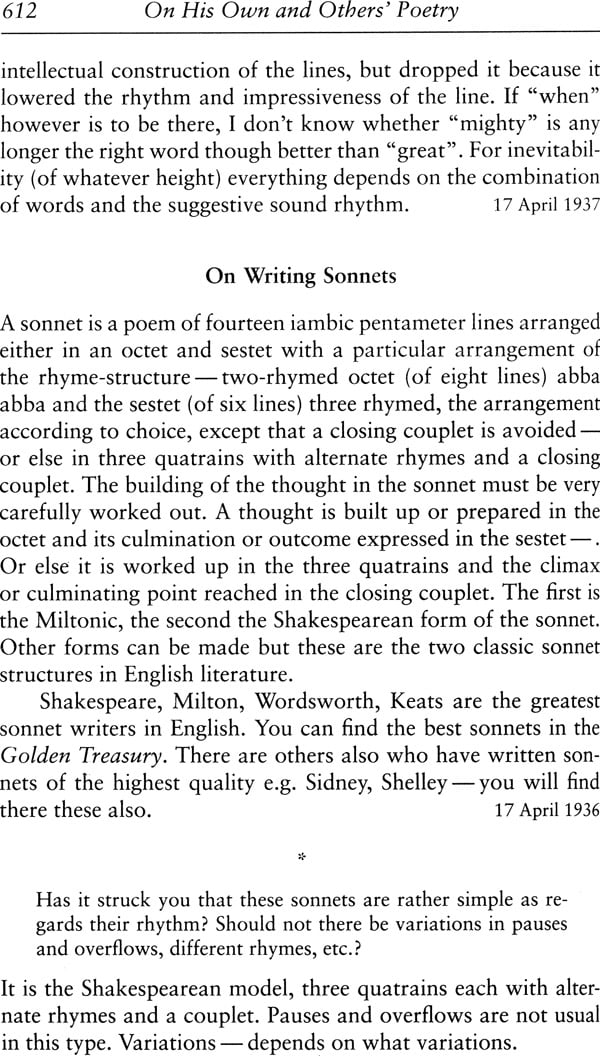
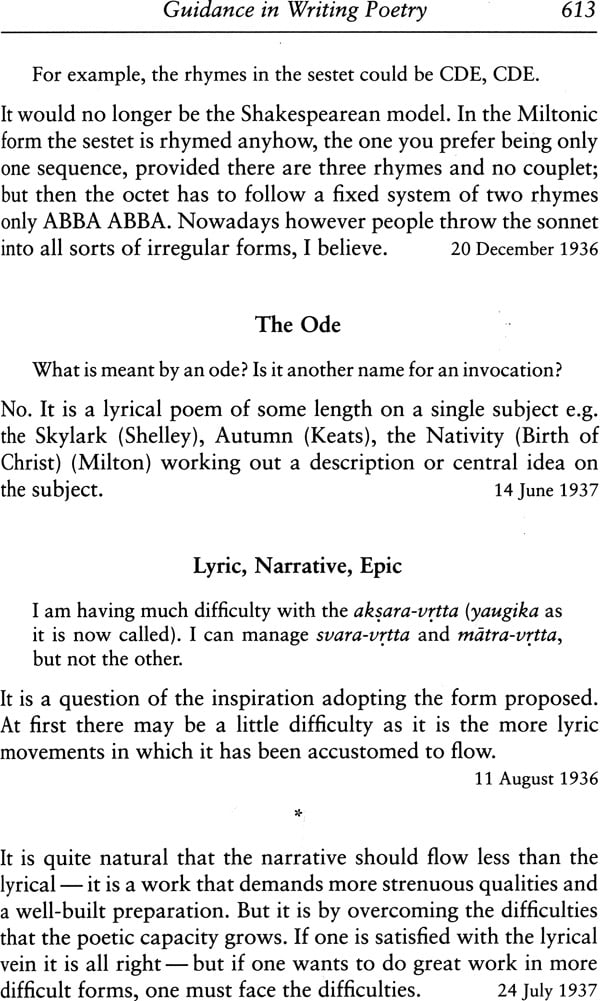
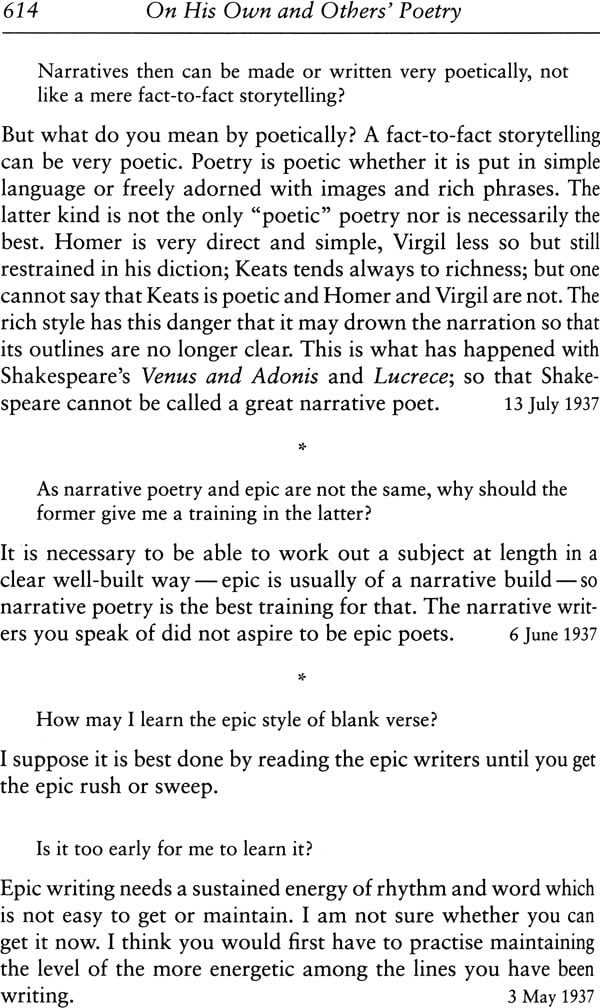
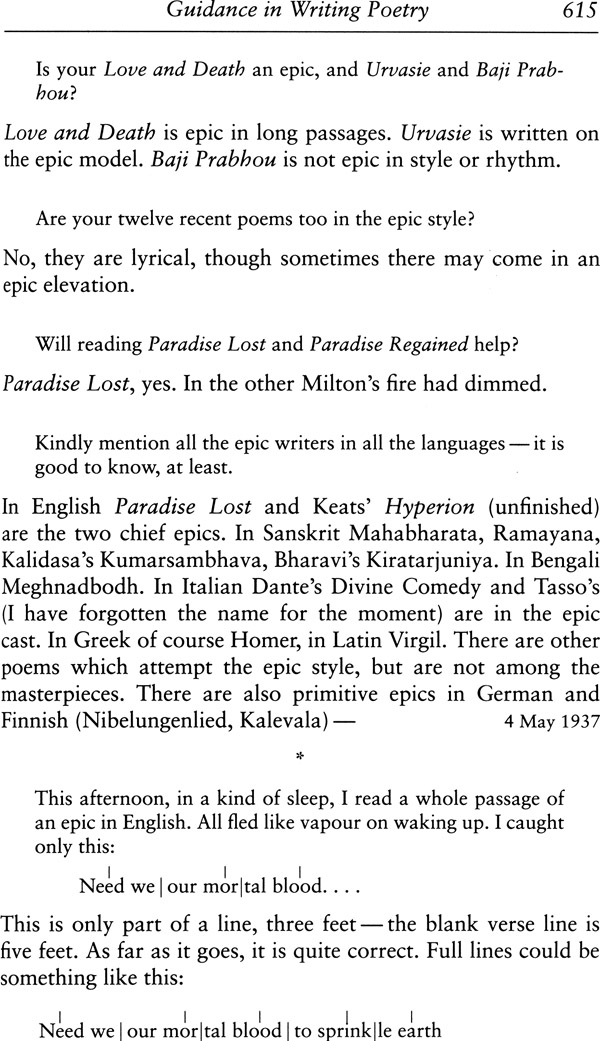
This volume comprises letters written by Sri Aurobindo on poetry, literature, art and aesthetics, and their relation to the practice of Yoga. He wrote most of the letters to members of his Ashram during the 1930s and 1940s, primarily between 1931 and 1937.
Before the present volume, collections 01 Sri Aurobindo's letters on poetry and art had been published in three different books. In this volume they are appearing together for the first time. Moreover, the volume contains about 500 letters that did not appear in any of the previous collections.
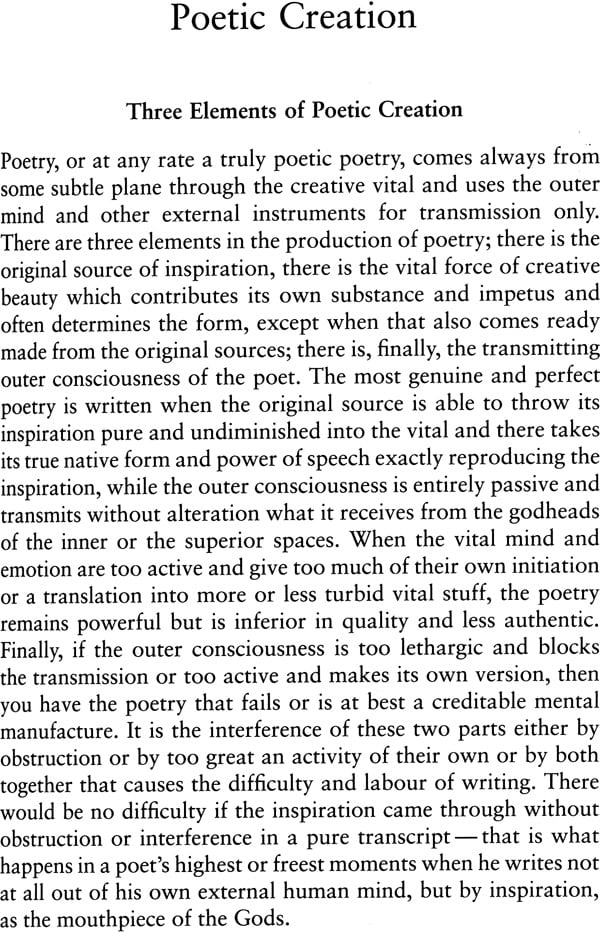
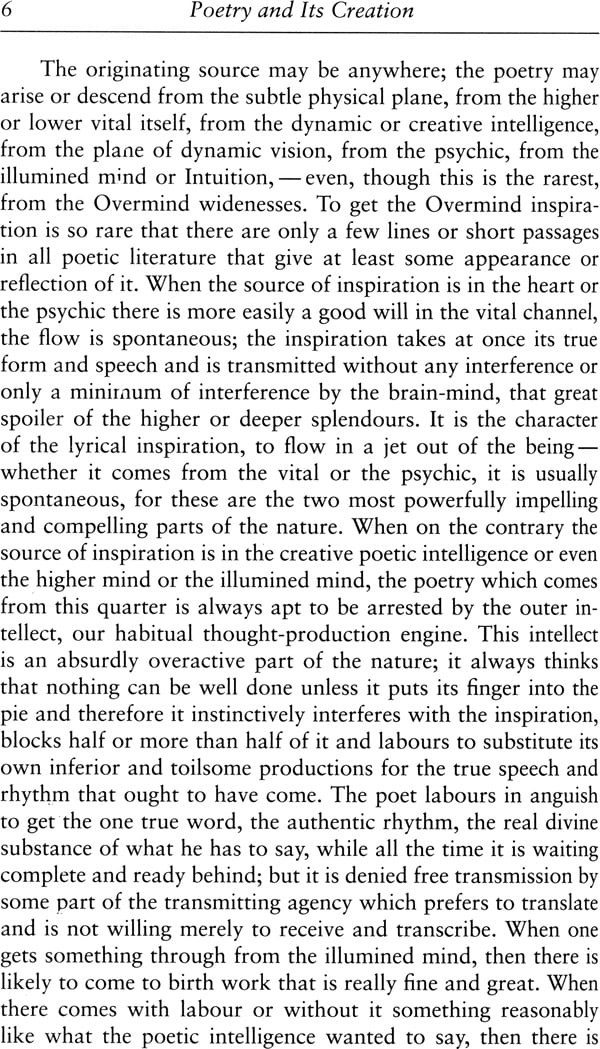
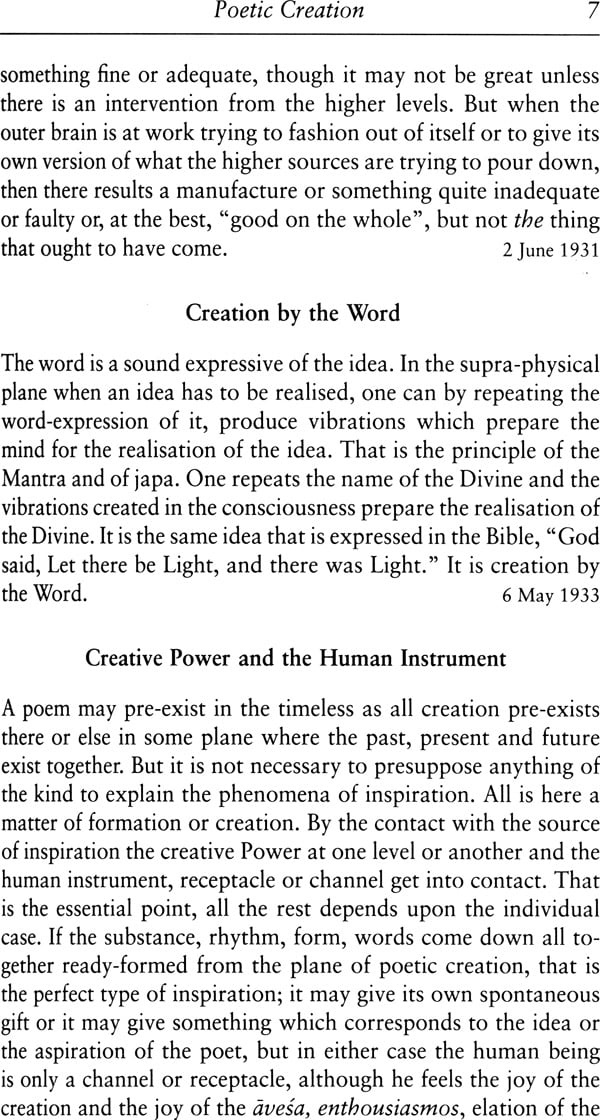
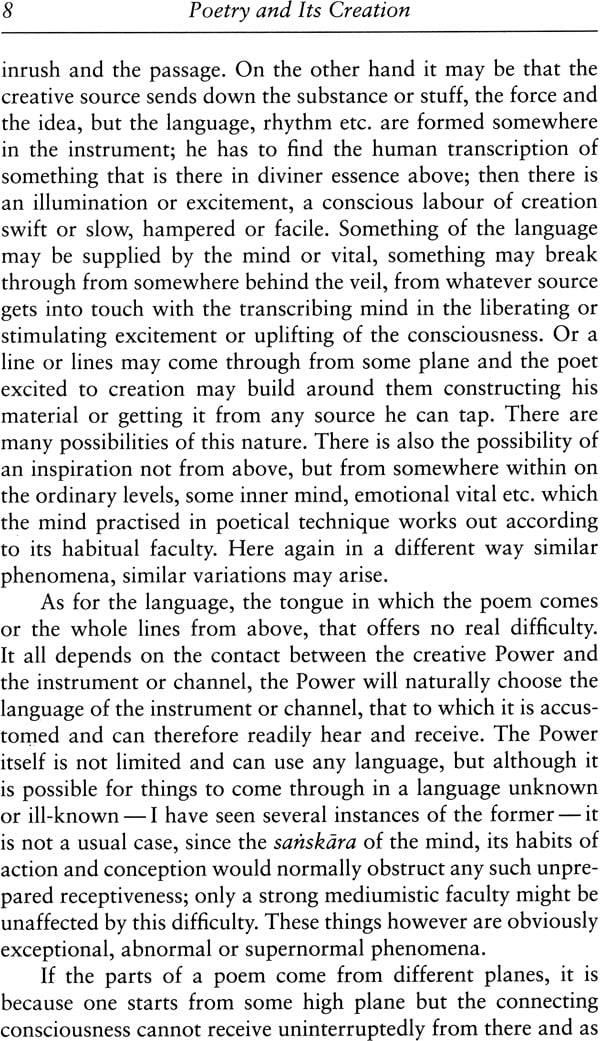
In these letters Sri Aurobindo speaks about his own poetry, the poetry of his disciples, and the works of the world's great poets. He speaks also about the various levels of poetic inspiration and the process of poetic creation. To aspiring writers he offers practical guidance. To spiritual seekers he explains the value of literary, artistic and musical activities in the practice of Yoga. Within the intimacy of private correspondence, these letters reveal Sri Aurobindo's vision of the role of poetry and the arts in human development.
About the Author
Sri Aurobindo was born in Calcutta on 15 August 1872. At the age of seven he was taken to England for his education. He studied at St. Paul's School, London, and at King's College, Cambridge. Returning to India in 1893, he worked for the next thirteen years in the Princely State of Baroda in the service of the Maharaja and as a professor in the state's college.
In 1906 Sri Aurobindo quit his post in Baroda and went to Calcutta, where he became one of the leaders of the Indian nationalist movement. As editor of the newspaper Bande Mataram, he put forward the idea of complete independence from Britain. Arrested three times for sedition or treason, he was released each time for lack of evidence.
Sri Aurobindo began the practice of Yoga in 1905. Within a few years he achieved several fundamental spiritual realisations. In 1910 he withdrew from politics and went to Pondicherry in French India in order to concentrate on his inner life and work. Over the next forty years, he developed a new spiritual path, the Integral Yoga, whose ultimate aim is the transformation of life by the power of a supramental consciousness. In 1926, with the help of his spiritual collaborator the Mother, he founded the Sri Aurobindo Ashram. His vision of life is presented in numerous works of prose and poetry, among the best known of which are The Life Divine, The Synthesis of Yoga, Essays on the Gita and Savitri. Sri Aurobindo passed away on 5 December 1950.
Contents
| Part One | Poetry and Its Creation | |
| Section One | The Sources of Poetry | |
| Poetic Creation | 5 | |
| Sources of Inspiration | 14 | |
| Overhead Poetry | 20 | |
| Examples of Overhead Poetry | 50 | |
| Section Two | The Poetry of the Spirit | |
| Psychic, Mystic and Spiritual Poetry | 83 | |
| Poet, Yogi, Rishi, Prophet, Genius | 102 | |
| The Poet and the Poem | 106 | |
| Section Three | Poetic Technique | |
| Technique, Inspiration, Artistry | 117 | |
| Rhythm | 124 | |
| English Metres | 128 | |
| Greek and Latin Classical Metres | 137 | |
| Quantitative Metre in English and Bengali | 141 | |
| Metrical Experiments in Bengali | 145 | |
| Rhyme | 155 | |
| English Poetic Forms | 157 | |
| Substance, Style, Diction | 164 | |
| Grades of Perfection in Poetic Style | 185 | |
| Examples of Grades of Perfection in Poetic Style | 188 | |
| Section Four | Translation | |
| Translation: Theory | 199 | |
| Translation: Practice | 201 | |
| Part Two | On His Own And Others' Poetry | |
| Section One | On His Poetry and Poetic Method | |
| Inspiration, Effort, Development | 211 | |
| Early Poetic Influences | 219 | |
| On Early Translations and Poems | 223 | |
| On Poems Published in Ahana and Other Poems | 227 | |
| Metrical Experiments | 231 | |
| On Some Poems Written during the 1930s | 239 | |
| On Savitri | 261 | |
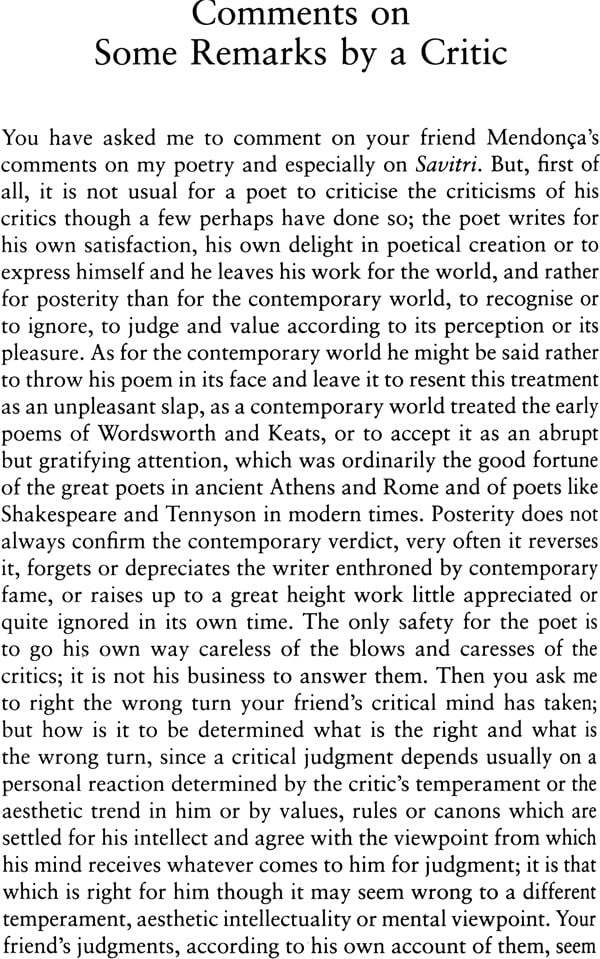
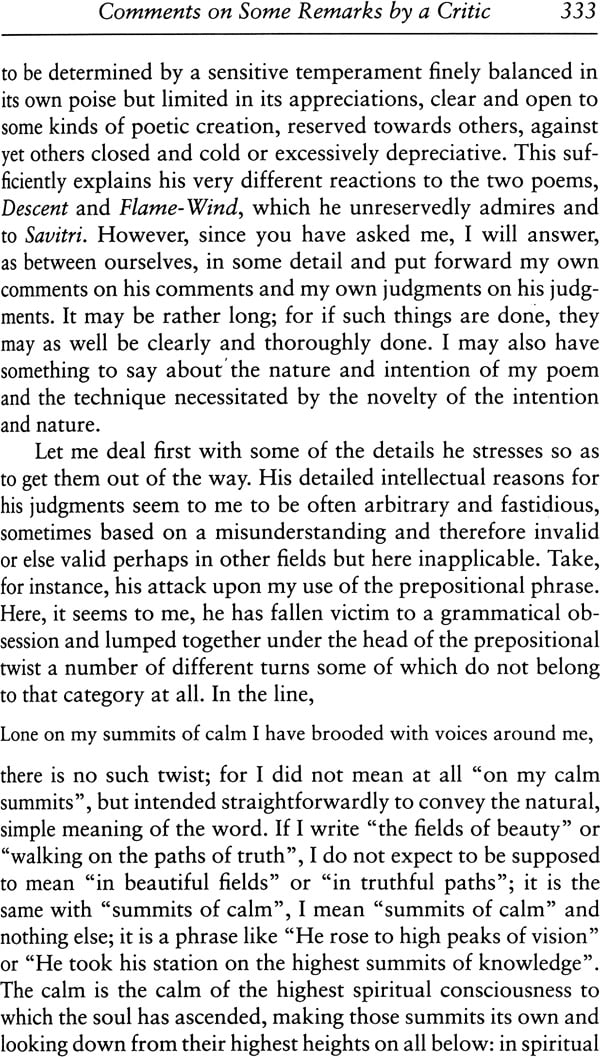
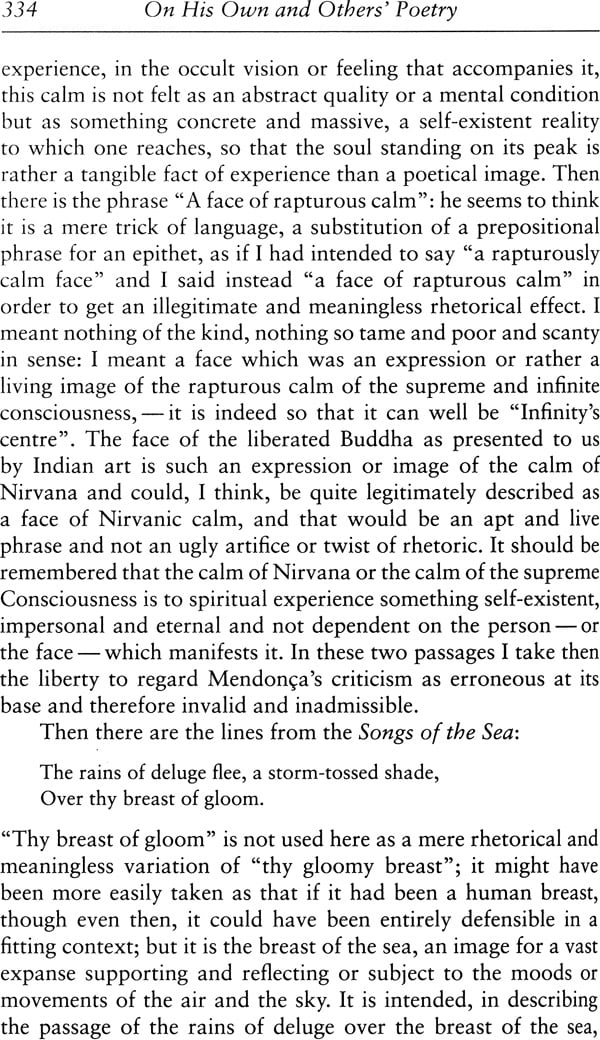
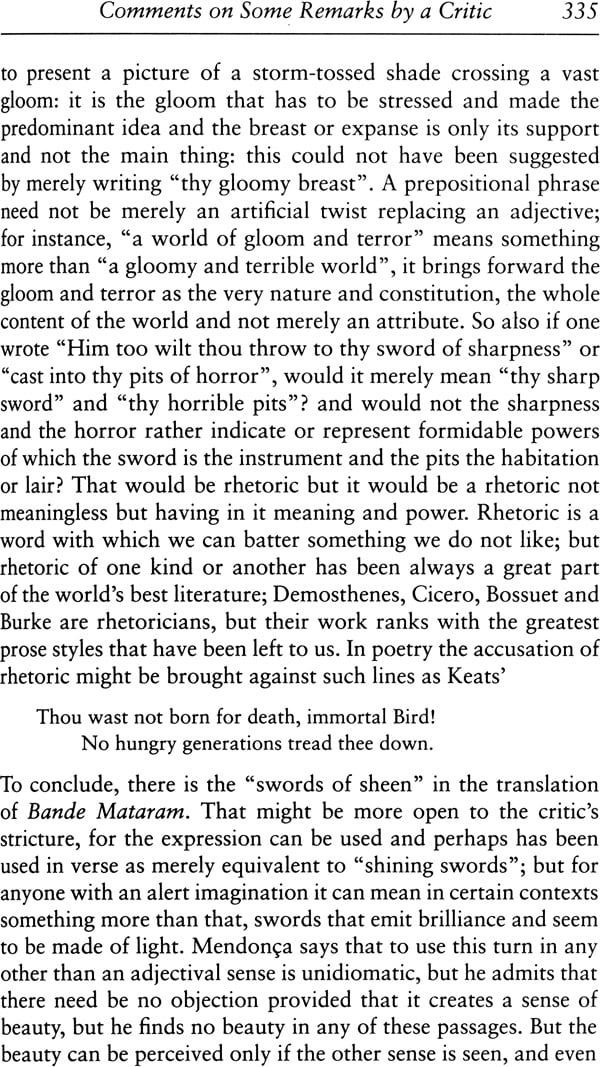
| Comments on Some Remarks by a Critic | 332 | |
| On the Publication of His Poetry | 359 | |
| Section Two | On Poets and Poetry | |
| Great Poets of the World | 367 | |
| Remarks on Individual Poets | 372 | |
| Comments on Some Examples of Western Poetry (up to 1900) | 387 | |
| Twentieth-Century Poetry | 412 | |
| Comments on Examples of Twentieth-Century Poetry | 430 | |
| Indian Poetry in English | 442 | |
| Poets of the Ashram | 453 | |
| Comments on the Work of Poets of the Ashram | 467 | |
| Philosophers, Intellectuals, Novelists and Musicians | 519 | |
| Comments on Some Passages of Prose | 554 | |
| Section Three | Practical Guidance for Aspiring Writers | |
| Guidance in Writing Poetry | 567 | |
| Guidance in Writing Prose | 627 | |
| Remarks on English Pronunciation | 629 | |
| Remarks on English Usage | 640 | |
| Remarks on Bengali Usage | 656 | |
| Part Three | Literature, Art, Beauty and Yoga | |
| Section One | Appreciation of Poetry and the Arts | |
| Appreciation of Poetry | 663 | |
| Appreciation of the Arts in General | 675 | |
| Comparison of the Arts | 678 | |
| Appreciation of Music | 682 | |
| Section Two | On the Visual Arts | |
| General Remarks on the Visual Arts | 685 | |
| Problems of the Painter | 687 | |
| Painting in the Ashram | 692 | |
| Section Three | Beauty and Its Appreciation | |
| General Remarks on Beauty | 699 | |
| Appreciation of Beauty | 705 | |
| Section Four | Literature, Art, Music and the Practice of Yoga | |
| Literature and Yoga | 711 | |
| Painting, Music, Dance and Yoga | 733 | |
| Appendixes | ||
| Appendix 1 | The Problem of the Hexameter | 743 |
| Appendix II | An Answer to a Criticism | 745 |
| Appendix III | Remarks on a Review | 749 |
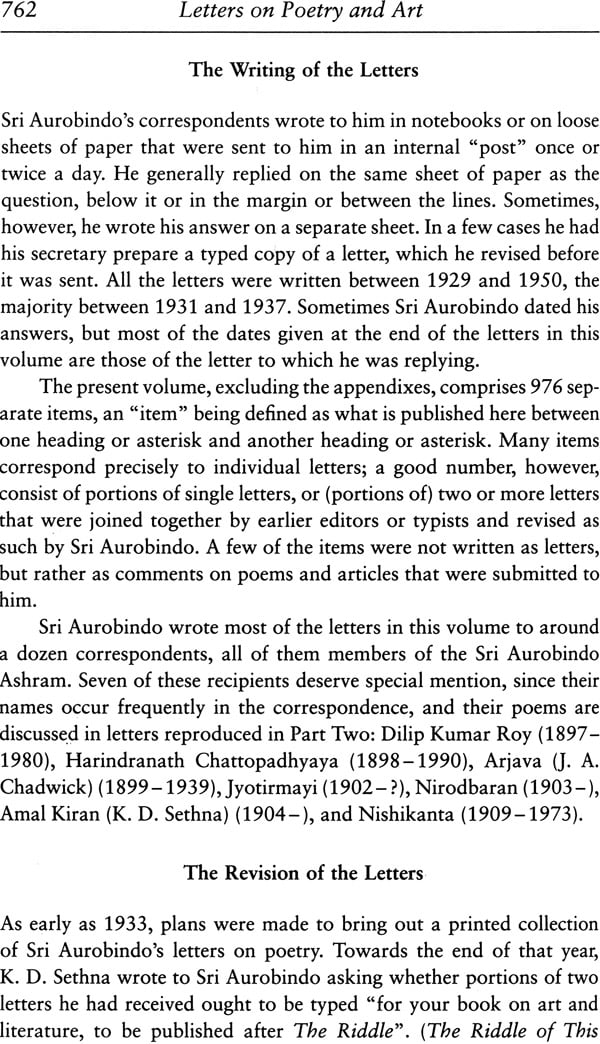
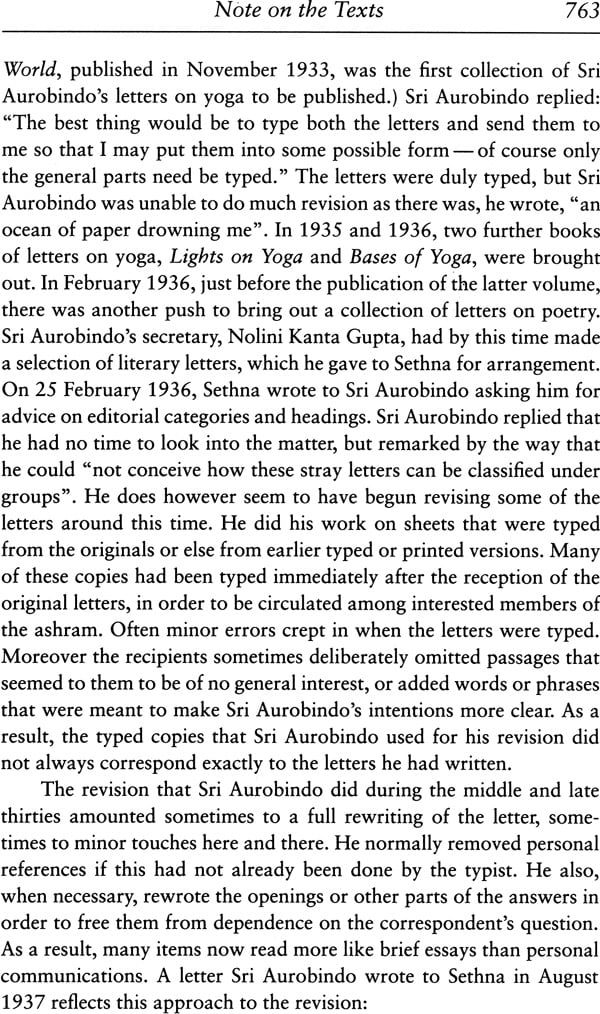
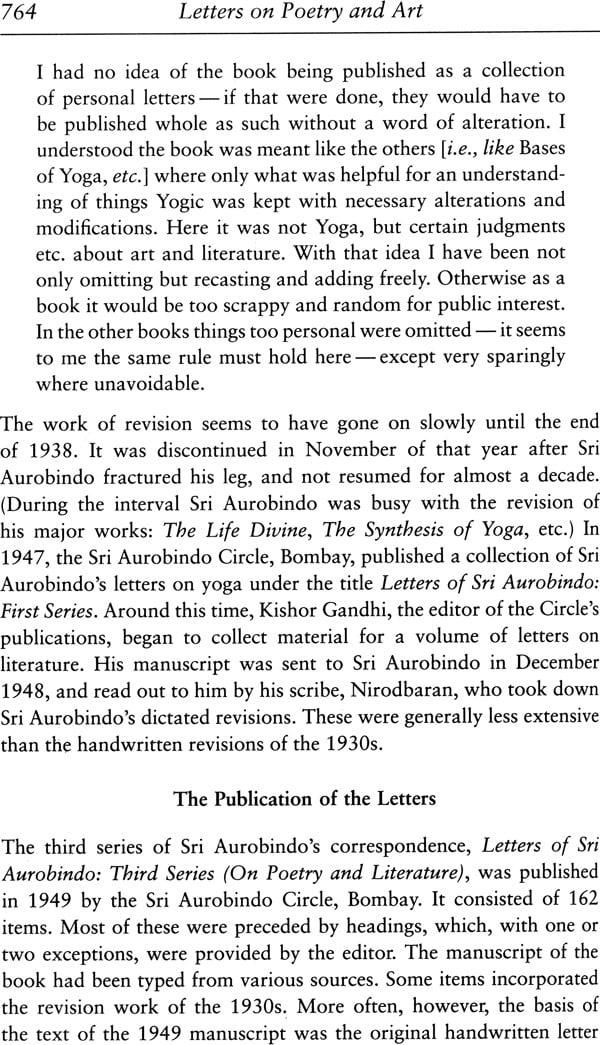
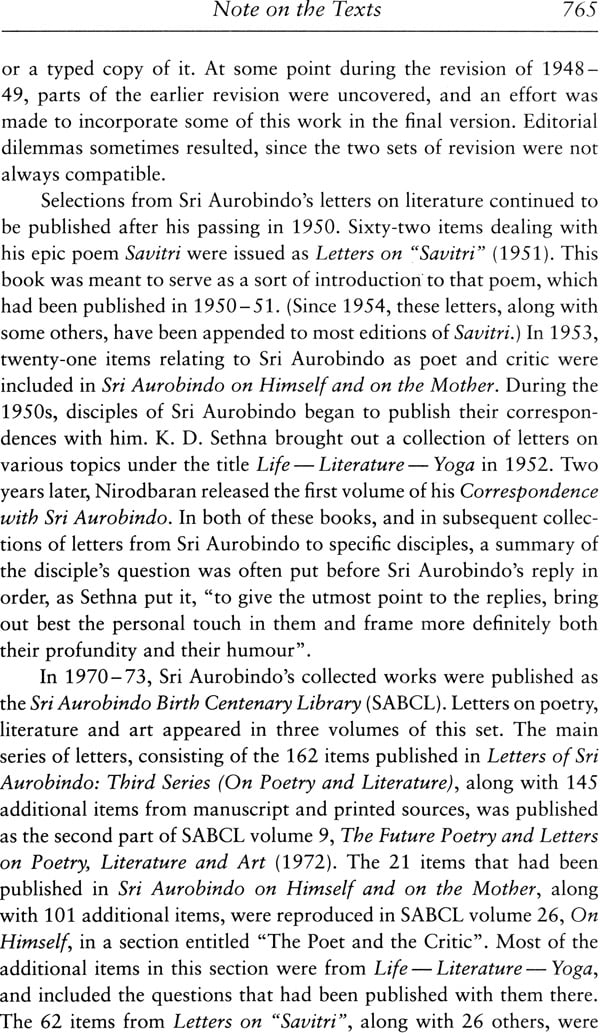
| Note On The Texts | 759 |
Sample Pages