

Manual of Pali
Book Specification
| Item Code: | IDJ091 |
| Author: | Prof. C. V. Joshi |
| Publisher: | Chaukhamba Sanskrit Pratishthan |
| Language: | English |
| Edition: | 2005 |
| ISBN: | 8170842502 |
| Pages: | 158 |
| Cover: | Paperback |
| Other Details | 8.4" X 5.4" |
Book Description
Introduction
The Pali language was derived from Vedic Sanskrit; its former name appears to have been Magadhi, the dialect of the Magadha country. The name Pali to the language was given later. Really speaking Pali ( a line ) is the Tripitaka text as distinguished from the Tika or commentary, the latter always referring to the former as Pali. Gradually the connotation of the word was enlarged and it came to be applied to every composition in Magadhi and consequently to the language itself.
2. The language was the vernacular of ancient Magadha, in which the great Buddha preached his doctrine to every man and Asoka inscribed his immortal message to generations. A study of Pali is of great use to the students of Philosophy, ancient history and philology. Yet the want of a suitable text-book on Pali grammar presented a great difficulty to the Indian student, who was already equipped with a knowledge of Sanskrit grammar and whose mother tongue consisted of a Sanskrit and Prakrit vocabulary, as similar to the Pali as any two Provincial dialects in the same country. The texts on Pali grammar treated the Pali forms without reference to the rules of Sanskrit grammar, but this method cannot explain numerous forms which are bodily taken from the corresponding Sanskrit ones. My method is to follow Pali rules as far as practicable and to point to the Sanskrit formations when Pali rules are not adequate to explain them.
3. In the treatment of the verbs, I am following the Sanskrit system with its ten conjugations and not the Pali one with its seven. The latter system which puts the roots us, hu, ha, tudh & c. under the 1st conjugation cannot account for the peculiarities in the conjugation of these verbs. I have not treated the Attanopada, which is rarely represented in literature except on a few occasions in Poetry and in the Passive voice, where too its presence is an exception rather than a rule. Similarly I have dispensed with the three preterite tenses in preference to a single Past Tense. In declension also I have avoided the multiplicity of forms in which the Pali grammarians indulge excessively.
4. Students wishing to appear for the Matriculation, Entrance or School leaving examination are recommended to study the elements of Sanskrit grammar before taking up Pali, a step which will facilitate their work. Those who are advanced in Sanskrit will find a study of Pali very delightful as it may form an acquaintance with the joining link between Sanskrit and their mothertongue.
5. A chart of the Roman, Burmese, Sinhalese, Siamese and Brahmi characters has been appended to the book for scholars who want to read Pali books printed outside India. All the Pali books are not yet available in the Devanagari characters but it is hoped that in the near future it will be an accomplished fact. The book has been recognised by University in and out of India, to whom the author is grateful.
| Lesson | Section | Subject | Page |
| I | 1 - 5 | The Alphabet | 1 |
| II | 6 - 9 | Rules of change | 3 |
| III | 10 - 11 | Declension of substantives | 9 |
| 12 | Mascoline nouns ending in Aa | 10 | |
| 13 | The padas | 11 | |
| 14 | The present Tense | 11 | |
| 15 | The 1st conjugation | 11 | |
| IV | 16 | Neut, nouns ending in Aa | 13 |
| 17 - 18 | The 2nd and 4th conjugations | 14 | |
| V | 19 | Fem nouns ending in Aaa | 17 |
| 20 - 21 | The 6th and 7th conjugations | 18 | |
| 22 | The use of Adjectives | 19 | |
| VI | 23 | Masc. nouns ending in e and au | 21 |
| 24 | The 10th conjugation | 22 | |
| 25 | The numeral dve | 23 | |
| VII | 26 | Neut. nouns ending in e and au | 25 |
| 27-28 | Prepositions & Indeclinables | 25 | |
| 29 | The 1st per. Pronoun Aha | 26 | |
| 30 | The numeral ti | 27 | |
| VIII | 31 | F. nouns ending in e and au | 29 |
| 32 - 33 | Prefixes ( upsagga ) | 30 | |
| 34 | The 2nd per.pron. tumh | 31 | |
| 35 | The numeral chatu | 31 | |
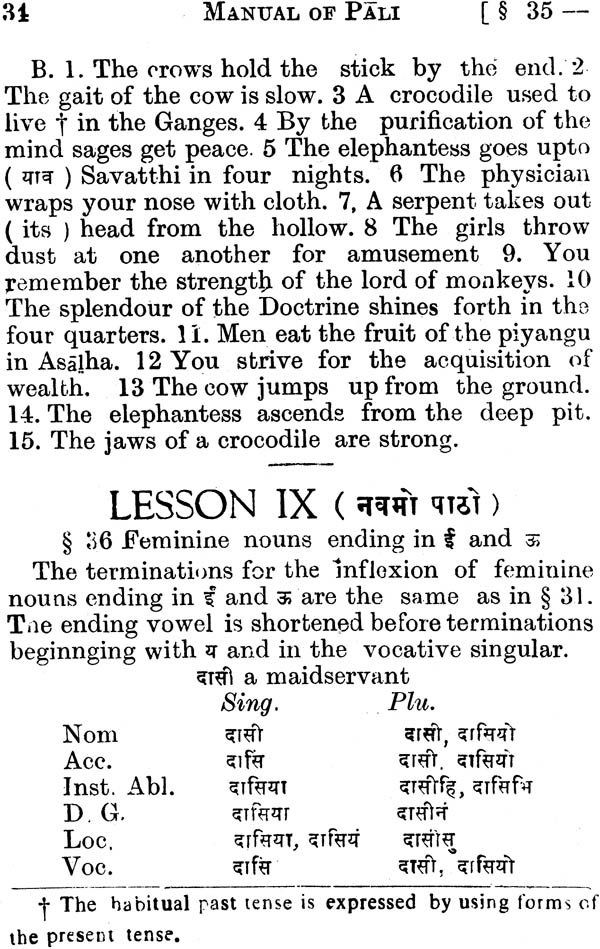
| IX | 36 | F. nouns ending in e and auu | 34 |
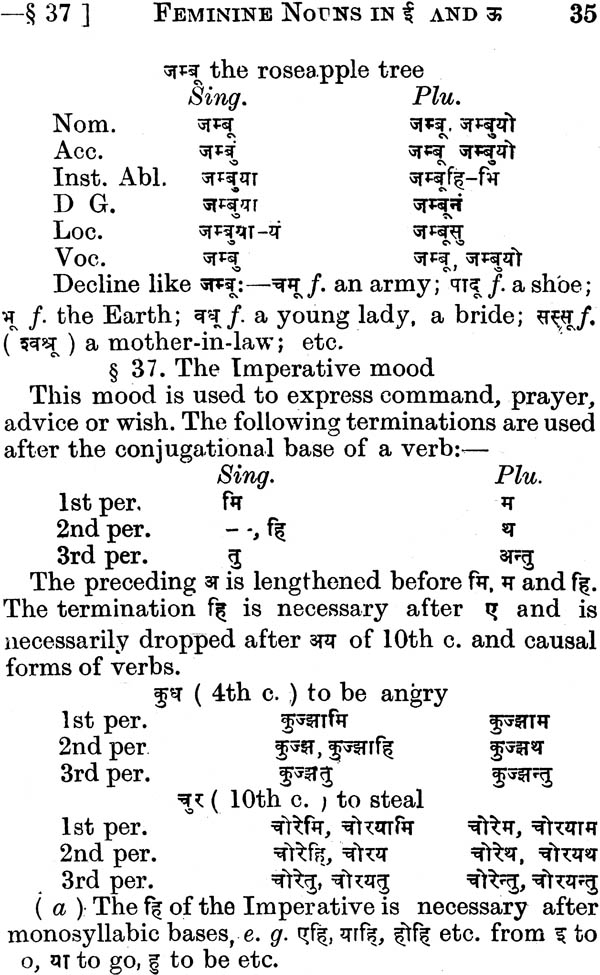
| 37 - 38 | The imperative mood | 35 | |
| 39 | The Attanopada | 36 | |
| 40 | The 3rd per. pron. (masc.) | 36 | |
| 41 | The numeral punch | 37 | |
| X | 42 - 45 | Nouns ending in in in Sansk. | 39 |
| 46 | Uppadtatpurish Compounnds | 41 | |
| 47 - 48 | The Future Tense | 42 | |
| 49 | The 3rd per. pron. (fem) | 42 | |
| 50 | Numerals from six to ten | 43 | |
| XI | 51-52 | Masc. And n. nouns ending in auu | 45 |
| 53 | Nouns ending in bhu | 46 | |
| 54 | The Passive Voice | 46 | |
| 55 | The 3rd per. Pron. ( neut. ) | 47 | |
| 56 | The numerals ( 11 to 18 ) | 47 | |
| XII | 57-61 | The Pronouns | 49 |
| XIII | 62 | Masc. Noun go | 56 |
| 63-64 | The Past Tense ( Continued ) | 56 | |
| XIV | 65 | Nouns raj, brah and ardh | 60 |
| 66-68 | The Past Tense ( Completed ) | 61 | |
| XV | 69 | Nouns ath, yuv pum and saa | 65 |
| 70-71 | The Potential Mood | 67 | |
| XVI | 72-74 | Nouns ending in tu in Sanskrit | 71 |
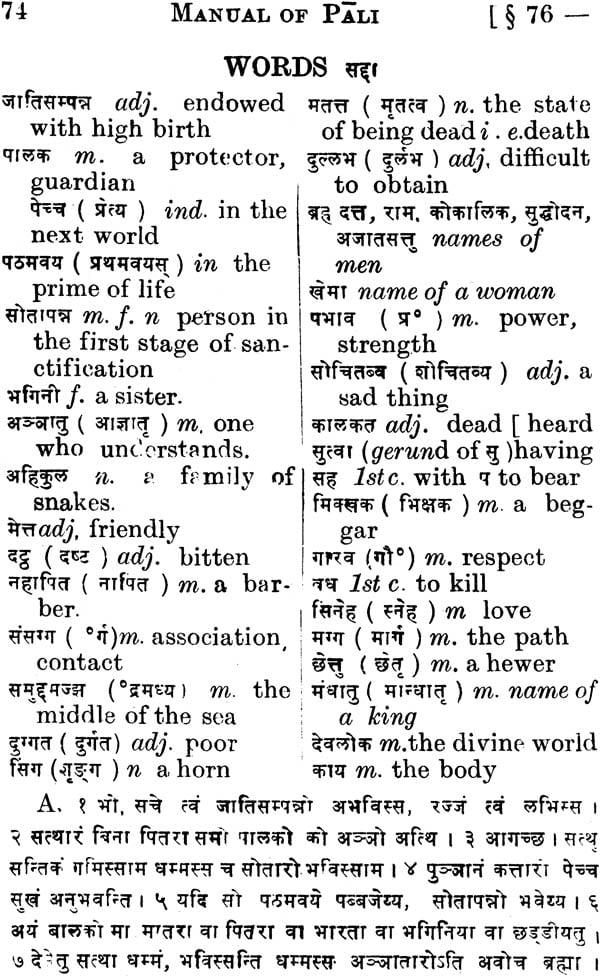
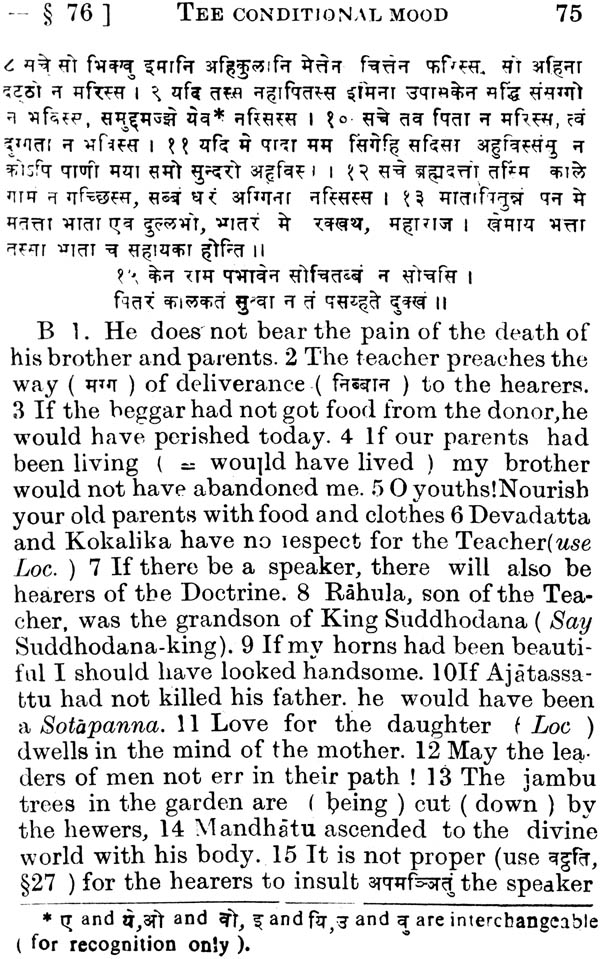
| 75-76 | The Conditional Mood | 72 | |
| XVII | 75-79 | Nouns ending in vant and mant | 76 |
| 80 | Irregularities in the 1st conjugation | 77 | |
| XVIII | 81-88 | Present participles | 81 |
| 84 | Absolute Construction | 83 | |
| 85 | The 3rd conjugation | 83 | |
| XIX | 86-88 | The Causal | 87 |
| 89 | Denominative Verbs | 88 | |
| 90 | I he 5th conjugation | 88 | |
| 91 | Neut. Nouns ending in sa ( SK ) | 89 | |
| XX | 92-93 | The 8th and 9th conjugations | 92 |
| 94-99 | The Namerals | 93 | |
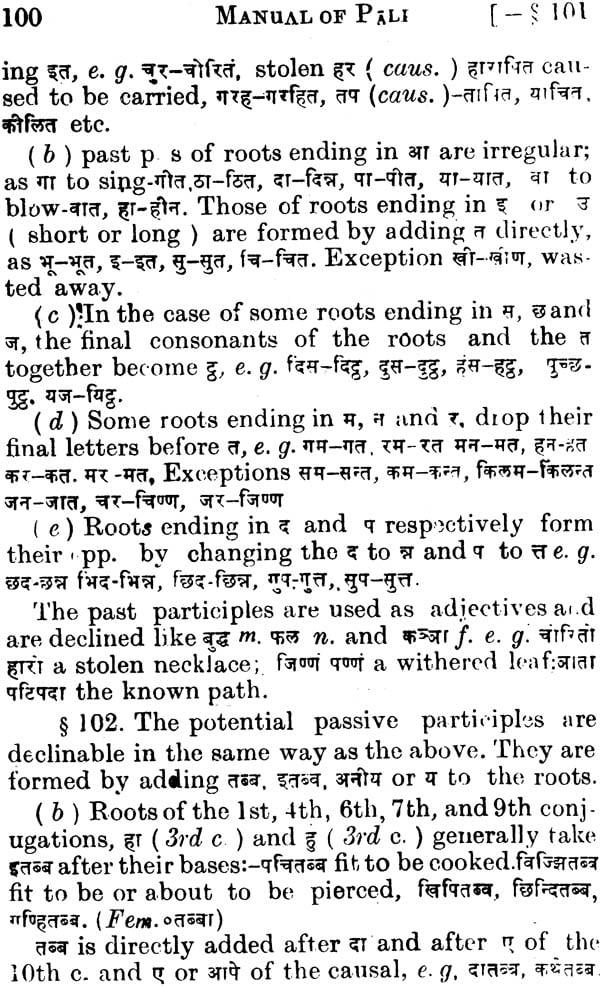
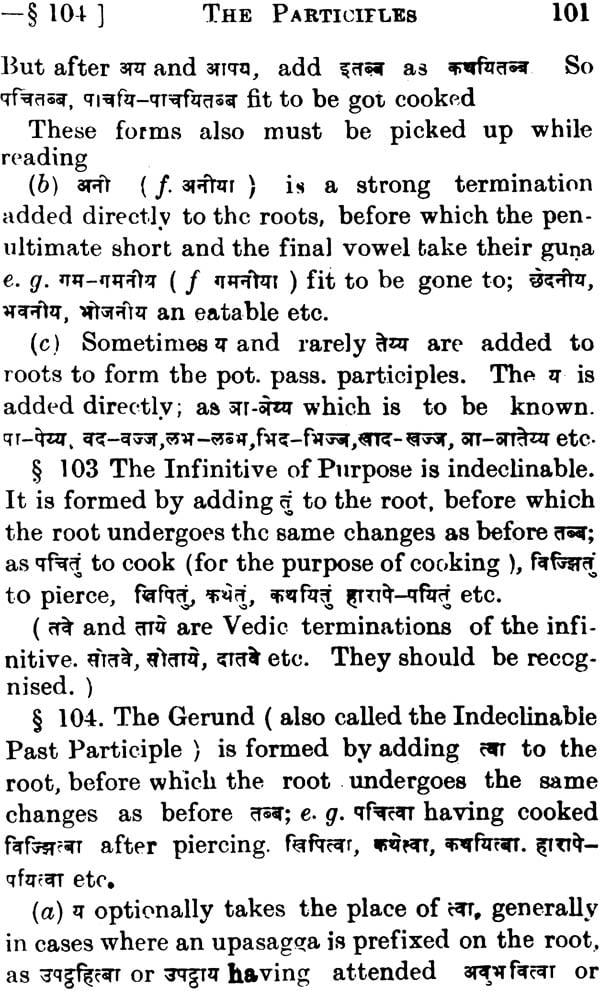
| XXI | 100-105 | The Participles | 99 |
| XXII | 106 | Irregularities in Declension | 105 |
| 107 | Some obsolete verbal forms | 106 | |
| 108-111 | The Sandhi | 107 | |
| 112 | Suffixes | 112 | |
| XXIII | 112-122 | Compounds | 112 |
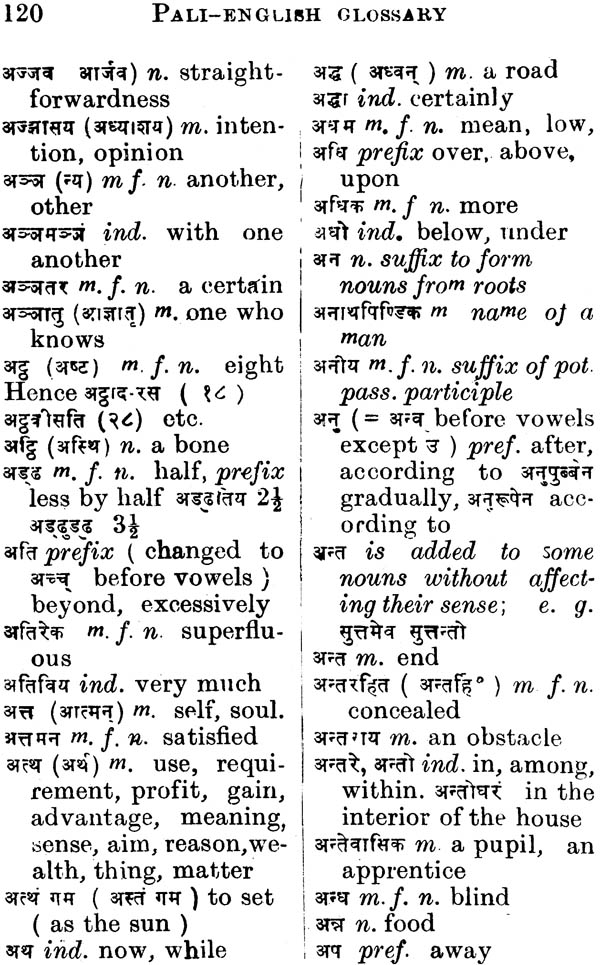
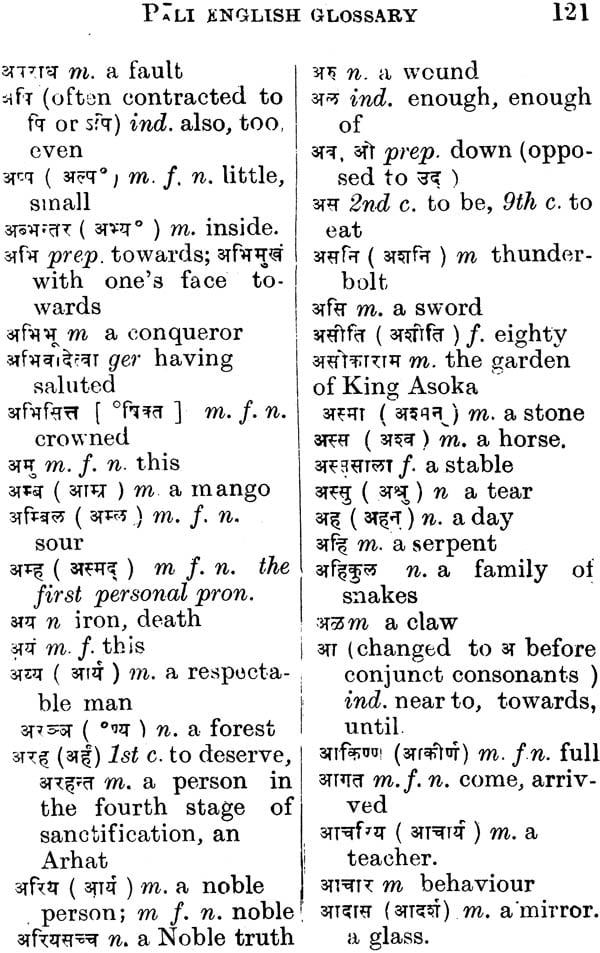
| Pali-English Glossary | 119 | ||
| English-Pali Glossary | 146 | ||
| Pali Alphabet in different characters | 159 |