

Existence and Yoga
Book Specification
| Item Code: | IDK848 |
| Author: | Lalit Kilam and Manju Kilam |
| Publisher: | Parimal Publication Pvt. Ltd. |
| Language: | English |
| Edition: | 2008 |
| ISBN: | 9788171103331 |
| Pages: | 388 |
| Cover: | Hardcover |
| Other Details | 8.7" X 5.7" |
| Weight | 520 gm |
Book Description
'Existence and Yoga' gives a ray of hope to man's existence and his struggle to live a turbulent free and fulfilled life.
Creation of a man, the study of ancient civilization and the world's oldest written source of knowledge; the Vedas, Upanisads, Bible, Torah and Qur'an explain the questions of the nature of God, man's existence and our consciousness.
Yoga Philosophy, Meditation and the technique of Pranayama has been examined to unravel the power of matter, mind and energy to attain love, light and peace in our day-to-day life.
The authors hope that this book may open the door the vast internal realm of mankind and light his internal lamp which will lead to the path of harmony and wisdom.
"Existence and Yoga" offers a powerful inspiration to its readers to study the eastern and western religious and philosophical thoughts. It encourages the reader to explore the purpose of his existence, salvation, of one's soul and find the everlasting truth. By the Yoga practices one becomes better at whatever one is; a better Christian, a better Hindu, and a better human being.
the book reveals the nature of man his existence and the problems of survival since his evolution and the practice of Yoga for meaningful survival. Man stands and experiences entirely alone the events in his life. He is responsible for his actions and inactions. This book also probes into the historical events and practices of ancient river valley civilizations. One astounding revelation among the people was the undaunted faith and devotion and steadfastness of the mind. Yoga helps mankind to develop universal existence and also enlightens the societies to a path of morality, compassion and virtuous living. To day, many values in the societies have changed. There is a great and relentless advance in the world. Break through in the world. There is more interdependence in trade, education, science, research and various human cultures. The Creation of man and the world civilization we found it too voluminous to discuss fully. Therefore we were constrained to restrict our discussions to the most basic and important aspect.
A comprehensive introduction is given to the prominent religions of the world namely: Christianity, Judaism, Islam, Confucianism, Buddhism and Hinduism. It provides an understanding of the basic teachings of the above religions so that the human's can make sense of all religions and respect other different religions. "We are all children of God." Every human basically has the same question! "Is life only about accumulation of wealth, power, position and material comforts?" Beyond this is there any purpose of man's existence? Self knowledge, Yoga practices, healthy and right living may provide answers to the complex questions of human existence. Ethics for any society or culture is very important and it is discussed briefly in this book. It is concerned with the issues of right and wrong. It is an enquiry as to what is generally good for the society as a whole. Present times are uncertain times; there is much suspicion among individuals and uneasiness in the world. Situational levels. An example, from the epic of Mahabharata is given to expand on the importance of situational thinking at present violent times.
Special emphasis is given to the section of Vedanta. This being a complex concept, many books on religions fail to clearly and fully explain numerous questions about life, role of the material world and above all the Self or Atman. In writing this book care was taken to keep it simple for the understanding of our readers, who may have little or no knowledge of the scripted to make the reader an expert in Hinduism; there are many other advanced books on this subject the reader can pursuer, if this book arouses his interest.
There is great deal of interdependence of philosophy with the religion in the east than in the west. An attempt has been made to explore the differences in the various schools of thoughts in Vedanta on one hand and Kant and Schopenhauer philosophy on the other. There are some commonalities between these two schools of philosophies as will be found by the reader. We have not investigated deep into the complex nature of these two schools of philosophies.
Another interesting subject in this volume is the role of "Yoga and Meditation," in the present age, Yoga practice is a path to living a complete life; it is a means to an enlightened existence. It is timeless, pragmatic science evolved over thousands of years dealing with the physical, moral and spiritual existence of a man as a whole. Yoga has its roots even in the holy Vedas. This volume offers tremendous benefits to individuals from every culture, race, sex, and economic status and beliefs to realize the law of one's own being. It of often the plunge into the unknown that grabs our attention the most. It forces us to search our soul to meet the challenges we face in our mundane existence. The Bhagavad Gita says: "Working out of one's Karma according to the law of one's own being is therefore the Dharma or Religion or way to salvation of an individual.
Lalit Kilam completed his higher education in Europe and in the mountainous region of the Himalayas. He is a computer engineer who enjoys working with Computers and interconnecting masses by providing High Speed Internet to the customers of Saskatchewan, Canada. During these years he had an opportunity to experience a wide range of various religious Philosophies happenings around the world and also their impact on the human life. He strongly believes that mankind is responsible for his own actions and he also is a fervent and sincere believer in the practice of Yoga and spiritual growth. According to him Yoga and meditation brings inspiration and solace to the spirits of the people living around the globe.
Manju Kilam has completed her education from a reputed University in India. She has a Masters in Business and also a Ph.D. Presently she is teaching Business management courses, in the school of Business. She has a wealth of experience in business and teaching from India and North America. She is enthusiastic about globalization and its impact on Canada and other parts of the world and has published several articles in reputed academic journals. Travel is another of her interests and has traveled to several countries around the globe, Closer to home, Manju is involved with Yoga and naturopathy.
| Preface | 15 | |
| Chapter 1. | 19 | |
| CREATION OF UNIVERSE AND CIVILIZATION | 19 | |
| Creation of the Universe | 19 | |
| Epic of Matsya Purana | 23 | |
| Mesopotamian Civilization | 29 | |
| Egyptian Civilization | 32 | |
| Early Dynastic Period | 32 | |
| Old Kingdom | 32 | |
| Middle Kingdom | 33 | |
| New Kingdom | 33 | |
| Post Empire | 33 | |
| Greek Civilization | 36 | |
| Western civilization | 39 | |
| Latin American civilization | 39 | |
| The Indus Valley Civilization | 40 | |
| The Aryan civilization and the Rgveda | 43 | |
| The Yellow River Valley Civilization | 45 | |
| Shang Dynasty | 45 | |
| Chou Dynasty | 46 | |
| Ch'in Dynasty | 47 | |
| Chapter 2. | 50 | |
| NATURE AND THE CONCEPT OF MAN | 50 | |
| Auguste Comet's Three Stages of Development | 50 | |
| Theological the first Stage of Development | 51 | |
| Metaphysical The Second Stage of Development | 51 | |
| Scientific Third Stage of Development | 52 | |
| Nature and Needs of Man | 54 | |
| Philosophy of the existence of Man | 58 | |
| Chapter 3. | 62 | |
| RELIGIONS OF THE WORLD | 62 | |
| Introduction | 62 | |
| Christianity | 64 | |
| Who was Jesus? | 65 | |
| The life of Jesus | 66 | |
| John Baptizes Jesus | 66 | |
| The Teachings of Jesus | 67 | |
| Final Days of Jesus Before Crucifixion | 68 | |
| Return of Jesus | 69 | |
| Roman Catholicism | 69 | |
| Eastern Orthodoxy | 70 | |
| Protestantism | 70 | |
| Similarities between Christianity and Hinduism: | 72 | |
| Judaism | 73 | |
| Origins of Jews | 74 | |
| Origins of Judaism | 74 | |
| The Patriarchal period | 76 | |
| Abraham (Abram) | 76 | |
| Isaac | 77 | |
| Jacob | 77 | |
| The Mosaic Period | 78 | |
| Moses | 78 | |
| Joshua as the successor | 79 | |
| The period of the Judges! Shoftim | 79 | |
| Exodus from Egypt | 81 | |
| The Torah (the law) | 82 | |
| The Talmud | 82 | |
| Similarities between Judaism and Hinduism: | 83 | |
| Islam | 83 | |
| What is Islam? | 84 | |
| Early life of Muhammad | 84 | |
| Muhammad's Early Years in Mecca | 84 | |
| Muhammad's Vision Call to Become a Prophet | 85 | |
| Qur'an Its Significance | 86 | |
| Five Pillars of Islam | 87 | |
| Muhammad's Teaching in Mecca | 89 | |
| Muhammad's Migration to Medina | 89 | |
| Qur'an Vision of after life | 90 | |
| Similarities between Islam and Hinduism: | 91 | |
| Confucianism | 92 | |
| Self as Creative Transformation | 96 | |
| Community as a Vehicle for human Flourishing | 96 | |
| Nature as Home | 96 | |
| Heaven as a Source of Ultimate Transformation | 97 | |
| Quote One of the Disciples | 97 | |
| Similarities between Confucianism and Hinduism | 98 | |
| Buddhism | 98 | |
| The Departure | 99 | |
| The Enlightenment | 100 | |
| The Buddha's First Sermon | 100 | |
| The Four Noble Truths | 100 | |
| The Eight-Fold Path | 102 | |
| The Doctrine of Dependent Origination | 103 | |
| Influence of Samkhya Philosophy on Buddhism: | 106 | |
| Similarities between Buddhism and Hinduism | 107 | |
| Hinduism | 108 | |
| The Four Paths recommended in Hinduism | 110 | |
| Reincarnation | 111 | |
| Chapter 4. | 116 | |
| VEDANTA | 116 | |
| Introduction | 116 | |
| The Compiling of the Vedas | 117 | |
| Upanisads | 118 | |
| The Aitareya Upanisad belongs to Rgveda | 119 | |
| Creation of Virat- Purusa | 120 | |
| Concerning the Self | 125 | |
| Gross Body | 126 | |
| Subtle Body | 127 | |
| Causal Body | 127 | |
| Katha Upanisad belongs to Yajurveda | 128 | |
| Mundakopanisad belongs to Atharvaveda | 133 | |
| Kenopanisad belongs to Samaveda | 135 | |
| Date of Composition of Vedas | 138 | |
| The Goal of Vedanta | 139 | |
| What is Vedanta? | 140 | |
| Vedic Concept of God | 142 | |
| Surya God of Light | 144 | |
| Agni God of Fire | 145 | |
| Vayu God of Wind | 147 | |
| Prthvi God of Earth | 148 | |
| Varuna God of Water | 149 | |
| Akasa God of Sky | 149 | |
| Vedic Yoga: | 150 | |
| Four Stages of man's life Cycle in Vedas | 152 | |
| Brahman and Atman | 154 | |
| Different States of Human Consciousness | 157 | |
| Waking State | 158 | |
| Subtle State | 158 | |
| Deep Steep State | 158 | |
| Turiya State | 159 | |
| The Classification of Indian Philosophy | 160 | |
| Six Vedic (Orthodox) Schools of Philosophy | 161 | |
| 1. Nvdya of Gautama | 161 | |
| 2. Vaisesika | 161 | |
| 3. Samkhya of Muni Kapila | 162 | |
| 4. Yoga Sutra of Patanjali | 167 | |
| 5a. Uttara Mimamsa | 167 | |
| 5b. Purva Mimamsa of Jaimini | 168 | |
| 6. Vedanta | 168 | |
| Two different divisions of Vedanta Philosophy | 170 | |
| I) Monastic (non-dualistic) II) Monotheistic | 170 | |
| Monastic or Adviata School of Thought | 170 | |
| Introduction | 170 | |
| The Principal doctrines of Adviata Vedanta | 170 | |
| Monotheistic School of Thought | 171 | |
| Four most prominent schools of thoughts: | 171 | |
| a) Ramanuja b) Nimbarka c) Madhva d) Vallabha | 171 | |
| Ramanuja's School of Thought (Qualified Monism) | 172 | |
| Nimbarka's School of Thought (Non Dualism) | 174 | |
| Madhva's School of Thought | 174 | |
| Vallabha's School of Thought (Pure Monism) | 174 | |
| How to attain the vision of God? | 176 | |
| Harmony in Religions according to Vedanta | 177 | |
| Chapter 5. | 179 | |
| ETHICS | 179 | |
| Introduction | 179 | |
| Ethics and Christianity | 180 | |
| Ethics and Judaism | 181 | |
| Ethics and Islam | 182 | |
| Ethics and Buddhism | 183 | |
| Ethics and Confucianism | 185 | |
| Five things that Confucius Did Say | 185 | |
| Ethics and Vedanta | 186 | |
| The three great paths man must follow | 186 | |
| Chapter 6. | 190 | |
| POWER OF YOGA | 190 | |
| Yoga Sutras of Maharsi Patanjali | 191 | |
| Yoga and different systems of Philosophical Thought | 193 | |
| Different Schools of Yoga | 194 | |
| 1) Jnana Yoga | 195 | |
| 2) Bhakti Yoga | 197 | |
| 3) Karma Yoga | 198 | |
| 4) Mantra Yoga | 199 | |
| 5) Yantra Yoga | 199 | |
| 6) Laya Yoga and Kundalini Yoga | 200 | |
| 7) Tantric Yoga | 200 | |
| Hatha Yoga | 201 | |
| Raja Yoga | 202 | |
| The steps of the Astanga Yoga | 203 | |
| 1. Yamas Social Discipline | 204 | |
| a) Ahimsa (non-violence) | 204 | |
| b) Astheya (non-stealing) | 204 | |
| c) Satya (truthfulness) | 204 | |
| d) Brahmacarya (continence) | 205 | |
| e) Aparigraha (non-coveting) | 205 | |
| 2. Niyamas Individual Discipline | 205 | |
| a) Sauca (purety, cleanliness) | 205 | |
| b) Santosa (contentment) | 205 | |
| c) Tapas (discipline or self control) | 206 | |
| d) Svadhyaya (study of scriptures) | 206 | |
| e) Isvara Pranidhana (devotion to Lord) | 206 | |
| 3. Asanas (postures) | 206 | |
| 4. Pranayama (breath control) | 207 | |
| 5. Pratyahara (sense withdrawal) | 207 | |
| 6. Dharma (concentration) | 207 | |
| 7. Samadhi (Super consciousness) | 208 | |
| 8. Dhyana (Meditation) | 208 | |
| Relevance of Yoga in Day to day life | 210 | |
| Yoga Asanas | 211 | |
| "Surya Namaskara" | 211 | |
| Benefits: | 220 | |
| "Padmasana" | 221 | |
| Benefits: | 222 | |
| "Siddhasana" | 222 | |
| Benefits: | 223 | |
| "Pascimottanasana" | 223 | |
| Benefits: | 223 | |
| "Bhujangasana" | 224 | |
| Benefits: | 224 | |
| "Sarvangasana" | 225 | |
| Benefits: | 225 | |
| "Halasana" | 226 | |
| Benefits: | 226 | |
| "Garudasana" | 227 | |
| Benefits: | 227 | |
| "Ardha Matsyendrasana" | 228 | |
| Benefits: | 228 | |
| "Savasana" | 229 | |
| Benefits: | 229 | |
| Chapter 7. | 230 | |
| POWER OF CAKRAS | 230 | |
| Prana or Energy Centers | 232 | |
| Sahasrara Cakra | 233 | |
| The Ajna or third eye Cakra | 234 | |
| Visuddha or Visuddhi Cakra | 235 | |
| Anahata Cakra | 236 | |
| Manipura Cakra | 237 | |
| Svadhisthana Cakra | 237 | |
| Muladhara Cakra | 238 | |
| Chapter 8. | 242 | |
| POWER OF PRANAYAMA | 242 | |
| The Art of Yoga Breathing | 242 | |
| Breathing is important for two basis reasons | 244 | |
| The Five Pranas: | 245 | |
| Five forms of Prana | 245 | |
| Why Oxygen is so vital for our bodies? | 247 | |
| Oxygen purifies the blood stream | 248 | |
| 1. Puraka (Inhalation) | 249 | |
| 2. Abhyantara Kumbhaka | 249 | |
| 3. Recaka (Exhalation) | 250 | |
| 4. Bahya Kumbhaka (Pause after Exhaling) Empty Pause | 250 | |
| Important Preparations | 251 | |
| The Techniques of Pranayama | 251 | |
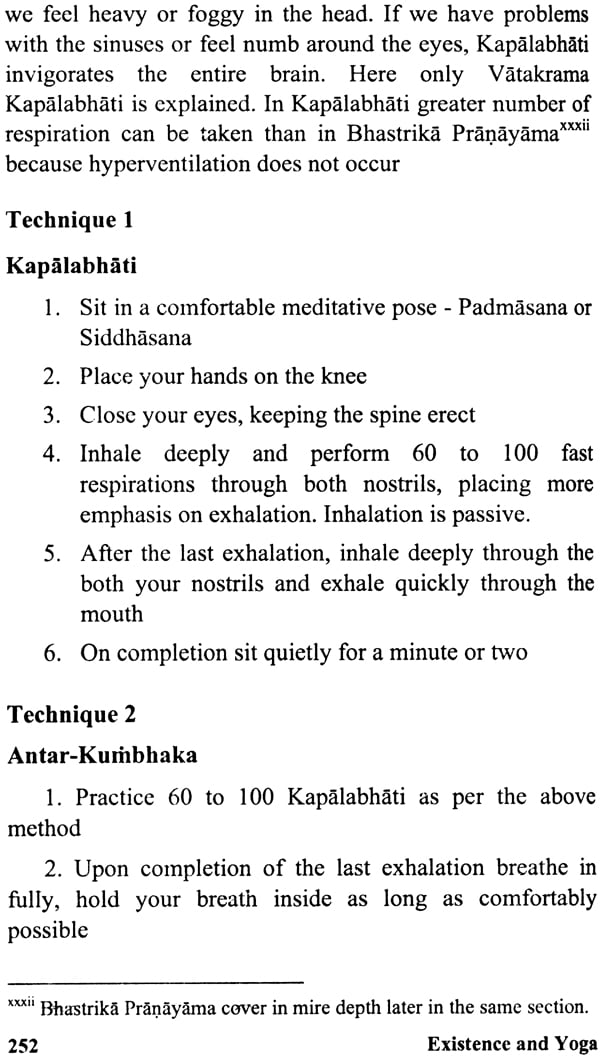
| Kapalabhati (The Cleansing Breath) | 251 | |
| Technique 1 | 252 | |
| Antar Kumbhaka | 252 | |
| Technique 2 | 252 | |
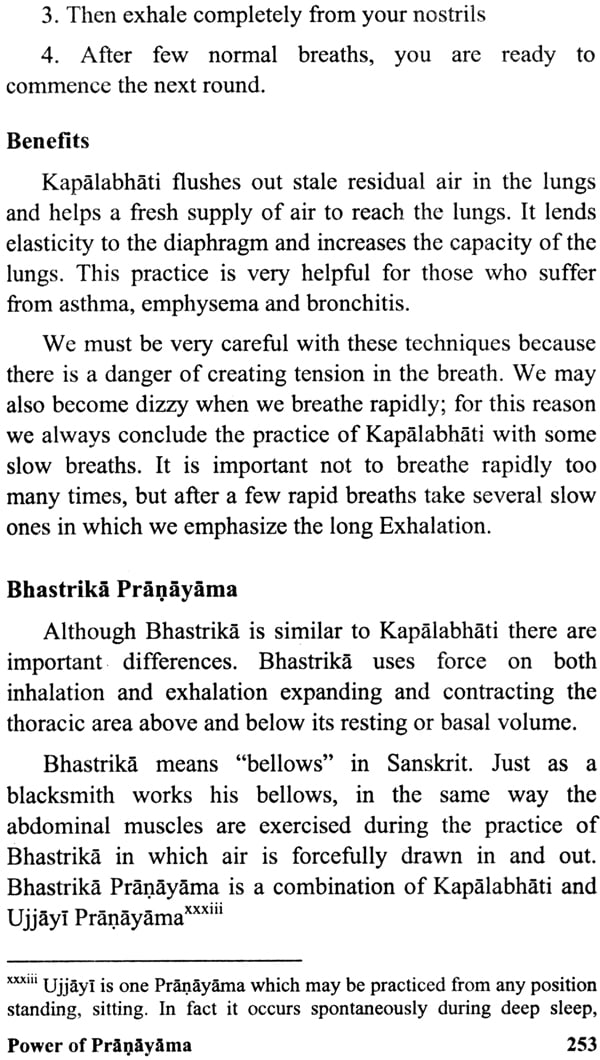
| Antar Kumbhaka | 252 | |
| Benefits | 253 | |
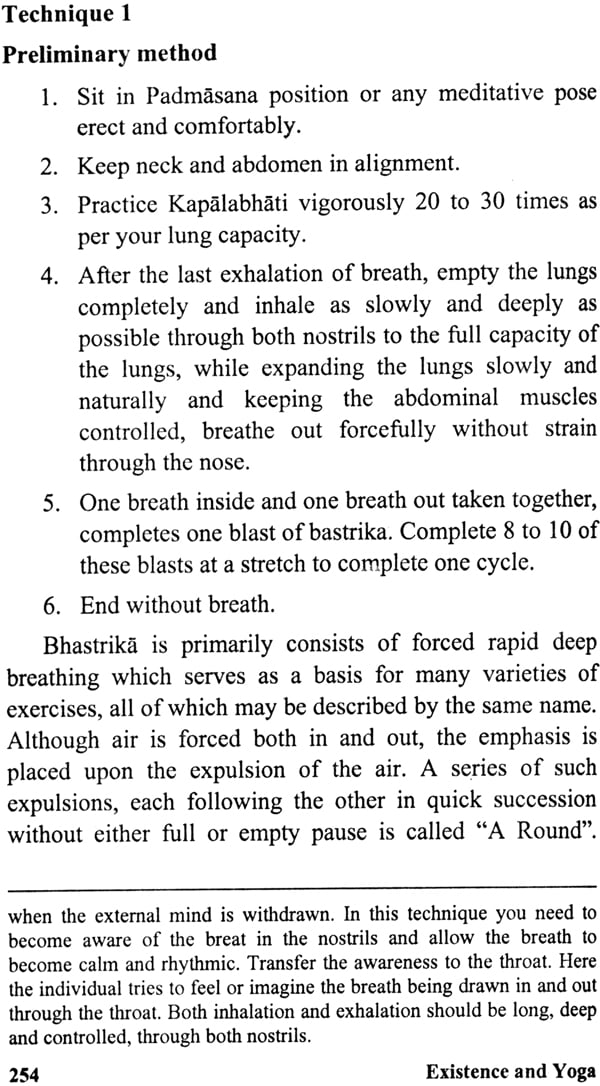
| Bhastrika Pranayama | 253 | |
| Technique 1 | 254 | |
| Preliminary method | 254 | |
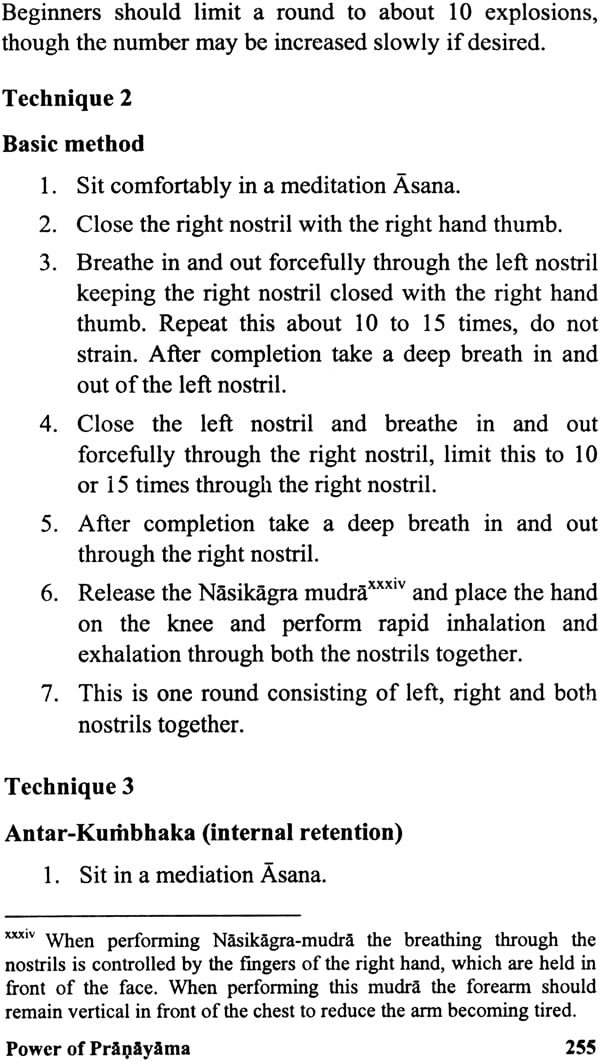
| Technique 2 | 255 | |
| Basic method | 255 | |
| Technique 3 | 255 | |
| Antar Kumbhaka (internal retention) | 255 | |
| Benefits | 256 | |
| Anuloma Viloma | 257 | |
| Anuloma Viloma Alternate Nostril Breathing | 257 | |
| Benefits of Anuloma Viloma | 258 | |
| Rules for Pranayama | 258 | |
| Glossary | 260 | |
| Bibliography | 276 | |
| Index | 282 |