

India in 1872- As Seen by the Siamese
Book Specification
| Item Code: | AZG465 |
| Author: | Sachchidanand Sahai |
| Publisher: | B.R. PUBLISHING CORPORATION |
| Language: | ENGLISH |
| Edition: | 2002 |
| ISBN: | 9788176462334 |
| Pages: | 446 (B/W Illustrations) |
| Cover: | HARDCOVER |
| Other Details | 9.00x6.00 |
| Weight | 690 gm |
Book Description
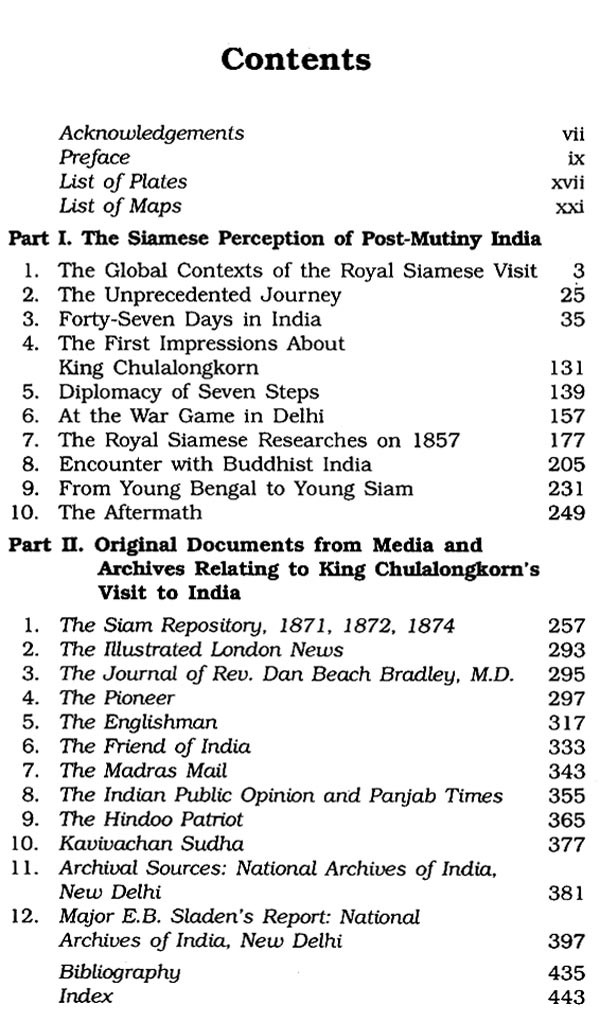
In the first part of the monograph, ten independent chapters offer an in-depth critical study of the Siamese perception of post-mutiny India. The global contexts and the unprecedented nature of this journey are focused in the first two chapters. The following chapter presents a micro-history of India for forty-seven days in 1872 when the Siamese delegation visited seven cities of India. Indian and British impressions about the Siamese King, diplomatic nuances, the war game in Delhi, the royal Siamese researches on 1857, encounters with Buddhist India form the subjects of successive chapters. Chapter 9 probes into the intellectual history of India and Thailand, making an attempt to link the Young Bengal movement with the Young Siam. In the concluding chapter, the effects of Indian journey on Siam have been briefly discussed. In the second part, twelve separate sections provide contemporary newspaper materials and archival sources including. Major Sladen's Report which enable the readers visualise the to significance and magnitude of Siamese perception of India.
The monograph is an indispensable work for every one interested in the study of nineteenth century Indian history, society, religious and cultural conditions and intellectual horizons. It also sheds new light on the beginnings of Indo Thai diplomatic and cultural relations.
Professor Sahai was offered a Fulbright post-doctoral fellowship at Cornell University. Ithaca, New York, Visiting Fellowships at Australian National University and Maison de Science de l'Homme, Paris.
Under the auspices of Indian Council for Cultural Relations Professor Sahai worked as Visiting Professor of Asian Civilization at Sisavangvong University, Vientiane, Laos. He also worked as Research Professor at Indira Gandhi National Centre for the Arts, New Delhi.
Professor Sahai is the author of a number of books and research papers on the cultural history of South East Asia. He is the founder of the South East Asian Review and the International Conference on Thai Studies.
However, I was not sure at that stage if enough archival sources were still preserved to enable one to outline in any detail the presence of King Chulalongkorn in India for 47 days from 11th January to 26th February 1872.
The king did not leave any diary or notes on his travels in India as he did for his later journeys to Europe. It appears that sometimes after the king returned from India a brief account of this travel was written by some unknown hands. This account, under the title of "Neungsu Reuang Sadec Meuang Kalkatta" and in the shape of a handwritten manuscript on paper, is preserved in the National Library. Bangkok.
In 1917 on the occasion of the cremation ceremony of certain dignitary, Prince Damrong Rajanubhab had an account of the royal travel compiled under the title Chotmaihet Sadet praphat tang prathet nai rachakan thi 5. This publication was based on the manuscript preserved in the National Library, Bangkok and information available to Prince Damrong.
**Contents and Sample Pages**