About the Author Justice P. Kodanda Ramayya was born in the year 1926. He was enrolled as an Advocate of High Court of Madras in the year 1952. He was elevated to the Bench of Andhra Pradesh High Court in the year 1982 and held that office till 1988. He is the founder Chairman of a Publishing Trust known as "Arsha Vijnana Trust".
The theme of this work is to draw the attention of the modern young men emphasizing on the fact that several Dharmas practiced by Sri Rama, the hero of the Epic Ramayana, are really in the nature of faculties - life skills, that every human being should imbibe and practice to make his life successful and purposeful.
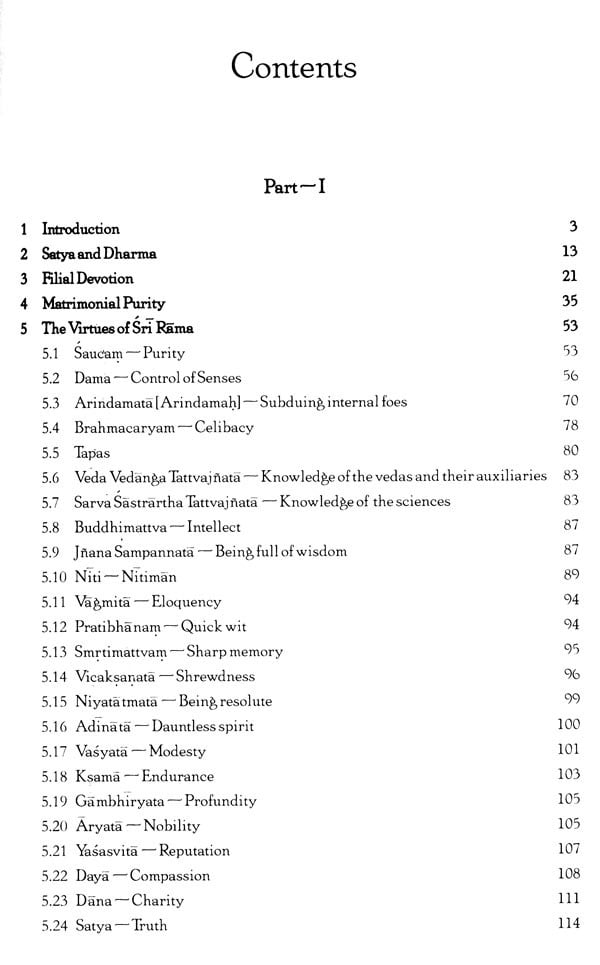
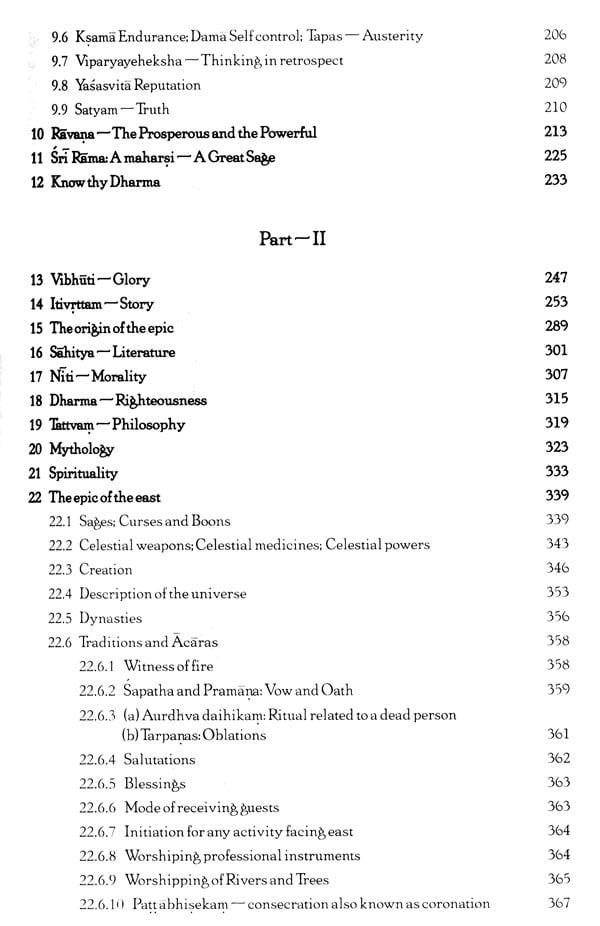
The book is divided into two parts, each part containing twelve topics. The first part deals with the concept of Satya and Dharma Truth and Righteousness, and their facets with special reference to the story of the Epic and also with reference to the present day conditions. The second part deals with the glory of the Epic, its historicity, its inherent value and its features which are specially eastern in character.
He is also author of "Message of Mahabharata". He highlighted several concepts of Dharma taken from Mahabharata of Sage Veda Vysa. This book is translated into Tamil, Telugu and Kannada.
Preface Ramayana and Mahabharata are two Itihasas-heroic histories of this country. In the West, these stories are classified as epics. We have also begun to state them as epics, after foreign rule, forgetting their character as Itihasas. The famous epics of the West are the Iliad and the Odyssey. An epic is defined as a poem narrating heroic legendary figures embodying a national concept of past history. The expression "legend' indicates a notion of myth as a traditional story as historical. but unauthenticated. "The Wordsworth Encyclopedia" classified the Ramayana and Mahabharata as epics of India and stated that epics are "narrative poem or cycle of poems dealing with some great deed- often the founding of a nation or the forging of national unity- and often using religious or cosmological themes." It is true that these two epics satisfy the requirement of 'cosmological', as they relate to earth and heaven, and human beings and angels mix together. Several episodes and events cannot be believed by common man hence they are termed as myths in the west. Epics instill greater values in humanity, and hence in the West they are found to be useful and essential for humanity. Even an iconoclast like Bernard Shaw acknowledged the essentialities of myths. In this country we know when the absolute descends on earth and takes a form, it will have powers and super natural qualities. We have such experiences of several incarnations. No Indian doubts the events in these epics. Further, sages Valmiki and Veda Vyasa are the contemporaries of the heroes in these stories and actually witnessed all the events. Hence these epics are live stories in this country and therefore they are well known Itihasas and not myths.
These epics are not merely cosmological but also religious. The religious character of the epic, does not take away its national character. If all citizens belong to one religion, it constitutes the founding of a nation. If they belong to different religions, it forges national unity.
Introduction Ramayana is the first poem. Valmiki is the first poet. It ranks first amongst the world literature and touches several aspects of human life and thus transcends religion and the Church. It is an ancient legend and represents not only the culture of India, but also the eternal and universal Dharma of mankind.
Dharma
What is Dharma? Dharma is that which sustains the world and directs the world on correct lines. Dharma is duty. It exhorts man to do his duty. The practice of Dharma gives both prosperity and bliss. Dharma is manifold. Truth is the life blood of any Dharma. Hence it is said that Dharmas are different facets of truth.'
Sage Veda Vyasa said, "Maryadayam sthito Dharmah"-Keeping oneself within bounds is Dharma and "Samascaivasya Lakshanam" Self control is its essence.
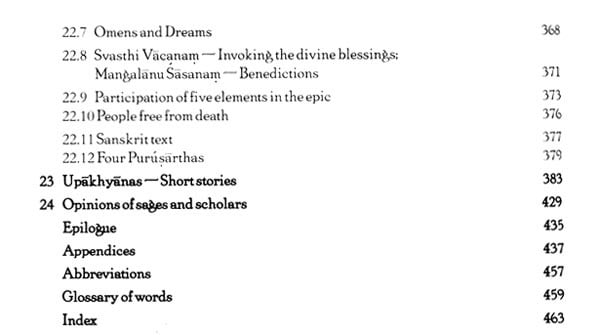
**Contents and Sample Pages**