| Lecture I
| General Laws guiding the Development of Language: The different stages in the Development of Sanskrit | 1-34 |
| | Preliminary | 1 |
| | Sanskrit : its importance | 3 |
| | Phonetic decay | 9 |
| | Svasa : Nada | 10 |
| | False analogies | 13 |
| | Names of Objects | 14 |
| | Gradual disappearance of Words | 16 |
| | Three Languages of the World | 17 |
| | Three Varieties of Sanskrit | 18 |
| | Chief characteristics of Vedic Sanskrit; an example of Vedic Sanskrit | 22 |
| | Do – of Brahmana passage; its peculiarities | 23 |
| | The next stage of Sanskrit | 23 |
| | The petrified or nominal stage | 24 |
| | The nominal stage cultivated in philosophical writings | 25 |
| | Middle stage of writing : Sanskrit of Samkaracarya | 26 |
| | Change of style after samkaracarya | 26 |
| | Real style of Sanskrit | 26 |
| | Katyayana, his evidence about the Sanskrit style | 27 |
| | Conclusion that verbal form had been obsolete and participles were used in their place | 30 |
| | Places and rules in which Panini has become obsolete | 32 |
| | Conclusion from this | 33 |
| | Panini's Grammar contains the Middle Sanskrit and Katyayana's the Classical Sanskrit | 34 |
| Lecture II
| Pali and the Dialects of the Period | 35-78 |
| | Sanskrit corrupted in course of time | 36 |
| | Examples from Pali | 37 |
| | Phonology of the Pali Dialect – Pronouncing a Conjunct | 38 |
| | Svasa: Nada | 39 |
| | No Pali consonants omitted by Pali speakers | 44 |
| | Exceptions to the above | 45 |
| | Changes of single consonants | 46 |
| | Matra | 49 |
| | Possible influence of aliens on language modification | 53 |
| | Assimilation of Consonants a universal rule in Pali | 53 |
| | Several words, unknown to Sanskrit, but formed Sanskrit, coming into use | 54 |
| | Grammar of the pali Dialect | 54 |
| | The Noun : Masculine Nouns ending in अ | 57 |
| | Masculine Nouns in इ and उ | 58 |
| | Masculine Nouns in ऋ | 58 |
| | Masculine Nouns in a consonant | 59 |
| | Feminine Nouns | 60 |
| | Neuter Nouns | 61 |
| | Pronouns | 61 |
| | False Analogies or Generalisation : false ideas regarding some of these | 64 |
| | The Verb in Pali | 65 |
| | Terminations in Pali | 66 |
| | The Gramaar of Asoka Inscriptions : their | 72 |
| | place Examples of Asoka Inscriptions | 73 |
| | resemblance of some Inscriptions in Pali to Sanskrit | 76 |
| Lecture III
| The Prakrits and the Apabhramsa | 79-133 |
| | Prakrits: Vararuci's Prakrtaprakasa; Hemacandra's kosa of Desi words | 79 |
| | Dandin : his Kavyadarsa; Setubandha; Vakpatiraja; Gaudavadhakavya | 80 |
| | General rule that the dramatic person should speak languages of the country to which he is supposed to belong | 83 |
| | Later dramatists : Sahityadarpaua | 83 |
| | Points of Difference between Maharastri and Sauraseni dialects | 85 |
| | Examples of above | 88 |
| | Ms. of Gaudavadha | 89 |
| | Phonetic changes common to pali and Prakrits | 90 |
| | Phonetic changes in the Prakrits | 93 |
| | Assimilation | 98 |
| | Maharastri, Sauraseni, Magadh, Paisaci, Culika Paisci & c. | 103 |
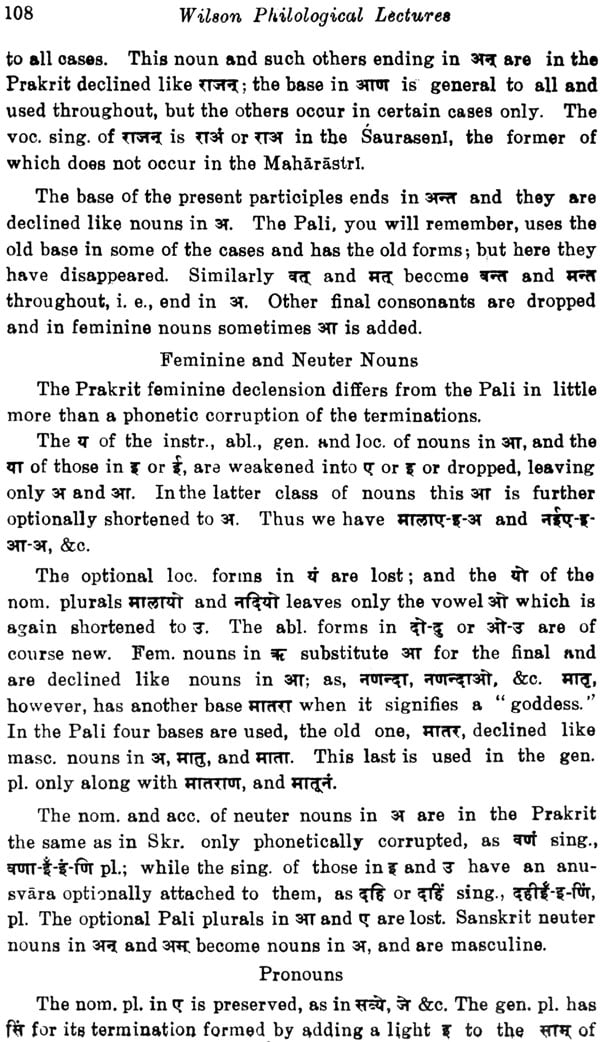
| | The Grammar of Prakrits | 105 |
| | Masculine Nouns in अ in Prakrits | 106 |
| | Masculine Nouns in इ and उ Prakrits | 106 |
| | Masculine Nouns in ऋ in Prakrits | 107 |
| | Masculine None in अन , अत, (pres, Parti), वत, मत &c. | 107 |
| | Feminine and Neuter Nouns in prakrits | 108 |
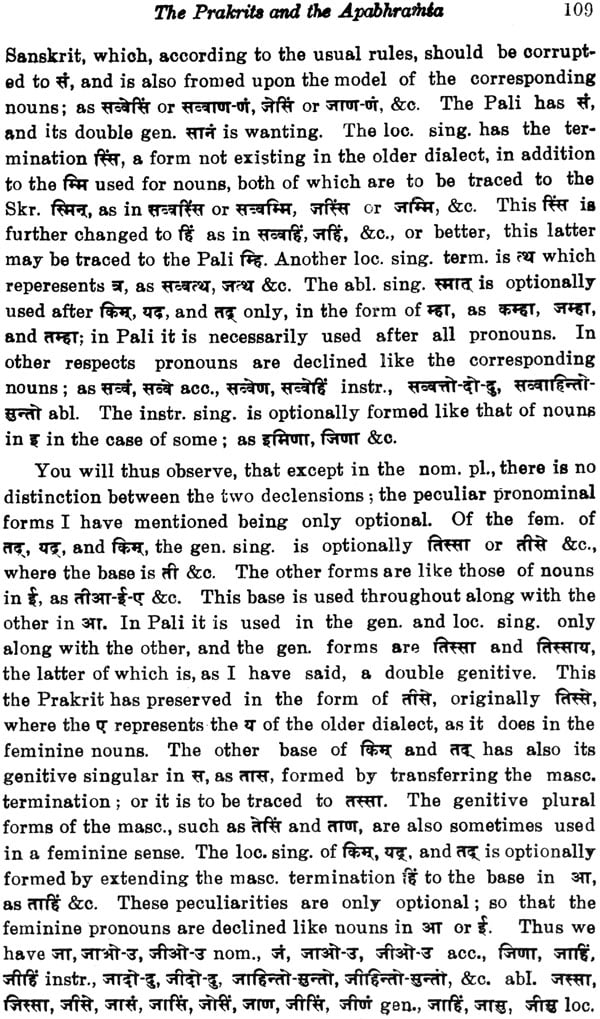
| | Pronouns in Prakrits | 108 |
| | The prakrit Verb | 112 |
| | Conjugations | 112 |
| | Sadhyavastha and Siddhavastha dialects | 116 |
| | Thadbhava, Tatsama and Desya Words; their definitions | 120 |
| | Some Desva wordbecoming Tadhavavas | 121 |
| | The Apabhamsa | 122 |
| | An illustration of Apabhramsa | 123 |
| | The Phonology of Apabhramsa | 124 |
| | Declension of Apabhramsa | 125 |
| | Nouns in अ in Apbhamsa | 125 |
| | Nouns in इ or उ in Apabhramasa | 128 |
| | Feminine Nouns in apabhramsa | 128 |
| | Pronouns in Apabhramsa | 130 |
| | The verb in the Apabhramsa | 131 |
| Lecture IV
| Phonology of the Vernaculars of Northern India | 134-233 |
| | Nine Principal Languages in India | 135 |
| | Nepali and Kashmiri not to be taken into account Old Hindi written in two dialects ; Difference between them | 135 |
| | Old Hindi Written in two dialects Difference between them | 136 |
| | Eight Principal Dialects in Northern India, instances of them | 137 |
| | Words derived from Sanskrit from the eight Dialects | 141 |
| | Distinction between the Vocabulary of the Vernaculars of N. India. | 147 |
| | Distinction between modern Tatsamas, Sanskrit & c. | 148 |
| | Three classes of Prakrit and newly constructed words | 149 |
| | Tracing the Vernaculars from Pali and prakrits | 150 |
| | Accent in Modern Vernaculars | 172 |
| | The suffix ka in Panini's time to indicate littleness & c. | 180 |
| | The original and Derivative Accents in the Vernaculars | 182 |
| | Accent in the Hindi | 184 |
| | Exceptions to the Above | 185 |
| | Accent in Gujarati | 186 |
| | Accent in Panjabi | 186 |
| | Accent in Sindhi | 186 |
| | Accent in Bengali and Oriya | 186 |
| | Accent on Vernacular Terminations | 187 |
| | Accent in Vernacular Compounds | 187 |
| | Avoiding of the Hiatus in the Vernaculars | 188 |
| | Consonantal changes in the Vernaculars | 191 |
| | Interchangeableness of certain Consonants | 200 |
| | Va of the Causal Terminations in the Vernaculars | 207 |
| | Treatment of Sanskrit Conjuncts in the Vernaculars | 221 |
| | Dentals changed to Palatals | 225 |
| | Assimilation of Members of Conjuncts | 231 |
| Lecture V
| Remnants of the Older Grammatical Forms in the Northern Vernaculars | 234 - 271 |
| | Case terminations in the Vernaculars | 234 |
| | Pronouns in the Vernaculars | 234 |
| | Personal Pronouns in the Vernaculars | 239 |
| | Case terminations in the Vernaculars | 240 |
| | Verb in the Vernaculars | 241 |
| | Verbal Terminations: The Present | 242 |
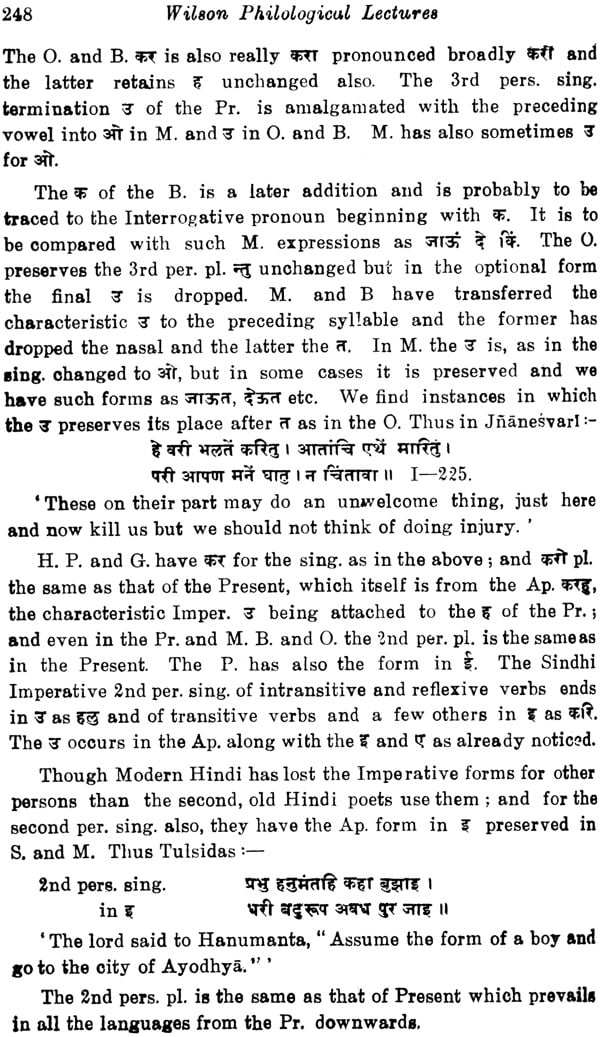
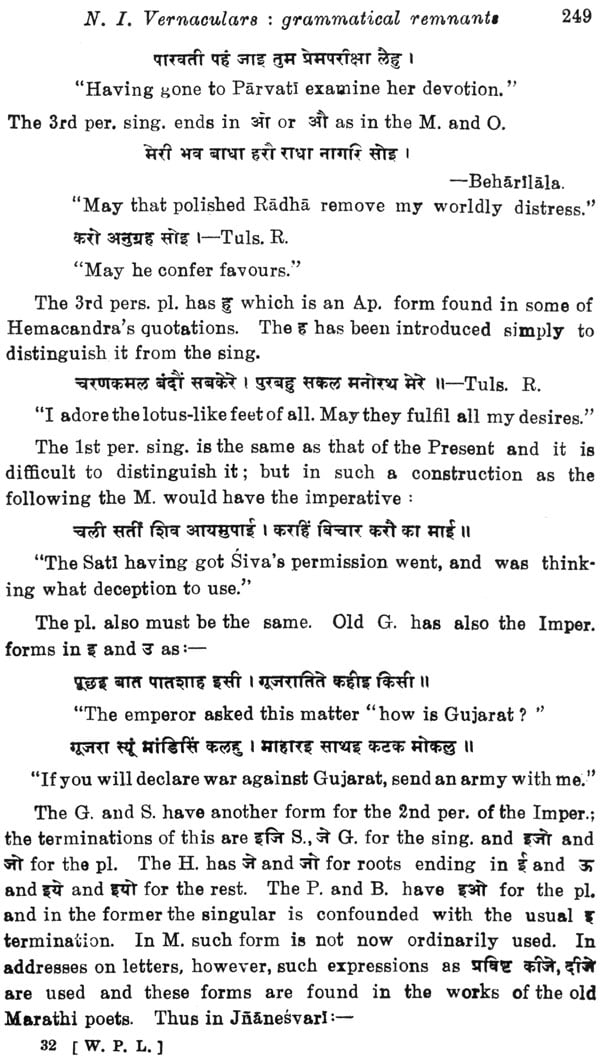
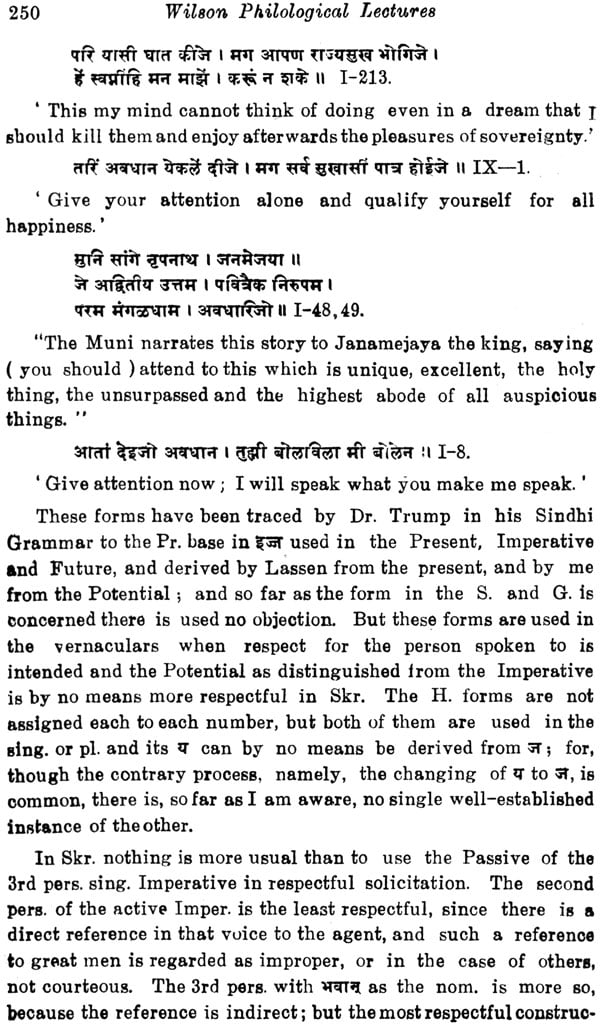
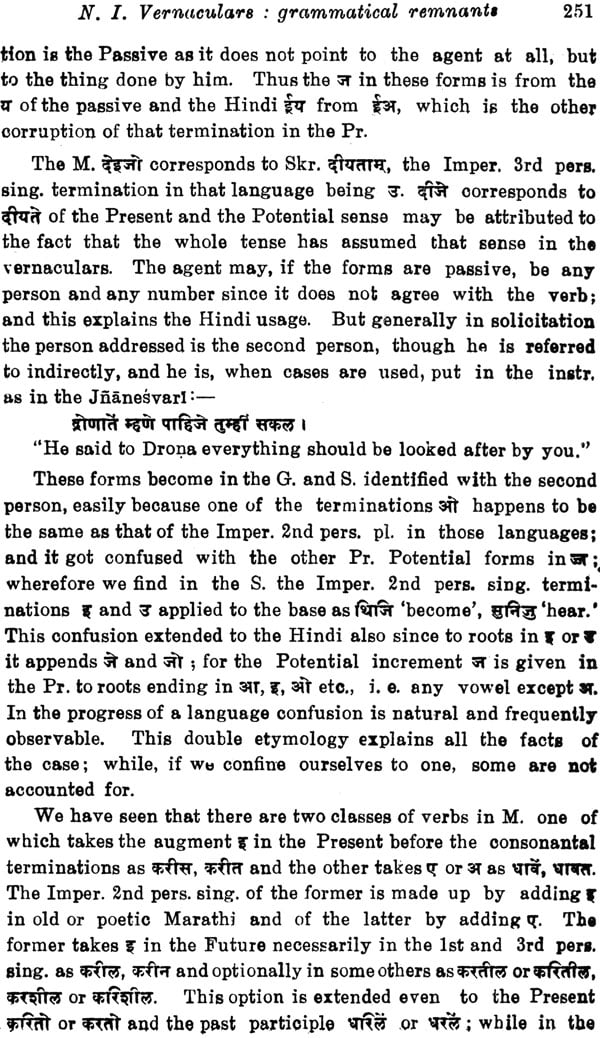
| | Verbal Terminations: The Imperative | 247 |
| | Verbal Terminations: the Future | 253 |
| | The past tense in the Vernaculars | 255 |
| | The past Participle | 255 |
| | The Present Participle in the Vernaculars | 260 |
| | The Absolutive in the Vernaculars | 261 |
| | Infinitive of Purpose in the Vernaculars | 262 |
| | Potential participle in the Vernaculars | 262 |
| | Passive in Participle in the Vernaculars | 263 |
| | Causal in Participle in the Vernaculars | 264 |
| Lecture VI
| New Grammatical Formations in the Northern Vernaculars | 272-317 |
| | The oblique forms | 273 |
| | The oblique form in the Marathi : Five ways of taking the Obsolete forms in Marathi | 273 |
| | The Oblique forms of Sindhi | 275 |
| | The Oblique forms of Punjabi | 276 |
| | The Oblique forms of Hindi | 276 |
| | The Oblique forms of Gujarati | 276 |
| | Absence of Oblique from in Bengali and Oriya | 278 |
| | Nature of the Oblique form | 279 |
| | Analysis of the Marathi Oblique Form | 280 |
| | Analysis of the Sindhi Oblique forms | 281 |
| | Hindi and Punjabi Oblique forms | 281 |
| | New Terminations in the Vernaculars | 285 |
| | Origin of ka in the Vernacular Terminations | 286 |
| | Origin of Sa in the Vernacular Terminaions | 292 |
| | The verbal forms | 305 |
| | The Future Tense | 313 |
| Lecture VII
| Relations between Sanskrit, Pali, the Prakrits and the Modern Vernaculars | 318-350 |
| | The Vedic dialect lost a good deal of its words: "Middle Sanskrit" | 318 |
| | Pali the Sacred language of the Southern Buddhists | 318 |
| | Not great difference in the dialect: Prakrits coming into importance | 319 |
| | Certain scholars holding that the Prakrits were an artificiality; its refutation | 319 |
| | The present practice of Desastha Brahmanas | 320 |
| | Prakrits became literary and dead dialects like Sanskrit | 322 |
| | Were there various dialects in the Vedic times? | 322 |
| | Many uneducated persons using wrong English: instances | 325 |
| | The theory is utterly untenable; contemporaneous development of Sanskrit and Prakrits an impossibility | 329 |
| | Other objections – their refutation | 330 |
| | Positive evidence that Sanskrit was a spoken language the evidence of Yaska | 332 |
| | Panini and patanjali | 332 |
| | Sanskrit Grammar the best in the world | 334 |
| | Sanskrit Compounds in the language later writer using rather too many Sanskrit Compounds | 335 |
| | Traces of Sanskrit expressions showing that Sanskrit in colloquial use once existed | 336 |
| | Sanskrit was not the only language in the time of Katyayana and Patanjali; instances | 337 |
| | Patanjali's evidence | 338 |
| | Who were the Sistas without learning Panini's Grammar | 341 |
| | Characters in plays – Males and Females | 345 |
| | Sanskrit losing ground – after some times | 345 |
| | Chronology and historical changes of the same | 347 |
| | Pali people a foreign race? | 347 |
| | Pali continuing for a long time as the mother tongue | 347 |
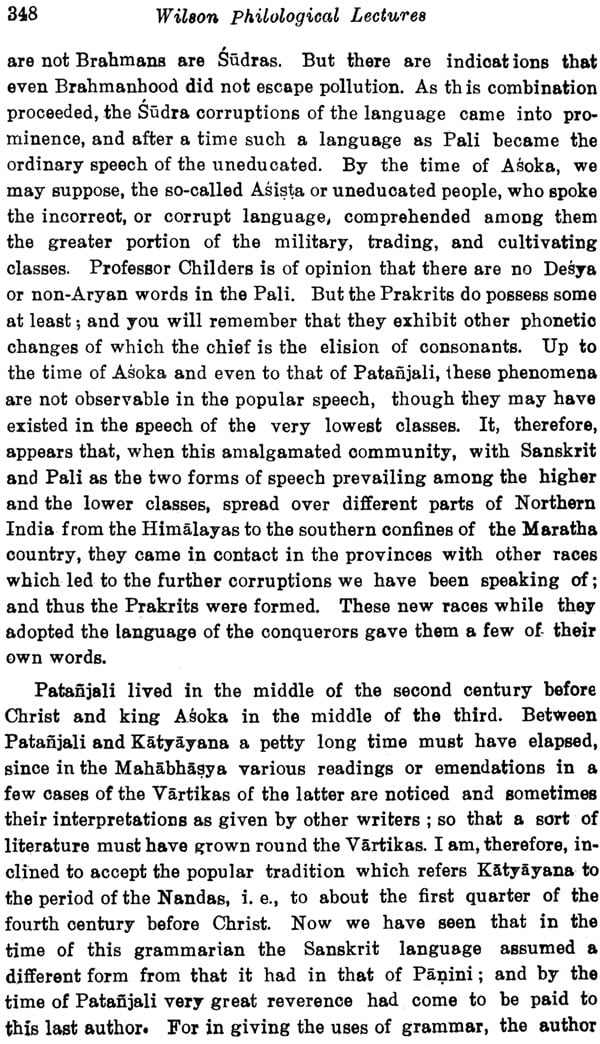
| | Times of Asoka | 348 |
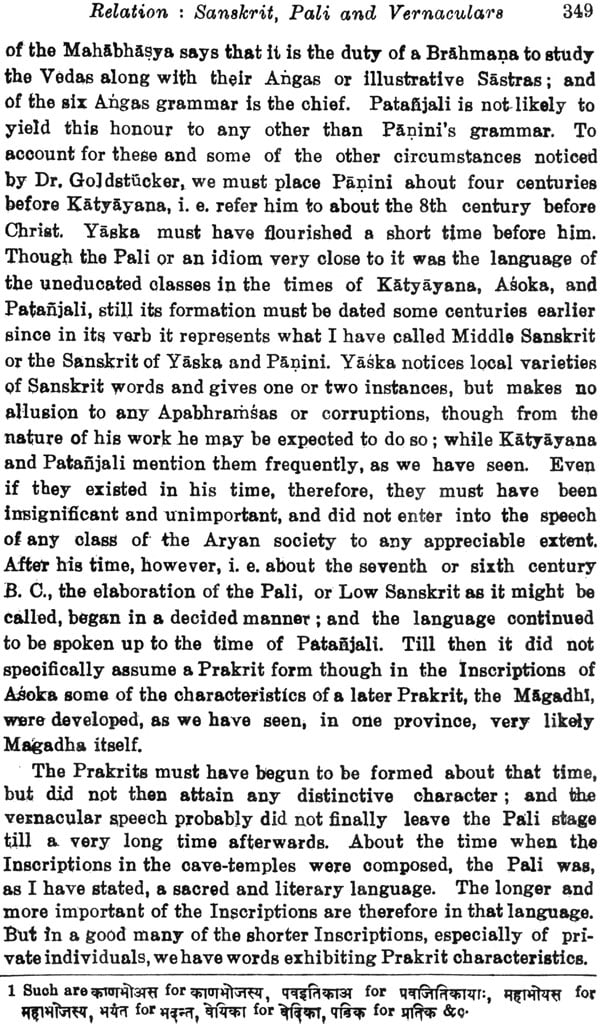
| | Dates of Panini, katyayana and Patanjali | 349 |
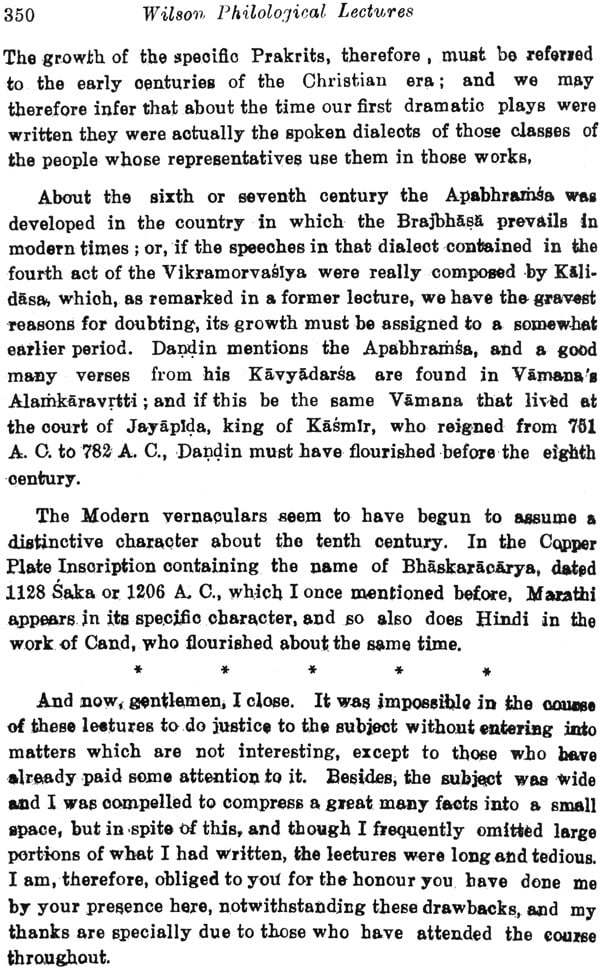
| | Prakrits coming into importance in the early centuries of the Christian era | 350 |
| | Apabhramsa in the sixth or seventh century; Dandin kalidasa | 350 |
| | Modern Vernaculars appearing about the tenth century, a Copper – plate Inscriptions of 1206 A.D. | 350 |
| | Author's Farewell | 350 |
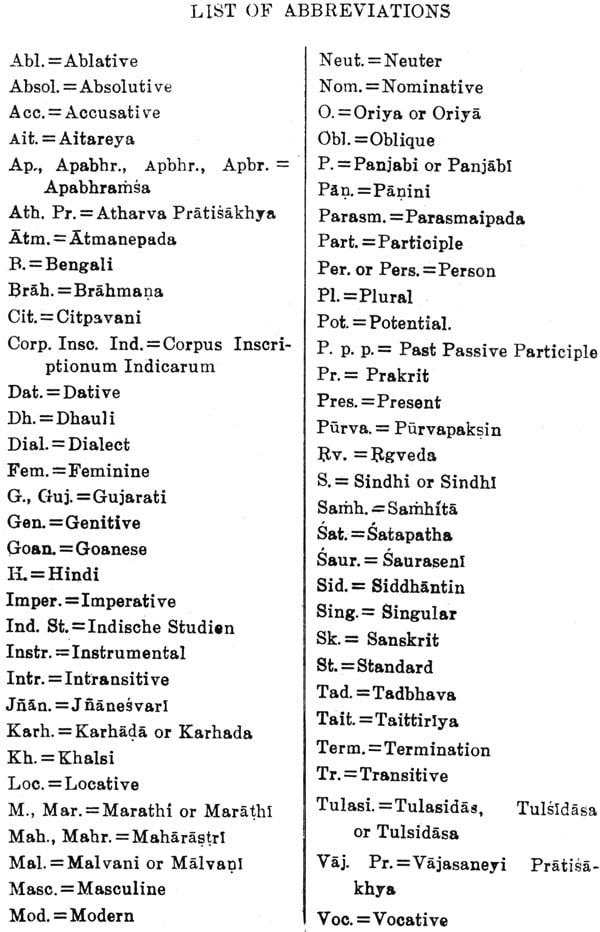
| | List of Abbreviations | 351 |
| Index I
| General Index | 353 |
| Index II
| Index of Archaic and Obsolete Sanskrit Words | 360 |
| Index III
| Index of Mythological Names | 361 |
| Index IV
| Index of Ancient Writers and Works | 362 |
| Index V
| Index of Modern Scholars | 366 |
| Index VI
| Index of Sanskrit and other Words | 369-400 |